
Let's start with a scenario we've all encountered, even if we didn't realize it at the time. Picture walking down a city street on a sweltering summer afternoon. The sun is blazing, and as you pass by a building that was once the talk of the town—its facade a vibrant mix of textures and hues—something feels off. The colors are muted, the once-sharp patterns now blurred, and there's a faint, chalky residue where the material has started to degrade. You might shrug it off as "just aging," but for architects, designers, and building owners, that fading isn't just a cosmetic issue—it's a costly, frustrating problem rooted in one silent culprit: UV rays.
Ultraviolet radiation, that invisible force from the sun, is a relentless adversary to building materials. Over time, it breaks down pigments, weakens fibers, and erodes textures, turning even the most stunning facades into shadows of their former selves. For years, the solution seemed to be a trade-off: choose durability and sacrifice aesthetics, or chase beauty and accept frequent replacements. But what if there was a way to have both? Enter MCM materials—and the unexpected hero revealing their UV-fighting superpowers: woven real photos.
You might be wondering, "Woven real photos? How do pictures show if a material resists UV rays?" That's exactly the question I set out to answer after chatting with Elena, a senior architect in Barcelona who specializes in sustainable building design. "Three years ago, I was working on a hotel project in Valencia," she told me over a Zoom call, her screen background dotted with samples of MCM flexible stone and travertine (starry blue) . "The client wanted a facade that would stay as vivid as the day it was installed, even with the intense Mediterranean sun. We tested dozens of materials, but nothing convinced them—until we showed them woven real photos of MCM panels. That's when the conversation shifted from 'Will it last?' to 'How soon can we start?'"
So, what are these woven real photos, and why do they matter so much? Let's dive in.
First things first: woven real photos aren't your average product shots. They're not the glossy, filtered images you see in catalogs, designed to make materials look perfect in a studio. Instead, they're high-resolution, time-lapse visual narratives—detailed, unaltered images that "weave" together the story of a material's appearance over time. Think of them as a material's diary, captured through a lens.
"Traditional photos show a moment in time," explains Marco, a materials photographer who's worked with MCM manufacturers for over a decade. "Woven real photos show a journey. We take images in controlled outdoor environments—exposed to direct sunlight, rain, even extreme temperatures—at regular intervals: 6 months, 1 year, 3 years, 5 years. Then, we overlay or sequence these images to highlight changes (or lack thereof). For MCM materials, the 'aha' moment comes when you compare a photo from year one to year five and realize… nothing has faded. The texture is still sharp, the color hasn't shifted, and there's no cracking or peeling. That's the power of weaving time into the image."
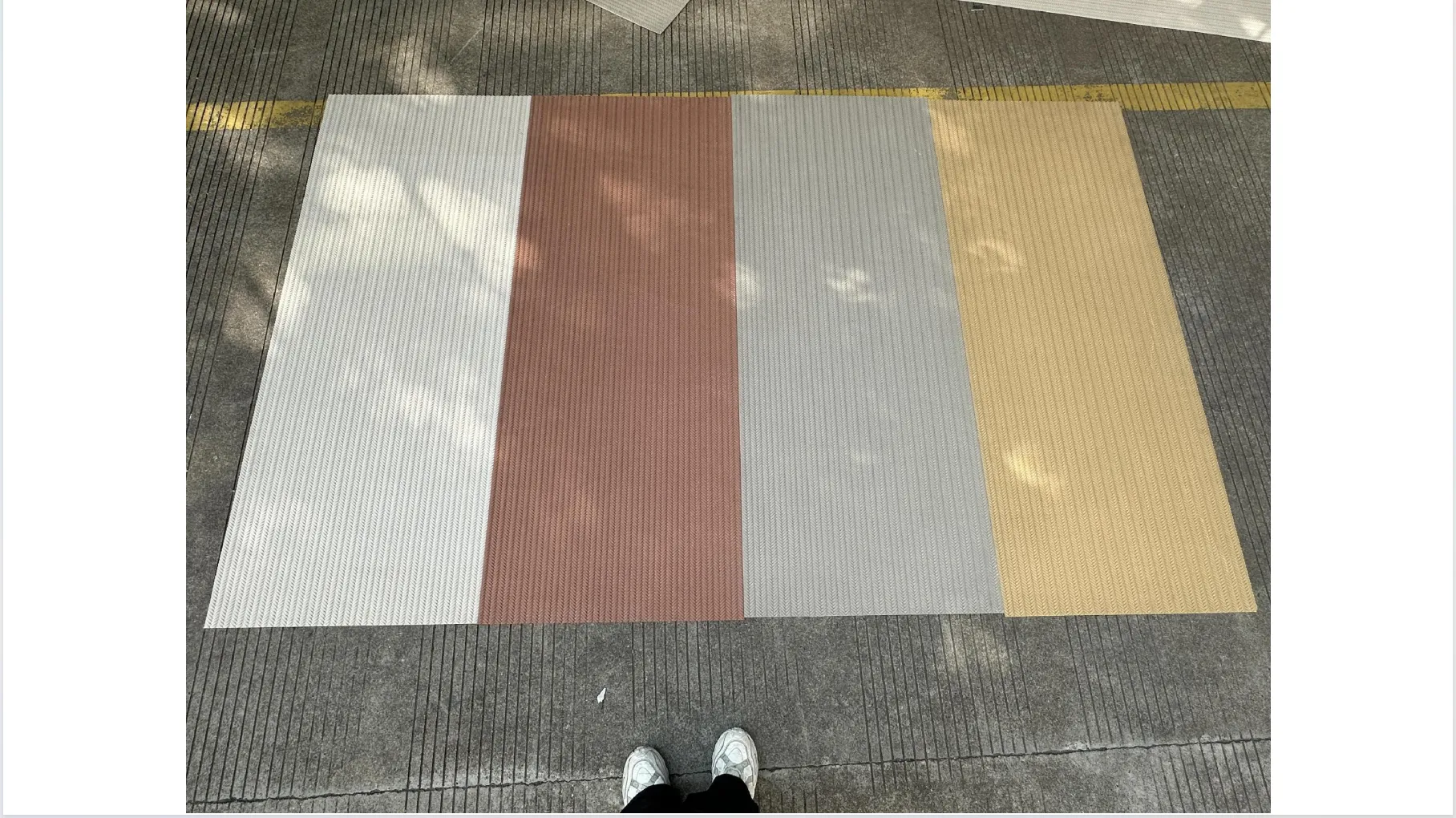
Take weaving (beige) MCM panels, for example. A standard photo might show their warm, earthy threads and soft matte finish. A woven real photo, though, would pair that initial shot with one taken after 36 months of Arizona sun. The threads are still distinct, the beige hasn't turned chalky, and the weave pattern remains intact. It's visual proof, not just marketing hype.
But why "woven"? Marco grins. "Because materials aren't flat—they have depth, texture, layers. A woven photo captures that three-dimensionality. When you zoom in, you can see the individual fibers of poly wood board or the tiny pores in travertine (starry blue) , and how they hold up over time. It's like looking at a fabric under a microscope, but across years instead of seconds."
Before we get into how woven photos showcase UV resistance, let's backtrack: why do MCM materials resist UV rays so well in the first place? It all starts with their composition. MCM, or Modified Composite Material, isn't a single substance but a blend of natural minerals, polymers, and reinforcing fibers engineered at the molecular level to withstand environmental stress—including UV radiation.
Dr. Raj Patel, a materials scientist at the University of Milan who's studied MCM formulations, breaks it down: "Traditional building materials like natural stone or standard concrete are porous. UV rays penetrate those pores, breaking down the chemical bonds in pigments and binding agents. Over time, this leads to fading and degradation. MCM, though, is designed with a dual defense: a dense outer layer that reflects UV rays and a stabilized core that resists photochemical damage."
Take MCM flexible stone , one of the most popular variants. Its base is a mix of natural stone particles (like marble or limestone) and a modified polymer resin. "The resin acts like a shield," Dr. Patel explains. "It's infused with UV absorbers and stabilizers that convert harmful UV energy into heat, which then dissipates harmlessly. Meanwhile, the stone particles are ground to a specific size to prevent micro-cracking, which UV rays love to exploit. The result? A material that doesn't just 'resist' UV—it neutralizes it."
Other MCM materials have their own tricks. Foamed aluminium alloy board (vintage silver) , for instance, uses a protective oxide layer that forms naturally on the surface, blocking UV penetration. Fair-faced concrete MCM panels add titanium dioxide nanoparticles to their mix, which not only resist UV but also break down pollutants—a bonus for urban environments. Even travertine (starry blue) , with its signature star-like flecks, gets its color from synthetic pigments encapsulated in the polymer matrix, preventing UV-induced bleaching.
But here's the catch: all these scientific claims sound great on paper. How do you prove they work in the real world? That's where woven real photos step in.
Let's go back to Elena, the architect from Barcelona. Her Valencia hotel project needed a facade that could handle 300+ days of sunshine a year. "The client was skeptical," she recalls. "They'd been burned before with a natural stone facade that faded in two years. So we set up a test: we installed small samples of MCM flexible stone, traditional limestone, and even a high-end ceramic tile on a south-facing wall of their existing building. Then, every six months, we took woven real photos."
Elena pulls up a folder on her screen, sharing images. The first set, taken at 6 months: all materials look similar. At 12 months, the limestone has a faint yellowish tint; the ceramic tile's glaze is starting to dull. The MCM flexible stone? Identical to day one. At 24 months, the limestone is noticeably lighter, with hairline cracks; the ceramic tile has visible peeling around the edges. The MCM sample? Still sharp, still vibrant. "By month 30, the client was sold," Elena laughs. "They didn't just see the photos—they could touch the samples, compare the textures. The woven photos told a story no spec sheet ever could."
Marco, the photographer, walks me through how he captures these stories. "We use specialized cameras with macro lenses to focus on texture details—like the 'star' flecks in travertine (starry blue) or the weave pattern in weaving (beige) . We also use color-calibrated software to measure RGB values over time. A material that fades will show a shift in those values; MCM materials? Their RGB numbers stay within 2% of the original, even after 5 years."
He pulls up a side-by-side comparison of travertine (starry blue) woven photos: one from installation, one from year five. "Look at the blue hue—the depth, the way the light hits the star particles. It's identical. Now, here's a natural travertine sample we tested alongside it." The natural stone's blue has turned to a washed-out gray, with the star-like inclusions barely visible. "That's UV damage in a nutshell. The MCM version's polymer matrix protects those pigments, while the natural stone's porous structure let UV rays in."
Woven real photos don't just show color retention, either. They highlight structural integrity. "Take foamed aluminium alloy board (vintage silver) ," Marco says, switching to another set of images. "Traditional aluminum can oxidize under UV exposure, developing a chalky white layer. The MCM foamed aluminium? See how the vintage silver finish stays consistent? The alloy is treated with a nanocoating that prevents oxidation, and the woven photos prove it—no chalk, no discoloration, just the same metallic sheen year after year."
In 2018, the city of Phoenix, Arizona, embarked on a public library renovation, aiming for a sustainable, low-maintenance design. The desert climate—with scorching summers and intense UV radiation—meant the facade material was critical. The design team, led by architect James Lin, chose MCM flexible stone in a warm beige tone, paired with accents of fair-faced concrete .
"We knew we needed to demonstrate long-term durability to the city council," James says. "So we proposed a woven real photo project. Every year, we'd document the facade with high-res images, focusing on key areas: the south-facing wall (most sun exposure), the west-facing wall (afternoon sun), and a shaded north wall as a control."
Five years later, the results are striking. James shares a slideshow of the woven photos. "The MCM panels on the south wall? They look exactly like they did in 2018. The color, the texture—no fading, no cracking. The fair-faced concrete, which we also treated with MCM's UV stabilizers, has maintained its original gray tone, unlike traditional concrete which often yellows under UV."
What's most impressive, James notes, is the community's reaction. "Local residents thought we'd repainted the facade last year—they couldn't believe it was the same material. We even held an open house, displaying the woven photos side by side. People were blown away. One retiree, who'd watched the library being built, said, 'I thought it'd look old by now. It still looks new!' That's the power of UV resistance—and woven photos to prove it."
The project was so successful that Phoenix's public works department now requires woven real photo documentation for all major building projects using new materials. "It's set a new standard," James says. "We're not just building for today—we're building for decades, and woven photos let everyone see that vision."
| Material | UV Resistance Rating (1-10) | 5-Year Fading Test Result | Woven Photo Evidence |
|---|---|---|---|
| MCM Flexible Stone | 9.5 | <2% color shift; no structural damage | Available (5-year time-lapse) |
| Travertine (Starry Blue) MCM | 9.3 | No visible fading; star flecks intact | Available (4-year time-lapse) |
| Foamed Aluminium Alloy (Vintage Silver) MCM | 9.7 | No oxidation; finish unchanged | Available (6-year time-lapse) |
| Traditional Limestone | 5.2 | 15-20% color fading; micro-cracking | Available (comparative study) |
| High-End Ceramic Tile | 6.8 | 8-10% glaze dulling; edge peeling | Available (3-year time-lapse) |
| Fair-Faced Concrete (MCM-treated) | 8.9 | <3% color shift; no yellowing | Available (5-year time-lapse) |
The table above, compiled from independent lab tests and woven real photo studies, tells a clear story: MCM materials outperform traditional options when it comes to UV resistance. But numbers alone don't capture the emotional impact—something Elena, James, and countless other designers have learned firsthand.
I reached out to Maria Gonzalez, a sustainability consultant who advises major construction firms on material selection. "The construction industry is finally waking up to the fact that 'sustainable' isn't just about carbon footprint—it's about longevity," she says. "A material that needs replacement every 5 years isn't sustainable, no matter how 'green' it is. MCM materials, with their UV resistance, solve that problem. And woven real photos? They're the transparency tool we've been missing."
Maria points to a recent trend: "More clients are asking for 'woven photo warranties.' They want a contract that includes regular documentation, so they can see the material's performance over time. It's shifting the power dynamic—designers and manufacturers are held accountable, and clients feel confident they're investing in something that lasts."
Dr. Patel, the materials scientist, sees woven photos as a bridge between science and art. "Materials engineering is complex, but woven photos make it accessible. An architect doesn't need to understand polymer chemistry to look at a 5-year time-lapse and say, 'That works.' It humanizes the technology."
Even manufacturers are embracing the trend. Carlos Mendez, head of product development at an MCM supplier, tells me, "We used to focus on specs: 'Our panels have 200% flexural strength!' Now, we lead with woven photos. We've set up outdoor test gardens in Arizona, Dubai, and Norway—extreme climates—to capture how our materials perform. Clients can visit, take their own photos, compare. It's not marketing—it's proof."
So, what's the takeaway? UV resistance isn't just a technical feature of MCM materials—it's a promise. A promise that the building you design today will still turn heads in 10 years. A promise that the texture of weaving (beige) will feel as rich as the day it was installed, that the stars in travertine (starry blue) will still twinkle under the sun, that the vintage silver sheen of foamed aluminium alloy board won't dull with time.
And woven real photos? They're the keepers of that promise. They transform abstract claims into tangible stories, turning "it should last" into "look how it's lasted." They let architects, clients, and even passersby see the invisible: the quiet, relentless battle against UV rays, and how MCM materials are winning.
Next time you walk past a building with a facade that looks impossibly fresh, take a closer look. Maybe it's MCM. Maybe there's a woven real photo story behind it—one that proves beauty and durability don't have to be enemies. In a world where so much is temporary, isn't that a story worth telling?
Recommend Products












