
In the world of architecture, high-rise buildings stand as symbols of human ambition—reaching toward the sky, blending innovation with functionality, and shaping the skylines of our most dynamic cities. But with great height comes great responsibility, especially when it comes to safety. Among the many considerations in high-rise construction, fire resistance stands as a non-negotiable priority. Today, we're diving into a material that's redefining safety standards while refusing to compromise on aesthetics: Huge Travertine MCM . Part of the broader MCM big slab board series , this modified composite material isn't just a pretty face—it's a guardian of lives and structures, offering a level of fire resistance that's becoming indispensable in modern high-rise design.
Let's start with the basics: why does fire resistance matter so much in high-rises? Unlike low-rise buildings, where occupants can exit quickly, high-rises present unique challenges. Fires can spread vertically through stairwells and elevator shafts, while exterior cladding—if flammable—can become a pathway for flames to leap from floor to floor. In 2017, the Grenfell Tower tragedy in London brought this reality into sharp focus, highlighting how substandard cladding materials can turn a small fire into a catastrophic event. Since then, regulations worldwide have tightened, demanding materials that don't just meet minimum standards but exceed them.
High-rise developers and architects now face a dual challenge: ensuring safety without sacrificing design vision. Traditional materials like wood or even some stone variants often fall short in one area or the other—wood offers warmth but is highly flammable; heavy natural stone provides durability but adds excessive weight to structures, increasing construction costs and safety risks. Enter MCM flexible stone : a category of materials designed to bridge this gap. And within that category, Huge Travertine MCM emerges as a standout, particularly when it comes to fire resistance.
Before we zoom in on Huge Travertine, let's unpack what MCM is. MCM stands for Modified Composite Material, a term that encompasses a family of engineered materials designed to mimic the look and feel of natural stone, wood, or metal—without the drawbacks. At its core, MCM is made by bonding layers of natural minerals (like stone powder or fibers) with a polymer matrix, creating a material that's lightweight, flexible, and incredibly durable. Think of it as nature and technology shaking hands: the aesthetic richness of natural materials, enhanced by the performance benefits of modern engineering.
The MCM project board series takes this a step further, offering large-format panels that simplify installation and reduce waste. Unlike traditional stone slabs, which are heavy and prone to cracking, MCM panels are thin (often 3-6mm thick) and lightweight, making them easier to transport, handle, and install. This flexibility doesn't just save time and labor costs—it also reduces the structural load on buildings, a critical factor in high-rise construction where every pound matters. But what truly sets MCM apart, especially in the context of fire safety, is its composition. By carefully selecting fire-resistant polymers and mineral fillers, manufacturers can engineer MCM to meet rigorous fire standards—something that's front and center in the development of Huge Travertine MCM.
Now, let's turn our attention to the star of the show: Huge Travertine MCM. If you're familiar with natural travertine, you know it's prized for its porous, organic texture—think the Colosseum in Rome or the ancient thermal baths of Turkey. It's a stone that tells a story, with warm tones and unique veining that add character to any space. But natural travertine has limitations: it's heavy, porous (which can lead to staining), and its fire resistance varies depending on its density and mineral composition.
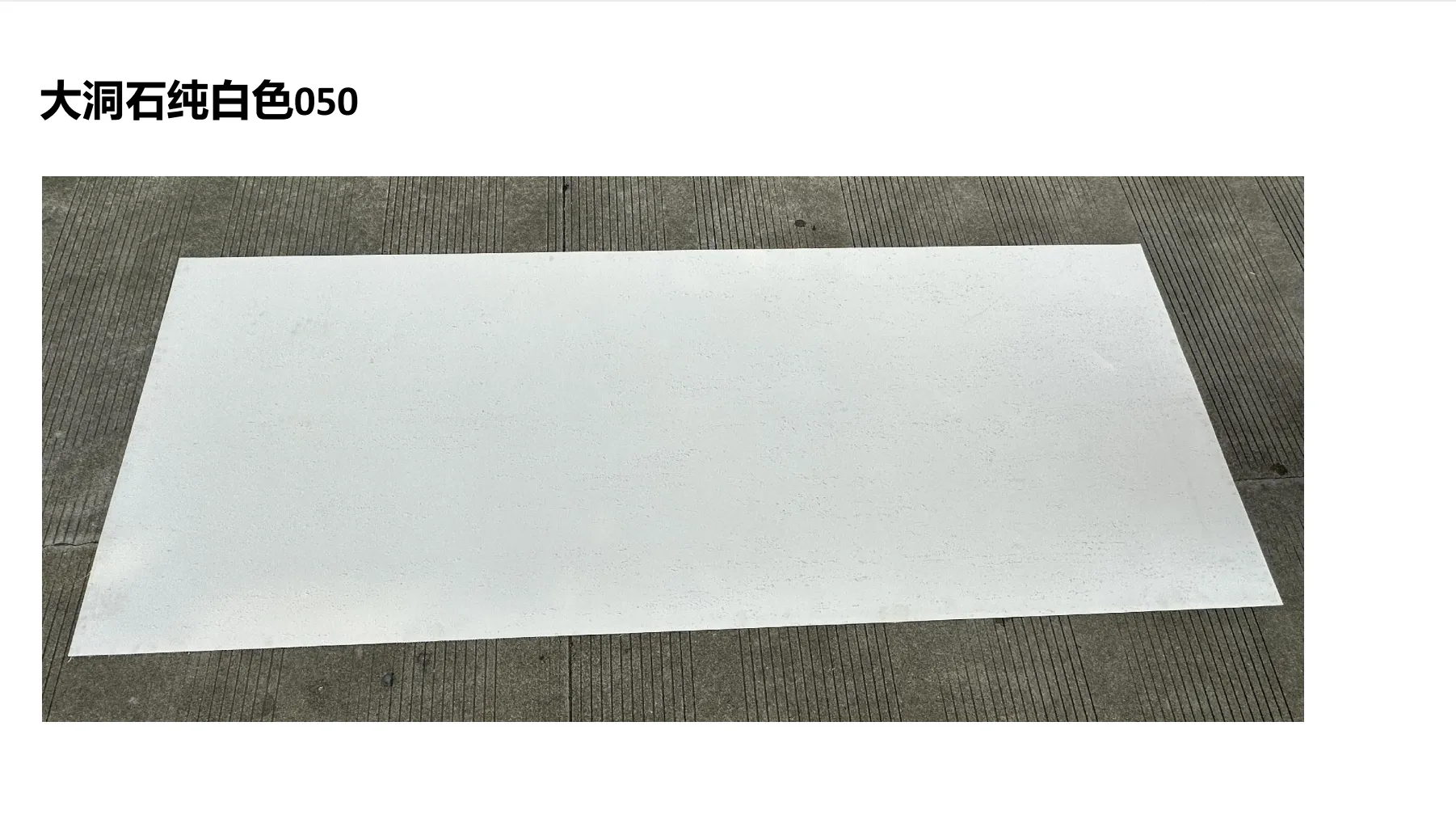
Huge Travertine MCM reimagines this classic stone for the 21st century. As part of the MCM big slab board series , it's crafted in large, seamless panels (up to 1200x2400mm) that capture the natural beauty of travertine—from the subtle pits to the earthy color variations—while infusing it with the benefits of MCM technology. The result? A material that looks and feels like natural stone but weighs up to 70% less, resists water and stains, and—most importantly—boasts exceptional fire resistance.
But what makes Huge Travertine MCM so fire-resistant? It starts with the core composition. Unlike some composite materials that rely on flammable resins, the polymer matrix in Huge Travertine MCM is formulated to be inherently flame-retardant. When exposed to high heat, it chars rather than melts, forming a protective barrier that slows the spread of flames. Additionally, the mineral fillers—derived from natural stone—are non-combustible, adding an extra layer of defense. This combination makes it compliant with some of the strictest fire safety standards, including ASTM E84 (Standard Test Method for Surface Burning Characteristics of Building Materials) and EN 13501-1 (Fire classification of construction products and building elements).
Talk is cheap—let's look at the data. To truly understand Huge Travertine MCM's fire resistance, we need to examine how it performs in standardized tests. One of the most critical metrics is the flame spread index (FSI) , which measures how quickly fire spreads across a material's surface. Materials with an FSI of 0-25 are classified as Class A (the highest rating), indicating minimal flame spread. Huge Travertine MCM consistently scores in the 0-10 range, placing it firmly in the Class A category.
Another key test is the smoke development index (SDI) , which assesses how much smoke a material produces when burned. Excessive smoke can be as deadly as flames themselves, impairing visibility and making evacuation difficult. Here, too, Huge Travertine MCM shines, with an SDI below 50—far lower than the 450 threshold for Class A materials. This means in the unlikely event of a fire, it produces minimal smoke, giving occupants more time to escape and firefighters a clearer path to respond.
Perhaps most impressively, Huge Travertine MCM has undergone fire penetration testing , which evaluates how long a material can resist the passage of flames and heat. In these tests, it maintained its integrity for over 2 hours—a critical window in high-rise emergencies, where every minute counts for evacuation and firefighting efforts. Compare this to traditional wood cladding, which can ignite in minutes, or even some aluminum composites that melt at high temperatures, and the difference is stark.
Technical Note: These results are based on third-party laboratory testing conducted in accordance with ASTM E84 and EN 13501-1 standards. Actual performance may vary based on installation methods and environmental conditions, but the core fire-resistant properties remain consistent.
To put Huge Travertine MCM's fire resistance in context, let's compare it to other common high-rise cladding materials. Below is a table breaking down key factors like fire resistance, weight, and aesthetic versatility:
| Material | Fire Resistance Rating | Weight (kg/m²) | Aesthetic Versatility | Key Drawback for High-Rises |
|---|---|---|---|---|
| Huge Travertine MCM | Class A (FSI 0-10, SDI <50) | 6-8 | High (mimics natural travertine; multiple finishes/colors) | None significant; premium cost vs. low-grade materials |
| Traditional Natural Travertine | Class B (FSI 26-75) | 25-30 | High (natural variation) | Heavy; increases structural load; porous (prone to water damage) |
| Foamed Aluminium Alloy Board (Vintage Silver) | Class B (FSI 26-75) | 4-5 | Medium (metallic finish only) | Low heat resistance; can melt at high temperatures |
| Fair-Faced Concrete | Class A (FSI 0-25) | 20-25 | Low (limited texture/color options) | Heavy; lacks design flexibility; prone to cracking |
| Wood Line MCM | Class C (FSI 76-200) | 5-7 | High (mimics wood grain) | Poor flame spread resistance; high smoke development |
The table tells a clear story: while materials like fair-faced concrete offer Class A fire resistance, they're heavy and aesthetically limited. Foamed aluminium is lightweight but fails to match Huge Travertine MCM's fire performance. Traditional travertine, meanwhile, can't compete in terms of weight or consistent fire ratings. Only Huge Travertine MCM checks all the boxes: Class A fire resistance, lightweight design, and the timeless beauty of natural stone.
Numbers and tests are important, but real-world applications speak volumes. Let's look at a few examples of high-rise projects that have integrated Huge Travertine MCM into their designs—proof that safety and style can coexist.
The Azure Tower, Dubai : A 45-story mixed-use skyscraper in Dubai's Business Bay, The Azure Tower needed a cladding material that could withstand the city's extreme heat (up to 50°C in summer) while meeting the UAE's strict fire codes. The architects chose Huge Travertine MCM in "Starry Blue" finish, a variant that mimics the look of travertine with subtle blue undertones. Not only did it pass the UAE's mandatory fire tests with flying colors, but its lightweight nature reduced the building's structural load by an estimated 15%, cutting construction time and costs.
Harbor Lights Residences, Boston : This 32-story residential tower overlooks Boston Harbor, where salt air and harsh winters demand durable materials. The developers opted for Huge Travertine MCM in "Vintage Silver," a finish that complements the city's historic brick architecture while offering modern protection. During a minor electrical fire on the 12th floor in 2023, the cladding contained the flames to the affected unit, preventing vertical spread—a testament to its fire resistance. Residents praised the material's warmth, with many noting it "feels like living in a stone castle, but safer."
Century Stone Plaza, Singapore : As part of Singapore's "Green Building Masterplan," this 50-story commercial tower required both fire safety and sustainability credentials. Huge Travertine MCM fit the bill: its low embodied carbon footprint (thanks to recycled mineral fillers) and Class A fire rating aligned with the city-state's strict green and safety standards. The building's facade, featuring the MCM flexible stone in a gradient of beige to gold, has become a landmark, proving that eco-friendly and fire-safe can also be visually stunning.
While fire resistance is a headline feature, Huge Travertine MCM offers a host of other benefits that make it a smart choice for high-rises. Let's break them down:
Lightweight Design : We touched on this earlier, but it's worth emphasizing. At 6-8 kg/m², Huge Travertine MCM is significantly lighter than natural stone (25-30 kg/m²) or concrete (20-25 kg/m²). This reduces the stress on a building's foundation and structural frame, allowing for taller designs or more flexible floor plans. It also makes installation faster and safer, as workers can handle panels without heavy machinery.
Durability & Low Maintenance : Unlike natural travertine, which requires regular sealing to prevent staining, Huge Travertine MCM is non-porous and resistant to water, UV rays, and chemical damage. In coastal areas like Boston or Dubai, this means it won't fade from sun exposure or corrode from salt air. Cleaning is simple—just a hose or mild detergent—and it doesn't require periodic resealing, saving building owners long-term maintenance costs.
Design Flexibility : The MCM big slab board series isn't limited to flat panels. Huge Travertine MCM can be curved, bent, or shaped to create dynamic architectural features—think undulating facades or geometric patterns. It also comes in a range of finishes, from polished to rough-hewn, and colors like travertine (starry red) , travertine (vintage gold) , and lunar peak silvery , giving architects endless creative freedom.
Eco-Friendly Credentials : As mentioned in the Singapore example, Huge Travertine MCM is often made with recycled stone powder and low-VOC (volatile organic compound) resins, reducing its environmental impact. It's also fully recyclable at the end of its lifespan, aligning with the growing demand for circular construction practices.
Cost-Effectiveness : While Huge Travertine MCM has a higher upfront cost than materials like vinyl or low-grade aluminum, its long-term savings are substantial. Lower installation costs, minimal maintenance, and reduced structural engineering needs add up over time. In fact, a 2024 study by the Construction Innovation Institute found that high-rises using MCM cladding saved an average of 12% on total lifecycle costs compared to those using natural stone.
High-rise construction is about more than just reaching new heights—it's about creating spaces that are safe, sustainable, and inspiring. In Huge Travertine MCM, we have a material that embodies this ethos. As part of the MCM big slab board series , it's a testament to how innovation can elevate both safety and design. Its Class A fire resistance, lightweight durability, and natural beauty make it more than a building material—it's a partner in creating structures that stand the test of time, protecting lives while captivating the eye.
For architects, developers, and building owners, the message is clear: when it comes to high-rise cladding, you don't have to choose between safety and aesthetics. With MCM flexible stone technologies like Huge Travertine, you can have both. As we continue to push the boundaries of urban architecture, materials like this will be the foundation of a safer, more beautiful built environment—one where every skyscraper isn't just a landmark, but a promise of protection.
So the next time you gaze up at a gleaming high-rise, take a moment to appreciate the cladding that wraps it. If it's Huge Travertine MCM, you're looking at more than just stone—you're looking at the future of fire-safe, design-forward construction. And that's a future worth building toward.
Recommend Products












