
How modern design materials are turning rough, imperfect spaces into stunning architectural stories
Picture this: You're standing in front of a wall that feels more like a topographical map than a flat surface. Cracks snake through the concrete, bumps rise like tiny hills, and dips create shadowed valleys. Your client dreams of a natural stone finish—something with texture, warmth, and that timeless "old-world" charm—but traditional materials? They're shaking their heads. Granite is too heavy, marble too brittle, and even lightweight veneers seem to crack or peel when faced with such imperfection. This is the quiet struggle of designers, architects, and builders everywhere: the beauty of natural stone, meet the chaos of real-world walls.
For years, uneven surfaces have been the Achilles' heel of high-end design. We've all been there—spending hours shimming, sanding, and smoothing, only to watch a $500 slab of travertine crack when the wall shifts. Or worse, compromising on aesthetics, swapping natural stone for plain paint or generic tiles because "it's the only thing that will work." But what if there was a material that didn't just tolerate imperfection—it embraced it? That's where MCM (Modified Composite Material) flexible stone steps in, and at the heart of this revolution? Huge Travertine , a line that's redefining what's possible when beauty meets adaptability.
Let's start with the obvious: traditional natural stone is stunning. The veining in marble, the earthy warmth of travertine, the durability of granite—these materials have been the gold standard for centuries. But here's the catch: they're rigid. A slab of natural travertine, for example, might flex a millimeter or two before snapping. On a perfectly smooth, structurally sound wall, that's fine. But on a surface that's more "characterful" than "level"? Disaster.
Take a historic building renovation, for instance. Those old brick walls? They've settled over decades, creating waves and gaps that no amount of mortar can hide. Or a modern home with poured concrete walls that, despite best efforts, have minor "blisters" from air bubbles during curing. Traditional stone, with its zero tolerance for unevenness, becomes a liability. You either spend weeks (and a small fortune) leveling the surface, or you give up on the look entirely. And even then, rigid materials often fail over time—cracking as the building shifts, or delaminating when moisture seeps into those tiny gaps between stone and wall.
Then there's weight. A standard 12×24-inch travertine slab can weigh 15–20 pounds. Multiply that by hundreds of slabs for a commercial project, and you're not just talking about installation challenges—you're talking about structural concerns. Older buildings, in particular, weren't built to handle the load of heavy stone, leaving designers stuck between safety codes and client expectations.
Enter MCM flexible stone—a category that's been quietly disrupting the industry for the past decade. At first glance, it looks like natural stone. Run your hand over it, and you'll feel the same texture, the same depth, the same subtle variations that make stone so appealing. But pick it up? You'll do a double-take. It's lightweight—sometimes 80% lighter than traditional stone. And flex it? It bends. Not like rubber, but with a gentle give that lets it hug curves, follow dips, and conform to surfaces that would make traditional stone weep.
MCM (Modified Composite Material) is a blend of natural stone particles, polymers, and reinforcing fibers. Think of it as stone reimagined: all the aesthetic benefits of the real thing, minus the weight and rigidity. And within this family, the MCM big slab board series stands out—offering larger formats (up to 4×8 feet) that minimize grout lines and create a seamless look, even on uneven surfaces. But today, we're zeroing in on a star player: Huge Travertine .
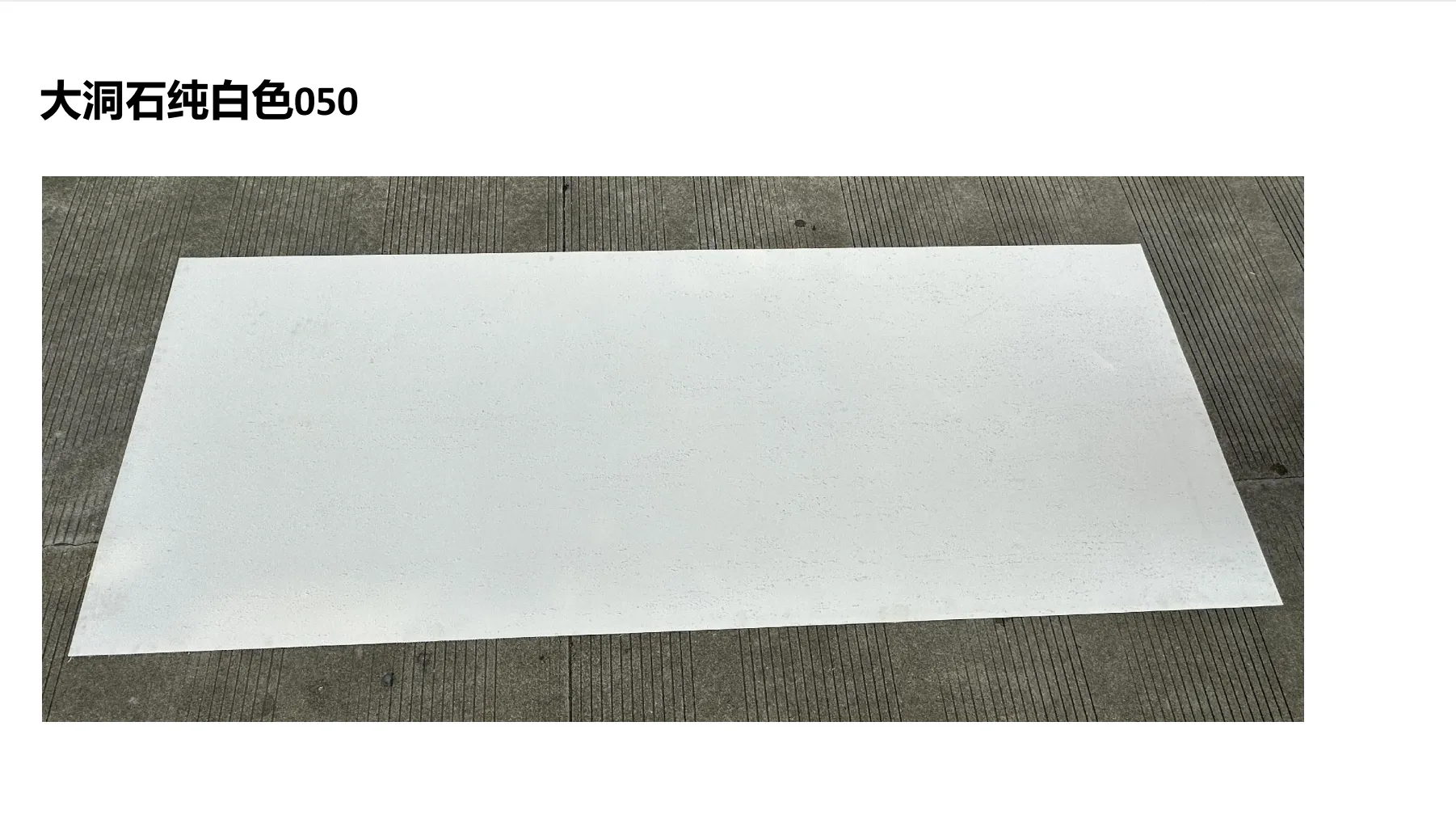
Huge Travertine isn't just a product—it's a solution to that "topographical map" wall we talked about earlier. Part of the MCM flexible stone lineup, it's designed to mimic the look of classic travertine (think honeyed tones, subtle pitting, and those signature "wormholes" that give the stone its organic charm) but with a twist: flexibility. While traditional travertine slabs are thick, heavy, and unforgiving, Huge Travertine sheets are thin (as little as 3mm), lightweight (around 8kg per square meter), and surprisingly bendable—able to conform to surfaces with up to 30mm of unevenness without cracking or delaminating.
What does that mean for you? It means you can install it on a wall that's been through decades of wear, a ceiling with gentle curves, or even a fireplace surround with heat-induced expansion gaps. It means no more hours of prep work, no more fear of costly breakage, and no more compromising on the natural stone look your client craves.
| Feature | Traditional Travertine Slab | MCM Huge Travertine Flexible Stone |
|---|---|---|
| Weight (per sqm) | 45–55kg | 7–9kg |
| Flexibility | Rigid (snaps under bending) | Bends up to 30mm (conforms to uneven surfaces) |
| Installation Prep | Extensive (sanding, shimming, structural reinforcement) | Minimal (clean, prime, and apply—even on rough surfaces) |
| Durability | High, but prone to cracking on uneven walls | High (impact-resistant, moisture-resistant, and crack-proof on shifting surfaces) |
| Installation Time (10sqm) | 2–3 days (2 people) | 1 day (1 person) |
It's not magic—it's engineering. Huge Travertine's flexibility comes from its unique composition. The base is a high-strength polymer matrix reinforced with fiberglass, which gives it tensile strength (the ability to stretch without breaking). Embedded within that matrix are crushed travertine particles, ranging from fine dust to larger granules, which mimic the stone's natural texture and color. The result? A material that's thin enough to bend but tough enough to withstand the elements.
Installation is where it really shines. Unlike traditional stone, which requires mortar beds or heavy-duty adhesives, Huge Travertine uses a lightweight, polymer-based adhesive that's applied directly to the wall—even if that wall has bumps or dips. The sheets conform to the surface as you press them on, with the adhesive filling in minor gaps and creating a bond that's both strong and flexible. It's like wrapping the wall in a second skin—one that looks like it's been there for centuries, but installs in hours.
And let's talk about texture. Huge Travertine doesn't skimp on the details. Whether you opt for travertine (starry blue) with its subtle metallic flecks, travertine (vintage gold) for warm, sunlit tones, or classic travertine (beige) , the surface feels authentic—rough where it should be, smooth where the stone would naturally polish. Run your hand over it, and you'd swear it's the real thing. That's the beauty of MCM: it doesn't just look like stone; it feels like it, too.
The Challenge: A 1920s warehouse in Chicago, with brick walls that had seen better days. Cracks, bulges, and even areas where bricks had fallen out (repaired with patchy concrete) made traditional stone installation impossible. The client wanted an "industrial meets rustic" vibe, with walls that felt like they'd been there since the building's heyday.
The Solution: Huge Travertine in travertine (starry grey) , paired with fair-faced concrete panels for contrast. The MCM sheets conformed to the brick's uneven surface, with the adhesive filling in gaps and creating a seamless look. The starry grey hue, with its subtle silver flecks, played off the warehouse's steel beams, while the travertine's natural pitting added texture that felt authentically aged.
The Result: A wall that tells a story. The client wept when they saw it—not just because it looked beautiful, but because it felt "real." No more compromises, no more "good enough." Just a surface that embraced the building's flaws and turned them into features. And the best part? The install took two days instead of two weeks, and the total weight added to the walls was less than 100kg—well within the building's structural limits.
Huge Travertine isn't just about solving problems—it's about unlocking creativity. With a range of finishes and colors, it adapts to any design vision. Want a modern, minimalist look? Go for travertine (vintage silver) with a smooth, honed surface. Craving something bold? travertine (starry red) adds a pop of color with its deep crimson base and metallic highlights. For a classic feel, travertine (beige) brings that warm, earthy tone that pairs perfectly with wood, metal, or even foamed aluminium alloy board (vintage gold) for a luxe, mixed-material look.
And it's not just walls. Huge Travertine works on ceilings, columns, fireplace surrounds, and even furniture. Imagine a coffee table with a top that looks like a slab of ancient travertine, but weighs so little you can move it yourself. Or a bathroom backsplash that bends around the curve of a vanity, no grout lines in sight. The possibilities are endless—and that's before you factor in the rest of the MCM lineup, like wood grain board or rust mosaic stone , which can be mixed and matched with Huge Travertine for one-of-a-kind designs.
In a perfect world, every wall would be laser-level, every surface smooth as glass. But the real world isn't perfect—and that's its charm. Old buildings have character because of their cracks and creaks. Modern homes have soul because they're built on uneven terrain. Design shouldn't fight that; it should celebrate it. MCM flexible stone, and Huge Travertine in particular, lets us do just that.
It's about more than just installation ease, though that's a big part of it. It's about democratizing design. No longer do you need a six-figure budget to install natural stone on a less-than-perfect wall. No longer do you have to choose between beauty and practicality. With Huge Travertine, you get both—and that's a game-changer for designers, builders, and homeowners alike.
Think about the impact: A small café with a bumpy concrete wall, transformed into a rustic retreat with Huge Travertine. A homeowner with a basement that floods occasionally, now able to use stone-look panels that won't warp or rot. A school with aging brick walls, suddenly feeling warm and inviting instead of institutional. These aren't just design projects—they're spaces that feel human, because they embrace imperfection.
As we move forward, the demand for materials that combine aesthetics and adaptability will only grow. We're designing for older buildings, for sustainable construction (MCM uses less natural stone and energy to produce than traditional slabs), and for spaces that feel authentic, not sterile. Huge Travertine isn't just a product for today—it's a glimpse into the future: one where design doesn't just sit on top of our walls, but works with them, flaws and all.
So the next time you're staring at a wall that looks more like a mountain range than a flat surface, take a deep breath. You don't have to compromise. You don't have to settle. With MCM flexible stone, and Huge Travertine leading the charge, you can turn that uneven surface into something extraordinary. Because in the end, the most beautiful spaces aren't the ones that are perfect—they're the ones that tell a story. And isn't that what design is all about?
Recommend Products












