
There's a moment in every designer's process that feels like standing at a crossroads. You've sketched the layouts, nailed the flow, and visualized the light—but when it comes to the materials, something's missing. Maybe the client wants their café to feel like a sunlit courtyard in Tuscany, or a tech startup's office to echo the quiet grandeur of a moonlit mountain range. Traditional stone is too heavy, paint feels flat, and generic wallpapers lack soul. This is where the story of MCM materials begins—not just as products, but as collaborators in crafting spaces that breathe with personality.
In a world where "custom" often means little more than swapping out colors on a preset palette, MCM (Modified Composite Material) stands apart. It's a collection of surfaces that don't just cover walls or floors—they tell stories. From the earthy warmth of lime stone (beige) to the celestial shimmer of lunar peak silvery , each series is designed to answer that unspoken question: What does this space need to feel like? Let's dive into how MCM turns the challenge of customization into an opportunity to create something truly one-of-a-kind.
Walk into any home improvement store, and you'll find rows of "neutral" tiles, "versatile" paints, and "classic" wood grains. They're marketed as "perfect for any space," but that's the problem—"any space" means no space feels yours . A boutique hotel in Kyoto shouldn't feel like a suburban kitchen in Chicago, and a family's beach house deserves more than the same gray concrete as a downtown office.
Designers and architects often hit walls with traditional materials. Natural stone is stunning but fragile; marble scratches, granite is heavy, and travertine stains easily. Worse, customization is limited—you can choose from what's quarried, not what your project needs . A client once told me, "I want the feeling of walking on ancient Roman streets, but I need it to withstand kids running and coffee spills." Traditional travertine couldn't deliver that balance of history and durability. MCM could.
At its core, MCM is a marriage of innovation and intuition. By bonding natural minerals with high-performance polymers, it creates surfaces that are lightweight (up to 80% lighter than natural stone), flexible (they can bend around curves), and virtually maintenance-free. But numbers and specs don't tell the whole story. What makes MCM special is how it captures the essence of natural materials—their texture, their depth, their ability to evoke emotion—without the limitations.
Take the MCM flexible stone series, for example. I worked with a designer who wanted to clad a circular staircase in stone, but traditional slabs would have required heavy structural support and left ugly seams. MCM flexible stone wrapped around the curves like fabric, each panel aligning so seamlessly that guests run their hands along the walls, half-convinced it's solid rock. "It's not just a material," she said. "It's a way to make impossible shapes feel natural."
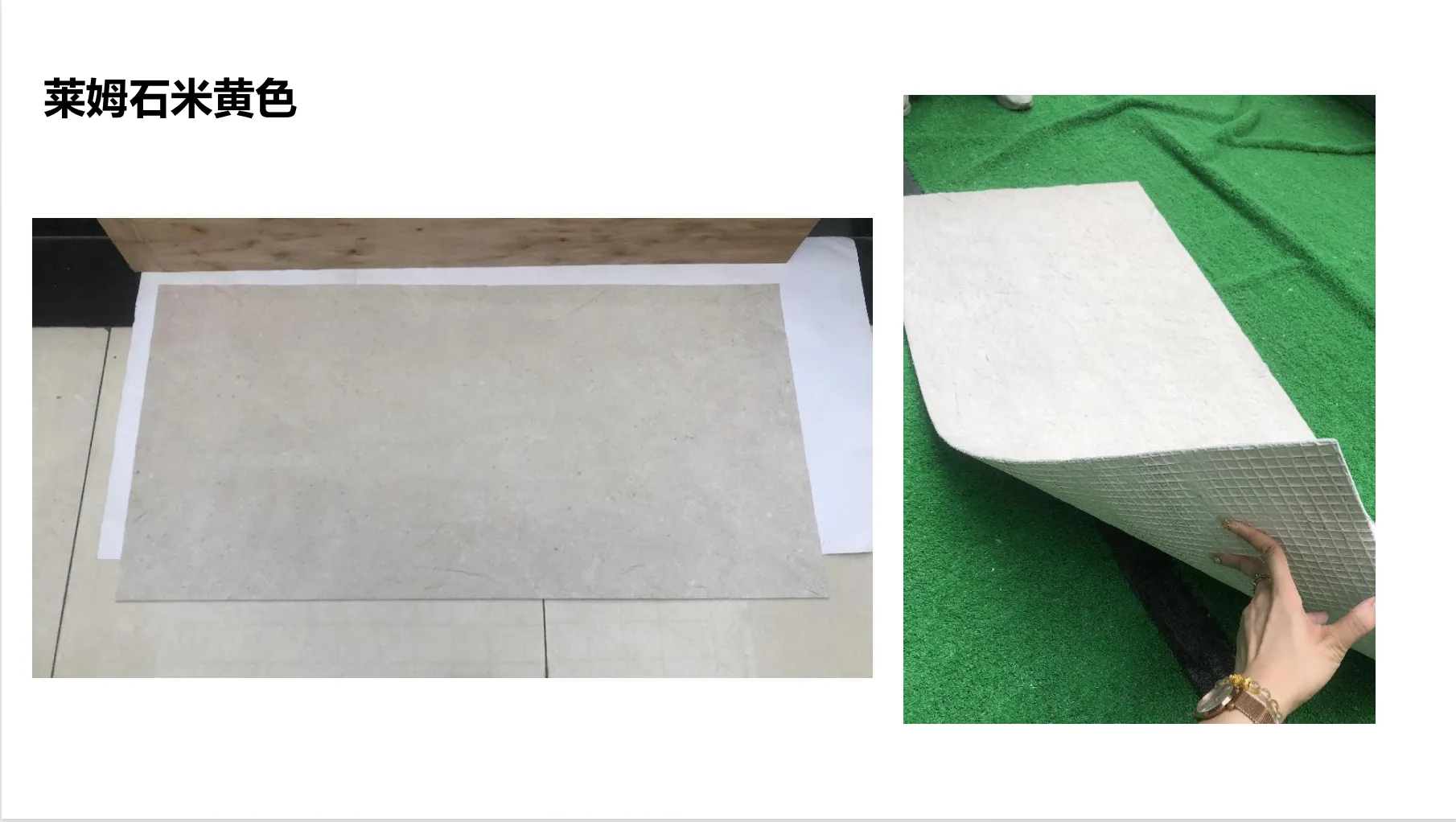
If there's one material in the MCM lineup that feels like a hug, it's lime stone (beige) . Let's talk about its texture first—it's not the flat, uniform beige of builder-grade tile. Run your hand over it, and you'll feel the subtlest variations: tiny indentations that mimic the way rain erodes stone over centuries, flecks of lighter cream that look like sunlight filtering through dust. It's earthy but not muddy, warm but not overwhelming.
I visited a family home in Portland last year where the kitchen backsplash and dining nook walls were clad in lime stone (beige). The homeowners, both teachers, wanted a space that felt "lived-in but intentional"—no cold, sterile surfaces. The lime stone (beige) delivered that. In the morning, sunlight hits the walls and turns them golden, like the adobe houses of Santa Fe. In the evening, under warm pendant lights, it softens into the color of fresh-baked bread. "Our kids spill juice on it, we lean against it when we're cooking, and it still looks like it did the day it was installed," the wife told me. "It's not just a backdrop. It's part of our family."
What makes lime stone (beige) so versatile is its ability to play well with others. Pair it with wood grain board for a rustic cabin vibe, or with foamed aluminium alloy board (vintage silver) for a modern twist. It's the chameleon of materials—quiet enough to let other elements shine, but rich enough to stand alone. And when you see lime stone real photos , you're not just seeing a product; you're seeing potential. A café could use it to evoke a European piazza, a spa to mimic sunlit desert sands, or a home office to feel like a cozy library.
Lime stone (beige) is a crowd-pleaser, but MCM's true power lies in its range. Let's explore a few standout series that prove customization isn't just about color—it's about emotion.
For projects that crave calm sophistication, lunar peak silvery is unmatched. It's a soft, cool gray with a subtle metallic sheen, like moonlight reflecting off wet stone. A tech company in Seattle used it for their boardroom walls, and the effect is striking: during the day, it's understated, letting the focus stay on presentations; at night, with the city lights outside, it glows faintly, turning meetings into something almost ceremonial. "We wanted a space that felt innovative but not sterile," the CEO said. "Lunar peak silvery feels like looking at the stars—ambitious, but grounded."
If lunar peak silvery is moonlight, travertine (starry green) is the night sky. This series takes classic travertine's pitted texture and infuses it with tiny, iridescent flecks that catch the light—like distant stars in a forest-green sky. A boutique hotel in Aspen used it in their lobby, pairing it with warm wood and soft lighting. Guests often pause at the entrance, squinting to see if the "stars" are real. "It's not just decoration," the hotel manager. "It's a conversation starter. Couples take photos in front of it, kids point out constellations they swear they see. It turns a lobby into a story."
Sometimes, a space demands boldness—a single, uninterrupted surface that makes a statement. The MCM big slab board series delivers that with slabs up to 3 meters long, perfect for feature walls or floors. I saw it used in a luxury home's living room, where a single slab of boulder slab (vintage black) spanned the entire back wall. It was paired with floor-to-ceiling windows, and at sunset, the black surface reflected the sky, turning the room into a canvas for the changing light. "Natural stone this size would have required cranes and reinforced floors," the architect explained. "MCM let us have the drama without the headache."
Anyone who's ordered paint based on a swatch knows the disappointment: the color that looked soft blue in the store turns gray in your bedroom. Materials are no different—online images can be misleading, and samples often don't capture the full scale of texture or color variation. That's why MCM's "real photos" make all the difference.
These aren't stock photos with filtered lighting; they're high-resolution images taken in real spaces, under natural and artificial light, from multiple angles. A designer once told me she'd written off travertine (starry red) after seeing a small sample—she thought it was too bright. Then she saw real photos of it in a wine bar, where the red deepened in dim light, looking like aged terracotta. "It wasn't just red anymore," she said. "It was the color of a cozy evening, of laughter over a glass of wine." She used it in her client's restaurant, and it became the most Instagrammed wall in the city.
| Material Series | Key Vibe | Ideal Project | Why It Works |
|---|---|---|---|
| Lime Stone (Beige) | Warm, timeless, inviting | Family homes, cafés, spas | Mimics sun-baked earth; softens spaces without fading |
| Lunar Peak Silvery | Calm, sophisticated, modern | Offices, boardrooms, luxury apartments | Reflective sheen adds depth without being flashy |
| Travertine (Starry Green) | Whimsical, elegant, unique | Boutique hotels, lobbies, feature walls | Iridescent flecks create movement and conversation |
| MCM Flexible Stone | Versatile, sculptural, seamless | Curved walls, staircases, custom shapes | Bends without breaking; eliminates unsightly seams |
| Big Slab Board Series | Dramatic, grand, uninterrupted | Living rooms, hotel lobbies, art galleries | Large slabs create a sense of expansiveness |
At the end of the day, design is about connection—between people and the spaces they inhabit. MCM materials don't just solve technical problems; they bridge the gap between a client's vision and the reality of construction. They let a homeowner say, "This feels like my childhood home, but better," or a business owner declare, "This is exactly what I imagined when I dreamed of opening this place."
Whether you're drawn to the comforting warmth of lime stone (beige) , the celestial allure of travertine (starry green) , or the modern edge of lunar peak silvery , MCM invites you to stop settling for "good enough." It's a reminder that the best spaces aren't just built—they're felt .
So the next time you're standing at that design crossroads, remember: the right material isn't just a surface. It's the first chapter of your project's story. And with MCM, that story can be as unique as you are.
Recommend Products












