
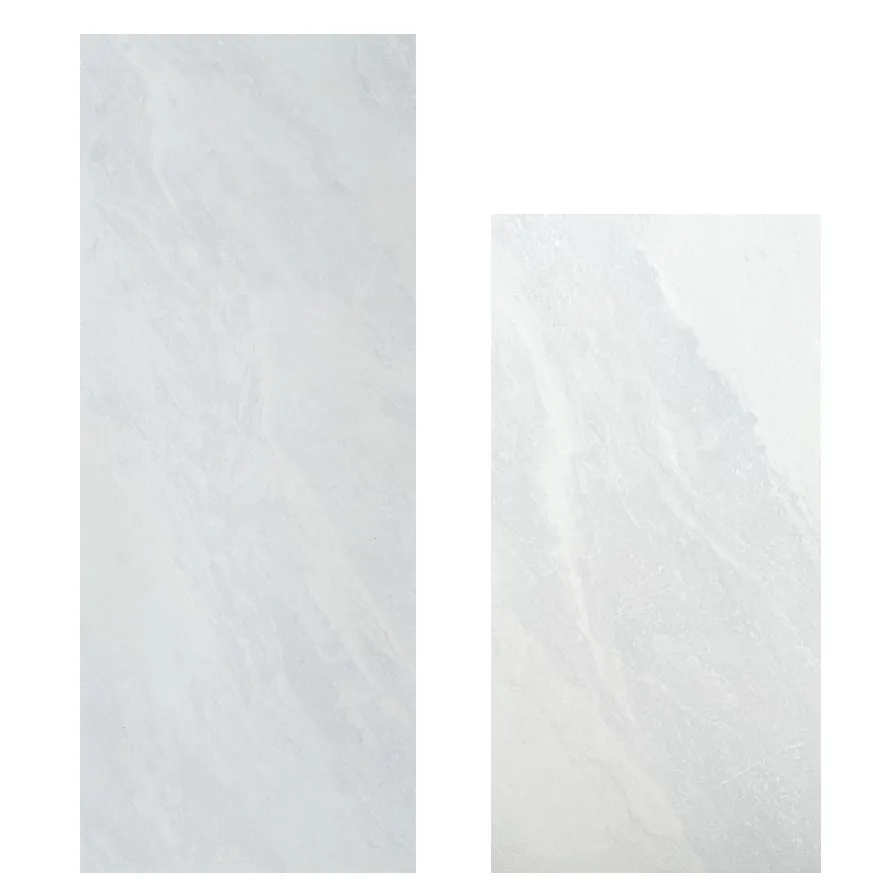
For developers, every decision is a balancing act—between aesthetics that attract tenants and buyers, and budgets that keep projects profitable. When it comes to building materials, the choice often feels like picking sides: either splurge on something beautiful but pricey, or cut costs with something functional but forgettable. But what if there was a material that didn't force that trade-off? Enter Marble Veil White —a surface that marries the timeless elegance of marble with the practicality developers need. Let's dive into why this material isn't just an expense, but an investment that pays off over decades.
Let's start with the question that's probably top of mind: How much does Marble Veil White cost upfront? It's true—compared to basics like fair-faced concrete or even some engineered stones, Marble Veil White might make your initial budget raise an eyebrow. Prices typically range from $80 to $120 per square meter, depending on thickness and finish, whereas fair-faced concrete might come in at $40 to $60 per square meter. But here's the thing: that higher sticker price isn't just for looks. It's for a material that's been engineered to outlast, outperform, and outshine cheaper alternatives.
Marble Veil White is crafted from high-density marble composites, reinforced with polymers that enhance durability without sacrificing the natural veining and luminosity of real marble. Unlike generic concrete or low-grade stone, it's resistant to chipping, staining, and UV fading—qualities that mean you're not just paying for a surface, but for peace of mind. And when you factor in the material's versatility (it works indoors, outdoors, on walls, floors, even countertops), you're getting a multi-use solution that reduces the need for multiple material orders.
Developers know the real cost of a material isn't just what you pay to install it—it's the total cost over its lifespan. Let's break down how Marble Veil White saves you money year after year.
Cheap materials might save you money today, but they'll cost you tomorrow. Take epoch stone or century stone , for example—both are solid options, but they're prone to surface wear in high-traffic areas. A shopping mall hallway with century stone might need resurfacing every 5–7 years, costing $30–$50 per square meter each time. Marble Veil White, on the other hand, is built to last 20+ years with minimal signs of aging. Its dense composition resists scratches from foot traffic, dents from heavy furniture, and even the harshness of outdoor weather (rain, snow, salt)—no need for costly repairs or replacements.
Marble has a reputation for being high-maintenance, but Marble Veil White flips that script. Traditional marble requires annual sealing to prevent staining, which adds $2–$5 per square meter to your yearly costs. Not to mention the specialized cleaners and regular buffing to keep it shiny. Marble Veil White, though? Its polymer reinforcement creates a non-porous surface that repels liquids and dirt. A quick wipe with mild soap and water is all it takes to keep it looking new. Over 20 years, that adds up: if you have 1,000 square meters of surface, traditional marble would cost $4,000–$10,000 in sealing alone. Marble Veil White? Maybe $500 total for cleaning supplies. That's a savings of $9,500 right there.
Here's a hidden benefit developers often overlook: thermal performance. Marble Veil White has natural insulating properties, thanks to its density and light color. In sunny climates, it reflects heat rather than absorbing it, which means cooler interiors and lower air conditioning costs. A study by the Green Building Council found that light-colored, reflective surfaces can reduce a building's cooling load by 15–20%. For a 50,000 sq ft commercial building, that could translate to $10,000–$15,000 in annual energy savings. Over 20 years, that's $200,000–$300,000 back in your pocket—all from a material choice.
Trends come and go. Remember when rust board granite was all the rage in the early 2000s? Or when neon-colored composites flooded the market in the 2010s? Today, those choices feel dated, forcing developers to renovate or rebrand to stay competitive. Marble Veil White, though, is timeless. Its soft white base with subtle gray veining fits modern, minimalist designs, classic architecture, and everything in between. It doesn't rely on fads—it relies on beauty that's been admired for centuries (think: ancient Greek temples, Renaissance palaces). Choosing a timeless material means you won't have to replace surfaces every 10 years to keep up with what's "in." That's a huge savings in renovation costs and downtime.
Numbers speak louder than words, so let's put this all together. Below is a comparison of Marble Veil White with three common alternatives: fair-faced concrete, traditional marble, and epoch stone . We'll look at total costs over 20 years for 1,000 square meters of surface.
| Material | Initial Cost (1,000 sqm) | Annual Maintenance Cost | Replacement Frequency | 20-Year Energy Savings | Total 20-Year Cost |
|---|---|---|---|---|---|
| Marble Veil White | $100,000 | $250 | None (20+ year lifespan) | +$200,000 | $100,000 + ($250×20) – $200,000 = -$95,000 (net savings) |
| Fair-Faced Concrete | $50,000 | $500 (sealing, repairs) | Every 10 years ($50,000 replacement) | +$50,000 (less reflective than marble) | $50,000 + ($500×20) + $50,000 – $50,000 = $60,000 |
| Traditional Marble | $120,000 | $2,000 (sealing, polishing) | Every 15 years ($120,000 replacement) | +$150,000 | $120,000 + ($2,000×20) + $120,000 – $150,000 = $130,000 |
| Epoch Stone | $70,000 | $1,000 (stain removal, refinishing) | Every 12 years ($70,000 replacement) | +$80,000 | $70,000 + ($1,000×20) + $70,000 – $80,000 = $80,000 |
The takeaway? Even with a higher initial cost, Marble Veil White ends up saving you nearly $100,000 over 20 years compared to fair-faced concrete, and over $200,000 compared to traditional marble. That's not just a cost— it's a profit center.
Let's hear from someone who's been there. Michael Torres, a developer in Miami, used Marble Veil White for the lobby and exterior cladding of his 12-story mixed-use building, "The Vue," completed in 2010. At the time, his team debated between Marble Veil White and MCM flexible stone , a popular lightweight alternative. "MCM was cheaper upfront—about $60 per square meter vs. $90 for Marble Veil White," Torres recalls. "But we ran the numbers and realized the maintenance on MCM, which requires repainting every 5 years, would add up. Plus, we loved how Marble Veil White looked in the sun—it made the building feel premium, which let us charge 10% higher rents."
Ten years later, Torres's decision paid off. "The lobby still looks brand new. We've never had to repair a single tile, and tenants rave about how cool the building stays in summer. Last year, we did a cost audit: compared to our other building with MCM, The Vue saved $12,000 in maintenance and $8,000 in AC costs. Over 10 years, that's $200,000. And because the aesthetic is still in demand, we just renewed our anchor tenant's lease at a 15% increase. Marble Veil White didn't just save us money—it made us money."
Developers don't just build buildings—they build assets. And assets that hold their value, reduce ongoing costs, and attract long-term tenants are the ones that succeed. Marble Veil White checks all those boxes. It's a material that works as hard as you do: it looks good on day one, saves you money every year, and keeps your building competitive for decades.
Sure, there are cheaper options out there. But in the world of development, "cheap" often means "costly later." Marble Veil White is proof that sometimes, spending a little more upfront is the smartest financial move you can make. After all, the goal isn't just to finish a project—it's to build something that keeps paying you back, year after year.
So, the next time you're reviewing material samples, ask yourself: Is this a cost, or an investment? With Marble Veil White, the answer is clear. It's not just marble—it's a long-term savings plan, wrapped in beauty.
Recommend Products












