
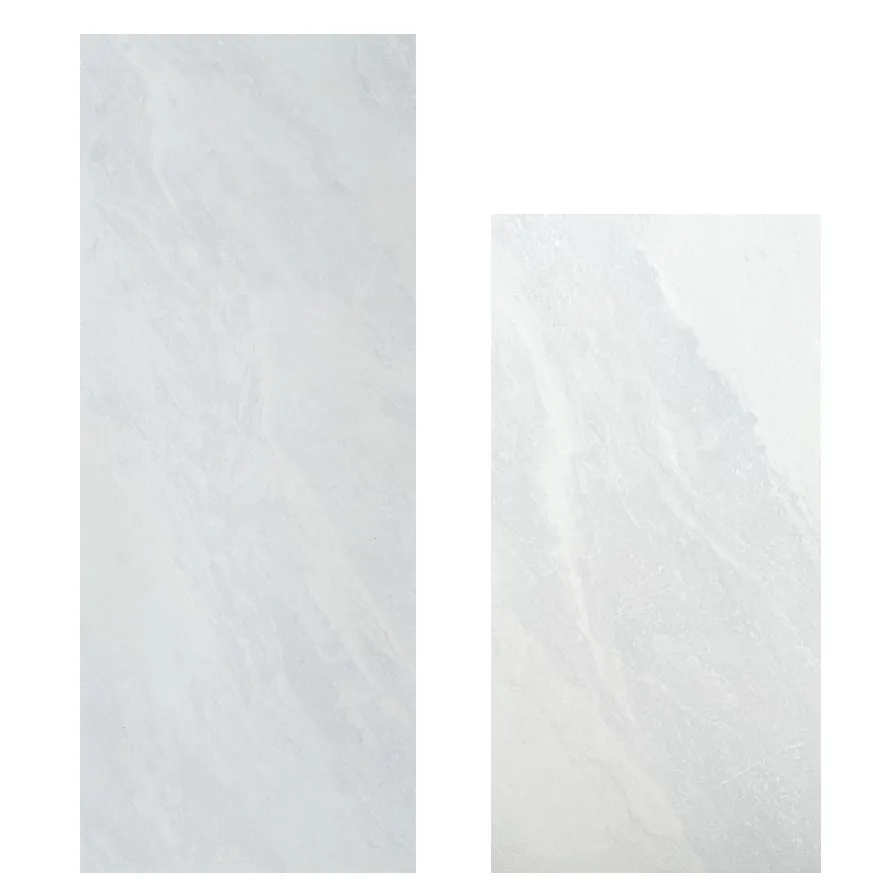
Walk into a luxury hotel lobby, a high-end restaurant, or even a thoughtfully designed home, and there's a good chance you'll encounter it—the soft, luminous surface of Marble Veil White . Its creamy white base is swirled with delicate veins, sometimes pale gray like fog, other times warm gold like sunlight through honey, or even faint blue like a summer sky. These veins don't just decorate the stone; they tell a story millions of years in the making. They're nature's artwork, shaped by heat, pressure, and the quiet chemistry of the Earth. But what exactly causes those mesmerizing patterns? Let's peel back the layers—literally—and uncover the science behind the veining that makes Marble Veil White so endlessly captivating.
To understand Marble Veil White's veins, we first need to understand where marble itself comes from. It all starts with limestone, a sedimentary rock formed on the ocean floor over millions of years. Imagine ancient seas teeming with tiny marine creatures—clams, corals, plankton—whose shells and skeletons, rich in calcium carbonate, pile up layer upon layer. Over time, these layers compact into solid rock, storing not just the memory of ancient life, but also traces of the world around them: bits of clay, iron-rich minerals, or even organic matter trapped in the sediment.
Then, the Earth's tectonic plates shift. That limestone, once at the bottom of the sea, gets pushed deep underground—miles below the surface—where temperatures soar (between 300°C and 600°C) and pressure mounts (thousands of atmospheres, enough to crush a car into a cube). This is metamorphism—the process that transforms limestone into marble. Under such extreme conditions, the calcium carbonate crystals in limestone recrystallize, growing larger and interlocking like a jigsaw puzzle. The result? A rock that's harder, denser, and far more lustrous than its sedimentary ancestor. But here's the twist: those tiny impurities in the original limestone? They don't just disappear. They become the stars of the show—the veins in your Marble Veil White.
Veins in marble are like nature's doodles, but they're anything but random. They form when the minerals that didn't quite fit into the recrystallizing calcium carbonate matrix start to "flow." Think of it like stirring cream into coffee: the heat and pressure act like a spoon, pushing these impurities through the rock as it transforms. As the marble cools and solidifies, these minerals settle into cracks, crevices, or the spaces between growing calcite crystals, creating the linear patterns we call veins.
What determines their color? It's all in the minerals. Iron oxides, for example, can turn veins golden, rusty red, or even deep brown—like a splash of autumn in stone. Manganese might add streaks of purple or black, while clay minerals often bring soft grays or muted greens. In Marble Veil White, the veins are typically subtle—pale grays or silvery blues—because the original limestone had only trace amounts of impurities. It's this balance that gives the stone its ethereal, almost cloud-like appearance: a canvas of white interrupted by veins that look like they were painted with a watercolor brush.
The thickness and direction of the veins depend on how the rock "moved" during metamorphism. If the pressure was uneven, the marble might have twisted or folded, creating wavy, irregular veins. If it cooled slowly, the minerals had time to spread out, forming thin, delicate lines. Cool too quickly, and you might get thicker, more abrupt streaks. Every slab of Marble Veil White is a fingerprint—no two are exactly alike—because no two patches of limestone experience the exact same heat, pressure, or mineral mix.
These veins aren't just for show—they play a big role in how we use and perceive Marble Veil White. For architects and designers, the pattern adds depth and movement to spaces. A wall clad in Marble Veil White doesn't feel flat; the veins draw the eye, creating a sense of flow that can make a room feel larger or more dynamic. In countertops, the subtlety of the veins means they pair well with bold cabinetry or vibrant decor—they complement, rather than compete.
Compare this to something like Travertine (Starry Green) , another stunning natural stone but with a very different texture. Travertine forms from mineral-rich hot springs, where calcium carbonate deposits layer up quickly, trapping gas bubbles that leave tiny "stars" (hence "Starry Green"). Its texture is porous and pitted, with veins that are often more scattered and earthy—think mossy greens and terracotta. While Travertine (Starry Green) feels organic and rustic, Marble Veil White leans into elegance and timelessness. Both are beautiful, but their veins tell entirely different geological stories.
In a world of modern materials, Marble Veil White still holds its own—but it's not the only player. Take MCM Flexible Stone , for example. A newer innovation, MCM (Modified Composite Material) Flexible Stone mimics the look of natural stone but with added versatility: it's lightweight, bendable, and easier to install on curved surfaces or high-rise exteriors. While it can replicate the veining of Marble Veil White, it lacks that "lived-in" quality—the uniqueness that comes from millions of years of geological history. MCM is a chameleon, but marble is a storyteller.
Then there's Fair-faced Concrete , the industrial darling of modern design. Its appeal lies in its raw, unpolished look—no veins, just the texture of the formwork that shaped it. It's bold, minimalist, and unapologetically modern. But where Fair-faced Concrete feels cool and utilitarian, Marble Veil White feels warm and inviting. It's the difference between a concrete jungle and a sunlit meadow—both have their place, but marble's veins add that touch of nature that's hard to replicate.
And let's not forget Wood Grain Board , a material that celebrates the organic texture of trees. Unlike marble's flowing veins, wood grain is linear, with rings that tell the story of a tree's life—wet years, dry years, growth spurts. It's a different kind of "veining," one that feels cozy and familiar, like a hug from nature. When paired with Marble Veil White, the contrast is striking: the stone's cool elegance balanced by the wood's warmth, proving that texture—whether from the Earth or the forest—has the power to transform a space.
| Material | Texture Origin | Pattern Character | Best For | Unique Trait |
|---|---|---|---|---|
| Marble Veil White | Metamorphic (limestone + heat/pressure) | Delicate, wispy veins (grays, silvery blues) | Luxury interiors, statement walls, countertops | Each slab has a one-of-a-kind "vein fingerprint" |
| Travertine (Starry Green) | Sedimentary (hot spring deposits) | Porous with scattered "star" bubbles, earthy green veins | Rustic patios, walls, warm-toned spaces | Bubbly texture from trapped gas in mineral deposits |
| Wood Grain Board | Engineered (wood fibers + resin) | Linear, ring-like patterns mimicking tree growth | Flooring, accent walls, cozy living spaces | Warm, tactile texture that feels "lived-in" |
| Fair-faced Concrete | Man-made (cement + aggregates) | Uniform, matte finish with subtle formwork texture | Industrial-chic interiors, exteriors, minimalist designs | Raw, unpolished look that highlights simplicity |
| MCM Flexible Stone | Engineered (stone particles + polymer) | Replicated natural veins, lightweight and flexible | Curved surfaces, high-rise cladding, budget-friendly luxury | Mimics marble's beauty with modern durability |
In a world obsessed with the new and the next, Marble Veil White endures because it's more than a material—it's a bridge between the ancient and the modern. Its veins carry the memory of oceans that existed before dinosaurs, of mountains rising and falling, of the Earth itself reshaping. When we touch a slab of Marble Veil White, we're touching history. And yet, it feels fresh—equally at home in a sleek, contemporary penthouse as it is in a classic villa.
Maybe that's the real magic of its veins: they're a reminder that beauty doesn't have to be perfect. The slight imperfection of a wavy line, the soft blur of a gray streak—these are the things that make Marble Veil White feel alive. It's not a cold, sterile surface; it's a story written in stone, one that invites us to slow down, look closer, and marvel at the artistry of nature.
So the next time you see Marble Veil White, take a moment to trace a vein with your eye. Think about the journey it took—from the ocean floor to your living room, from limestone to luxury. Those lines aren't just pretty. They're a love letter from the Earth, and they're waiting to be admired.
Recommend Products












