
Walk into any modern architectural space today, and you'll likely notice something remarkable: surfaces that don't just exist —they tell a story . The walls might ripple like a frozen stream, or the ceiling could weave a tapestry of light and shadow, as if crafted by both human hands and cutting-edge technology. This magic is where MCM's 3D printing innovations meet the timeless art of weaving, blurring the line between industrial precision and organic warmth. Let's dive into how these two worlds collide to redefine what's possible in design, one texture at a time.
3D printing has long been hailed as the future of manufacturing, but in the hands of MCM, it's become a storyteller . The MCM 3D Printing Series isn't just about printing parts—it's about printing experiences . Imagine (oops, scratch that— picture ) a facade that twists and turns like a desert wind, each curve calculated to catch the sun at dawn, each surface embedded with the granular detail of travertine (starry blue) . That's the power of MCM's 3D printing: it takes the rigid limitations of traditional construction and melts them into something fluid, allowing designers to dream in complex geometries without sacrificing the tactile, earthy feel we crave.
What makes this series stand out? It's all in the texture. Unlike generic 3D-printed materials that often feel plasticky or uniform, MCM's process layers materials in a way that mimics natural formation. Take lunar peak silvery , for example. Run your hand over a panel printed with this finish, and you'll swear you're touching moon dust—fine, slightly gritty, with a subtle shimmer that shifts as you move. It's not just a "look"; it's a sensory experience . And it's not limited to one texture: the series spans everything from the rough-hewn charm of boulder slab (vintage black) to the smooth, cool elegance of fair-faced concrete , all printed with precision that would make a sculptor envious.
But why stop at "realistic"? MCM's 3D printing goes a step further, creating textures that enhance nature. The travertine (starry blue) variant, for instance, amplifies the natural pitting of travertine by 3D printing tiny, star-like indentations that catch light, turning a standard stone finish into something almost celestial. It's as if the material itself is alive, responding to its environment. Architects love this flexibility—whether they're designing a minimalist office or a whimsical cultural center, the 3D Printing Series adapts, turning blueprints into surfaces that feel both intentional and alive.
Let's talk about the how . Traditional construction often limits designers to flat panels or simple curves, but MCM's 3D printers build layer by layer, allowing for overhangs, undulations, and even honeycomb structures that would be impossible with concrete or stone alone. Think of it like stacking thin sheets of material—each just a fraction of a millimeter thick—each infused with pigments and aggregates that mimic natural stone, metal, or wood. The result? A wall that could curve upward like a wave (hello, wave panel ) or a ceiling that dips and rises like a mountain range, all while retaining the weight and durability needed for commercial spaces. It's engineering with a soul.
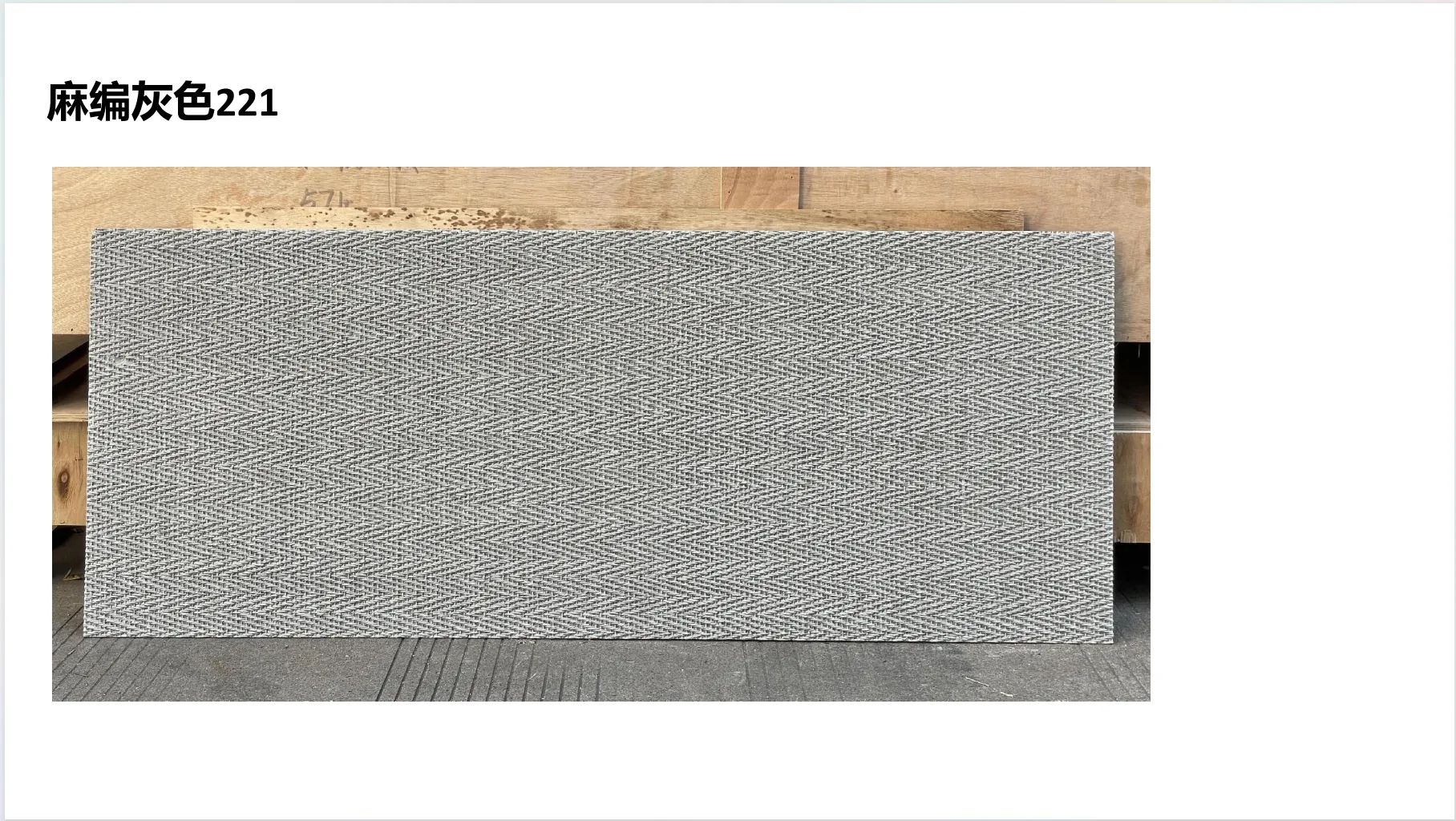
If 3D printing is the "precision" half of this design equation, weaving is its "heart." There's something inherently human about woven textures—they evoke memories of handcrafted blankets, basketry passed down through generations, or the way sunlight filters through a woven screen. MCM's weaving real photos collection doesn't just replicate this feeling; it elevates it, using modern materials to capture the essence of woven fabric in architectural form.
Take weaving (khaki) , for example. At first glance, it might look like a simple textile stretched across a wall, but get closer, and you'll realize it's far more durable than any fabric. MCM weaves synthetic fibers with reinforced polymers, creating a surface that's water-resistant, fire-retardant, and yet still soft to the touch—like running your hand over a well-loved canvas. The khaki hue adds warmth, making spaces feel cozy without veering into cliché. It's perfect for lobbies or residential interiors where you want to balance modernity with a sense of home.
But weaving at MCM isn't just about mimicry. The weaving real photos series plays with scale and pattern in ways that traditional weaving can't. Imagine a ceiling installation that's 20 feet wide, woven in a repeating geometric pattern that shifts from tight, dense weaves to loose, airy ones, creating pockets of light that dance across the floor below. Or a partition wall that weaves wood line textures with metallic threads, blurring the line between natural and industrial. These aren't just "decorative"—they're functional, too. Woven panels can act as sound absorbers, softening echo in large spaces, or as light diffusers, turning harsh sunlight into a gentle glow.
What's striking about MCM's woven textures is their authenticity . The "real photos" in the series name aren't just marketing—they're a promise. Each weave pattern is inspired by real textiles, from the tight, uniform grid of a utility basket to the loose, flowing drape of a handwoven shawl. The result? Surfaces that feel familiar, even if you can't pinpoint why. It's the difference between looking at a digital render and touching a physical object—one feels distant, the other draws you in.
Choosing between 3D printed and woven textures can feel like picking a favorite child—both have unique strengths. To help, here's a breakdown of how they stack up in key areas:
| Feature | MCM 3D Printing Series | Weaving Real Photos |
|---|---|---|
| Geometry | Excels at complex, non-uniform shapes (e.g., lunar peak golden curves, wave panel undulations). | Thrives in repetitive, rhythmic patterns (e.g., weaving (jacinth) grids, bamboo mat board weaves). |
| Tactile Feel | Varied—can mimic rough stone ( rough granite stone (dark grey) ) or smooth metal ( foamed aluminium alloy board (vintage silver) ). | Soft, textured, and slightly flexible—invites touch (e.g., weaving (beige) feels like a thick textile). |
| Light Interaction | Uses depth and shadow (e.g., travertine (starry red) pits catch light like tiny lanterns). | Creates dappled, diffused light (e.g., weaving (white) lets sunlight filter through in patterns). |
| Best For | Statement walls, exterior facades, structural elements needing durability. | Interior partitions, ceilings, accent walls where warmth is key. |
The magic, of course, isn't in choosing one over the other—it's in combining them. Picture a restaurant where the exterior is clad in MCM's 3D printed boulder slab (vintage gold) , its rugged edges catching the sunset, while the interior features a woven weaving (khaki) that divides dining areas. The contrast is electric: the exterior feels bold and industrial, the interior soft and intimate. It's a dance of opposites that feels perfectly balanced.
Some of MCM's most stunning projects happen when 3D printed and woven textures aren't just neighbors—they're collaborators. Take, for example, the use of foamed aluminium alloy board (vintage gold) 3D printed panels paired with weaving (grey) accents. The aluminium's metallic sheen and sharp angles play off the weave's softness, creating a surface that's both futuristic and inviting. It's like pairing a tailored blazer with a hand-knit scarf—unexpected, but undeniably chic.
Another standout combination? Fair-faced concrete 3D printed walls with thread -thin woven inlays. The concrete's raw, industrial texture provides a neutral canvas, while the woven threads add pops of color and movement. Imagine a museum lobby where the walls are printed to look like ancient stone, but upon closer inspection, you notice delicate woven patterns running through the "cracks"—as if history and modernity are intertwined. It's storytelling through material, and it's brilliant.
Even nature-inspired textures get a boost from this synergy. Consider travertine (starry orange) 3D printed tiles mixed with stream limestone (claybank) woven panels. The travertine's starry pits evoke a night sky, while the limestone weave mimics the flow of a river, creating a space that feels like standing at the intersection of earth and sky. It's not just design—it's immersion .
Enough theory—let's talk about how these textures come to life in the real world. One recent project in Dubai's Design District uses MCM's 3D Printing Series to clad the exterior of a boutique hotel. The architects opted for travertine (vintage black) printed panels, shaped into undulating waves that reflect the desert heat, keeping the building cool while looking like a modern art installation. Inside, the lobby features a 20-foot-tall woven weaving (jacinth) screen that filters light from the floor-to-ceiling windows, casting pink and gold patterns across the marble floors. Guests often pause to run their hands over the weave, commenting on how it "feels like a hug."
In Tokyo, a co-working space took a different approach, blending lunar peak black 3D printed desks with wood grain board woven room dividers. The desks' sharp, angular geometry (printed to mimic the jagged peaks of Mount Fuji) contrasts with the dividers' soft, organic weave, creating a space that feels both energizing and calm. "We wanted to balance productivity with comfort," says the lead designer. "The 3D printed elements keep things sharp and focused, while the woven textures remind people to breathe."
Even residential spaces are getting in on the action. A private home in Bali features a backyard pavilion with a 3D printed gobi panel roof (shaped to withstand heavy rain) and woven bali stone walls that let in ocean breezes. The result? A space that's as functional as it is beautiful—proof that these textures aren't just for show; they enhance how we live.
As technology evolves, so too will MCM's ability to merge 3D printing and weaving. Imagine (again, picture ) 3D printed panels that can change texture with temperature, or woven materials embedded with sensors that adjust light based on occupancy. The possibilities are endless, but one thing remains constant: the human desire for surfaces that feel alive .
In a world dominated by screens and digital interactions, there's something deeply comforting about touching a wall that feels like stone or a ceiling that weaves like a blanket. MCM's 3D Printing and Weaving Real Photos series don't just satisfy that desire—they amplify it, turning buildings into experiences. So the next time you walk into a space that takes your breath away, take a moment to run your hand along the wall. Chances are, you're feeling the magic of MCM's textures at work.
At the end of the day, design is about connection—between people, between spaces, and between the past and the future. MCM's 3D printing and weaving technologies don't just build walls; they build bridges. Bridges between innovation and tradition, between precision and warmth, between the digital and the tactile. And in that bridge, we find something truly special: design that doesn't just look good—it feels good.
Recommend Products












