
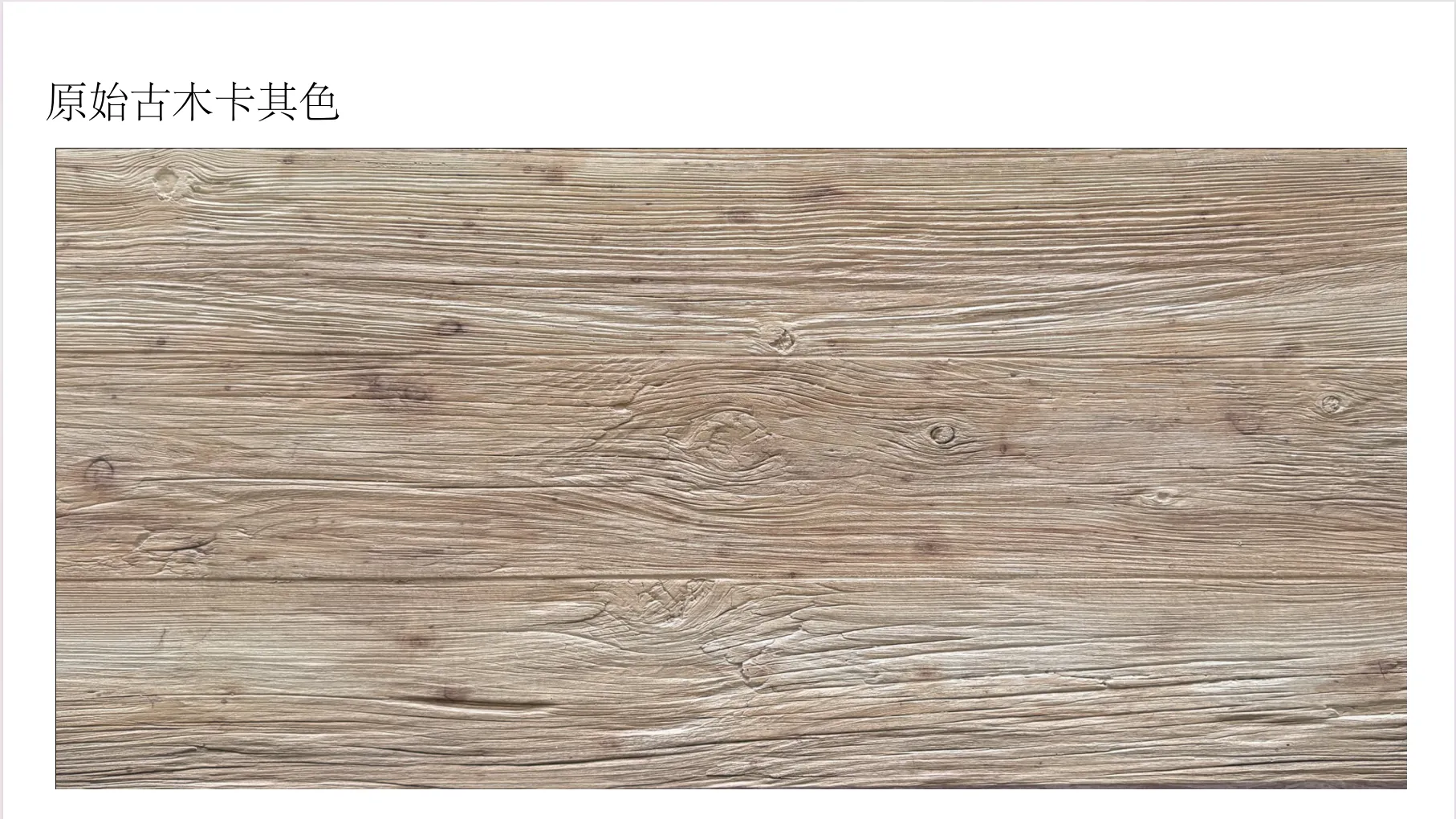
There's something almost magical about ancient wood. It's not just a material—it's a storyteller. Imagine running your hand over a beam that's stood for centuries, its grain twisting like a river, knots that look like hidden secrets, and edges softened by time. In luxury design, that warmth, that history, is the gold standard. But here's the catch: real ancient wood is rare, fragile, and often impractical for modern projects. Traditional replicas? They feel flat, lacking the soul of the original. Enter MCM 3D printing series—a technology that's not just copying the look of ancient wood, but capturing its spirit. Let's dive into how this innovation is turning the dream of intricate ancient wood motifs into a tangible, luxurious reality for designers and architects worldwide.
Walk into any high-end hotel, boutique restaurant, or luxury residence, and you'll likely spot it: the warm glow of wood that feels like it has a past. Designers crave ancient wood motifs because they bring a sense of groundedness, a connection to something timeless, in spaces that often lean toward sleek modernity. Think of a grand lobby with a reception desk carved to look like reclaimed barn wood, or a penthouse wall paneled with patterns reminiscent of 18th-century oak. These motifs aren't just decorative—they're emotional. They make a space feel lived-in, not just built.
But here's the problem: sourcing real ancient wood is a minefield. Old-growth trees are protected, reclaimed wood is expensive and inconsistent, and even when you find it, it's heavy, prone to warping, and needs constant maintenance. And let's not forget sustainability—ripping out centuries-old beams for a single project? Not exactly aligned with the eco-conscious values luxury clients now demand. So designers have been stuck: they want the beauty of ancient wood, but traditional materials are holding them back.
This is where MCM 3D printing series steps in—and it's not just a tech upgrade; it's a creative revolution. MCM, or Modified Composite Material, has already made waves with its flexible, durable, and lightweight solutions (hello, MCM flexible stone). But pair that with 3D printing, and suddenly, the rules change. 3D printing isn't new, but in the world of building materials, it's a game-changer. Instead of carving or molding wood-like patterns by hand, designers can now digitize the most intricate ancient wood motifs—down to the tiniest crack or weathered knot—and print them directly onto MCM panels with stunning precision.
What makes MCM 3D printing series different? It's all in the detail. Traditional 3D printing for construction often focuses on structure, not aesthetics. MCM's approach is the opposite: it's about capturing the essence of a material. Take ancient wood, for example. A 3D scanner can map every nuance of a centuries-old plank—a split here, a water stain there—and turn that data into a digital model. Then, using MCM's specialized printers, that model is brought to life layer by layer, using materials that mimic the texture, color, and even the subtle sheen of real wood. The result? A panel that doesn't just look like ancient wood—it feels like it.
Let's pull back the curtain on how this magic happens. It starts with inspiration. A designer might fall in love with the weathered oak beams of a 17th-century chateau in France, or the twisted teak from an old Indonesian fishing boat. The MCM team then scans that wood—literally creating a 3D digital twin of its surface. Every bump, groove, and imperfection is captured in microscopic detail. Next, designers tweak the model: maybe they want to a particularly striking knot pattern, or adjust the color to complement a space's palette. This is where the "custom" in luxury truly shines—no two projects need to be the same.
Once the digital design is locked in, the 3D printing begins. MCM uses a blend of modified stone powders, resins, and fibers (the same tech that makes MCM flexible stone so durable) to build up the motif layer by layer. Unlike traditional 3D printers that extrude plastic, MCM's process fuses materials that mimic the density and texture of wood. The result is a panel that's lightweight (so it's easy to install on walls, ceilings, or even furniture), flexible (it can curve around corners without cracking), and tough enough to withstand the wear and tear of high-traffic luxury spaces.
And here's the best part: the motifs aren't just on the surface. With 3D printing, the depth is real. Run your finger over a printed "ancient wood" panel, and you'll feel the grain rise and fall, the knots indent like they've been there for decades. It's not a flat sticker or a painted-on pattern—it's a three-dimensional work of art.
Of course, even the best 3D printing tech is only as good as the materials it uses. That's where MCM flexible stone and wood grain board come into play. Let's start with MCM flexible stone. Traditional stone is heavy and rigid—great for countertops, but not so much for intricate wall panels or curved surfaces. MCM flexible stone, though? It's a game-changer. Made from natural stone powders mixed with high-strength polymers, it's thin (as little as 4mm), bendable, and surprisingly strong. When combined with 3D printing, it becomes the perfect canvas for ancient wood motifs: the stone's natural texture adds depth, while its flexibility lets designers create shapes that would be impossible with real wood or stone.
Then there's wood grain board—a material designed specifically to mimic the look and feel of real wood, but with the durability of MCM. Unlike cheap laminates that peel or fade, MCM's wood grain board uses a multi-layer process: a core of recycled fibers for stability, a layer of 3D-printed wood grain (using the same ancient wood motif scans we talked about), and a protective top coat that resists scratches, moisture, and UV rays. The result? A board that looks like it was milled from a 200-year-old tree, but can be installed in a fraction of the time and lasts decades without warping or rotting.
Together, these materials solve the biggest pain points of traditional wood. Want to use ancient wood motifs in a bathroom with high humidity? MCM flexible stone and wood grain board won't swell or mold. Need to cover a massive facade on a luxury hotel? They're lightweight enough to reduce structural load. Concerned about sustainability? Both materials use recycled content and require less energy to produce than mining stone or cutting down trees. It's a win-win for designers, clients, and the planet.
Let's get concrete—literally. How are top designers using MCM 3D printed ancient wood motifs in real luxury projects? Take the Azure Sky Hotel in Dubai, a 5-star property known for blending modern minimalism with cultural heritage. Their lobby features a 20-foot-tall accent wall covered in MCM 3D printed panels designed to mimic the weathered teak from traditional Emirati dhows (fishing boats). The motifs include tiny details: the way the wood splits around nails, the saltwater stains that look like brushstrokes, even the faint from years of use. Guests often stop to touch it, convinced it's real wood—until they realize how lightweight the panels are.
Or consider the Villa Serenity in the south of France, a private residence owned by a tech entrepreneur who wanted "the warmth of a 18th-century farmhouse with the efficiency of a smart home." The interior walls are clad in MCM wood grain board printed with oak motifs scanned from a decommissioned barn in Normandy. The dining room table? A single slab of MCM flexible stone, 3D printed to look like a reclaimed oak stump, complete with "cracks" and "bark" edges. Even the ceiling beams—usually a structural nightmare with real wood—are MCM 3D printed, lightweight enough to hang without extra support but looking every bit like the original timber.
And it's not just residential or hospitality. Retailers are getting in on the action too. A high-end fashion boutique in Milan recently used MCM 3D printed ancient wood motifs on their display shelves and cash wrap, creating a contrast between edgy clothing designs and the timeless warmth of the wood. Shoppers report feeling more relaxed, more connected to the brand—proof that materials with soul drive emotional engagement.
So, what makes these motifs more than just a pretty face? Let's break down the benefits that have designers and architects raving:
| Feature | Traditional Ancient Wood | Standard Replicas | MCM 3D Printed Motifs |
|---|---|---|---|
| Availability | Rare; often protected or expensive | Widely available but generic | Unlimited; can replicate any wood type |
| Durability | Prone to warping, rot, and pests | Fade, peel, or scratch easily | Waterproof, scratch-resistant, UV-stable |
| Customization | Limited by the wood's natural shape | Basic patterns; little variation | Endless—scan any motif, adjust size/color |
| Sustainability | Often unsustainable; depletes old-growth forests | Plastic-based; not eco-friendly | Uses recycled materials; low carbon footprint |
| Installation & Maintenance | Heavy; requires structural support; high upkeep | Easy to install but needs frequent replacement | Lightweight; DIY-friendly; no special maintenance |
Beyond the table, there's the "wow factor." Luxury design is all about exclusivity, and MCM 3D printing delivers that. Since each motif can be scanned from a unique piece of ancient wood, clients can have a one-of-a-kind design—no two projects will ever be identical. Imagine telling a client, "This panel is based on a 300-year-old oak from a castle in Scotland"—it adds a story, a level of detail that generic materials can't match.
Sustainability is another big win. MCM's materials use recycled stone and wood fibers, reducing reliance on virgin resources. The 3D printing process itself is energy-efficient, with minimal waste (unlike traditional carving, which generates lots of scrap). For luxury clients who care about their environmental footprint, this is a selling point that goes beyond aesthetics.
And let's not forget cost. Real ancient wood? Eye-wateringly expensive, especially for rare species. MCM 3D printed motifs? A fraction of the cost, with no compromise on quality. Designers can allocate those savings to other luxury touches—custom lighting, high-end fixtures—making projects more competitive and profitable.
As MCM 3D printing series evolves, the possibilities for ancient wood motifs are only growing. Imagine scanning wood from historical sites—say, a beam from a Roman villa or a temple in Kyoto—and using that to create motifs for a museum or cultural center. Or combining ancient wood patterns with other MCM materials, like lunar peak silvery or fair-faced concrete, for a look that's both timeless and futuristic.
Designers are already pushing boundaries. One firm is experimenting with 3D printing ancient wood motifs onto curved MCM flexible stone panels for a luxury yacht interior, creating a space that feels like a cozy cabin but is durable enough to withstand life at sea. Another is using the technology to replicate wood carvings from 17th-century palaces, preserving cultural heritage while making it accessible for modern projects.
At the end of the day, MCM 3D printing isn't just about technology. It's about connection—connecting us to the past through materials that fit the future. It's about proving that luxury doesn't have to be wasteful, that innovation can honor tradition, and that the most beautiful spaces are the ones that feel like they've been loved for centuries, even if they're brand new.
Ancient wood motifs have always been about more than decoration—they're about storytelling. They whisper of history, of craftsmanship, of time passing gently. MCM 3D printing series isn't just those stories; it's giving them new life. It's letting designers write their own narratives, blending the best of the past with the possibilities of today.
So the next time you step into a luxury space and feel that inexplicable warmth, that sense of timelessness, take a closer look. It might not be real ancient wood—but chances are, it's MCM 3D printed. And in that moment, you'll realize: it doesn't matter. Because what matters is the feeling—the story it tells. And that, in the world of luxury design, is everything.
Recommend Products












