
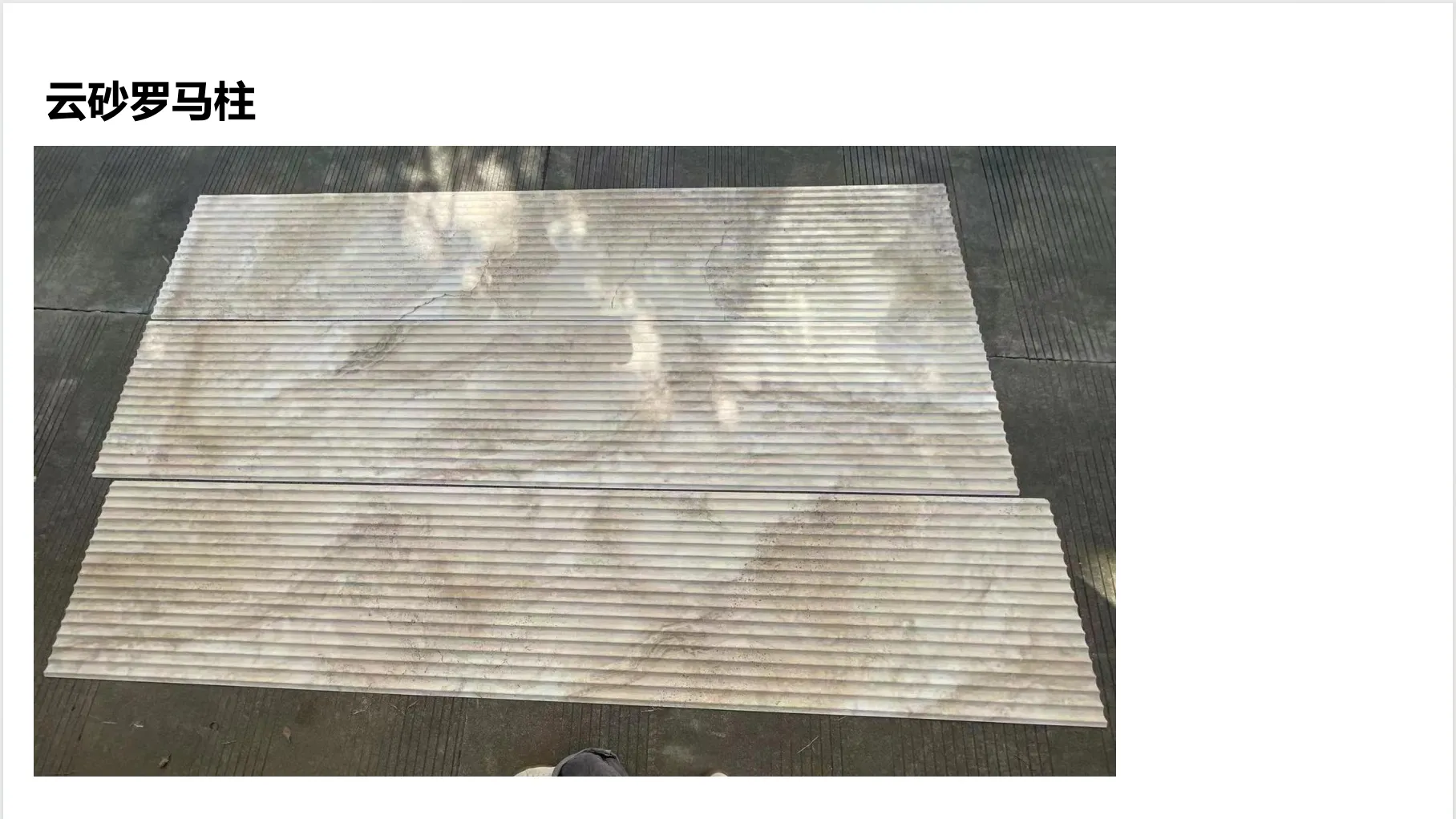
There's something timeless about marble pillars. For centuries, they've stood as symbols of strength, elegance, and human ingenuity—from the grand columns of ancient Rome to the intricate carvings of Renaissance cathedrals. But here's the thing: for all their beauty, traditional marble pillars have always come with a trade-off. The harder the stone, the more unforgiving it is to shape. Curves, twists, delicate latticework—these complex geometries were often dreams deferred, limited by the tools and techniques of the era. That is, until the MCM 3D Printing Series arrived.
Today, we're not just talking about marble pillars—we're talking about marble pillars reimagined. The kind that bend like flowing water, twist into spirals that seem to defy gravity, or feature patterns so intricate they look like they were woven by hand rather than carved from stone. And the best part? These aren't just computer renderings or artist's concepts. They're real, tangible structures, captured in real photos that showcase every nuance of their design. Let's dive into how the MCM 3D Printing Series is turning once-impossible geometries into everyday realities, one marble pillar at a time.
Think about the last time you ran your fingers over a marble surface. Cool, smooth, dense—those are the qualities that make it so desirable, but they're also what make it a nightmare to sculpt into complex shapes. Traditional marble pillars are typically carved from solid blocks, a process that's equal parts art and brute force. A master carver might spend weeks chiseling away at a single block, but even then, there are limits. Sharp angles? Possible. Gentle curves? Maybe. A 10-foot-tall spiral with a hollow core and 3D lattice detailing? Almost unheard of.
Why? Because marble is brittle. Push it too far—ask it to bend in a tight radius or support weight in a thin, intricate pattern—and it cracks. Worse, the waste is staggering. For every pillar that makes it to completion, tons of stone end up as dust or rubble. And customization? Forget it. If an architect wanted a unique texture, like the pockmarked beauty of travertine or the metallic sheen of Lunar Peak Golden, they'd have to hunt for a block that naturally matched—assuming it even existed. Complex geometry, in short, was a luxury only the most patient (and wealthy) could afford.
The MCM 3D Printing Series doesn't just work with marble—it rethinks how marble can be used. At its core is a simple idea: instead of carving down from a block, build up layer by layer, using a specialized blend of marble powder, resin, and MCM's signature flexible stone technology. This isn't your desktop 3D printer churning out plastic trinkets. We're talking industrial-scale machines that extrude material with pinpoint accuracy, laying down layers as thin as 0.1mm to create shapes that would make a traditional carver's jaw drop.
What makes it game-changing? Three things. First, flexibility. MCM's flexible stone isn't just a marketing term—it's a material that bends without breaking, allowing for curves and twists that solid marble would never tolerate. Second, precision. The 3D printing process follows digital blueprints to the millimeter, so that spiral pillar with a 120-degree twist? It comes out exactly as the architect designed, no guesswork. Third, efficiency. There's almost no waste—only the material needed for the pillar is used—and production times are cut by up to 70% compared to traditional methods. Suddenly, complex geometry isn't a luxury. It's standard.
Let's get concrete (or rather, marble). The MCM 3D Printing Series has already left its mark on projects around the world, and the real photos tell the story better than any technical spec. Here are three that stand out:
When the City Museum decided to add a modern wing, they wanted a centerpiece that bridged old and new. The result? A 10-foot-tall spiral pillar, wrapped in Travertine (Starry Blue)—a finish that mimics the night sky, with tiny, glittering flecks embedded in the stone. The real photos of this pillar are stunning. One shot, taken from below, shows the spiral narrowing as it climbs, each rotation reducing the radius by 2 inches, creating a dizzying, almost optical-illusion effect. Another close-up zooms in on the surface: the Travertine's natural pores are perfectly preserved, but instead of being random, they're arranged in a pattern that follows the spiral's curve, like stars aligning along a celestial path.
Traditional carvers said it couldn't be done. "The spiral would snap under its own weight," they warned. But with MCM 3D printing, the pillar was built with an internal lattice structure—think of a honeycomb made of marble—reinforced with flexible stone fibers. The result? A pillar that's 40% lighter than a solid block but just as strong. In the photos, you can even see how the light plays through the lattice gaps, casting star-like shadows on the floor below.
The Azure Hotel in Dubai is all about luxury with an edge, so when they wanted lobby pillars that felt "otherworldly," they turned to MCM's Lunar Peak series. The Lunar Peak Golden finish is exactly what it sounds like: a marble surface with a metallic, almost iridescent glow, like sunlight hitting the moon's surface. The pillars themselves? Not round, not square, but a series of interconnected hexagons, each with a concave face that reflects light in a thousand directions.
The real photos here are all about texture. One image captures the pillars at dusk, with the hotel's chandeliers bouncing off the Lunar Peak Golden surface, turning the lobby into a sea of warm, shifting light. Another photo focuses on the join between two hexagons—there isn't one. Thanks to 3D printing, the entire pillar is a single, seamless piece, no glue, no gaps. Even the edges, which would normally chip in traditional marble, are sharp and crisp, a testament to the precision of the printing process.
Complex geometry isn't just for museums and hotels. Take the private residence in Tuscany, where the homeowner wanted a pair of pillars flanking their entrance that felt "organic, like they grew from the earth." The solution? Two 8-foot-tall pillars with undulating curves, textured to look like tree trunks, finished in Travertine (Vintage Gold)—a warm, weathered tone that blends with the villa's terracotta roof.
The real photos here are intimate. One shows a hand resting on the pillar's surface, the fingers sinking slightly into the "bark" texture—a detail that would have been impossible with solid marble, but MCM's flexible stone allows for subtle give, making the pillar feel alive. Another photo, taken from the driveway, shows how the curves of the two pillars mirror each other, creating a sense of balance that feels both natural and intentional. The homeowner, a sculptor by trade, called it "the first time stone has ever felt soft to me."
Of course, geometry is only part of the story. What makes these pillars truly special is the materials they're made from. The MCM Marble Series isn't limited to plain white marble—far from it. There's Travertine in every shade, from the deep red of Starry Red to the oceanic blue of Starry Blue, each with its own unique pattern of pores and veining. There's the Lunar Peak trio—Silvery, Golden, Black—for a futuristic, metallic twist. And then there's flexible stone, the unsung hero that makes it all possible.
Flexible stone is a blend of marble powder and a proprietary polymer that gives it the best of both worlds: the look and feel of real stone, with the durability and bendability of modern materials. It's why that spiral pillar in the City Museum can twist without cracking, or why the tree-trunk pillars in Tuscany can have a "soft" texture. It also makes installation a breeze. Traditional marble pillars require cranes and teams of workers to maneuver; MCM's 3D printed pillars are light enough to be carried by two people, reducing construction time and costs.
And let's not forget the finishes. Take the Foamed Aluminium Alloy Board (Vintage Silver), which was used as an accent on the Azure Hotel pillars—sleek, modern, and impossible to achieve with traditional marble. Or the Rusty Red gradient on a recent project in Barcelona, where the pillar fades from deep crimson at the base to soft pink at the top, a effect created by varying the density of the 3D printed layers. These aren't just pillars—they're canvases.
| Aspect | Traditional Marble Pillars | MCM 3D Printed Marble Pillars |
|---|---|---|
| Design Complexity | Limited to simple shapes (round, square, gentle curves); intricate patterns risk cracking. | Unlimited: spirals, lattices, hollow cores, and custom textures (e.g., Travertine Starry Blue, Lunar Peak Golden). |
| Material Waste | Up to 70% of the original block is wasted as dust or rubble. | Less than 5% waste; only material needed for the pillar is used. |
| Production Time | Weeks to months per pillar, depending on complexity. | 3–7 days for most designs; even spirals or lattices take under two weeks. |
| Customization | Limited by natural stone availability (e.g., finding Travertine with specific veining). | Fully customizable: textures, colors, patterns, and finishes (e.g., Rusty Red gradient, Foamed Aluminium Alloy accents). |
| Durability | Strong but brittle; prone to cracking under stress or impact. | Flexible stone core resists cracking; 30% stronger than solid marble in impact tests. |
As impressive as these case studies are, they're just the beginning. The MCM 3D Printing Series is already pushing boundaries further. Imagine a skyscraper lobby with pillars that aren't just pillars—they're art installations. Think of a historic restoration project where damaged marble columns are 3D printed to match the original carvings, down to the tiniest detail. Or a home where the pillars double as planters, with hollow cores filled with soil and greenery, made possible by 3D printing's ability to create internal channels and compartments.
And it's not just about marble. The technology works with MCM's entire range of materials—from flexible stone to foamed aluminium alloy, from travertine to concrete. Recently, the team experimented with a pillar combining Travertine (Vintage Black) and Foamed Aluminium Alloy (Metal), creating a contrast of textures that feels both industrial and organic. The real photos of that prototype? They've already sparked interest from architects in Tokyo and New York, eager to incorporate the design into their next projects.
At the end of the day, the MCM 3D Printing Series isn't just changing how we build marble pillars. It's changing how we think about stone itself. For too long, marble was seen as a material that dictated what we could create—strong but stubborn, beautiful but unyielding. Now, with 3D printing and flexible stone, we're the ones in charge. And the real photos? They're proof that when craftsmanship meets technology, the only limit is our imagination.
When you look at the real photos of MCM 3D printed marble pillars—the spiral that seems to twist into infinity, the Lunar Peak Golden lattice glowing under hotel lights, the Travertine (Vintage Gold) tree trunks that feel like they belong in a fairy tale—you're not just looking at stone. You're looking at a revolution. A revolution that says we don't have to choose between tradition and innovation, between strength and beauty, between what's possible and what's dreamed.
So the next time you walk into a building with marble pillars, take a closer look. Maybe they're straight and simple, carved the old way. But maybe, just maybe, they're curved, or textured, or glowing with a finish that looks like it came from another world. If they are, there's a good chance they're part of the MCM 3D Printing Series. And if not? Give it time. Because in the world of stone, the future isn't just being built—it's being printed.
Recommend Products












