
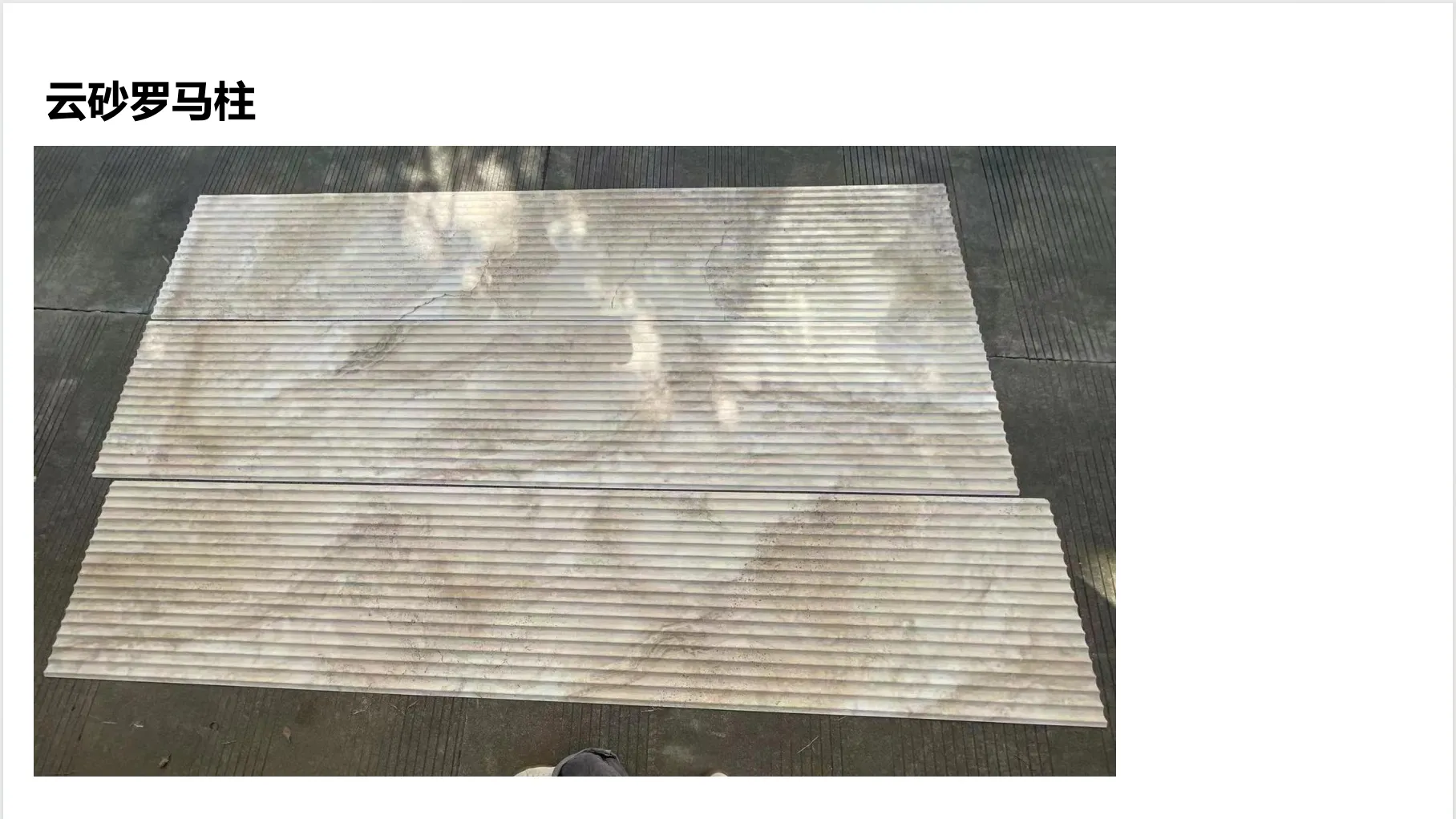
Marble pillars have long stood as symbols of elegance and grandeur in architecture, from the towering columns of ancient Greek temples to the intricate carvings of Renaissance palaces. They're more than just structural elements—they're storytellers, adding depth, character, and a touch of timelessness to any space. But for all their beauty, traditional marble has always come with limitations: weight, fragility, and the struggle to achieve truly unique, custom designs. That's where the MCM 3D Printing Series steps in, redefining what's possible with marble-inspired pillars and bringing architects' wildest visions to life.
Imagine walking into a modern hotel lobby and being greeted by a set of marble pillars that don't just stand straight—they curve gently, as if dancing to an unseen melody, their surfaces textured with patterns that mimic flowing water or starry night skies. Or picture a museum atrium where pillars aren't uniform columns but organic, sculptural forms that seem to grow from the floor, each one a one-of-a-kind masterpiece. These aren't just dreams anymore. Thanks to MCM's innovative 3D printing technology and flexible stone cladding panels, custom geometry in marble pillars has become an accessible reality, blending artistry with cutting-edge engineering.
Geometry isn't just about angles and measurements—it's about emotion. A sharp, angular pillar might evoke strength and modernity, while a soft, curved one feels welcoming and serene. For architects and designers, the ability to play with geometry is key to translating a vision into a physical space. But traditional marble, heavy and prone to cracking, has always limited this creativity. Carving complex shapes from solid stone is time-consuming, expensive, and risky; one wrong move, and the entire block is ruined.
MCM's 3D printing series changes the game by shifting from "carving" to "building." Using advanced 3D modeling software and precision printing techniques, designers can create pillars with geometries that were once unthinkable: spiral twists, undulating waves, honeycomb textures, even asymmetrical forms that challenge the eye. And because the base material is MCM flexible stone—a lightweight, durable composite that mimics the look and feel of natural marble—these designs aren't just beautiful; they're practical. No more worrying about structural overload or transportation nightmares. A pillar that might weigh tons in traditional marble can now be crafted in sections, installed easily, and withstand the test of time.
Take, for example, the concept of "organic geometry." Many modern architects are moving away from rigid, boxy designs in favor of shapes inspired by nature—think the curve of a leaf, the spiral of a seashell, or the rugged texture of a mountain peak. With MCM 3D printing, these organic forms can be replicated with stunning accuracy. The surface of a pillar might feature tiny, 3D-printed indentations that look like raindrops on stone, or a gradient texture that fades from smooth to rough, mimicking the way natural stone weathers over centuries. It's a level of detail that pays homage to nature while embracing the precision of technology.
Words can only describe so much—seeing is believing. Below is a curated showcase of real projects featuring MCM 3D printed marble pillars, each highlighting unique custom geometry and the versatility of MCM materials. These aren't renderings or concept art; they're real photos of installed pillars, bringing spaces to life around the world.
| Project Name | Custom Geometry Feature | Material Used | Application |
|---|---|---|---|
| Azure Tower Hotel Lobby | Double-helix spiral with embedded "starry blue" LED accents; pillars twist 360° over 12ft height | Travertine (starry blue) + MCM flexible stone cladding panels | Commercial hospitality (5-star hotel entrance) |
| Verde Museum Atrium | Undulating wave panel texture; pillars narrow from base to top (18" to 12" diameter) with organic, non-uniform curves | Stream limestone (claybank) + 3D printed MCM composite | Cultural institution (art museum central atrium) |
| Heritage Residences Penthouse | Semicircle board profile with "lunar peak silvery" finish; pillars feature alternating concave/convex segments | Lunar peak silvery + architectural big slab solutions | Luxury residential (penthouse living space) |
| Tech Hub Innovation Center | Angular "crystal" geometry with sharp, faceted edges; surface etched with linear travertine (claybank) lines | Linear travertine (claybank) + foamed aluminium alloy board (vintage silver) | Commercial office (tech startup campus) |
| Ancient Pathfinders Cultural Center | Historical pathfinders stone texture with 3D-printed "fossil" indentations; pillars designed to look partially eroded, honoring archaeological themes | Historical pathfinders stone + MCM flexible stone | Cultural heritage (museum exhibit hall) |
Each of these projects tells a story. The Azure Tower's spiral pillars, for instance, were designed to symbolize growth and ascent, mirroring the hotel's brand ethos of "reaching new heights." The undulating waves in the Verde Museum pillars echo the nearby river, creating a visual connection between the building and its natural surroundings. And the "crystal" pillars at the Tech Hub? They're a nod to innovation, with sharp edges representing breakthrough ideas and the travertine lines symbolizing the flow of data.
Behind every stunning custom geometry is a material that can keep up. MCM's marble pillars aren't just about 3D printing—they're about reimagining what "stone" can be. At the core of this innovation is MCM flexible stone cladding panels, a composite material that combines natural stone aggregates, high-performance polymers, and fiberglass reinforcement. The result? A material that's 80% lighter than natural marble, water-resistant, fire-retardant, and incredibly flexible.
Why does flexibility matter for geometry? Imagine trying to create a curved pillar with traditional marble: you'd need to cut and polish multiple curved slabs, each weighing hundreds of pounds, and hope they fit together seamlessly. With MCM flexible stone, the panels can bend to a radius as tight as 30cm, allowing for smooth, continuous curves without visible seams. It's like wrapping the pillar in a "stone blanket" that conforms to any shape, whether concave, convex, or somewhere in between.
But flexibility doesn't mean sacrificing realism. MCM's 3D printing process uses high-resolution texture mapping to replicate the look of natural marble down to the smallest detail. Want the warm beige tones of travertine (beige)? The deep, moody gray of dolomitic travertine (dark grey)? Or the shimmer of lunar peak golden? The color palette is vast, and each finish is designed to mimic the unique veining, pores, and imperfections that make natural stone so charming. Even better, MCM offers "vintage" finishes—like travertine (vintage silver) or boulder slab (vintage black)—that give pillars an aged, weathered look, perfect for spaces aiming for a rustic or industrial vibe.
Another game-changer is MCM's architectural big slab solutions. Traditional marble slabs are limited by size—usually around 8ft x 4ft—meaning larger pillars require multiple joints, disrupting the visual flow. MCM big slabs, however, can be printed in sizes up to 12ft x 6ft, reducing seams and creating a more cohesive, impactful look. For projects with pillars (like in grand atriums or cultural centers), this is a game-saver, allowing designers to maintain the integrity of their geometry without compromising on aesthetics.
Custom geometry and stunning visuals are important, but for architects, builders, and project managers, practicality matters just as much. MCM 3D printed marble pillars don't just look good—they make construction easier, faster, and more cost-effective. Let's break down the benefits:
A traditional marble pillar can weigh upwards of 500kg per linear meter. Installing one requires heavy machinery, specialized labor, and careful structural planning. MCM pillars, by contrast, weigh just 15-20kg per square meter, making them easy to transport, handle, and install with basic tools. This not only cuts down on labor costs but also reduces the load on the building's foundation—a critical advantage for retrofits or projects with weight restrictions.
Natural marble is porous and prone to staining, scratching, and weathering. A spilled glass of wine or a harsh storm can leave permanent marks. MCM flexible stone is non-porous, stain-resistant, and UV-stable, meaning it won't fade in sunlight or discolor over time. Cleaning is as simple as wiping with a damp cloth—no need for special sealants or expensive maintenance crews. For high-traffic areas like hotel lobbies or shopping malls, this durability is a lifesaver.
Mining natural marble is resource-intensive, often involving large-scale quarrying that disrupts ecosystems. MCM materials, on the other hand, use recycled stone aggregates and low-VOC polymers, reducing their environmental footprint. Additionally, 3D printing minimizes waste—only the exact amount of material needed is used, unlike traditional carving, which produces tons of stone dust and offcuts. For projects aiming for LEED certification or sustainable building standards, MCM is a smart choice.
MCM 3D printed marble pillars aren't limited to one type of project—they're versatile enough to enhance spaces of all kinds. Here are just a few areas where they're making a mark:
Hotels, restaurants, and office lobbies thrive on first impressions, and a set of custom pillars can be the focal point that sets a space apart. Imagine a boutique hotel using lunar peak silvery pillars with spiral geometry to create a futuristic, upscale vibe, or a restaurant with travertine (starry red) pillars that evoke warmth and intimacy. In retail, pillars can even become part of the branding—think a tech store with sleek, foamed aluminium alloy board (vintage gold) pillars that match their logo, or a luxury boutique using marble veil white pillars with subtle gold veining to reflect elegance.
Museums, theaters, and government buildings often aim to tell a story through architecture, and custom pillars are the perfect narrative tool. A history museum might use historical pathfinders stone pillars with 3D-printed etchings of ancient symbols, while a science center could feature pillars with cosmic-inspired geometries—like lunar peak black pillars with star-like indentations—to complement its space exhibits. Even public parks and plazas are getting in on the action, with pillars that double as art installations, inviting visitors to touch, admire, and interact with the space.
Luxury homes and high-end apartments are embracing custom pillars as a way to add personality and grandeur. A homeowners' lobby might feature bamboo mat board pillars for a tropical, serene feel, or a penthouse could have a statement pillar with a unique "weaving (jacinth)" texture, adding warmth and texture to an open-concept living space. Even outdoor spaces—like poolside cabanas or garden pavilions—can benefit from weather-resistant MCM pillars, designed to withstand rain, sun, and humidity without losing their luster.
As technology advances, the line between "possible" and "impossible" in architecture continues to blur. MCM's 3D printing series isn't just a tool for creating pillars—it's a catalyst for reimagining how buildings interact with people. Imagine a world where every pillar is a unique work of art, where geometry isn't constrained by material limits, and where spaces feel more human, more connected, and more inspiring.
For architects, this means more freedom to experiment, to take risks, and to push the boundaries of what a building can be. For builders, it means faster timelines, lower costs, and fewer headaches. For the people who inhabit these spaces—whether they're guests in a hotel, visitors in a museum, or families in a home—it means spaces that feel less like "buildings" and more like experiences.
At the end of the day, MCM 3D printed marble pillars are more than just construction materials. They're a celebration of human creativity, a bridge between tradition and innovation, and a reminder that in architecture, as in life, the most beautiful things often come from breaking the rules—one curve, texture, and custom design at a time.
Marble pillars have been captivating us for millennia, but with MCM's 3D printing series, they're entering a new era—one where custom geometry is limited only by imagination, not material. Whether you're designing a grand hotel lobby, a cozy residential space, or a cultural landmark, MCM flexible stone cladding panels, architectural big slab solutions, and 3D printing technology give you the power to turn your vision into reality.
So the next time you look at a pillar, don't just see a column—see a canvas. With MCM, that canvas is waiting for your design. The future of architecture is here, and it's printed in stone.
Recommend Products












