
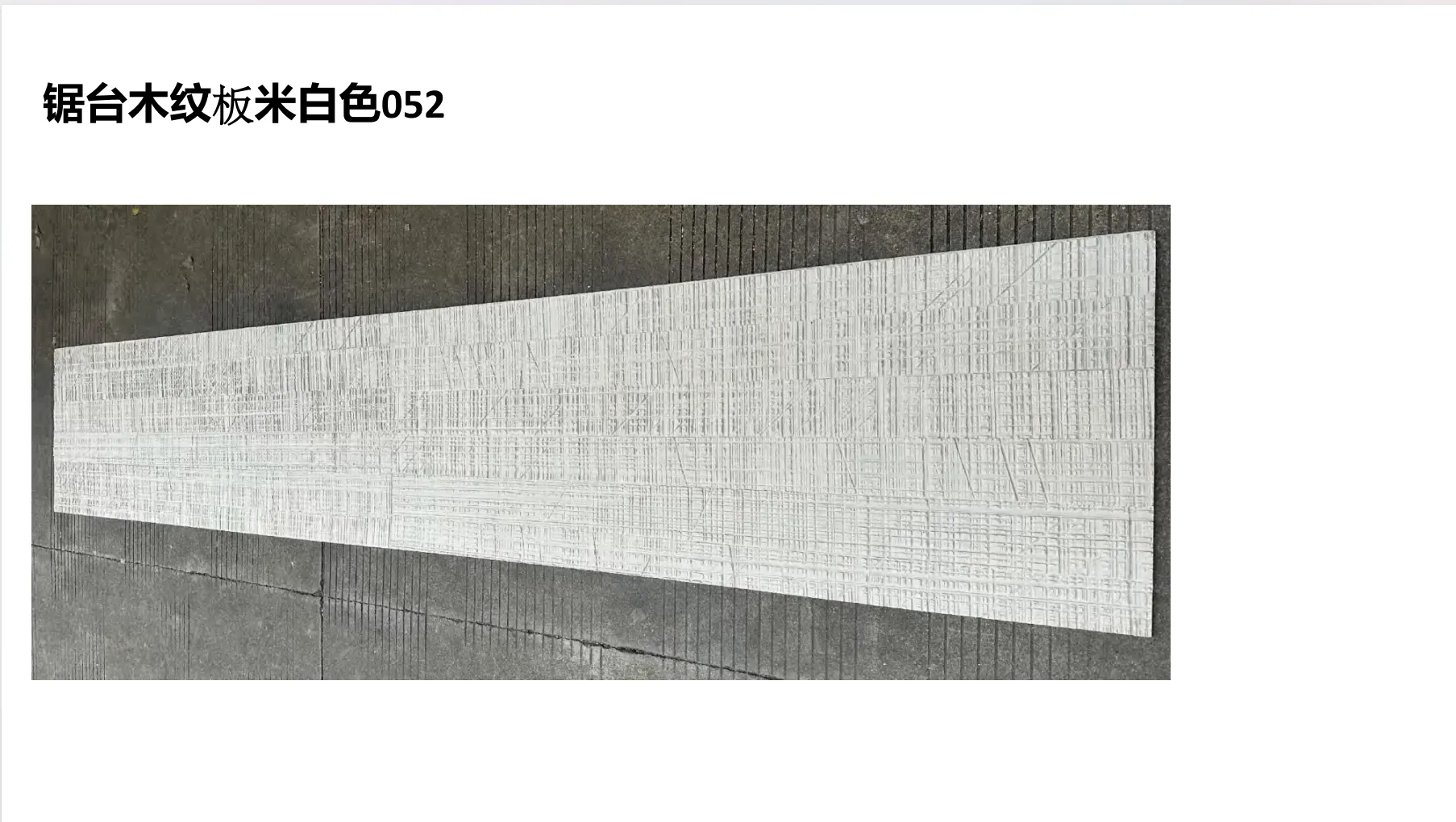
When it comes to large-scale construction projects—whether it's a sprawling shopping mall, a towering office complex, or a public cultural center—every material choice sends a ripple effect through the project's lifespan. Architects, contractors, and designers often find themselves at a crossroads: stick with time-tested classics or embrace innovative alternatives that promise better performance. Two materials that frequently enter this debate are the traditional sawing wood board and the modern MCM big slab board series . Both have their merits, but when the stakes are high (think durability, cost, and long-term maintenance), the differences become stark. Let's dive into what makes each unique, how they stack up, and why one might just be the smarter choice for your next big project.
Let's start with the familiar. Sawing wood board is exactly what it sounds like: planks of wood cut from trees, sanded, and often treated to enhance durability. For centuries, wood has been the go-to for adding warmth and natural beauty to buildings. Walk into a historic library or a cozy restaurant, and that rich, earthy aroma? That's wood doing its job. It's no wonder we're drawn to it—it feels organic, timeless, and has a way of making large spaces feel inviting.
But here's the thing about wood: it's a living material, even after it's cut. That means it reacts to its environment. In humid climates, it swells; in dry ones, it shrinks. Over time, this constant movement can lead to warping, cracking, or even rot if moisture seeps in. For small projects—a backyard deck or a home interior wall—these issues are manageable with regular maintenance: sealing, staining, replacing a plank here and there. But for large projects? Imagine a five-story commercial building with a wood-clad facade. Suddenly, "regular maintenance" becomes a full-time job. And let's not forget sustainability. While FSC-certified wood exists, large projects require massive quantities of timber, which can put a strain on forests if not sourced responsibly. Even with certifications, the carbon footprint of harvesting, transporting, and treating all that wood adds up.
Don't get me wrong—sawing wood board has its place. It's perfect for projects where aesthetics take precedence over longevity, or where the budget allows for ongoing upkeep. But when you're building something meant to stand the test of time (and the elements), wood starts to show its age—literally.
If sawing wood board is the reliable old friend, MCM big slab board is the innovative newcomer with a trick up its sleeve. MCM stands for "Modified Composite Material," and it's exactly that: a blend of natural minerals, polymers, and fibers engineered to mimic the look of natural materials—like stone, wood, or concrete—without their downsides. And the MCM big slab board series takes this technology to the next level, offering large-format panels (think 1200x2400mm or bigger) that are lightweight, flexible, and built to last.
At the heart of MCM's appeal is its flexible stone core. Unlike rigid natural stone slabs, MCM panels bend slightly, making them easier to install on curved surfaces or uneven walls—something wood or traditional stone struggles with. But flexibility doesn't mean fragility. These panels are resistant to scratches, UV rays, and moisture, thanks to their composite structure. Ever seen a building with a stone facade that looks as good after 20 years as it did on day one? Chances are, it's MCM.
One of the biggest selling points? Design variety. The MCM big slab board series isn't limited to one "look." Want the sleek, modern vibe of fair-faced concrete ? They've got it. Craving the cosmic sparkle of travertine (starry blue) or the metallic sheen of lunar peak silvery ? Yep, those are options too. And because they're manufactured, you get consistency—no two panels will have drastically different grain patterns or color variations, which is a lifesaver for large, uniform facades.
To really understand which material works better for large projects, let's break it down by the factors that matter most: durability, installation, cost, sustainability, and design flexibility. Spoiler: the differences are eye-opening.
| Factor | MCM Big Slab Board Series | Sawing Wood Board |
|---|---|---|
| Durability | Resistant to rot, pests, warping, and UV damage. Lasts 30+ years with minimal maintenance. | Prone to warping, cracking, rot, and termite damage. Requires replacement every 10–15 years in outdoor settings. |
| Installation | Lightweight (5–8kg/m²) makes handling easy. Can be cut on-site with standard tools. No acclimatization needed. | Heavy (15–20kg/m²) requires more labor. Must acclimate to site conditions for weeks to prevent post-installation warping. |
| Cost (Short-Term vs. Long-Term) | Higher upfront cost, but minimal maintenance (no sealing/staining). Total cost over 30 years: ~30% lower than wood. | Lower upfront cost, but annual maintenance (sealing, staining) adds up. Total cost over 30 years: ~50% higher than MCM. |
| Sustainability | Made with recycled materials (up to 40% of the composite). Lightweight design reduces transport emissions. No deforestation. | Requires large quantities of timber. Even with FSC certification, over-harvesting risks exist. High carbon footprint from treatment chemicals. |
| Design Flexibility | Available in 100+ finishes (e.g., lunar peak silvery, travertine starry blue, fair-faced concrete). Can mimic wood, stone, or metal. | Limited to natural wood grain and colors. Custom finishes require staining, which fades over time. |
Durability: The Elephant in the Room
For large projects, durability isn't just a nice-to-have—it's a necessity. Imagine building a 100,000 sq. ft. retail center with wood cladding. Within five years, you'd start noticing issues: a warped plank here, a water-stained section there. By year 10, you'd be looking at partial replacements. MCM big slab boards, on the other hand, laugh off the elements. Rain, snow, intense sunlight—they don't faze it. I once worked on a project in coastal Florida, where hurricanes and saltwater are constant threats. The MCM facade we installed 15 years ago still looks brand new. The wood boardwalk nearby? It's been replaced twice.
Installation: Time = Money
Large projects have tight deadlines, and every day on-site costs money. MCM panels are lightweight—about half the weight of wood—so crews can carry and install them faster. No need to wait for the wood to "acclimate" to the environment (a process that can take weeks in humid or dry climates). And because MCM is flexible, it can be installed on curved surfaces without cracking—a huge plus for modern, architectural designs. Wood? It's rigid, heavy, and if you rush the acclimation process, you'll end up with gaps or buckling later. Not ideal when you're paying a crew of 20 to stand around waiting.
Cost: The Long Game
Wood might seem cheaper upfront—until you factor in maintenance. Let's say you're cladding a 10,000 sq. ft. building. Wood boards might cost $15/sq. ft., while MCM is $25/sq. ft. But wood needs annual sealing ($2/sq. ft./year) and replacement every 15 years ($15/sq. ft. again). Over 30 years, wood costs $15 + (30x$2) + $15 = $90/sq. ft. MCM? $25 upfront + $0 maintenance + $0 replacement = $25/sq. ft. That's a $65/sq. ft. difference. For 10,000 sq. ft., that's $650,000 saved. Ouch.
Sustainability: Greenwashing vs. Green Reality
Wood is often marketed as "sustainable," but large projects require massive amounts of timber. Even with FSC certification, logging can disrupt ecosystems. MCM, on the other hand, uses recycled stone powder, polymers, and fibers, reducing waste. Plus, its lightweight design means less fuel is used during transportation, and its long lifespan means fewer replacements (and thus less material consumption overall). It's a win-win for the planet.
Design Flexibility: Creativity Without Compromise
Wood has a classic look, but it's limited by nature. Want a wood facade that shimmers like
lunar peak silvery
? Or one that glows with the deep blue of
travertine (starry blue)
? Not happening. MCM, though, lets you mix and match finishes. Imagine a commercial building with a base of
fair-faced concrete
MCM panels and upper floors in
lunar peak golden
—it's bold, modern, and totally doable. Wood can't compete here.
Still not convinced? Let's look at real projects where the choice between MCM and wood made all the difference.
A few years back, a major mall in Dubai decided to renovate its exterior. The original design called for sawing wood board to create a "natural, welcoming" vibe. But after consulting with engineers, they switched to MCM big slab boards in travertine (starry blue) and lunar peak silvery . Why? Dubai's harsh sun and occasional sandstorms would have destroyed wood in years. Today, five years later, the facade still looks vibrant, and the mall has saved over $200,000 in maintenance costs alone.
Another example: a university in Canada built a student center with wood cladding in 2010. By 2018, the wood had warped so badly that parts of the facade were peeling away. The cost to replace it? $1.2 million. The university opted for MCM big slab boards in fair-faced concrete finish, and now, five years later, there's zero maintenance needed. Lesson learned: wood might look good on day one, but it's a ticking financial time bomb for large projects.
At the end of the day, large projects demand materials that can keep up with the scale. MCM big slab board isn't just a "better" material—it's a smarter investment. Here's why it stands out:
Not necessarily. Wood still has its place—in small projects, interior spaces, or where the "imperfect, natural" look is intentional. But for large-scale construction? The math (and the real-world examples) don't lie. MCM big slab board series offers durability, cost savings, and design flexibility that sawing wood board just can't match.
When you're working on a large project, you're not just building for now—you're building for the next 30, 50, even 100 years. The materials you choose will shape how that building looks, functions, and costs over time. Sawing wood board is a classic, but classics fade. MCM big slab board? It's the future of construction: strong, smart, and stunning.
So, the next time you're planning a large project, ask yourself: Do I want something that looks good today, or something that will look good and save me money for decades? The answer, I think, is clear.
Recommend Products












