
Blending Earth's Palette with Architectural Innovation
Walk through any modern city, and you'll notice a quiet tension in its architecture. On one hand, there's a hunger for innovation—clean lines, bold geometries, materials that scream "future." On the other, there's a longing for warmth, for spaces that feel rooted in something real, something that whispers of time and tradition. Architects and designers aren't just building structures anymore; they're crafting stories. And the materials they choose? They're the words of those stories.
Enter the problem: traditional building materials often force a choice. Go with sleek, industrial fair-faced concrete, and you get a raw, minimalist edge—but risk feeling cold, almost sterile. Opt for natural stone like travertine, and you gain texture and history—but lose flexibility in design, especially when aiming for large, seamless surfaces. Even traditional rammed earth, with its earthy charm, can feel limited in color range and scalability. What if there was a material that refused to choose? One that marries the organic warmth of ancient building techniques with the precision and flair of 21st-century design?
That's where MCM Big Slab Gradient Color Rammed Earth Boards step in. They're not just a building material—they're a bridge between the past and the future, a canvas where earth's natural hues blend into gradients as soft as a sunset, yet strong enough to stand up to the harshest urban elements. Let's dive into what makes these boards a game-changer for anyone who believes walls should do more than just divide space—they should inspire it.
Rammed earth isn't new. For centuries, civilizations from China to Africa have layered moist soil, gravel, and clay, then compressed it into solid walls that stood for generations. There's a primal beauty to it—the way the material bears the marks of its making, the subtle variations in color that echo the earth from which it came. But traditional rammed earth has its limits: it's heavy, hard to transport, and nearly impossible to replicate in complex color patterns. Enter MCM (Modified Composite Material), a technology that takes the soul of rammed earth and reimagines it for the modern world.
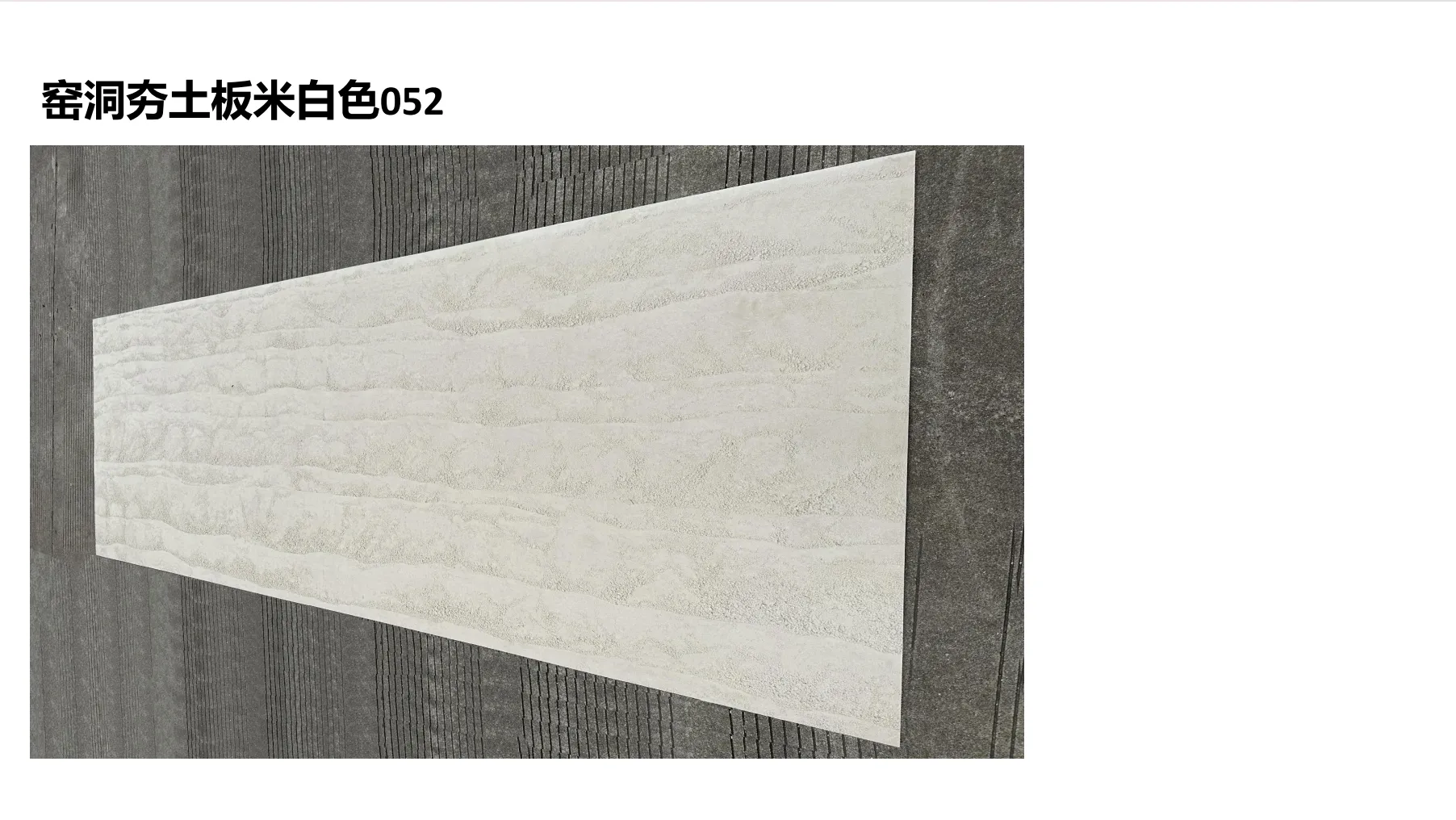
MCM Big Slab Gradient Color Rammed Earth Boards start with that same reverence for natural materials—minerals, recycled aggregates, and eco-friendly binders—but add a dose of innovation. The "big slab" format (think panels up to 1200x2400mm) means fewer seams, creating walls that flow like a single, continuous piece of art. And the "gradient color"? That's where the magic happens. Using advanced pigment integration and layering techniques, MCM artisans can create transitions so smooth they mimic the way sunlight fades from gold to rose at dusk, or how storm clouds shift from charcoal to steel gray. It's not just color—it's emotion, painted into the very fabric of the wall.
Take, for example, the Lunar Peak series, with its silvery, golden, and black hues. A wall clad in Lunar Peak gradient boards doesn't just reflect light—it tells a story of the moon's phases, of shadow and illumination. Or consider the Travertine (Starry Blue) accents, tiny flecks of iridescent material that catch the light like distant stars. When paired with a gradient from soft beige to deep indigo, it's as if the night sky itself has been pressed into the wall. These aren't just colors on a panel; they're narratives.
Imagine standing in front of a wall made of small, tiled stones. Your eye is drawn to the grout lines, the breaks in the pattern—it feels busy, fragmented. Now picture a wall with no visible seams, where color flows uninterrupted from floor to ceiling. Suddenly, the space feels larger, calmer, more intentional. That's the power of large-format panels, and it's a game-changer for architects aiming to create immersive environments.
MCM's big slabs aren't just about aesthetics, though. They're about practicality, too. Fewer panels mean faster installation (up to 30% quicker than traditional cladding, in fact), which cuts down on labor costs and project timelines. And because MCM panels are lightweight (up to 80% lighter than natural stone), they reduce structural load, opening up possibilities for retrofits and high-rise applications where weight is a concern. It's a rare win-win: beauty that doesn't compromise on functionality.
But let's circle back to that seamless visual impact. In a world where we're bombarded by stimuli—screens, ads, cluttered spaces—our brains crave calm. Seamless walls create a sense of order, a respite from the chaos. They act as a backdrop that lets other elements—art, furniture, human activity—take center stage. And when that backdrop is infused with gradient color? It becomes active, almost alive. A lobby clad in MCM gradient rammed earth boards doesn't just "be" a lobby—it evolves with the light of day, shifting from warm to cool as the sun moves, keeping the space feeling fresh and dynamic.
Architecture isn't just visual—it's tactile. We reach out to touch walls, run our hands over surfaces, and those sensations stick with us. MCM Big Slab Gradient Color Rammed Earth Boards understand this, balancing visual beauty with a texture that invites interaction. Unlike the smooth, almost clinical feel of fair-faced concrete , which can feel cold and uninviting, MCM rammed earth has a subtle, organic texture—like the surface of a river stone worn smooth by time, but with enough grip to feel substantial, real.
Run your hand over a panel, and you'll notice tiny variations: a slight ridge here, a soft dip there, echoes of the traditional rammed earth process. These imperfections aren't flaws; they're fingerprints, reminders that this material has a "memory" of how it was made. It's a texture that feels both ancient and new—grounded, yet forward-thinking. Compare that to the uniform finish of polished concrete, which, while sleek, lacks the personality that makes a space feel unique. MCM doesn't just look like it belongs in a home or a hotel; it feels like it belongs there, too.
And let's not forget the interplay of texture and color. The gradient hues aren't flat—they're deepened and enriched by the texture of the surface. A golden gradient, for example, will catch the light differently in the smoother areas than in the more textured ones, creating a depth that flat paint or even solid-color panels can't match. It's like looking at a landscape from a distance versus up close—there's always something new to discover, a detail you didn't notice before.
To truly appreciate MCM Big Slab Gradient Color Rammed Earth Boards, it helps to see how they measure up against other popular cladding options. Below is a comparison table highlighting key attributes:
| Attribute | MCM Gradient Rammed Earth | Traditional Rammed Earth | Fair-faced Concrete |
|---|---|---|---|
| Weight | Lightweight (8-12 kg/m²) | Heavy (150-200 kg/m²) | Moderate (20-30 kg/m²) |
| Color Range | Unlimited gradients (e.g., Lunar Peak, Starry Blue) | Limited to natural soil hues | Neutral (gray, off-white) |
| Seamlessness | Large slabs (up to 1200x2400mm) for minimal seams | Seams from formwork; hard to scale | Seams from formwork; requires careful finishing |
| Durability | Weather-resistant, fire-rated (up to 2 hours), fade-proof | Durable but prone to cracking in moisture | Durable but can stain; prone to efflorescence |
| Sustainability | Recycled materials, low carbon footprint | Eco-friendly but high transportation impact | High carbon footprint (cement production) |
As the table shows, MCM Gradient Rammed Earth Boards aren't just an upgrade—they're a revolution. They take the best of traditional materials (sustainability, texture) and modern materials (lightweight, versatility) and fuse them into something entirely new.
Great materials don't just sound good on paper—they transform the spaces we live, work, and play in. Let's explore a few scenarios where MCM Big Slab Gradient Color Rammed Earth Boards shine:
Imagine a modern home nestled in the hills, its exterior clad in MCM gradient rammed earth boards in a palette inspired by the surrounding landscape—soft terracotta fading to sage green, with accents of Travertine (Starry Blue) around the windows. In the morning, the sun hits the terracotta, warming the entire facade; by afternoon, the green takes over, blending with the trees; at dusk, the starry blue accents twinkle, turning the house into a beacon. It's not just a house—it's a living part of the environment.
Hotel lobbies often aim to be grand, but many feel cold, dominated by marble and steel. Now picture a lobby with a 10-meter-tall wall of MCM gradient rammed earth, transitioning from Lunar Peak Silvery at the base to Lunar Peak Golden at the ceiling. The light from the skylights plays over the gradient, creating a sense of upward movement, of possibility. Guests don't just walk through—they pause, they look up, they remember. It's a lobby that feels less like a transit space and more like a gallery.
A museum dedicated to local history wants its walls to reflect the region's earthy heritage but also signal its forward-thinking mission. MCM gradient rammed earth boards in a "Historical Pathfinders Stone" gradient (warm browns fading to claybank) line the main hall, with inset panels of fair-faced concrete for contrast. The result? A space that feels rooted in the past but unafraid to embrace the new—perfect for telling stories of where we've been and where we're going.
In an era where "green building" is no longer a trend but a necessity, materials can't just look good—they need to do good, too. MCM Big Slab Gradient Color Rammed Earth Boards check that box with gusto. Let's break down their eco-credentials:
It's a circular approach to building: take care of the earth, and the earth will take care of your space. For architects and developers aiming for LEED or BREEAM certifications, MCM gradient rammed earth boards aren't just a material choice—they're a sustainability strategy.
Beauty and sustainability are crucial, but let's not overlook the nuts and bolts: how do these panels hold up in the real world? The answer might surprise you. MCM Big Slab Gradient Color Rammed Earth Boards are engineered to withstand the toughest conditions, making them suitable for both interior and exterior use:
In short, these aren't just pretty panels—they're workhorses. They combine the best of natural durability with modern engineering, giving architects the freedom to dream big without worrying about performance.
At the end of the day, architecture is about people. It's about how a space makes us feel—whether it calms us, inspires us, or connects us to something larger than ourselves. MCM Big Slab Gradient Color Rammed Earth Boards excel here because they're more than a surface—they're a sensory experience.
They're the way the light shifts on a gradient wall at 3 p.m., turning a lobby from bright to cozy. They're the sound of rain hitting the textured surface, a soft patter that feels like nature's lullaby. They're the memory a guest takes home after staying in a hotel with starry blue accents, thinking, "I've never seen a wall that felt so alive."
In a world that often prioritizes function over feeling, MCM reminds us that we don't have to choose. We can have walls that are strong and sustainable, innovative and rooted in tradition, sleek and full of soul. We can have walls that tell stories—of the earth, of light, of the people who designed them and the lives that unfold within them.
So the next time you walk into a space and feel that pull—that sense that something here is different—look at the walls. Chances are, they're not just walls. They're MCM Big Slab Gradient Color Rammed Earth Boards, and they're changing the way we think about building, one seamless, gradient story at a time.
Recommend Products












