
There's something almost primal about the way natural stone makes us feel. Walk into a room with walls clad in rough-hewn rock, and suddenly the space feels grounded—like it's been rooted in the earth for centuries. The texture under your fingertips, the subtle variations in color, the quiet story of geological time etched into every vein—natural stone isn't just a material; it's a connection to the planet itself. But here's the hard truth: as much as we love it, natural stone comes with a laundry list of headaches. It's heavy, often fragile, and quarrying it can leave ecological scars. And if you've ever dreamed of using a specific stone like dacite—with its unique volcanic texture and moody gray tones—you know the struggle: sourcing large, consistent slabs is tough, and installing them requires reinforced structures that drive up costs. Enter MCM, or Modified Cementitious Materials. These innovative composites are changing the game, letting us capture the raw beauty of natural dacite without the hassle. Let's dive into how MCM does it, and why it might just be the material your next project has been waiting for.
Before we talk about mimicking it, let's get to know the real thing. Dacite is a volcanic rock, born from the slow cooling of magma deep beneath the earth's surface. It's part of the same igneous family as granite and andesite, but with a personality all its own. Typically ranging from pale gray to inky black, dacite has a fine-grained texture that feels almost velvety to the touch, with occasional flecks of light-catching minerals called phenocrysts—little time capsules of the volcanic activity that formed it. Architects and designers go gaga for dacite because it's bold yet understated; it adds drama without screaming for attention. Imagine a luxury hotel lobby with a dacite feature wall: the stone's depth plays with light, shifting from cool gray in the morning to warm charcoal at dusk, creating an atmosphere that feels both modern and timeless.
But here's the rub: natural dacite is a diva. Quarrying large, unbroken slabs is a crapshoot—volcanic rock is often porous or has hidden fractures, meaning many blocks end up as waste. And once you do get a slab, moving it is a logistical nightmare. A single square meter of natural dacite can weigh upwards of 50 kg; multiply that by a wall full of slabs, and suddenly you're talking about needing reinforced steel beams just to hold it up. Installers need specialized equipment, and even then, there's a risk of cracking during transport or placement. For smaller projects or buildings with weaker structures? Forget it. Natural dacite was, for a long time, a "nice-to-have" that few could actually afford or pull off.
Enter MCM—Modified Cementitious Materials—and specifically, the MCM flexible stone series. These aren't your average concrete panels. Think of MCM as nature's greatest mimic: it uses a blend of cement, recycled aggregates, and high-performance polymers to recreate the look, feel, and even the subtle nuances of natural stone—including dacite—without the weight or fragility. The secret? It's all in the formula and the manufacturing magic.
Let's break it down. Traditional cement-based materials are rigid and heavy, but MCM flips the script with "flexible stone" technology. By tweaking the mix and adding polymers, manufacturers create a material that's thin (often just 3-5mm thick) yet surprisingly strong—and yes, flexible. You can bend an MCM panel without it snapping, which might sound counterintuitive for something mimicking stone, but that flexibility is a superpower. It means panels can contour to curved surfaces, wrap around columns, or fit into tight spaces that natural stone would never dream of. And at just 5-8 kg per square meter? That's less than 20% the weight of natural dacite. Suddenly, that dream feature wall in your second-floor bedroom isn't just possible—it's practical.
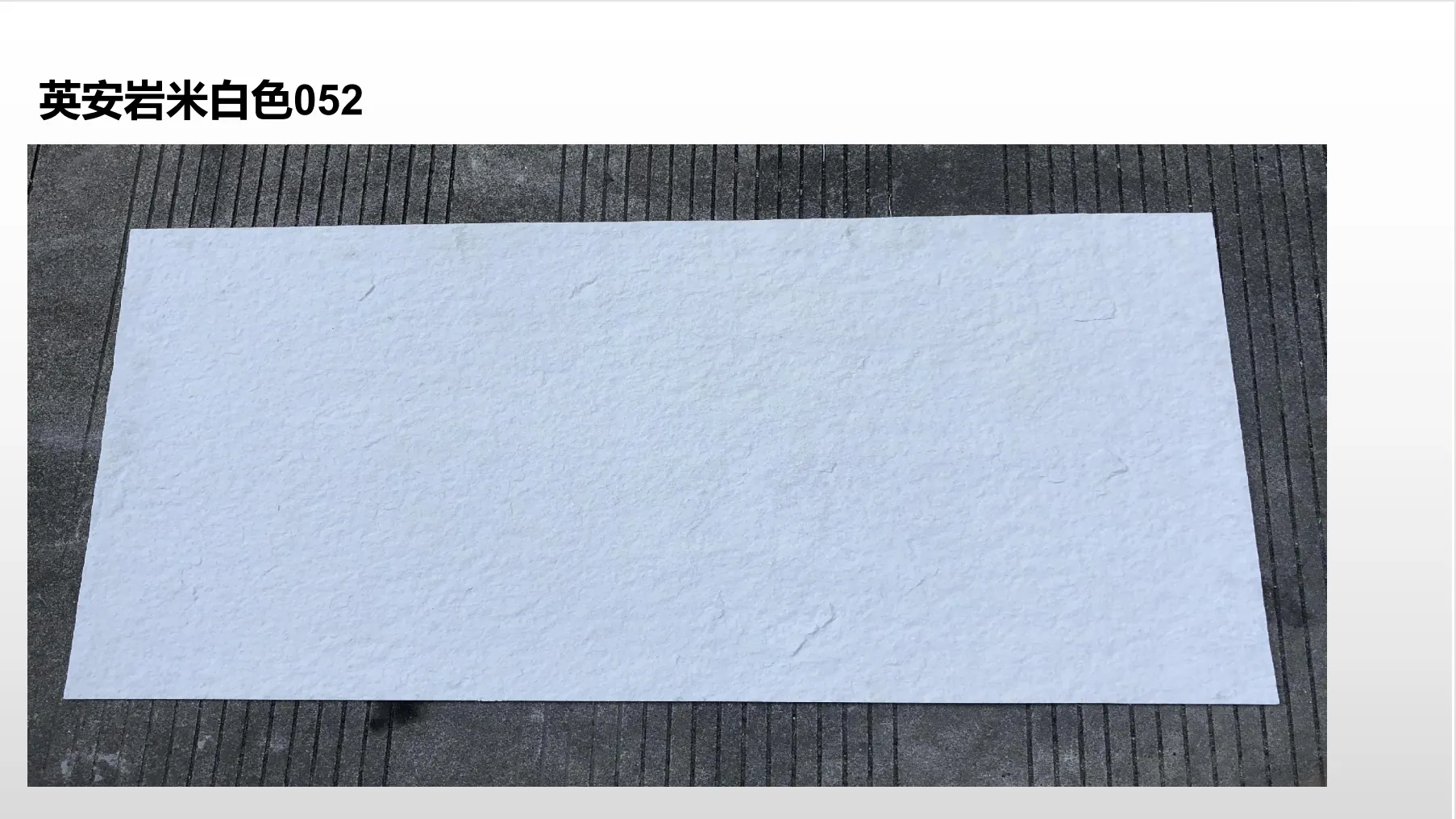
But the real star here is how MCM replicates dacite's unique texture. Natural dacite's surface is a study in subtlety: fine grains, tiny pits, and those occasional phenocrysts that catch the light. To copy that, MCM manufacturers use advanced 3D printing and mold-making techniques. They start by scanning real dacite slabs, capturing every ridge and valley in digital detail. Then, they use that scan to create molds or directly 3D-print the texture onto MCM panels. The result? A surface that looks so much like natural dacite, you'll find yourself leaning in to check if it's real. Run your hand over it, and you'll feel the same slightly rough texture, the same play of light and shadow across its surface. Even the color is spot-on: MCM uses mineral pigments that mimic dacite's gray-to-black spectrum, with variations that echo the natural inconsistencies of volcanic rock. No two panels are identical, just like no two pieces of natural dacite are—because nature isn't perfect, and that's the beauty of it.
We mentioned 3D printing, but let's dive deeper. MCM's 3D printing series isn't just about texture—it's about precision. Traditional stone mimics might use a one-size-fits-all mold, leading to repetitive patterns that feel fake. 3D printing lets manufacturers adjust the texture, color density, and even the size of "phenocrysts" on the fly. Want a panel with more light flecks? Tweak the design. Need a darker gray base with subtle blue undertones? No problem. This level of customization means MCM dacite panels can be tailored to match specific design visions, whether you're going for a raw, volcanic look or a more polished, modern take.
Then there's prefabrication. MCM dacite panels come ready to install, cut to size, and often with interlocking edges that snap together like puzzle pieces. No more on-site cutting (and the dust and waste that comes with it), no more waiting for custom slabs to be quarried. Prefabricated MCM panel systems turn a weeks-long installation process into a matter of days. For contractors, that means faster project turnarounds; for homeowners, it means less disruption. And because the panels are lightweight, you don't need a team of installers or heavy machinery. A couple of people with basic tools can handle it—another win for accessibility.
Still on the fence? Let's put natural dacite and MCM dacite panels head-to-head. The table below breaks down the key differences that matter most for homeowners, designers, and builders:
| Feature | Natural Dacite | MCM Dacite Panels |
|---|---|---|
| Weight (per sqm) | 50-60 kg | 5-8 kg |
| Installation | Requires structural reinforcement; specialized labor and equipment | Lightweight, no structural reinforcement needed; DIY-friendly with basic tools |
| Durability | Highly durable but prone to cracking during transport/installation | Impact-resistant, weatherproof, and flexible (less likely to crack) |
| Customization | Limited by what's available in quarries; hard to match specific colors/textures | Fully customizable: colors, textures, sizes, and even curved designs |
| Cost | Expensive (quarrying, transport, installation add up) | 30-50% less than natural stone, with lower installation costs |
| Eco-Friendliness | Quarrying disrupts ecosystems; high carbon footprint from transport | Uses recycled materials; low transport emissions (lightweight); minimal waste |
So, where can you actually use these panels? The short answer: almost anywhere. MCM's lightweight and durability make it versatile, indoors and out.
Indoors: Feature walls are a no-brainer. Imagine your living room with a floor-to-ceiling MCM dacite wall behind the TV—suddenly, the space feels grounded and sophisticated. Fireplaces are another perfect spot; the panels are heat-resistant, so they'll stand up to the warmth of a fire while adding that cozy, earthy vibe. Bathrooms? Yes, even there. MCM is water-resistant, so you can use it as a backsplash or shower surround without worrying about mold or water damage.
Outdoors: Facades are where MCM dacite panels really shine. Since they're weatherproof and UV-resistant, they'll hold up to rain, snow, and harsh sunlight without fading or cracking. They're also great for patios or outdoor kitchens—imagine grilling surrounded by walls that look like natural dacite but don't require a concrete slab to support them. Even pool areas benefit: the non-slip surface (thanks to that textured finish) adds safety, and the panels won't degrade in chlorinated water.
One of our favorite examples? A boutique hotel in Portland that wanted a volcanic-inspired exterior but couldn't afford the structural upgrades for natural dacite. They went with MCM dacite panels in a deep charcoal gray, and guests still stop to ask if it's real stone. The designers even added custom 3D-printed "phenocrysts" in a lighter gray to mimic the look of mineral deposits—proof that MCM doesn't just copy nature; it can elevate it.
At the end of the day, MCM dacite panels aren't just about solving logistical problems. They're about making the beauty of natural stone accessible to everyone. Whether you're a homeowner wanting to add warmth to your space, a designer pushing the boundaries of what's possible, or a builder looking to deliver better results faster, MCM offers something that natural stone can't: freedom. Freedom to dream big, to work within budgets, and to create spaces that feel connected to the earth without costing the earth.
Natural dacite will always have its place—there's something irreplaceable about holding a piece of rock that's been forming for millions of years. But MCM? It's the next best thing. It's nature's beauty, reimagined for the way we live now: flexibly, sustainably, and without compromise. So the next time you walk into a space with "stone" walls and find yourself wondering, "Is that real?"—chances are, it might just be MCM. And honestly? That's a good thing.
Recommend Products












