
Architecture is the art of turning dreams into tangible spaces, but for centuries, one material has both enabled and constrained those dreams: stone. From the Colosseum's towering travertine arches to the Taj Mahal's marble inlays, stone has given buildings permanence and soul. Yet its inherent weight—those dense, unyielding slabs—has forced designers to choose between grand vision and structural practicality. Curves became fragmented arcs, large-scale facades required Herculean support, and the beauty of natural stone came with a heavy price tag. That is, until MCM flexible stone arrived to rewrite the rules.
Walk through Rome's historic center, and you'll feel the gravity of travertine. Quarried from Tivoli's hills, this golden-hued stone built an empire, its porous surface breathing character into every column and courtyard. But for modern architects, travertine's 45-60 kg per square meter weight is a ("shackle"). Imagine specifying a 50-meter curved facade—traditional travertine would demand steel reinforcements, crane fleets, and a budget ballooning with each slab. Even worse, those curves would need to be hacked into small, ("jigsaw") pieces, losing the seamless flow that makes great design sing. Stone's beauty was undeniable, but its rigidity was a creative dead end.
MCM—Modified Composite Material—isn't just a new product; it's a material revolution. Here's the magic: by bonding natural stone particles with a ultra-light polymer matrix, MCM retains stone's authentic texture and color while slashing weight to 4-6 kg per square meter. That's a 90% reduction. Suddenly, a 20-story facade clad in travertine no longer requires reinforcing the entire building. A sweeping, 10-meter radius curve isn't a structural nightmare—it's a morning's installation. MCM flexible stone doesn't just mimic stone; it elevates it, freeing architects to design with the fluidity of cloth and the permanence of rock.
Take the MCM big slab board series as proof. These panels, spanning up to 1200x2400mm, turn vast surfaces into single, unbroken statements. Unlike traditional stone slabs that crack under their own weight, MCM big slabs flex—literally. Bend them around a circular lobby, drape them over a sloped roof, or wrap them around a curved stairwell; they adapt without losing integrity. This isn't just convenience—it's design liberation.
| Attribute | Traditional Travertine | MCM Flexible Travertine |
|---|---|---|
| Weight (per sq.m) | 45-60 kg | 4-6 kg |
| Flexibility | Brittle; no bending | Bends to 30mm radius |
| Installation Time | 3-4 workers per day (10 sq.m) | 2 workers per day (50+ sq.m) |
| Design Freedom | Limited to straight lines/small arcs | Unrestricted curves, angles, and scales |
| Durability | High; prone to staining/chipping | UV/impact resistant; stain-proof |
MCM doesn't just make stone lighter—it makes it more expressive. Take travertine (starry green) : this variant embeds microscopic iridescent particles within MCM's stone matrix, turning a standard wall into a celestial experience. As daylight shifts, the green base shimmers with star-like flecks, evoking a forest at dusk. It's travertine, but with a touch of magic—something traditional stone, with its uniform mineral structure, could never achieve.
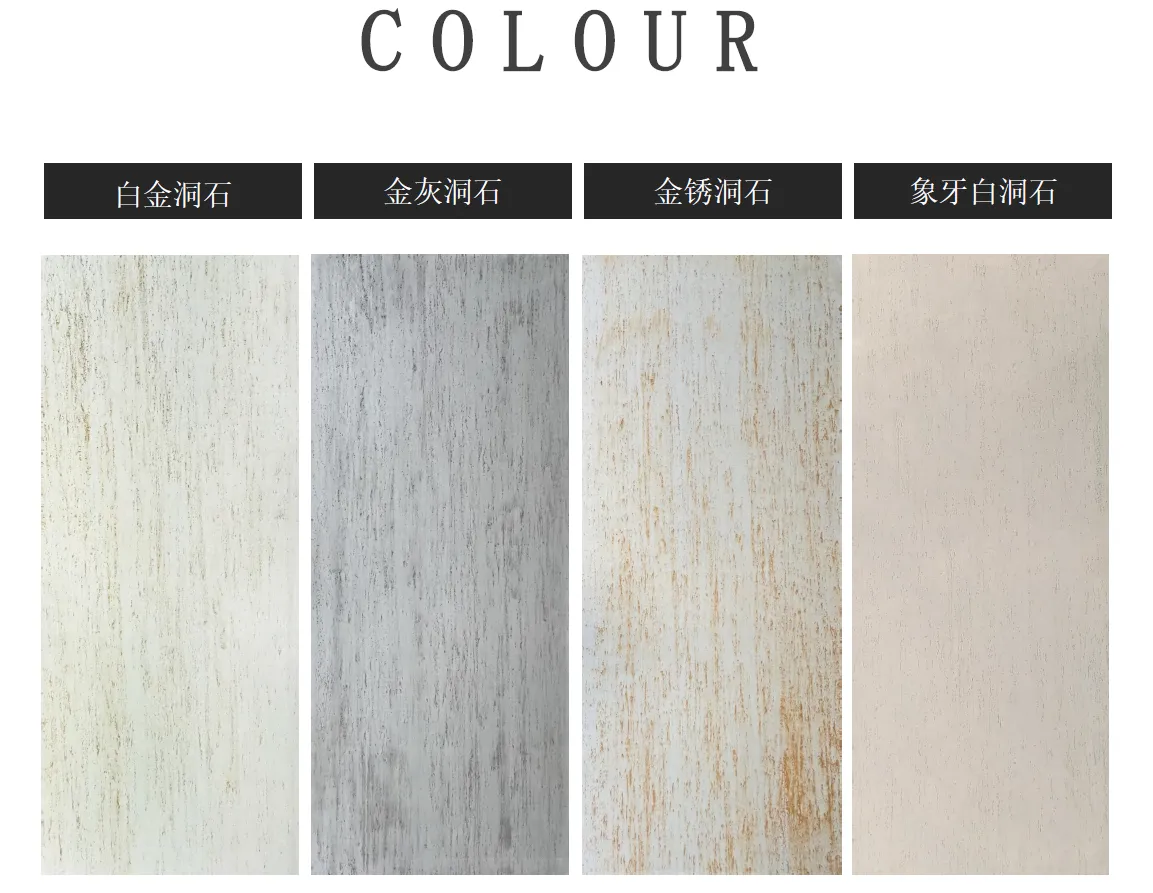
Then there's the vintage trilogy: travertine (vintage silver) , travertine (vintage gold) , and travertine (vintage black) . These aren't just colors—they're time capsules. The vintage silver variant mimics travertine weathered by a century of Roman rain, its surface softly muted with a metallic sheen. Vintage gold warms like afternoon sunlight on a Tuscan villa, while vintage black channels the drama of a storm-darkened quarry. Each finish tells a story, bridging ancient stone's patina with modern design's need for customization.
Design Harmony: MCM's Material Symphony
Great spaces thrive on contrast, and MCM's family of materials plays in perfect key. Pair
foamed aluminium alloy board (vintage silver)
with starry green travertine, and you get industrial edge meeting organic warmth—a boutique hotel lobby where metal's cool sleekness offsets stone's earthy glow. Or blend
fair-faced concrete
with
lunar peak silvery
MCM panels: the concrete's raw, gray minimalism grounds the silvery stone's ethereal shimmer, creating a home exterior that feels both rooted and otherworldly.
Commercial Marvel: The Starry Curved Facade
A tech campus in Shenzhen wanted a facade that screamed "innovation." The design? A 120-meter sweeping curve, clad in
travertine (starry blue)
MCM big slabs. Traditional stone would have required 300+ support beams; MCM needed just 40. The installation took 10 days instead of 3 months, and the result? A building that shimmers like a night sky, its blue stone surface rippling with starlight flecks. Employees now call it "The Nebula"—a space that inspires creativity, not just contains it.
Residential Revolution: The Weightless Villa
A cliffside home in Bali dreamed of blending into its jungle setting. The architect specified
bali stone
MCM panels for the exterior, paired with
wood grain board
accents. Traditional bali stone would have required reinforcing the cliff; MCM's 5kg/sq.m weight let the structure cantilever over the valley, offering unobstructed ocean views. Inside,
stream limestone (claybank)
MCM lines the walls, its soft, water-worn texture feeling like a riverbed brought indoors. The home weighs less, costs less, and connects more deeply to its environment than any stone-clad predecessor.
Heritage Renewal: The Roman Revival
A 19th-century theater in Prague needed restoration, but its original travertine facade was crumbling. Enter MCM
historical pathfinders stone
panels—engineered to match the original's weathered texture, right down to the fossilized shells. Installed in weeks (not months), the panels weigh 1/10th of the original stone, sparing the aging structure from further stress. Today, the theater stands reborn: a monument to history, preserved by innovation.
MCM's revolution isn't just about design—it's about responsibility. Traditional stone quarrying scars landscapes, and transporting 60kg slabs guzzles fuel. MCM changes that: 85% of its stone content comes from recycled quarry waste, and its lightweight nature cuts transportation emissions by 70%. A 10,000 sq.m MCM facade reduces a project's carbon footprint by 300+ tons compared to traditional stone. It's beauty that doesn't cost the earth—literally.
Stone has always been architecture's memory keeper, but MCM flexible stone is its future writer. It takes the soul of travertine, the drama of lunar peak black , the warmth of lime stone (beige) , and sets them free from weight and rigidity. Now, curves flow like music, large slabs tell unbroken stories, and the past's beauty lives in harmony with tomorrow's innovation.
So the next time you see a building that seems to defy gravity—a curved stone facade that glows like starlight, a grand lobby with the seamless sweep of a single stone—know this: it's not magic. It's MCM flexible stone, turning "impossible" into "already built." And in that transformation, architecture stops being about what stone demands… and starts being about what we dare to imagine.
Recommend Products












