
For today's architects and interior designers, the quest to merge striking aesthetics with practical functionality often feels like walking a tightrope. You want materials that don't just look good but can adapt to the unique curves of a building, withstand the test of time, and bring your creative vision to life without compromise. Enter two game-changers: MCM Flexible Stone and 3D Printed Marble Pillar Real Photos . These innovations are redefining what's possible, turning rigid design limitations into opportunities for creativity. Let's explore how they work, where they shine, and how they're reshaping the future of building design.
If you've ever wished stone could "bend" to your will, MCM Flexible Stone is your answer. Short for Modified Composite Material, MCM isn't your average stone cladding. It's a lightweight, ultra-durable material crafted from natural minerals and high-performance polymers, designed to mimic the look and feel of real stone—without the heaviness or brittleness. What truly sets it apart? Its flexibility. Imagine wrapping a stone-like surface around a curved building facade, or creating seamless, flowing walls that follow the organic lines of a room. With MCM, that's not just possible—it's routine.
The MCM Big Slab Board Series takes this versatility a step further. These large-format panels (often up to 1200x2400mm) minimize grout lines, creating a sleek, modern look that's perfect for both commercial and residential spaces. Whether you're cladding a skyscraper or designing a cozy home interior, these slabs offer consistency in color and texture that's hard to achieve with traditional stone. And the finishes? They're a designer's dream. Take Lunar Peak Silvery , for example—its soft, iridescent sheen evokes moonlight glinting off a mountain peak, adding a touch of ethereal elegance to any surface. Pair that with the warmth of Foamed Aluminium Alloy Board (Vintage Silver) for a mixed-material accent, and you've got a palette that balances modernity with timelessness.
Applications for MCM Flexible Stone are virtually endless. Exterior cladding? It stands up to harsh weather, from scorching sun to heavy rain, without fading or cracking. Interior walls? Its lightweight nature means easier installation and less structural stress. Even furniture—picture a kitchen backsplash in Travertine (Starry Green) , where the stone's natural veining is enhanced by MCM's precision, or a custom bookshelf wrapped in Wood Grain Board that looks and feels like solid oak but weighs half as much. It's stone, but smarter.
If MCM is about flexibility in surfaces, 3D Printed Marble Pillar Real Photos are about reimagining structure itself. 3D printing technology has revolutionized manufacturing, and now it's making its mark on architecture—starting with the humble pillar. Traditional marble pillars are heavy, labor-intensive to carve, and limited by the skills of stonemasons. 3D printed pillars? They're a different beast. Using a blend of marble powder and eco-friendly binders, these pillars are built layer by layer, allowing for intricate designs, custom shapes, and even impossible geometries that would leave traditional craftsmen scratching their heads.
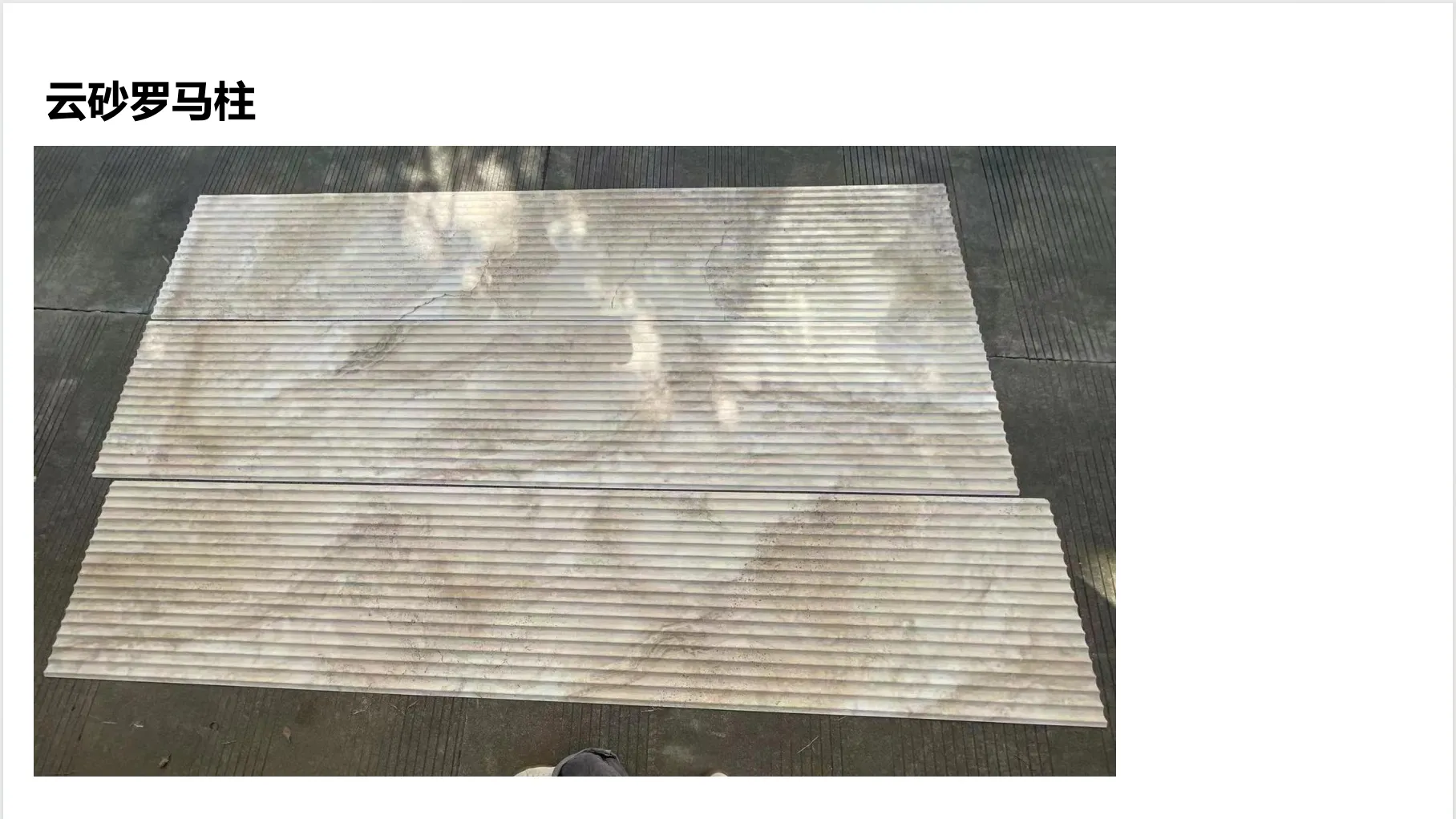
The "real photos" part is key here. Unlike renderings or prototypes, these photos showcase the tangible beauty of 3D printed marble. You can see the texture (the "thread" of the marble powder, the subtle variations in color), the precision of the curves, and the way light plays off the surface—just like natural marble, but with a modern twist. Imagine a hotel lobby anchored by a 3D printed pillar with a spiral pattern that seems to defy gravity, or a residential entryway featuring a custom pillar carved with family motifs—all made possible by 3D printing's ability to turn digital designs into physical art.
What's most exciting is the blend of tradition and innovation. Travertine (Vintage Gold) 3D printed pillars, for instance, marry the classic warmth of travertine with the cutting-edge precision of 3D technology. They're lighter than solid marble (easing installation and reducing structural load), yet just as durable. And because they're printed on-demand, customization is limitless—no two pillars have to be the same. It's a material that honors the past while building the future.
To truly understand how these materials stack up, let's break down their strengths, differences, and ideal uses. The table below compares key aspects to help you decide which (or both!) might be right for your next project:
| Aspect | MCM Flexible Stone | 3D Printed Marble Pillar |
|---|---|---|
| Core Strength | Large-scale flexibility; ideal for cladding, walls, and surfaces. | Custom, sculptural design; perfect for statement pillars and structural accents. |
| Material Makeup | Natural minerals + polymers; lightweight, bendable, and weather-resistant. | Marble powder + eco-binders; 3D-printed layer by layer for precision. |
| Design Options | Wide range of finishes (e.g., Lunar Peak Silvery, Foamed Aluminium Alloy Board (Vintage Silver)) and series (Big Slab, Wave Panel). | Intricate, custom shapes (spirals, patterns, text); finishes like Travertine (Vintage Gold) or custom color blends. |
| Installation | Lightweight (5-8kg/m²) for easy handling; can be cut, bent, or curved on-site. | Printed in sections for assembly; lighter than solid marble, reducing structural load. |
| Best For | Exterior cladding, interior walls, furniture, curved surfaces, and large-scale projects. | Lobbies, entryways, heritage restorations, custom structural accents, and artistic installations. |
Words and tables can only tell part of the story—seeing these materials in action is where the magic happens. Let's take a look at how designers are using them to transform spaces:
The Lunar Peak Hotel: This boutique hotel in the mountains wanted its exterior to reflect the surrounding peaks. The design team chose MCM Flexible Stone in Lunar Peak Silvery for the facade. The result? A building that shimmers like moonlight on stone, with curved corners that mimic the mountain ridges. Inside, Foamed Aluminium Alloy Board (Vintage Silver) accents complement the MCM walls, creating a cohesive, modern alpine aesthetic.
The Heritage Revival Home: A homeowner restoring a 1920s villa wanted to preserve the property's historic charm while adding modern flair. They opted for 3D printed marble pillars in Travertine (Starry Blue) for the entryway. The pillars echo the villa's original architectural style but feature a subtle starry pattern (a nod to the homeowner's love of astronomy) that could only be achieved with 3D printing. The real photos of the finished pillars show how seamlessly they blend old and new.
The Urban Co-Working Space: To foster creativity, this space combined MCM Big Slab Board Series walls (in Rona Yellow for energy) with 3D printed marble pillars featuring thread patterns that evoke connectivity. The result? A dynamic environment where surfaces flow and structures inspire—proof that MCM and 3D printed pillars aren't competitors, but collaborators.
While MCM Flexible Stone and 3D printed marble pillars are stars in their own right, they're even more powerful when paired with complementary materials from the MCM lineup. Lunar Peak Black MCM cladding, for example, adds drama to exterior walls, while Bamboo Mat Board brings warmth to interiors. Foamed Aluminium Alloy Board (Vintage Gold) offers a metallic contrast to stone, creating layered, textured spaces that engage the senses.
The key takeaway? Modern design isn't about choosing one material—it's about mixing, matching, and experimenting. MCM's flexibility and 3D printing's customization open the door to combinations that were once unthinkable. Want a curved MCM wall with embedded 3D printed marble accents? Go for it. Dream of a 3D printed pillar wrapped in MCM Wood Grain Board ? The only limit is your imagination.
MCM Flexible Stone and 3D Printed Marble Pillar Real Photos represent a shift in architecture—from "what's possible" to "what do you want?". They're materials that empower designers to stop compromising and start creating. Whether you're cladding a skyscraper, restoring a heritage building, or designing a one-of-a-kind home, these innovations offer the flexibility, durability, and beauty to turn your vision into reality.
So the next time you're stuck staring at a blank blueprint, remember: with MCM and 3D printed marble, the only rule is that there are no rules. Let the materials inspire you, and watch as your designs transform from ideas into spaces that delight, engage, and endure. After all, great architecture isn't just built—it's imagined, and now, more than ever, imagination has no limits.
Recommend Products












