
Walk onto any construction or renovation site, and you'll quickly notice that the choice of building materials isn't just about aesthetics or cost—it's about the people behind the installation. Ask any installer, and they'll tell you: the ease of getting a material from the truck to the wall (or floor, or ceiling) can make or break a project's timeline, budget, and even morale. Today, we're diving into two popular materials that often end up on these "ease of installation" shortlists: MCM flexible stone and sawing wood board. One is a modern composite innovation, the other a timeless natural option. But when it comes to the nuts and bolts of installation—cutting, carrying, fixing, and finishing—how do they really stack up? Let's roll up our sleeves and find out.
First, let's get to know MCM flexible stone . If you're picturing a rigid slab of stone that's heavy and hard to maneuver, think again. MCM stands for Modified Composite Material, and it's a game-changer in the building world. Imagine a material that looks and feels like natural stone—with textures ranging from the rustic charm of travertine (starry green) to the sleek modernity of fair-faced concrete —but bends like a thick rubber mat. That's MCM flexible stone in a nutshell. It's lightweight (often weighing 6-8 kg per square meter, compared to natural stone's 20+ kg), thin (usually 3-5mm thick), and designed with installation in mind from the ground up. And thanks to MCM's 3D printing series , it can even be custom-shaped into intricate designs like wave panels or geometric patterns—no extra hassle required.
But what makes it "flexible"? The secret is in its layers: a fiberglass mesh core sandwiched between modified stone powders and polymers. This combo gives it strength without brittleness, so it can handle being bent around curves, carried up ladders by one person, and cut with basic tools. Installers often joke that it's "stone that acts like fabric"—and after a day of wrestling with heavy materials, that's high praise.
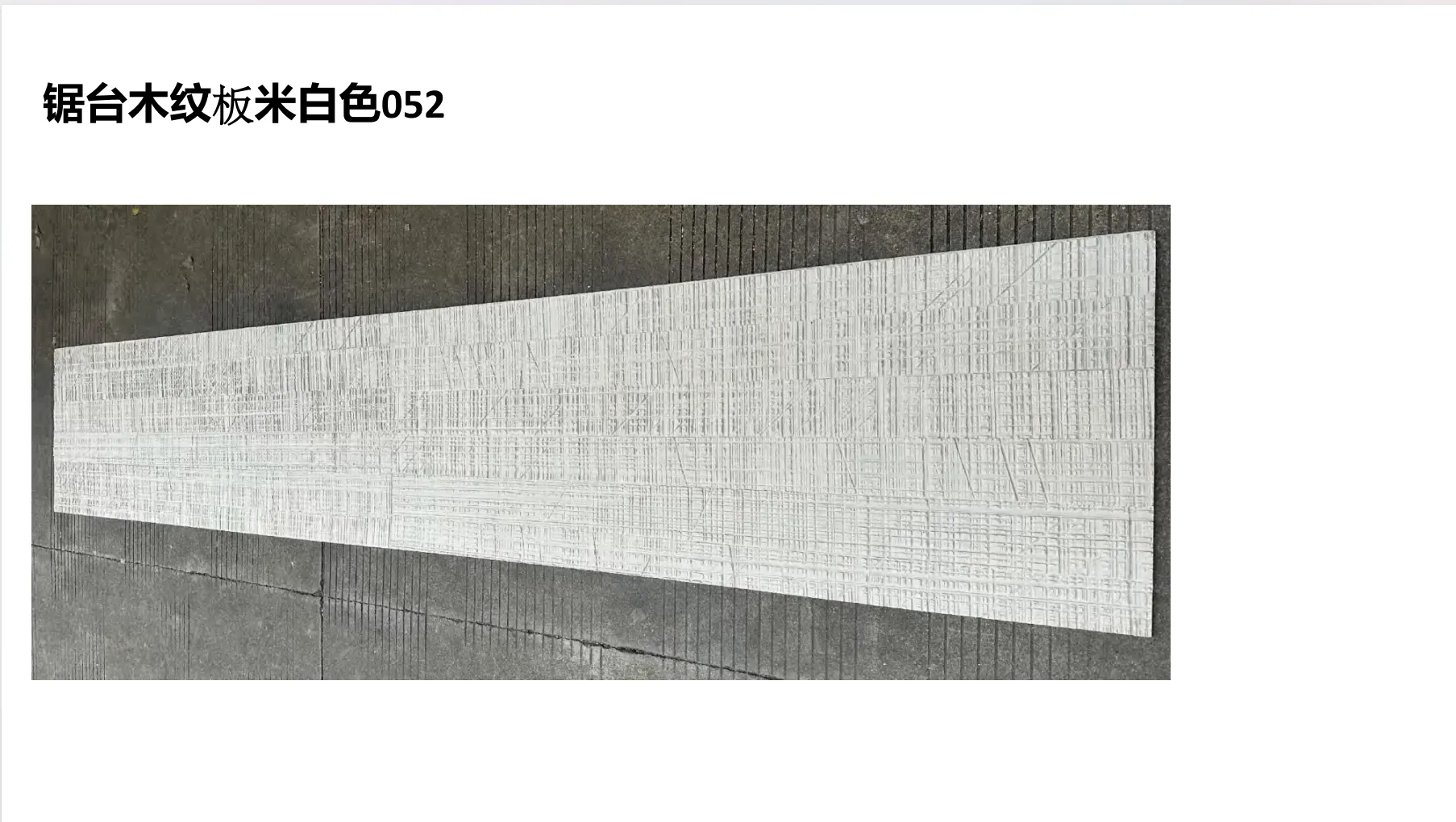
On the other side of the ring is sawing wood board—a material so familiar, it's practically part of construction's DNA. Made by cutting solid wood planks into uniform boards (hence "sawing"), it's been used for centuries for everything from walls and ceilings to furniture and flooring. Think of the warm, natural grain of oak, pine, or cedar, and you're visualizing sawing wood board. It's loved for its organic look, affordability, and the fact that it's a "tried and true" option—installers have been working with wood for generations, so there's a comfort factor there.
But here's the catch: "tried and true" doesn't always mean "easy." Wood is a natural material, which means it comes with natural quirks. It's heavier than you might think (a standard 18mm-thick pine board can weigh 10-12 kg per square meter), porous (so it soaks up moisture), and prone to splintering, warping, or splitting if not handled carefully. And while experienced installers know the tricks—like pre-drilling holes before nailing or using fine-toothed saws—those tricks add time and effort to the process. As one veteran installer put it: "Wood's great until you're on the 10th floor, carrying a 4x8 ft board by yourself, and it starts to splinter in your hands. Then it's just… work."
To really understand ease of installation, we need to walk through the process step by step—from unboxing the materials to the final nail (or adhesive bead). Let's break it down.
Every installer knows the golden rule: "Measure twice, cut once." But prep goes beyond measuring. Let's see what each material demands before the first cut.
MCM Flexible Stone: Minimal prep, maximum flexibility. Since MCM is factory-made with consistent thickness and density, there's no need for acclimation. You can unload it from the truck, carry it straight to the workspace, and start cutting—no waiting for it to "adjust" to the site's temperature or humidity. Even better, many MCM products (especially those in the 3D printing series ) come pre-cut to common sizes, so you might not need to trim at all for standard projects. For custom jobs, like installing a wave panel or a lunar peak silvery accent wall, the material's flexibility means you can tweak shapes on-site without specialized tools.
Sawing Wood Board: Prep time is non-negotiable. Wood is hygroscopic, which means it absorbs or releases moisture to match its environment. If you skip acclimation, you'll end up with warped, bowed, or cracked boards a few weeks later. So installers have to unload the wood, stack it with spacers (to let air circulate), and wait—sometimes 3-7 days—for it to adjust to the site's humidity. Then there's sealing: raw wood needs a primer or sealant before installation to prevent moisture damage, adding another step. And if the wood has knots or uneven grain (which it often does), you'll need to mark those areas to avoid splitting during cutting or nailing. It's not impossible, but it's time-consuming—time that could be spent actually installing.
Cutting is where the rubber meets the road (or the saw meets the material). A clean cut means a smooth finish, and a smooth finish means less time sanding or adjusting. Let's see how each material handles the blade.
MCM Flexible Stone: Cutting MCM is almost… satisfying. Because it's a composite material with a fiberglass core, it cuts cleanly with basic tools—no fancy equipment needed. A standard circular saw with a carbide-tipped blade works, but even a utility knife or jigsaw gets the job done for straight or curved cuts. There's no dust cloud like you'd get with natural stone, and no splinters—just a crisp edge that's ready to install right away. Installers often remark on how little effort it takes: "It's like cutting through thick cardboard," one said. "You don't have to fight the material; it just… gives." Even intricate cuts, like notches for outlets or corners, are a breeze because the material doesn't crack or chip under the blade.
Sawing Wood Board: Cutting wood can feel like a battle of wills. If you use a dull blade, you'll get ragged edges and splinters. If the grain runs diagonally, the wood might "tear out"—leaving a rough, uneven edge that needs sanding. To avoid this, installers use fine-toothed saws (like a miter saw with a 60-tooth blade) and often score the cut line with a utility knife first to "guide" the saw. Even then, cross-grain cuts (cutting against the direction of the grain) are tricky, and hardwoods like oak or maple require more power and slower cutting speeds. And let's not forget the cleanup: wood dust gets everywhere, sticking to clothes, tools, and lungs. It's manageable, but it adds steps—sanding, vacuuming, wiping down surfaces—that eat into installation time.
Here's a truth installers don't always talk about: how heavy a material is can make or break a workday. Carrying 50kg slabs up a flight of stairs isn't just tiring—it's a safety risk. Let's weigh in (pun intended).
MCM Flexible Stone: Lightweight is MCM's superpower. At 6-8 kg per square meter, even a large 4x8 ft panel weighs less than 30 kg—light enough for one person to carry with one arm. That means installers can move panels solo, up ladders, around tight corners, or onto high scaffolding without needing a helper. It's a game-changer for small crews or projects with limited labor. "On my last job, we had a 200 sqm wall to cover with MCM," one installer recalled. "Two of us finished in a day. With natural stone, that would've taken three people two days, easy." The flexibility helps too: panels can bend slightly to fit through doorways or around obstacles, reducing the risk of dropping or damaging the material. No more "oops, we dented the corner" moments—MCM is tough but forgiving.
Sawing Wood Board: Wood is dense, and density means weight. A standard 4x8 ft sawing wood board (18mm thick) weighs around 35-40 kg—too heavy for one person to carry comfortably. That means installers need a partner to lift and maneuver each board, which slows down the process. Ever tried carrying a 40kg board up a ladder with someone else? It's awkward, and awkwardness leads to mistakes—like dropping the board or misaligning it during installation. And if the board is wet (from rain or humidity), it gets even heavier and slipperier. "We had a job once where it rained halfway through," an installer shared. "The wood boards soaked up water, and suddenly a 40kg board felt like 50kg. We had to stop until they dried out—two hours wasted." Even dry wood can be unwieldy, especially for overhead installations (like ceilings), where holding a heavy board steady while nailing is a workout.
| Installation Aspect | MCM Flexible Stone | Sawing Wood Board |
|---|---|---|
| Weight per sqm | 6-8 kg (light enough for 1 person to carry) | 10-12 kg (requires 2 people for large panels) |
| Cutting Tools Needed | Circular saw, utility knife, or jigsaw (no special blades required) | Fine-toothed miter saw or jigsaw; scoring tool to prevent splintering |
| Handling Difficulty | Low (flexible, lightweight, easy to maneuver around obstacles) | High (heavy, rigid, prone to slipping when wet) |
| Fixing Methods | Adhesive, screws, or clips (no pre-drilling needed) | Nails or screws (requires pre-drilling to avoid splitting) |
| Average Time per 10 sqm | 1-1.5 hours (2 installers) | 2-3 hours (2 installers, including prep and cleanup) |
| Weather Sensitivity | Low (can be installed in rain, humidity, or cold) | High (requires dry conditions to avoid warping/swelling) |
Once the material is cut and carried, it's time to fix it in place. How easy is it to attach, and will it stay put? That's the million-dollar question.
MCM Flexible Stone: MCM's flexibility and lightweight nature make fixing a breeze. The most common method is adhesive: a construction-grade adhesive (like polyurethane or silicone) applied directly to the back of the panel, which bonds quickly to most substrates (drywall, concrete, metal, even wood). No pre-drilling, no nails, no screws—just apply, press, and hold for a few minutes. For added security (like in high-wind areas), you can use small clips or screws, but they're optional. And because MCM is flexible, it can "give" slightly with building movement (like thermal expansion), reducing the risk of cracks or loose panels over time. Installers love how forgiving it is: "If you misalign a panel by a few millimeters, you can just peel it off and reposition it—no damage to the wall or the panel," one said. "With stone or wood, you're stuck with the mistake."
Sawing Wood Board: Fixing wood is a balancing act. The traditional method is nails or screws, but wood has a tendency to split if you don't pre-drill holes first. So for every nail or screw, you're adding two steps: drilling a pilot hole, then driving the fastener. Even then, if the wood warps (which it will, over time), the fasteners can loosen, leading to squeaky floors or wobbly walls. Adhesive is an option, but wood's porous surface means you need more adhesive to get a strong bond, and it takes longer to dry. Plus, if you ever need to remove a board (for repairs, say), you'll likely damage the wood or the substrate. It's doable, but it requires precision—and patience. As one installer put it: "You can't rush wood. One wrong nail, and you're patching a split for 20 minutes."
At the end of the day, time is money. The faster a material can be installed, the lower the labor costs, and the sooner the project finishes. Let's crunch the numbers.
MCM Flexible Stone: Speed is MCM's middle name. Thanks to minimal prep, easy cutting, lightweight handling, and simple fixing, two installers can typically cover 10-15 square meters per hour. For a 100 sqm wall, that's 6-10 hours—less than a full workday. Compare that to natural stone, which might take 2-3 times as long, and it's clear why contractors love MCM for tight deadlines. "We had a retail client who needed their storefront redone in 3 days," a contractor shared. "We used MCM flexible stone in travertine (vintage gold) , and we finished in 2 days. With wood, we would've needed at least 4—prep alone would've taken a day."
Sawing Wood Board: Wood is slower, plain and simple. Between acclimation (3-7 days), cutting (slower due to splinter risk), handling (needing two people), and fixing (pre-drilling and careful nailing), two installers might cover 5-8 square meters per hour. For that same 100 sqm wall, you're looking at 12-20 hours of labor—plus the 3-7 days of prep. That's a week or more for a project that MCM could handle in days. It's not that wood is "bad"; it's just that it wasn't designed for speed. It was designed for durability, and while it delivers on that, the trade-off is time.
Weather waits for no one, and construction schedules rarely align with perfect sunny days. How do these materials handle rain, humidity, or cold?
MCM Flexible Stone: MCM laughs at weather. It's moisture-resistant, so rain or high humidity won't cause it to warp, swell, or delaminate. It can be installed in temperatures as low as -10°C (14°F) without becoming brittle, and as high as 50°C (122°F) without softening. That means no delays for weather—installers can work through drizzle, fog, or heatwaves without worrying about ruining the material. "We installed MCM during a monsoon once," an installer in a coastal area recalled. "The panels got soaked, but they dried out overnight, and the installation was perfect. With wood, we would've had to tarp everything and wait a week for it to dry. The client was thrilled we stayed on schedule."
Sawing Wood Board: Wood and weather are frenemies. Rain or high humidity causes wood to swell; dry, hot weather causes it to shrink. Install in the rain, and you'll end up with warped boards as they dry. Install in dry weather, and gaps might appear when humidity rises later. To avoid this, installers have to time their work around weather forecasts, which isn't always possible. If a storm rolls in mid-installation, you're stuck—tarps, fans, dehumidifiers, and delays. It's not MCM's fault; it's just the nature of wood. But in a world where deadlines are tight, weather delays can be the difference between profit and loss.
Ease of installation isn't just about the day of the project—it's about how the material performs in the long run. A material that's easy to install but needs constant maintenance isn't really "easy" at all. Let's see how MCM and sawing wood board hold up over time.
MCM Flexible Stone: MCM's durability is a post-installation win. It's resistant to moisture, mold, mildew, and UV rays, so it won't fade, warp, or rot. That means no repainting, no sealing, no replacing panels every few years. Install once, and it's good for decades. For installers, that translates to fewer callback jobs ("Can you come fix the warped board?") and happier clients. "We installed MCM in a beach house five years ago," a contractor said. "The owner called last month to say it still looks brand new—no peeling, no fading, even with the salt air. With wood, they would've replaced the siding twice by now."
Sawing Wood Board: Wood requires ongoing care. To keep it looking good, you'll need to seal it every 1-2 years (more in wet or sunny climates), sand out scratches, and replace warped or rotted boards. That's not just a hassle for homeowners; it's extra work for installers who get called back for maintenance. "I installed wood siding on a house seven years ago," one installer shared. "Last year, the homeowner called because half the boards were warped. We had to replace them, which took a week. If they'd gone with MCM, we wouldn't be having this conversation."
Let's put this all into context with real-world examples. Where do MCM flexible stone and sawing wood board shine (or struggle) in actual projects?
Scenario 1: A Restaurant Renovation with Tight Deadlines
A busy downtown restaurant needs a facade update to attract customers, and they can only close for three days. The design calls for a mix of
wave panels
and
travertine (starry blue)
for a modern, eye-catching look. MCM flexible stone is the clear choice here: lightweight panels can be installed by a small crew in two days, with no weather delays. The 3D printing series allows for custom wave panels that are pre-cut, reducing on-site cutting time. By day three, the restaurant is open again, with a facade that looks like it took weeks to install.
Scenario 2: A Residential Deck in a Humid Climate
A homeowner in Florida wants a deck with a natural look. They're torn between sawing wood board and MCM flexible stone. Wood is cheaper upfront, but the installer warns them about the humidity: wood will warp, splinter, and need sealing every year. MCM, with its moisture resistance and low maintenance, costs a bit more but saves time and money in the long run. The homeowner chooses MCM in
wood grain board
(which looks just like wood) and enjoys a deck that stays smooth and splinter-free for years—no annual sealing required.
Scenario 3: A High-Rise Office Ceiling
A construction crew is installing a ceiling in a 20-story office building. They need a material that's easy to carry up elevators and install overhead. MCM flexible stone's lightweight panels (6-8 kg) can be carried by one installer per elevator trip, and adhesive fixing means no heavy lifting overhead. Sawing wood board, at 10-12 kg per sqm, would require two installers per panel and pre-drilling, slowing the project by weeks. The crew finishes the ceiling in half the time with MCM, avoiding costly delays.
At the end of the day, both MCM flexible stone and sawing wood board have their place. Sawing wood board is a classic choice with natural charm, and for small, low-stakes projects (like a backyard shed), it can be a budget-friendly option. But when it comes to ease of installation—prep, cutting, handling, fixing, time, labor, and long-term maintenance—MCM flexible stone is in a league of its own.
MCM's lightweight design, flexibility, clean cutting, simple fixing methods, and weather resistance make it a dream for installers. It saves time, reduces labor costs, and minimizes headaches—all while delivering the look of natural stone, wood, or concrete. Sawing wood board, while timeless, requires more prep, more tools, more labor, and more long-term care. It's not that wood is "hard"; it's just that MCM is easier .
So, if you're a contractor, installer, or homeowner looking to make installation day less stressful, faster, and more reliable, MCM flexible stone is the way to go. It's not just a material—it's a partner in getting the job done right, on time, and with a little less sweat.
Recommend Products












