
Walk into a contemporary art gallery, a luxury hotel lobby, or even a thoughtfully designed home, and you'll quickly realize: the materials that clothe our spaces are more than just building blocks. They're storytellers. They set the mood, evoke emotions, and leave lasting impressions. In a world where design trends come and go, the mark of truly exceptional architecture lies in the quality of its materials—materials that don't just look good in renderings, but stand up to the chaos of real life, day in and day out. This is where MCM steps in, and today, we're diving into how their modified cementitious products, marble pillars, travertine, and the striking Lunar Peak series, are redefining quality—with real photos as our guide.
MCM isn't just a manufacturer; it's a curator of experiences. For over a decade, the brand has carved a niche in the industry by asking one question: What if building materials could be both durable and deeply expressive? The answer lies in their modified cementitious technology—a blend of traditional craftsmanship and cutting-edge engineering that transforms ordinary materials into something extraordinary. But here's the thing: talk is cheap. Anyone can claim to make "high-quality" products. MCM's difference? They let their work speak for itself—through real photos, not just glossy renderings.
Real photos are more than marketing tools; they're proof. They capture the way light dances on a marble pillar at dawn, the rough-hewn charm of a Lunar Peak slab under studio lights, the subtle flexibility of a flexible stone panel as it wraps around a curved wall. These aren't staged shots with perfect lighting and filters (though the lighting is intentional); they're unapologetic glimpses into the material's true character. And when it comes to marble pillars—those iconic, space-defining elements—real photos become even more critical. They show the precision of the curves, the uniformity of the finish, and the way the material interacts with its environment over time.
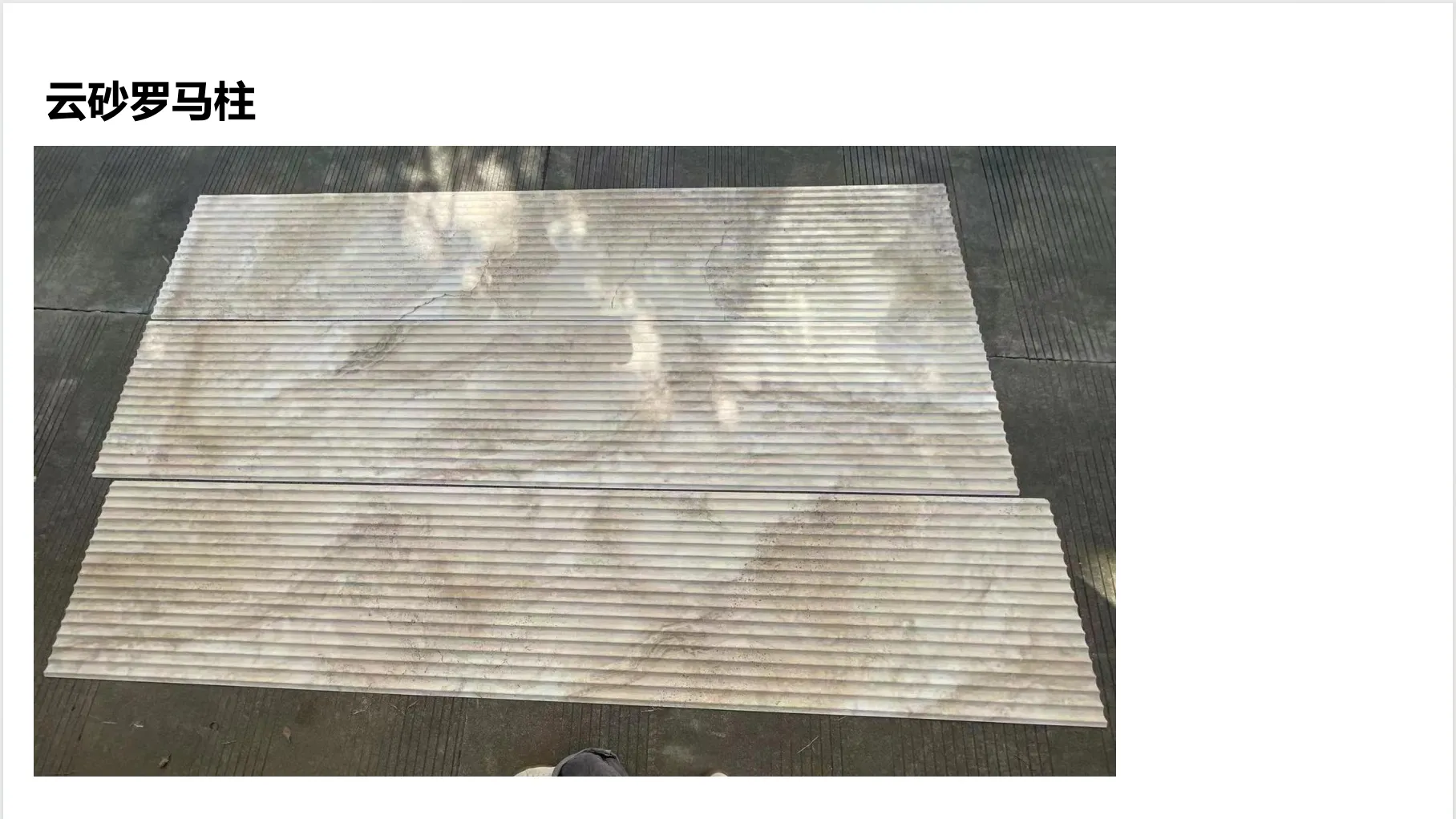
Let's zoom in on the star of the show: MCM's modified cementitious marble pillars. Traditional marble pillars are heavy, porous, and prone to cracking—beautiful, but high-maintenance. MCM's version? A game-changer. By infusing cementitious materials with natural marble aggregates and reinforcing them with advanced polymers, they've created pillars that mimic the elegance of natural marble but with a fraction of the weight and 10x the durability. But don't just take our word for it—look at the real photos.
In one set of photos, you'll see a close-up of a marble pillar's surface: tiny, iridescent flecks catch the light, while soft, meandering veins (replicated from premium Italian marble) give it depth. Run your finger over it (metaphorically, of course—though we wish you could feel it), and you'd notice a smoothness that's consistent across the entire pillar, no rough edges or uneven patches. Another photo shows the pillar installed in a high-traffic hotel lobby, flanked by glass doors. After six months of guests brushing against it, luggage bumping into it, and daily cleaning, the surface remains unscathed—no chips, no stains, just the same rich texture it had on day one. That's quality you can see.
But the magic isn't just in durability. MCM's marble pillars are also customizable. Want a pillar with a matte finish for a minimalist office? Done. Prefer a polished surface that reflects light in a retail space? Consider it. The real photos showcase this versatility: a slim, white marble pillar in a boutique café, its clean lines complementing the wooden tables; a thicker, gray-veined pillar in a corporate headquarters, exuding authority without feeling cold. Each photo tells a story of collaboration—between MCM's engineers, the architect's vision, and the material's inherent beauty.
If marble pillars are the drama, travertine is the quiet sophistication of MCM's lineup. Known for its porous, honeycomb-like texture and warm, earthy tones, travertine has been used in architecture for millennia (think the Colosseum). But traditional travertine is fragile—those pores can trap dirt, and its softness makes it easy to scratch. MCM's modified travertine? They've kept the texture, boosted the strength, and expanded the color palette—all of which shines through in their real photos.
Take the travertine (starry green) variant. In real photos, you'll see a deep, forest-green base with tiny, reflective "stars" (actually, recycled glass particles) embedded in the surface. When installed as a feature wall in a restaurant, the stars catch candlelight, creating an intimate, almost magical ambiance. Then there's travertine (vintage gold)—a warm, amber hue with subtle, fossil-like inclusions that nod to the stone's natural origins. A photo of it used as flooring in a heritage home shows how it ages gracefully: after a year, the color has mellowed slightly, giving the space a lived-in charm without looking worn.
What's most striking about the travertine real photos, though, is the consistency. In traditional travertine, no two slabs are alike—great for uniqueness, but a nightmare for large-scale projects where uniformity matters. MCM's 3D printing technology ensures that every travertine panel (or tile, or slab) matches the sample, down to the placement of those iconic pores. A photo of a hotel hallway lined with travertine (vintage silver) panels drives this home: each panel aligns perfectly, creating a seamless, flowing pattern that feels intentional, not haphazard.
For designers craving something out of this world, there's the Lunar Peak series—silvery, golden, and black variants that channel the moon's rugged, otherworldly allure. These aren't just pretty; they're built to withstand the elements, making them ideal for both indoor and outdoor use. And yes, the real photos are out of this world (pun intended).
Lunar Peak silvery, for example, has a cool, metallic sheen with a texture that mimics the moon's craters—subtle indentations that catch shadows and light, creating depth. A real photo of it used as an exterior cladding on a mountain lodge shows how it blends with the natural landscape: during the day, it reflects the sky, appearing almost translucent; at night, it glows under outdoor lights, becoming a focal point. Lunar Peak golden, on the other hand, is warm and inviting—a photo of it used as a fireplace surround in a ski chalet shows how it complements wooden beams and fur throws, turning a functional space into a cozy retreat.
But don't mistake beauty for fragility. The Lunar Peak series is reinforced with fiberglass mesh, making it resistant to extreme temperatures, UV rays, and even hailstorms. A time-lapse photo series (included in MCM's real photo gallery) documents a Lunar Peak black panel installed on a coastal home: through rain, wind, and salt spray, its color remains vibrant, no fading or peeling. That's the kind of durability that turns a design choice into a legacy.
Not all heroes wear capes—or marble. Sometimes, they wear concrete. MCM's fair-faced concrete series is a love letter to minimalism: clean lines, muted tones, and a raw, industrial edge that's surprisingly versatile. Unlike traditional concrete, which can be blotchy and prone to dusting, MCM's version is treated with a special sealant that locks in the color and creates a smooth, matte finish. The real photos? They'll make you rethink concrete entirely.
One photo features a fair-faced concrete wall in a modern art studio: the surface is so uniform, it looks like a single slab, with only the faintest imprints of the formwork adding character. Sunlight streams through a skylight, casting shadows that highlight the wall's subtle texture—a reminder that "raw" doesn't mean "unfinished." Another photo shows it paired with wood in a residential kitchen: the cool gray of the concrete backsplash balances the warmth of the wooden cabinets, creating a space that feels both contemporary and cozy. It's proof that fair-faced concrete isn't just for warehouses anymore—it's for homes, offices, and everything in between.
In an industry flooded with CGI renderings and airbrushed images, MCM's commitment to real photos is a breath of fresh air. Renderings can make any material look perfect; real photos show you what it *actually* looks like in your hands, in your space, under your lighting. For architects and designers, this is invaluable. Imagine specifying a material based on a rendering, only to have it arrive looking dull or mismatched—heartbreaking, and costly. MCM's real photos eliminate that risk.
Take, for example, a designer working on a restaurant project. They want to use travertine (starry blue) for the bar front, but they're worried the "stars" might be too flashy. A quick look at MCM's real photos puts their mind at ease: the stars are subtle, twinkling only when hit by direct light, adding a touch of whimsy without overwhelming the space. Or a homeowner considering Lunar Peak silvery for their outdoor patio—they're concerned about how it'll look in the rain. The real photos show it: water beads up on the surface, highlighting the texture without making it look slick or dull. These aren't just photos—they're problem-solvers.
| Product | Key Features | Typical Applications |
|---|---|---|
| Marble Pillar (Modified Cementitious) | Lightweight (70% lighter than natural marble), crack-resistant, customizable finishes (polished/matte) | Hotel lobbies, corporate entrances, heritage restorations |
| Travertine (Starry Green) | Recycled glass "stars," honeycomb texture, stain-resistant sealant | Restaurant feature walls, boutique retail floors, residential accent walls |
| Lunar Peak (Golden) | Metallic finish, crater-like texture, UV-resistant, suitable for outdoor use | Mountain lodges, rooftop bars, outdoor fire pits |
| Fair-Faced Concrete | Uniform color, matte finish, dust-resistant, heat-insulating | Art studios, modern kitchens, office reception areas |
| Flexible Stone Panels | Bendable (up to 90 degrees), lightweight, easy to install on curved surfaces | Round walls, column wraps, furniture accents |
We'd be remiss not to mention MCM's flexible stone panels—the unsung heroes of curved spaces. Traditional stone panels are rigid, making them impossible to install on rounded walls or columns. Flexible stone? It bends. Literally. Made by compressing natural stone particles into thin, resin-backed sheets, these panels can wrap around curves, archways, and even furniture with ease. The real photos are mind-blowing.
One photo shows a curved wall in a luxury spa, clad in flexible stone panels that mimic the look of sandstone. The panels flow seamlessly around the bend, no gaps or overlaps, creating a organic, cave-like atmosphere that's perfect for relaxation. Another photo features a retail display counter with a curved front, wrapped in flexible travertine (beige). The texture is so convincing, you'd swear it's solid stone—until you notice how tightly it hugs the counter's curved edge. It's innovation that doesn't sacrifice beauty, and the real photos make that crystal clear.
At the end of the day, building materials are an investment. You don't just buy them—you live with them, work with them, and watch them age. MCM gets that. That's why every product, from marble pillars to fair-faced concrete, undergoes rigorous testing: freeze-thaw cycles, scratch resistance, colorfastness, and impact tests. And when they say "real photos," they mean photos of the *tested* products—not prototypes. It's quality assurance you can see, touch, and trust.
Take the Lunar Peak series, for example. After 500 hours of UV exposure testing (simulating 5 years of sunlight), the color remained unchanged—a far cry from cheaper alternatives that fade after a single summer. The marble pillars? They passed a 10,000-cycle impact test (dropping a 5kg weight from 1m height) with no visible damage. These aren't just specs on a sheet—they're stories told through real photos: a Lunar Peak panel after testing, looking as vibrant as day one; a marble pillar with a small dent (from an extreme test) that's barely noticeable, proving it can handle the chaos of everyday life.
MCM's modified cementitious marble pillars, travertine panels, Lunar Peak series, fair-faced concrete, and flexible stone aren't just building materials. They're the backdrop to life's moments: the first impression of a hotel stay, the comfort of a home kitchen, the inspiration of an art studio. And in a world where so much is digital, there's something powerful about knowing that what you see in the real photos is what you'll get in real life—no filters, no exaggerations, just quality.
So the next time you're designing a space, ask for the real photos. Look at the texture, the color, the way the material interacts with light. And if you see MCM's name attached, rest easy—because behind every photo is a promise: to craft materials that don't just build spaces, but build memories. After all, the best stories aren't told in renderings. They're told in the real thing.
Recommend Products












