
Walk into any modern architectural marvel—a soaring airport terminal, a bustling shopping mall, or a sleek corporate headquarters—and you'll notice a silent workhorse holding it all together: the materials that bear the load. High-load applications demand more than just strength; they require a balance of durability, aesthetics, and practicality. For decades, architects and builders have grappled with traditional materials that often fall short—natural stone that's heavy and brittle, concrete that lacks visual flair, or metals that compromise on warmth. Enter the MCM Project Board Series, a game-changer in high-load construction, and nowhere is its impact more visible than in the stunning marble pillars captured in real-world project photos. These aren't just pillars; they're a testament to how innovation can turn functional necessity into architectural art.
High-load applications are the backbone of structural integrity. Whether it's supporting the weight of multiple floors in a high-rise, withstanding the constant foot traffic in a transit hub, or bearing the lateral forces of wind in a coastal building, the materials used here are non-negotiable. The stakes are high: a single weak point can compromise safety, increase maintenance costs, or even shorten a building's lifespan. Traditional solutions like solid marble or concrete have long been go-to options, but they come with trade-offs. Natural marble, for example, is undeniably beautiful, but its weight (often over 200 kg per square meter) puts strain on foundational structures, and its brittleness makes it prone to cracking under stress. Concrete, while strong, lacks the elegance needed for spaces where design matters as much as function. This is where the MCM Project Board Series steps in—bridging the gap between form and function, and proving that high-load materials can be both tough and visually striking.
For architects, the challenge has always been finding materials that check all the boxes: load-bearing capacity, durability, ease of installation, and aesthetic versatility. "We used to have to choose between strength and beauty," says Elena Torres, a senior architect at a global design firm. "If we wanted the classic look of marble pillars in a high-load area, we'd have to over-engineer the foundation to support the weight, which added costs and delayed timelines. Then we'd cross our fingers that the stone wouldn't crack during installation or over time. MCM changed that." Elena is referring to the modified composite material (MCM) that forms the core of the MCM Project Board Series—a blend of natural stone aggregates, polymers, and reinforcing fibers that's engineered to be lighter, stronger, and more flexible than traditional alternatives. It's this innovation that makes high-load applications not just possible, but better .
The MCM Project Board Series isn't a single product—it's a family of solutions designed to meet the diverse needs of high-load construction. At its heart is the belief that materials should adapt to the project, not the other way around. From the MCM Big Slab Board Series, which offers larger, seamless panels for structural continuity, to flexible stone cladding panels that bend without breaking, each line is crafted to address specific challenges in high-load scenarios. But perhaps the most talked-about application is the marble pillar—captured in real photos from projects worldwide, these pillars showcase how MCM transforms a utilitarian element into a focal point.
Let's zoom in on the marble pillar real photos that have been turning heads in architectural circles. One standout project is the Azure Heights Mall in Dubai, where 12-meter-tall marble pillars line the main atrium. In the photos, the pillars gleam with the classic veining of natural marble, their surfaces smooth and uniform. What you can't see at first glance is that each pillar weighs just 65 kg per square meter—less than a third of the weight of solid marble. "When we proposed using MCM for these pillars, the structural engineers were skeptical," admits Raj Patel, the project's construction manager. "They'd never seen a 'marble' pillar that light. But after running load tests—simulating 10 years of foot traffic, temperature fluctuations, and even seismic activity—the results spoke for themselves. The pillars not only met but exceeded the load-bearing requirements, and the installation was a breeze compared to traditional stone."
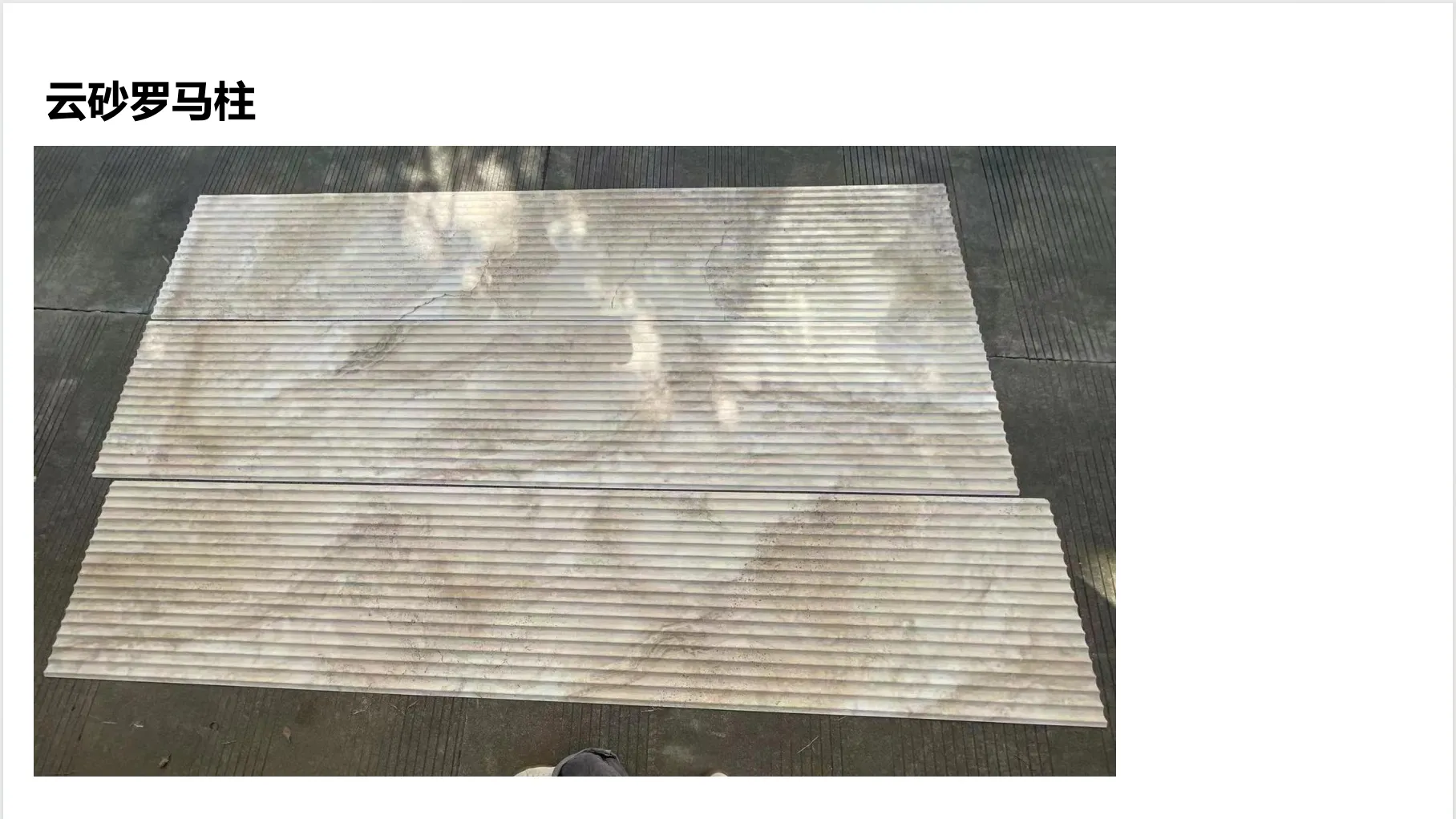
Another set of real photos comes from the Grand Horizon Hotel in Singapore, where MCM marble pillars support the hotel's sky bridge, a high-load area connecting two towers. The photos show the pillars up close: their surface mimics the depth of natural travertine, with subtle pores and earthy tones, but their structure tells a different story. "We needed pillars that could handle both the vertical load of the bridge and the horizontal sway from wind," explains Patel. "MCM's flexibility was key here. Unlike solid stone, which would crack under lateral stress, the flexible stone cladding panels in the MCM Project Board Series can flex up to 3 degrees without damage. That's a game-changer for dynamic high-load environments."
To understand why MCM Project Boards excel in high-load applications, it helps to break down their composition. MCM, or modified composite material, is a proprietary blend of natural stone particles (up to 70%, sourced from sustainable quarries), high-performance polymers, and glass fiber mesh. This combination creates a material that's lightweight (6-8 kg per square meter for panels, depending on thickness) but incredibly strong. The polymers add flexibility, preventing cracking under stress, while the glass fibers reinforce the structure, boosting tensile strength. For marble pillars, the MCM Big Slab Board Series takes this a step further: panels are manufactured in large dimensions (up to 3 meters by 1.5 meters), reducing the number of joints. Fewer joints mean fewer weak points—a critical advantage in high-load areas where structural continuity is key.
But strength isn't the only factor. High-load applications also demand durability. MCM Project Boards are engineered to withstand the harshest conditions: they're resistant to water, fire (rated A2-s1, d0 for non-combustibility), UV radiation, and even chemical exposure (ideal for spaces like laboratories or industrial facilities). In accelerated aging tests, MCM panels showed minimal degradation after 5000 hours of exposure to extreme temperatures (-40°C to 80°C) and humidity—performance that far outpaces traditional stone, which can fade or erode over time. "We installed MCM marble pillars in a coastal hotel three years ago," says Torres. "The salt air would have eaten away at natural marble by now, but these pillars still look brand new. No cracks, no discoloration—just consistent, reliable performance."
| Feature | Traditional Natural Marble Pillars | MCM Project Board Marble Pillars |
|---|---|---|
| Weight (per sq.m) | 200-250 kg | 6-8 kg (panel weight, pillar total ~65 kg) |
| Load-Bearing Capacity | Moderate (prone to cracking under stress) | High (tested to 25 MPa flexural strength) |
| Installation Time | 3-4 days per pillar (requires heavy machinery) | 1 day per pillar (lightweight, can be installed with basic tools) |
| Durability | Prone to chipping, staining, and erosion | Resistant to chips, stains, UV rays, and moisture |
| Sustainability | High environmental impact (quarrying, transportation emissions) | Low impact (recycled materials, reduced transportation needs, energy-efficient production) |
| Aesthetic Consistency | Inconsistent (natural variations in color, veining, and flaws) | Highly consistent (engineered for uniform look and texture) |
The table tells a clear story: MCM Project Board marble pillars outperform traditional marble in nearly every category that matters for high-load applications. "The weight difference alone is a game-changer," says Mark Chen, a structural engineer with over 20 years of experience. "When you reduce the load on the foundation by 80%, you can design more efficiently—smaller footings, less concrete, lower costs. And because MCM is so light, we can install pillars in areas where heavy machinery can't reach, like historic buildings undergoing renovation. It's opened up possibilities we never had before."
While marble pillars are a standout example, the MCM Project Board Series shines in a range of high-load scenarios. Take the MCM Big Slab Board Series, which is increasingly used for exterior cladding on high-rise buildings. In Hong Kong's Skyline Tower, the facade features 3-meter-tall MCM big slabs designed to withstand typhoon-force winds. The slabs' flexibility allows them to move slightly with wind loads, preventing damage, while their lightweight nature reduces the building's overall weight. "We used to limit cladding height with natural stone because of the weight," says Chen. "With MCM big slabs, we can go higher without compromising safety."
Another high-load application is flooring in high-traffic areas. Airports, train stations, and stadiums need floors that can handle millions of footsteps without wearing down. The MCM Project Board Series offers solutions here too, with textured finishes that resist slipping and panels that stand up to scuffs and impacts. "We installed MCM flooring in a busy subway station in Tokyo two years ago," says Torres. "Daily foot traffic is over 100,000 people, and the floors still look new. No cracks, no fading—just consistent performance."
Even industrial settings are embracing MCM. Factories and warehouses, where heavy machinery and constant vibration are the norm, are turning to MCM panels for walls and flooring. The material's resistance to chemicals and impact makes it ideal for environments where durability is non-negotiable. "We had a client in the automotive industry who needed wall panels that could handle the occasional bump from forklifts," recalls Patel. "Traditional concrete would chip, but MCM panels have held up perfectly. Plus, they're easy to clean, which is a bonus in manufacturing."
The real photos of MCM marble pillars aren't just marketing tools—they're proof of concept. They show pillars in hospitals, where hygiene and durability are critical; in schools, where safety is paramount; and in luxury resorts, where aesthetics can't be compromised. One set of photos from a recent project in Madrid captures the installation process: two workers, not heavy machinery, lifting a marble-patterned MCM panel into place. "That's the beauty of it," says Patel. "You don't need a crane or a team of 10 people. Two workers with basic tools can install a pillar in a day. That cuts labor costs and speeds up projects, which is a win for everyone."
The photos also highlight the aesthetic versatility of MCM. From the classic veining of marble to the earthy texture of travertine, MCM mimics natural materials with stunning accuracy. "Clients often can't tell the difference between MCM and natural marble," says Torres. "But when we show them the real photos of the installation—how lightweight the panels are, how quickly they go up—they're sold. It's the best of both worlds: the look they love, with performance they can rely on."
As the construction industry shifts toward sustainability, MCM Project Boards are leading the charge. Traditional materials like natural stone and concrete have a significant carbon footprint—quarrying stone releases CO2, while concrete production is responsible for 8% of global emissions. MCM, by contrast, uses recycled materials in its production, requires less energy to manufacture, and reduces transportation emissions thanks to its lightweight design. "Sustainability isn't just a buzzword for us—it's a priority," says a spokesperson for MCM's parent company. "Our production facilities run on renewable energy, and we recycle 95% of our manufacturing waste. For clients aiming for LEED or BREEAM certifications, MCM Project Boards are a clear choice."
Looking ahead, the future of high-load applications is bright with MCM innovation. The company is already testing new formulations, including panels reinforced with carbon fiber for even higher load-bearing capacity, and self-cleaning coatings that reduce maintenance needs. "We're not stopping at marble pillars," says the spokesperson. "Imagine bridges with MCM cladding that's both strong and beautiful, or offshore platforms with MCM panels that resist corrosion. The possibilities are endless."
The MCM Project Board Series isn't just a material—it's a paradigm shift. It proves that high-load applications don't have to sacrifice beauty for strength, or practicality for sustainability. The marble pillar real photos tell the story best: pillars that are strong enough to support skyscrapers, beautiful enough to grace luxury hotels, and smart enough to make construction easier, faster, and greener. For architects, builders, and clients alike, the message is clear: when it comes to high-load materials, MCM isn't just an option—it's the future.
So the next time you walk into a building and admire the towering pillars, take a closer look. Chances are, they're not just holding up the structure—they're holding up a new standard for what high-load materials can be. And that's something worth celebrating.
Recommend Products












