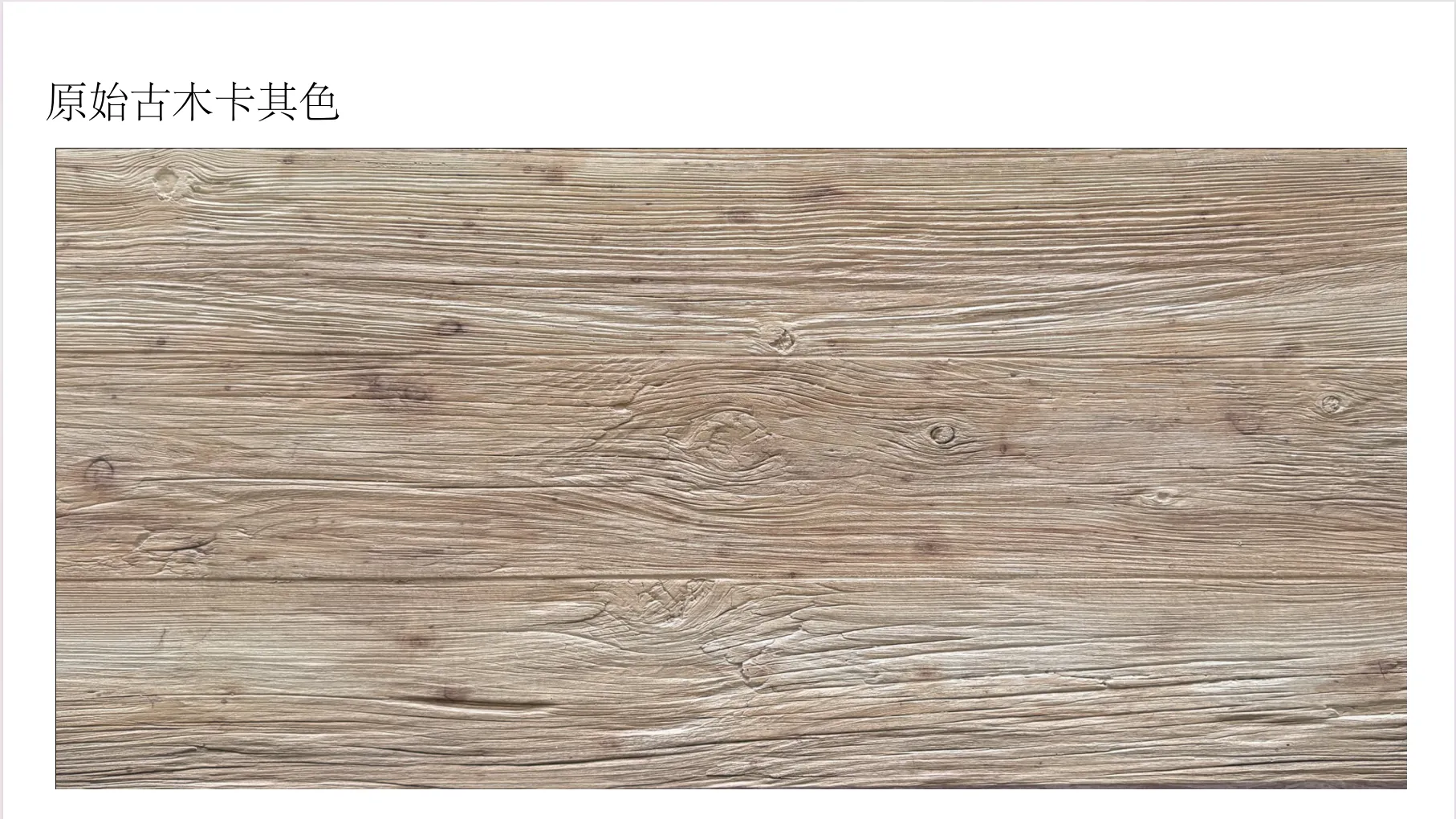
There's something almost primal about the way we respond to wood. It's in the creak of an old cabin door, the warmth of sunlit floorboards under bare feet, the quiet grandeur of a temple's wooden beams weathered by centuries.
Ancient wood structures—whether a Japanese
minka
farmhouse, a Scandinavian stave church, or a Native American log longhouse—aren't just buildings; they're storytellers. They carry the scent of pine or cedar, the memory of hands that hewed them, the marks of time that make each knot and grain unique. But here's the thing: real wood, for all its beauty, comes with a price. It warps, rots, and fades. It demands constant care, and sourcing it sustainably often means choosing between preservation and progress. That's where the
MCM Project Board Series
steps in—not just as a building material, but as a bridge between the soul of
ancient wood and the needs of modern construction.
The Inspiration: Capturing Wood's "Unspoken Language"
Walk into MCM's design studio, and you'll find mood boards covered in photographs: close-ups of 200-year-old oak beams from a French chateau, snapshots of driftwood smoothed by ocean tides, sketches of wooden
shoji
screens filtering light in a Kyoto teahouse. The team behind the Project Board Series didn't set out to "copy" wood—they wanted to
translate
it. "Wood isn't just a texture," says Elena Marquez, lead designer for MCM's thematic collections. "It's a language. The way the grain curves tells you about the tree's struggle for sunlight; the knots whisper of storms it survived; the patina speaks to years of rain, wind, and human touch. We wanted to capture that
narrative
in every panel."
The result? A series of boards engineered to evoke the
feeling
of
ancient wood, not just the look. Take a moment to run your hand over a sample of MCM's
Wood Grain Board
, and you'll notice it doesn't feel like plastic or cheap laminate. It has the subtle give of real timber, the kind that makes you want to trace a finger along a deep grain line. That's intentional. MCM's team spent two years studying how wood ages—how sunlight bleaches it, how moisture swells it, how time softens its edges—to replicate not just the visual texture, but the tactile memory we associate with well-loved wood.
Key Players: MCM's Wood-Themed Stars
The
MCM Project Board Series
isn't a one-size-fits-all solution. It's a toolkit, with each product designed to lean into a different facet of wood's personality. Let's meet the standouts that make
ancient wood themes possible in today's builds:
|
Product Name
|
Key Aesthetic Features
|
Material Magic
|
Ideal For...
|
Why It Matters
|
|
Wood Grain Board
|
Mimics 12+ wood species (oak, walnut, pine) with hyper-detailed grain, subtle color variations, and soft, matte finishes.
|
Modified composite material (MCM) with natural mineral fibers; flexible enough to bend around curves (up to 30mm radius).
|
Accent walls in living rooms, kitchen backsplashes, bedroom headboards—spaces craving warmth without bulk.
|
It's wood without the "fuss." No warping in humid bathrooms, no fading in sunlit entryways. Just that quiet, homey glow.
|
|
Sawing Wood Board
|
Rough-hewn edges, visible "saw marks," and a tactile surface that looks hand-sawn—like planks pulled from an old barn.
|
Reinforced with fiberglass mesh for durability; treated to resist scratches and stains (perfect for high-traffic areas).
|
Rustic cafes, cabin-inspired hotels, outdoor patios (paired with greenery for that "forest retreat" vibe).
|
It brings the
effort
of craftsmanship into modern builds. That rough texture? It's not just for show—it's a nod to the hands that used to spend days sawing planks by hand.
|
|
Poly Wood Board
|
Blends the warmth of wood with a slight industrial edge; available in "weathered gray" or "sun-bleached blonde" for that "found in nature" look.
|
Polymer matrix infused with recycled wood fibers; 50% lighter than solid wood, yet strong enough for decking or cladding.
|
Poolside decks, outdoor showers, coastal homes (resists saltwater and humidity like a champ).
|
It's wood that plays well with water. No more worrying about rot or splinters—just the look of driftwood without the upkeep.
|
|
Wood Concrete Board
|
Wood fibers suspended in a concrete matrix, creating a hybrid look: industrial strength with organic warmth (think: exposed wooden beams meets modern concrete walls).
|
Fire-resistant (up to 1200°C) and sound-absorbent; can be cut to custom sizes for large-scale installations.
|
Cultural centers, libraries, boutique offices—spaces where "history" and "innovation" need to coexist.
|
It's a conversation starter. Run your hand over it: cool like concrete, but with the soft texture of wood. It makes even minimalist rooms feel rooted in something real.
|
What ties these products together? They don't just
look
like wood—they
feel
like they belong in a story. The
Sawing Wood Board
, for example, was inspired by a 17th-century English barn the MCM team visited. The original planks had been sawn by hand, leaving uneven edges and faint tool marks that made the space feel alive. MCM's version replicates those marks not with stamps, but with a proprietary embossing process that raises the texture just enough to catch the light—so when morning sun hits a wall clad in
Sawing Wood Board, it casts shadows that mimic the barn's old beams.
Beyond Aesthetics: Why MCM Boards Outperform Real Wood
Let's talk practicality. Imagine building a mountain lodge with real wood siding. Within five years, you're power-washing mold, replacing warped planks, and shelling out for stain. Now imagine using MCM's
Poly Wood Board
instead. It weighs half as much (so installation is faster and cheaper), resists mold and mildew, and won't fade even after a decade of harsh mountain sun. That's the beauty of MCM's engineering: it takes the parts of wood we love and leaves out the parts that frustrate us.
Take durability, for instance. Traditional wood needs sealants to stand up to rain or humidity; MCM boards are inherently water-resistant, thanks to their modified composite core. In coastal areas, where salt air eats away at wooden decks,
Wood Concrete Board
holds strong—no peeling paint, no splintered surfaces. And when it comes to sustainability? MCM sources 85% of its raw materials from recycled or rapidly renewable resources. Choosing their
Wood Grain Board over solid oak means saving trees without sacrificing that "wooden" feel. It's progress that doesn't ask us to choose between the planet and beauty.
Bringing Ancient Wood Themes to Life: Real Spaces, Real Stories
Let's step into some spaces where the
MCM Project Board Series has already made its mark. Start with
The Rustic Nook
, a café in Portland, Oregon, that wanted to channel the coziness of a 1920s logging cabin. The owner, Maria, had grown up visiting her grandfather's cabin in the Cascades and dreamed of recreating that "log walls and hot cocoa" vibe—but with a modern, low-maintenance twist. MCM's
Sawing Wood Board
clad the walls, its rough texture and warm amber tones mimicking the cabin's original planks. "Customers walk in and say, 'This feels like my grandma's house,'" Maria laughs. "Little do they know, those 'planks' are tough enough to handle coffee spills and rowdy weekend crowds without a scratch."
Then there's the
Tsukiji Tea House
in Tokyo, a minimalist space inspired by 17th-century
wabi-sabi
aesthetics. The designer, Yuki Tanaka, wanted to evoke the serenity of a traditional wooden tea room but needed materials that could withstand Tokyo's humid summers. MCM's
Wood Grain Board
(in a soft walnut finish) was used for the sliding doors and ceiling panels, its subtle grain patterns mirroring the natural imperfections of aged wood. "Wood has a way of making silence feel comfortable," Yuki says. "With MCM, we didn't just get the look—we got that silence."
Even cultural institutions are leaning in. The
Heritage Museum of the American West
in Santa Fe recently expanded its exhibit space, and curators wanted the new wing to feel like an extension of the 1800s adobe and wood structures in the original building. MCM's
Wood Concrete Board
(stained a warm sienna) was chosen for the walls, its blend of wood fibers and concrete creating a texture that feels both ancient and sturdy—perfect for displaying artifacts like old saddles and hand tools. "It's not just about looking old," says curator James Ortiz. "It's about feeling
authentic
. MCM's boards don't just sit there—they interact with the artifacts, like they've been part of this story all along."
The Future of Ancient Wood Themes: More Than a Trend
In a world that often prioritizes sleek minimalism or high-tech futurism, the enduring appeal of
ancient wood themes says something about us: we crave connection—to nature, to history, to the quiet, tangible things that ground us. The
MCM Project Board Series
gets that. It doesn't try to replace wood; it celebrates it—by making its warmth, texture, and storytelling power accessible to everyone, in every kind of space.
So whether you're building a home that feels like a hug, a café that feels like a community, or a museum that feels like a journey through time, these boards are more than materials. They're collaborators. They're the creak of that old cabin door, the warmth of sunlit floorboards, the stories waiting to be told—all wrapped up in a package that's as tough as it is tender. Because in the end, we don't just build with wood. We build with memory. And with MCM, those memories can last.