
Every space has a voice. It speaks through the texture of its walls, the sheen of its floors, and the way light dances off its surfaces. For architects, designers, and project managers, choosing the right building materials isn't just about durability or cost—it's about finding that voice. It's about materials that don't just fill a space, but elevate it. In the world of innovative cladding and surfacing solutions, MCM has emerged as a storyteller, crafting materials that blend artistry with engineering. Today, we're diving into two of their most celebrated collections: the MCM Project Board Series and the Big Slab Board Series. Along the way, we'll shine a light on standout products like Rock Cut Stone, exploring how these materials aren't just "options"—they're partners in bringing design visions to life.
Before we zoom into specific stones and textures, let's set the stage. The MCM Project Board Series and Big Slab Board Series are two sides of the same creative coin, each tailored to distinct design needs. Think of Project Board as the "detail-oriented artist" of the family—nimble, versatile, and perfect for spaces that crave texture, pattern, or intricate storytelling. Big Slab, on the other hand, is the "grand visionary"—bold, expansive, and built for making a statement. Both series share MCM's signature commitment to innovation: lightweight yet durable, eco-friendly, and designed to push the boundaries of what's possible in architecture. But their personalities? That's where the magic lies.
Let's start with the Project Board Series. Imagine a collection where flexibility meets creativity. These boards are engineered for precision, often featuring 3D-printed textures, woven patterns, or delicate (Thread) that add depth to even the smallest surfaces. They're the go-to for designers working on interior accent walls, boutique facades, or spaces where "intricacy" is the keyword. Take the Wave Panel, for example—its undulating surface mimics the rhythm of ocean waves, turning a plain wall into a dynamic, sensory experience. Or the Bamboo Mat Board, which brings the warmth of natural bamboo into commercial spaces without the maintenance headaches of real wood. Project Board isn't just about covering a surface; it's about texturing a feeling .
Then there's the Big Slab Board Series. If Project Board is a sonnet, Big Slab is an epic poem. These are large-format panels—often spanning up to 1.2m x 2.4m—designed to create seamless, uninterrupted surfaces that command attention. They're the stars of luxury hotels, corporate lobbies, and public spaces where "grandeur" is non-negotiable. Think of the Travertine (Starry Green) slab: its soft beige base is dotted with iridescent mineral deposits that catch the light like stars in a night sky, turning a lobby wall into a celestial masterpiece. Or the Lunar Peak Silvery slab, with its metallic sheen and subtle crater-like texture, evoking the quiet majesty of the moon's surface. Big Slab isn't just about size; it's about presence .
To truly understand the distinction, let's break down the key features of each series. The table below compares their core attributes, helping you decide which series aligns with your project's needs:
| Feature | MCM Project Board Series | MCM Big Slab Board Series |
|---|---|---|
| Material Composition | Modified composite materials with 3D-printed or woven textures; often includes flexible stone or foamed aluminium alloy | High-density composite stone (e.g., travertine, marble, granite) or engineered stone; designed for large, seamless slabs |
| Size Range | Smaller formats (typically 0.6m x 1.2m to 1m x 1.8m); customizable for intricate designs | Large-format slabs (up to 1.2m x 2.4m); minimal joints for a seamless look |
| Thickness | Thinner (3-8mm); lightweight for easy installation on walls or ceilings | Thicker (10-20mm); sturdy enough for floor applications and high-traffic areas |
| Weight | Lightweight (8-12kg/m²); ideal for retrofits or structures with weight restrictions | Moderate weight (15-25kg/m²); requires sturdy mounting but still lighter than natural stone |
| Key Aesthetics | Textured, patterned, or 3D designs; focuses on detail and tactile appeal | Bold, uniform, or vein-patterned; focuses on continuity and visual impact |
| Ideal Applications | Interior accent walls, boutique facades, ceiling panels, furniture surfaces | Exterior cladding, lobby feature walls, hotel reception desks, large-scale floorings |
Now that we've covered the basics, let's dive into some of the most captivating products from both series. These are the materials that have designers talking—and for good reason.
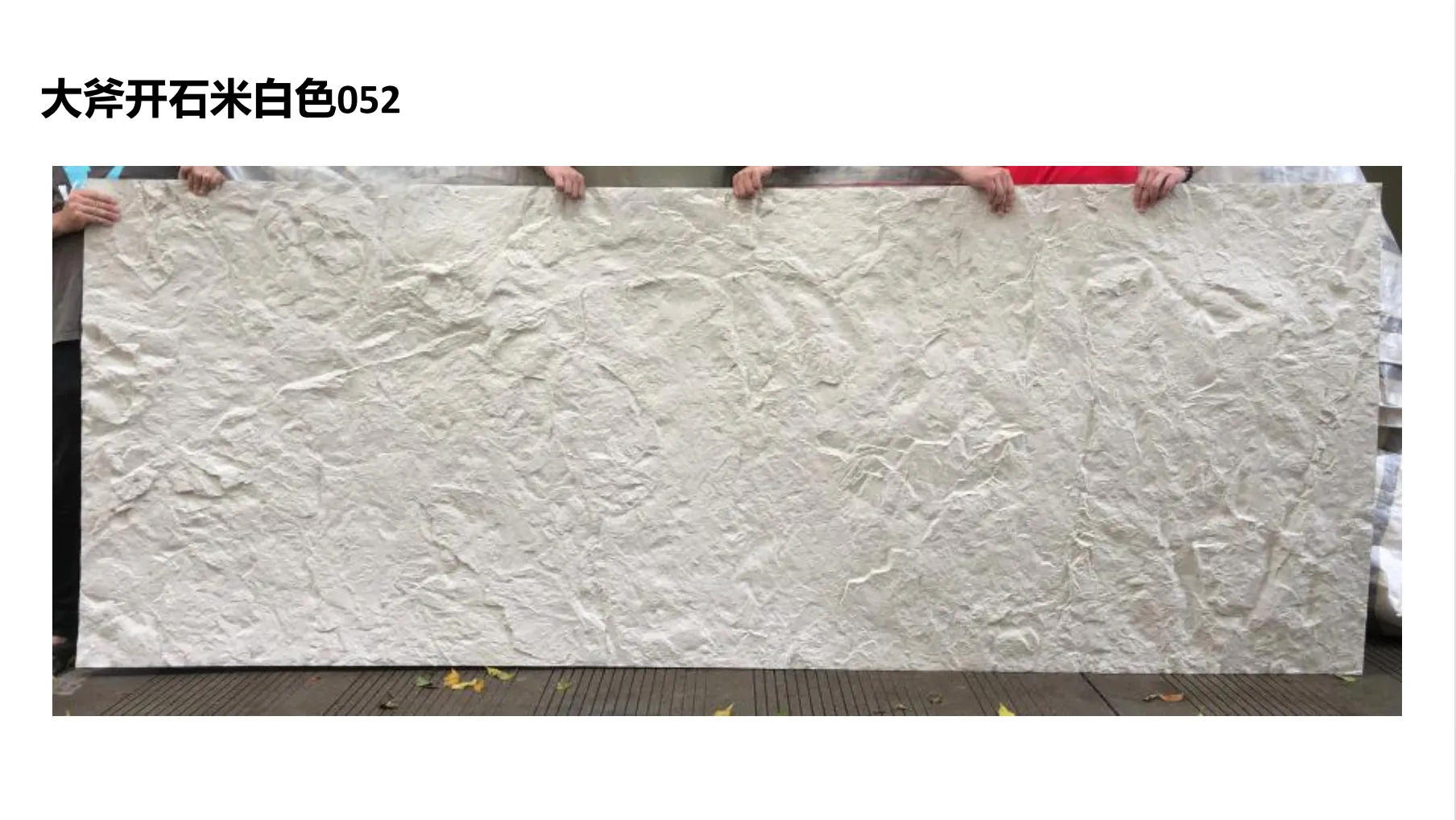
If there's one product that embodies the soul of the Project Board Series, it's Rock Cut Stone. Picture this: a surface that looks like it was hewn from ancient cliffs, with rough, chiseled edges and deep grooves that tell a story of time. That's Rock Cut Stone. Available in Dark Grey and Beige, it's designed to evoke the raw, earthy charm of historical architecture—think medieval castles or ancient cave dwellings—without the weight or cost of real stone. What makes it special? Its texture isn't just for show. Run your hand over it, and you'll feel the irregularities, the way light plays in the crevices, creating shadows that shift with the sun. It's perfect for heritage-inspired projects, like the renovation of a 19th-century town hall, where preserving historical character is key. Or, for a modern twist, pair it with sleek glass and steel in a restaurant interior, balancing old-world warmth with contemporary edge. Rock Cut Stone isn't just a material; it's a time capsule .
From the Project Board's intimacy to the Big Slab's grandeur, let's turn to Travertine (Starry Green)—a showstopper in the Big Slab Series. Travertine is a classic natural stone, but MCM's take? It's anything but ordinary. The Starry Green variant features a soft, muted green base (reminiscent of moss-covered forest floors) interspersed with tiny, iridescent mineral deposits. These deposits aren't just random; they're strategically distributed to mimic the night sky, with some clusters looking like constellations and others like shooting stars. The effect is mesmerizing: during the day, it's a calm, earthy green; at night, under warm lighting, it glows with a subtle, otherworldly shimmer. Imagine this slab wrapping around a hotel lobby's feature wall, paired with warm wooden accents and soft ambient lighting. Suddenly, the space isn't just a lobby—it's a planetarium. Or used as a backsplash in a high-end restaurant, turning every meal into a dining experience under the stars. Travertine (Starry Green) isn't just a slab; it's a universe in stone.
Another gem from the Big Slab Series is Lunar Peak Silvery. If Travertine (Starry Green) is the night sky, Lunar Peak Silvery is the moon itself. This slab features a cool, silvery metallic base with a texture that mimics the moon's pockmarked surface—subtle craters, gentle ridges, and a soft, matte sheen that reflects light without being overwhelming. It's modern, it's sleek, and it's designed for spaces that crave "quiet luxury." Think of a tech company's headquarters: a Lunar Peak Silvery slab as the backdrop for a reception desk, paired with black leather chairs and minimalist lighting. It says "innovation" without screaming it. Or a high-end spa, where the slab's calming, lunar vibe complements the serene atmosphere, making guests feel like they're relaxing on the moon's surface (minus the zero gravity). Lunar Peak Silvery isn't just a slab; it's a mood .
Of course, great design isn't just about looks—it's about performance. Both the Project Board and Big Slab Series deliver on MCM's promise of practicality, making them favorites among contractors and project managers. Let's start with weight: MCM's panels are up to 70% lighter than natural stone, which means easier transportation, faster installation, and reduced structural load. For high-rise buildings or retrofits where every kilogram counts, this is a game-changer. Then there's durability: MCM uses modified composite materials that are resistant to scratches, stains, and weathering. Rain, snow, UV rays—these panels can handle it all, making them suitable for both interior and exterior use. And let's not forget sustainability: MCM's manufacturing process minimizes waste, and many products are made from recycled materials, aligning with the growing demand for eco-conscious building solutions.
Take the Foamed Aluminium Alloy Board (Vintage Silver), for example—a standout in the Project Board Series. Aluminium is already lightweight and recyclable, but MCM's foaming process takes it further, creating a panel that's 50% lighter than solid aluminium while maintaining strength. It's perfect for exterior facades in coastal areas, where saltwater corrosion is a concern, or for interior ceilings in airports, where weight and fire resistance are non-negotiable. Or the Fair-Faced Concrete from the Big Slab Series: it mimics the raw, industrial look of traditional concrete but with none of the cracking or maintenance issues. It's ideal for modern offices or art galleries, where "industrial chic" is the aesthetic, and durability is a must.
So, how do you decide between Project Board and Big Slab? It all comes down to the story you want your space to tell. Ask yourself: Does the project call for intimacy or grandeur? Intricacy or simplicity? Texture or continuity?
If you're designing a boutique café with a cozy, welcoming vibe, the Project Board Series might be your match. Imagine Bamboo Mat Board on the walls, paired with Weaving (Khaki) panels for the ceiling, creating a space that feels like a warm, sunlit forest. Or Thread panels in a retail store, adding subtle (linear) patterns that guide customers through the space, almost like a visual roadmap.
If you're working on a luxury hotel lobby that needs to wow guests from the moment they walk in, the Big Slab Series is the way to go. Picture a Lunar Peak Golden slab (yes, there's a golden variant!) as the backdrop for the reception desk, paired with Travertine (Vintage Gold) flooring, creating a space that feels opulent yet timeless. Or a Gobi Panel slab—with its desert-inspired texture—in a convention center, evoking the vast, awe-inspiring beauty of the Gobi Desert and making attendees feel small in the best possible way.
And here's the best part: MCM encourages mixing and matching. Who says you can't use Project Board for the accent wall and Big Slab for the floor? The Historical Pathfinders Stone (a rugged, weathered texture from Project Board) could pair beautifully with a Bali Stone slab (smooth, tropical-inspired from Big Slab) in a resort lobby, blending "adventure" with "relaxation." The possibilities are endless—because great design isn't about choosing one story; it's about weaving many.
At the end of the day, the MCM Project Board Series and Big Slab Board Series aren't just collections of building materials—they're tools for storytelling. They give designers the freedom to craft spaces that don't just exist, but resonate . Whether you're drawn to the intimacy of Rock Cut Stone or the grandeur of Travertine (Starry Green), one thing is clear: MCM is redefining what's possible in architecture. So, the next time you're standing in front of a blank wall, remember: it's not just a wall. It's a canvas. And with MCM, the palette is endless.
Recommend Products












