
In the heart of Riyadh, a bustling commercial mall had stood for over two decades, once a vibrant hub for shoppers but now showing signs of age. Its concrete facade, faded by years of Saudi Arabia's intense sun and sandstorms, felt cold and unwelcoming. Foot traffic had dwindled as newer, more modern malls popped up nearby, and tenants were starting to voice concerns about the declining appeal. For the mall's owner, a local real estate developer with deep roots in the community, the goal was clear: transform the facade into something that would not only turn heads but also reflect the warmth and resilience of Saudi culture—all while withstanding the harsh desert climate.
Enter the design team at Urban Revival Studios, tasked with balancing three key priorities: blending traditional Saudi architectural elements with contemporary flair, ensuring the facade could endure scorching temperatures (often exceeding 45°C in summer) and frequent sandstorms, and minimizing disruption to mall operations during renovation. After months of research, they turned to MCM (Modified Composite Material) products, particularly the MCM Wood Line series, as the cornerstone of their solution. What followed was a collaborative journey of material innovation, cultural storytelling, and problem-solving that would redefine the mall's identity.
The mall, spanning 50,000 square meters, was located in a mixed-use district—steps from residential neighborhoods, office towers, and a historic souk. Its original design, dating back to the early 2000s, prioritized function over form: a flat, monochromatic facade with small windows and minimal texture. The client's brief was unambiguous: "Create a facade that feels like a bridge between our heritage and our future. It should invite people in, tell a story, and stand strong against whatever the desert throws at it."
The design team began by immersing themselves in local culture. They visited traditional mud-brick villages, studied the geometric patterns of Najdi architecture, and noted how natural materials like stone and wood had been used for centuries to combat heat. "We wanted the facade to whisper, not shout, about Saudi identity," explains Lina Hassan, lead architect at Urban Revival. "It needed to feel familiar to locals but fresh enough to young families and international visitors."
Key challenges quickly emerged: the mall's location meant it faced direct sunlight for most of the day, leading to excessive heat absorption and high cooling costs. The existing facade was also heavy, making structural upgrades expensive. Worse, the renovation had to happen while the mall remained operational—a logistical nightmare that required lightweight, easy-to-install materials. "We couldn't shut down the mall for months," says project manager Kareem Al-Mansoori. "Every day of closure would cost tenants revenue, and we couldn't let that happen."
After testing over 20 materials, the team landed on a curated selection from MCM's product lineup, chosen for their durability, sustainability, and aesthetic versatility. "MCM wasn't just a supplier—they were a partner," Hassan recalls. "Their technical team helped us simulate how each material would perform in Riyadh's climate, even sending samples for us to weather-test in our lab. That level of support made all the difference."
The primary material selected was MCM Wood Line —a lightweight composite panel with a realistic wood grain texture. Unlike real wood, which warps and fades in Saudi heat, MCM Wood Line is made from a blend of natural minerals and polymers, making it resistant to UV rays, moisture, and sand abrasion. "We wanted the warmth of wood without the maintenance headache," Hassan says. "Real wood would require sealing every six months, and in Riyadh's humidity, it would still rot. MCM Wood Line gave us that organic feel but with a 20-year warranty. It was a no-brainer."
The panels were installed in horizontal strips, mimicking the rhythmic patterns of traditional palm frond roofs. Their light weight (just 8kg per square meter) meant the existing structure required minimal reinforcement, cutting down on construction time. "Installers could carry panels by hand, which was a game-changer," Al-Mansoori notes. "We worked nights and weekends to avoid disrupting shoppers, and the MCM panels made those tight deadlines feasible."
For accent areas—like the mall's main entrance and window frames—the team chose flexible stone in a warm, earthy hue. "Flexible stone is revolutionary," Hassan explains. "It's 90% lighter than natural stone but has the same tactile quality. We used it to create 3D geometric patterns inspired by traditional Saudi pottery, adding depth to the facade without weighing it down."
The material's flexibility also allowed for curved edges around the entrance canopy, a design element that softens the facade's angularity. "We tested it in our lab by blasting it with sand at 60km/h—simulating a Riyadh sandstorm—and it didn't scratch," says materials engineer Ahmed Tariq. "That durability was non-negotiable."
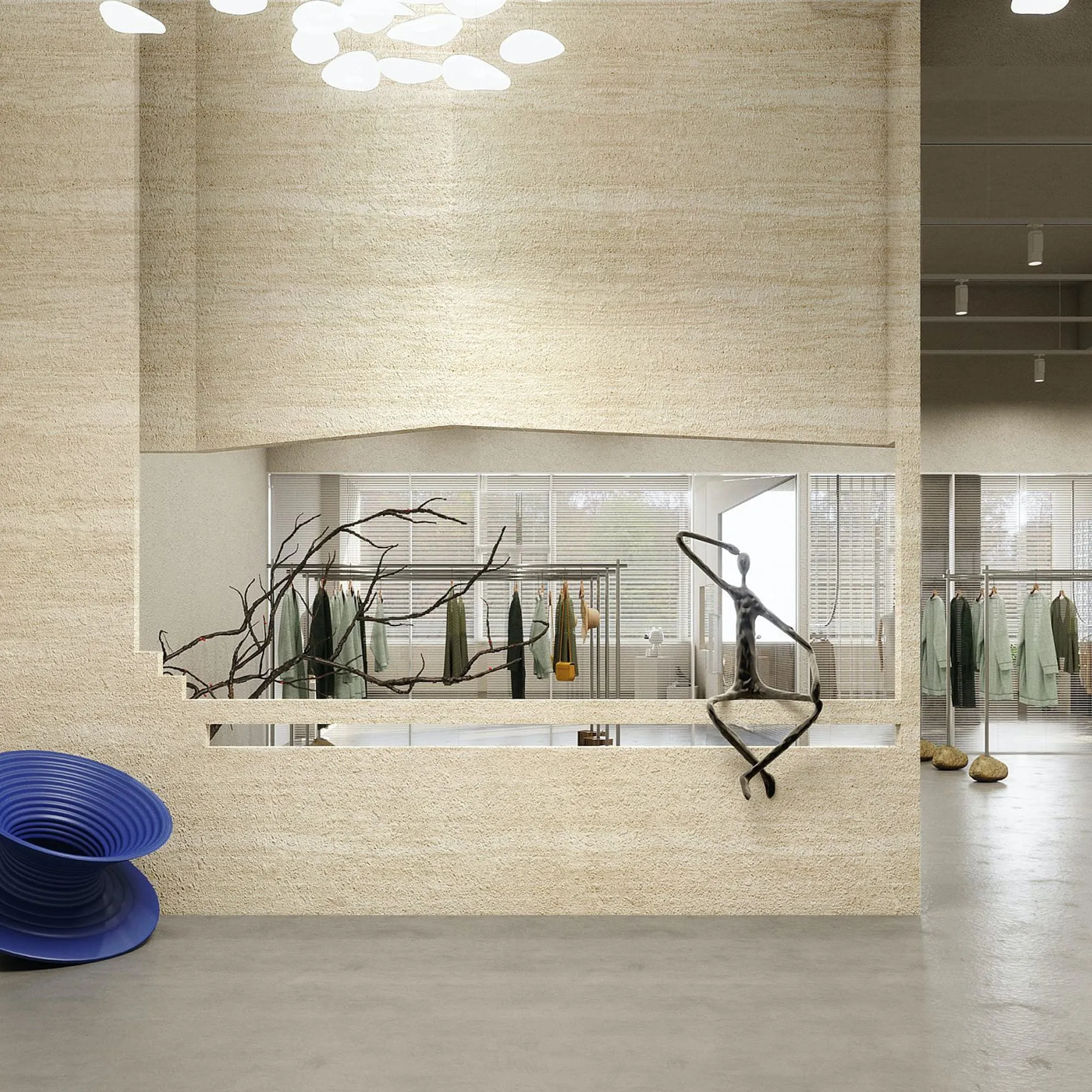
To ground the design in local aesthetics, the team incorporated travertine (beige) panels along the lower level, evoking the warm tones of desert stone. "Travertine has been used in Saudi architecture for centuries," Hassan says. "It's porous, which helps regulate temperature, and its natural veining adds a sense of movement. We paired it with bamboo mat board —another MCM innovation—for texture. The bamboo matting, with its woven pattern, echoes the palm leaves used in traditional roofing, but in a modern, fire-resistant form."
The combination of travertine (beige) and bamboo mat board created a welcoming base for the facade, while the MCM Wood Line above added height and warmth. "It's like layers of a story," Hassan adds. "The bottom feels grounded, the middle flows, and the top reaches for the sky."
To add a contemporary edge, the team used fair-faced concrete for the mall's signage and vertical accents. Its raw, industrial look balanced the organic textures of the wood and stone, creating a visual dialogue between old and new. "Concrete is timeless, but fair-faced concrete—with its exposed aggregate—feels intentional," Tariq explains. "We mixed in local sand to give it a pinkish hue, tying it back to the desert landscape."
| Material | Application | Key Benefits |
|---|---|---|
| MCM Wood Line | Primary facade (upper levels) | Lightweight (8kg/m²), UV-resistant, wood-like texture without maintenance, quick installation |
| Flexible Stone | Accent panels, entrance canopy | 90% lighter than natural stone, weather-resistant, customizable 3D patterns |
| Travertine (Beige) | Lower facade, baseboards | Earthy, traditional tone; natural temperature regulation; durable in sandstorms |
| Bamboo Mat Board | Mid-level texture accents | Woven pattern evokes traditional palm roofing; fire-resistant, lightweight |
| Fair-Faced Concrete | Signage, vertical accents | Industrial-modern aesthetic; mixed with local sand for desert-inspired color |
The renovation kicked off in January 2024, with the team working in phases to avoid disrupting mall operations. "We started with the north facade, which had the least foot traffic, then moved south," Al-Mansoori explains. "Each night, our crew would set up scaffolding, work from 10 PM to 6 AM, and break everything down before the mall opened. It was chaotic, but the lightweight MCM materials made it possible."
One of the biggest surprises was how the community reacted to the materials. "Local shoppers would stop and watch the installers," Hassan recalls. "Kids would press their hands against the bamboo mat board, feeling the texture, and parents would tell us, 'This feels like home.' That's when we knew we'd hit the mark."
Thermal testing after installation showed promising results: the MCM Wood Line and travertine (beige) panels reduced heat absorption by 35%, cutting the mall's cooling costs by 22% in the first summer. "We installed temperature sensors before and after," Tariq says. "On a 45°C day, the old facade would reach 60°C; the new one maxed out at 48°C. That's a huge difference for the AC system."
Sandstorms, a frequent nuisance in Riyadh, put the materials to the test in March 2024. "We were nervous," Al-Mansoori admits. "After the storm, we inspected every panel, and there wasn't a scratch. The flexible stone held up, the wood line didn't fade—even the bamboo mat board looked brand new. The client called me that day and said, 'You've given us a facade that can outlast the desert.'"
By June 2024, the renovation was complete, and the transformation was striking. The once-drab concrete facade now featured warm wood tones, earthy travertine (beige), and dynamic geometric accents, all shimmering softly in the sun. Foot traffic spiked by 40% in the first month, with social media posts of the "new mall" going viral among Riyadh residents. "Tenants reported a 25% increase in sales," says mall manager Fatima Al-Zahrani. "Restaurants are busier, stores are launching new collections—this facade didn't just fix a problem; it breathed life into the business."
For the design team, the project was about more than materials—it was about proving that modern architecture can honor tradition without being stuck in the past. "MCM gave us the tools to tell a story," Hassan says. "The Wood Line panels aren't just wood-look; they're a nod to the palm trees that have sustained communities here for centuries. The flexible stone patterns aren't random; they're a modern take on Najdi geometry. It's about making people feel seen."
Looking ahead, the client is already planning to replicate the design in other properties. "We've had developers from Jeddah and Dammam reaching out, asking about the materials," Al-Mansoori says. "MCM didn't just deliver a product; they delivered a solution that works for our climate, our culture, and our bottom line."
The Saudi commercial mall renovation is a testament to the power of thoughtful material selection. By choosing MCM Wood Line, flexible stone, travertine (beige), bamboo mat board, and fair-faced concrete, the design team didn't just create a beautiful facade—they solved practical challenges, honored local culture, and built a space that connects with people on an emotional level. In a world where architecture often prioritizes flash over substance, this project proves that the right materials can turn a building into a story.
As Lina Hassan puts it: "A facade isn't just skin deep. It's the first hello a building gives to the world. With MCM, we made sure this hello was warm, resilient, and unapologetically Saudi."
Recommend Products












