
Thermal expansion might sound like a term reserved for physics textbooks, but it's something every builder, architect, and homeowner should care about. Here's the basics: when materials get hot, their molecules move faster, taking up more space—so the material expands. When they cool down, the molecules slow down, and the material contracts. It's a natural process, but over time, this constant "breathing" puts stress on the material. Think of it like stretching a rubber band repeatedly—eventually, it weakens, snaps, or loses its shape.
For building materials, this stress manifests in ugly, costly ways. Exterior cladding might develop hairline cracks that let in moisture, leading to rot or mold. Flooring could buckle or create tripping hazards as boards push against each other. Even interior surfaces like wall panels might start to gap, ruining the seamless look designers work so hard to achieve. In extreme cases, repeated expansion and contraction can compromise a structure's integrity—hardly ideal for something meant to last decades.
Now, consider materials like traditional wood, which is beloved for its warmth but notoriously finicky. Wood absorbs moisture, swells in humidity, and shrinks when dry—exacerbating thermal movement. Or take natural stone, which might seem tough but can crack if expansion is restricted (ever noticed how sidewalks have gaps between concrete slabs? Those are expansion joints, there to prevent cracking from thermal stress). The problem isn't just about aesthetics; it's about durability, maintenance costs, and long-term performance.
So, what makes MCM Wood Line different? Let's start with what it is: a modified composite material (MCM stands for Modified Composite Material) designed to blend the best of natural elements with cutting-edge engineering. At its core, MCM Wood Line combines real wood fibers with a polymer matrix, reinforced by components like MCM flexible stone —a key ingredient that adds both durability and flexibility. Unlike pure wood or rigid stone, this hybrid composition isn't just thrown together; it's engineered at the molecular level to minimize thermal movement.
Here's the magic: the wood fibers provide that authentic grain texture we love, while the polymer matrix acts like a buffer, allowing slight movement without breaking. The MCM flexible stone component, which is itself a lightweight, bendable material, adds structural stability, ensuring the panel retains its shape even when temperatures spike or plummet. It's like giving the material a "memory"—it can flex with temperature changes but always returns to its original form, avoiding permanent deformation.
But don't just take my word for it. Let's talk numbers (but don't worry, I'll keep it simple). The thermal expansion coefficient measures how much a material expands per degree of temperature change, usually in micrometers per meter per degree Celsius (μm/m·°C). The lower the number, the more stable the material. Traditional solid wood, for example, can have a coefficient as high as 30–40 μm/m·°C, depending on the species. That might not sound like much, but over a 10-meter panel and a 50°C temperature swing (common in places like deserts or mountain regions), that's 1.5–2 mm of expansion—enough to cause visible gaps or warping.
MCM Wood Line, by contrast, clocks in at around 12–15 μm/m·°C. That's less than half the expansion of solid wood, and it's consistent across all directions (unlike wood, which expands more along the grain than across it). This low, uniform expansion is why architects are starting to specify it for projects in climates as varied as the hot, dry deserts of the Middle East to the freezing winters of Northern Europe.
To really understand MCM Wood Line's stability, let's pit it against some common alternatives—materials you might already be familiar with, like wood grain board , fair-faced concrete , bamboo mat board , and even bali stone , a popular natural stone option. The table below breaks down their thermal behavior, common issues, and best uses:
| Material | Thermal Expansion Coefficient (μm/m·°C) | Common Issues with Thermal Cycling | Best Applications |
|---|---|---|---|
| MCM Wood Line | 12–15 | Minimal: Slight flexing, no permanent deformation | Exterior cladding, flooring, wall panels (all climates) |
| Wood Grain Board (Traditional) | 30–40 | Warping, cracking, gapping; worsened by moisture | Interior accent walls (low humidity, stable temps) |
| Fair-Faced Concrete | 10–12 | Brittle; prone to cracking if expansion is restricted | Structural elements, large slabs (needs expansion joints) |
| Bamboo Mat Board | 25–35 | Swells in humidity, shrinks when dry; edges fray | Light interior use (shelving, decorative panels) |
| Bali Stone (Natural Stone) | 5–8 | High brittleness; cracks if thermal stress is uneven | Low-traffic, stable temp areas (indoor countertops) |
Note: Thermal expansion coefficients are approximate and can vary by product formulation or manufacturer. Data based on industry averages and third-party testing.
What jumps out here? Fair-faced concrete has a low coefficient, but it's rigid—so while it doesn't expand much, if it does expand and can't move (say, because it's fixed tightly to a structure), it cracks. Bali stone has even lower expansion, but it's brittle; a sudden temperature change (like a cold rain after a hot day) can cause it to fracture. Wood grain board and bamboo mat board have high expansion and are sensitive to moisture, making them poor choices for variable climates. MCM Wood Line, though, hits the sweet spot: low expansion, flexibility to handle movement, and resistance to moisture—making it versatile across applications.
Numbers and tables are great, but let's talk about real projects where MCM Wood Line has proven its mettle. Take the "Oasis Hotel" in Dubai, a boutique property with exterior cladding made entirely of MCM Wood Line. Dubai's climate is brutal: summer days see temperatures above 45°C (113°F), while nights can drop to 25°C (77°F)—a 20°C swing in hours. Add in the dry desert air, and most wood-based materials would turn into a warped mess within a year. But after three years, the hotel's cladding still looks brand-new, with no cracks, gaps, or fading. The general contractor, Ahmed Al-Mansoori, put it this way: "We've used traditional wood cladding before, and by year two, we were replacing panels. With MCM Wood Line, we haven't touched a single panel. It's been a game-changer for maintenance costs."
On the opposite end of the climate spectrum, consider "The Driftwood," a seafood restaurant in Cannon Beach, Oregon. Here, temperatures are milder (average summer high: 20°C/68°F, winter low: 5°C/41°F), but humidity is consistently high, and storms bring driving rain and wind. The restaurant's interior features MCM Wood Line wall panels and flooring, chosen for their resistance to moisture and thermal movement. Chef Maria Hernandez explains, "We have large windows that let in a lot of sunlight, so the interior heats up during the day, then cools down at night. With regular wood floors, we'd see gaps between boards within months. But these panels? They've stayed tight, no warping, even with all the foot traffic and temperature changes."
Another example is a residential development in Colorado, where homes experience all four seasons: blazing summers, snowy winters, and spring/fall days that can swing from 10°C to 25°C (50°F to 77°F) in a single day. The developer opted for MCM Wood Line as exterior siding, and homeowners report being impressed by how the material handles snowmelt (no rotting) and summer heat (no blistering). One homeowner, Lisa Chen,: "I was worried about how the siding would look after a Colorado winter, but it's held up better than the stone veneer on my last house. No cracks, no discoloration—it's like it doesn't care what the weather throws at it."
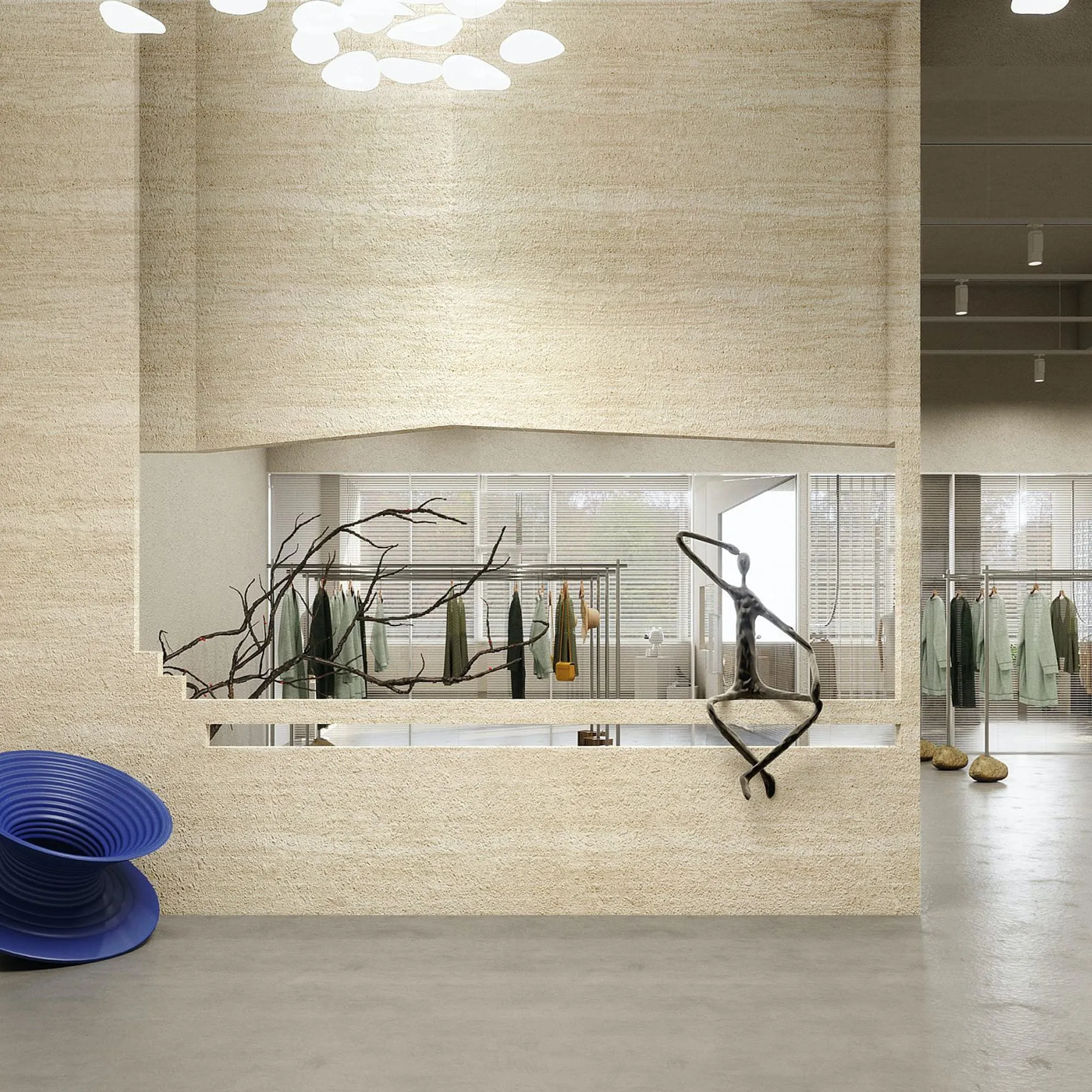
Let's dive a bit deeper into the science (without getting too geeky). MCM Wood Line's stability comes down to three key factors: its layered structure, fiber alignment, and moisture resistance.
First, the layered structure. Unlike solid wood, which is a single homogeneous material, MCM Wood Line is built in thin layers, like plywood but with more precision. Each layer's fibers are oriented at 90-degree angles to the one above, creating a "cross-bracing" effect that resists expansion in any single direction. It's similar to how a woven basket is stronger than a solid slab of material—each thread reinforces the others.
Second, fiber alignment. During manufacturing, the wood fibers are carefully aligned to run parallel to the panel's length, while the polymer matrix and MCM flexible stone particles fill in the gaps, creating a dense, uniform structure. This alignment reduces "weak spots" where expansion could occur, distributing stress evenly across the panel.
Third, moisture resistance. One of the biggest drivers of thermal movement in natural materials is moisture absorption. Wood swells when wet, which amplifies expansion when heated. MCM Wood Line's polymer matrix acts as a barrier, repelling water and preventing the wood fibers from absorbing moisture. That means even in humid climates or during rainstorms, the panels don't swell—keeping thermal expansion consistent and predictable.
Stability is the star here, but MCM Wood Line brings more to the table. For architects, it's a dream for design flexibility. Unlike rigid stone or heavy concrete, MCM Wood Line is lightweight (about 60% lighter than natural stone), making it easier to install on high-rise buildings or curved surfaces. It can be cut, shaped, or even bent to create custom designs—think wavy accent walls or curved facades that would be impossible with traditional wood.
For builders, installation is a breeze. Because it's lightweight and flexible, it requires fewer fasteners than stone or concrete, reducing labor time. And since it's resistant to thermal movement, there's no need for extensive expansion joints, which can complicate installation and disrupt the visual flow of a design.
For homeowners and business owners, the long-term savings are significant. Less maintenance means fewer repair bills, and the material's durability ensures it won't need replacement for decades. Plus, it retains its aesthetic appeal—no fading from UV rays, no discoloration from moisture, and that authentic wood grain look stays vibrant year after year.
Thermal expansion might not be the sexiest topic in architecture, but it's the unsung hero (or villain) of building durability. MCM Wood Line proves that we don't have to choose between beauty and performance—we can have both. Whether you're designing a desert resort, a coastal home, or a mountain cabin, this material offers the stability to stand up to nature's mood swings, the flexibility to bring creative visions to life, and the warmth of natural wood that makes spaces feel like home.
So the next time you walk past a building with stunning wood-like cladding, take a closer look. If it's still flawless after years of sun, rain, and snow, there's a good chance it's MCM Wood Line—quietly working behind the scenes to redefine what building materials can do. And isn't that the mark of true innovation? Solving problems we didn't even know we had, one stable panel at a time.
Recommend Products












