
Pillars have always been more than just structural supports—they're storytellers. For millennia, they've held up temples, palaces, and public spaces, but they've also carried the weight of culture, power, and human ingenuity. Nowhere is this more evident than in marble pillars, a material so timeless it has bridged ancient empires and cutting-edge contemporary design. Today, we're diving into the evolution of marble pillars, tracing how the grandeur of the past meets the innovation of the present, and how materials like travertine, lunar peak silvery, and fair-faced concrete are rewriting the rules of what a pillar can be.
To talk about traditional marble pillars is to talk about the dawn of Western architecture. Think of the Parthenon's stoic Doric columns, their fluted surfaces catching the Athenian sun, or the Pantheon's massive granite pillars, standing sentinel at the entrance to Rome's most iconic dome. These weren't just pieces of stone; they were labor-intensive works of art, carved by hand over months (sometimes years) by craftsmen who saw themselves as sculptors first, builders second.
Traditional marble pillars were defined by three things: material purity, symbolic detail, and human touch. Ancient stonemasons favored pure marble—often quarried from places like Carrara, Italy—for its creamy hue and subtle veining, which added depth without overwhelming the eye. They carved flutes (the vertical grooves) not just for aesthetics, but to make the pillars look taller and more slender from a distance. Capitals, the decorative tops, told stories: Doric for simplicity, Ionic for elegance with its scrolls, and Corinthian for opulence, adorned with acanthus leaves.
Take travertine, for example—a type of limestone with a porous, honeycombed texture that's been used since Roman times. The Colosseum, that colossus of ancient engineering, is clad in travertine blocks, their weathered surfaces bearing the marks of chisels and time. Run your hand over a traditional travertine pillar, and you'll feel the roughness of hand-carved edges, the slight unevenness that betrays human effort. It's a texture that whispers of patience: of stonemasons kneeling for hours, hammer and chisel in hand, turning raw stone into something that would outlive them by millennia.
These pillars were also deeply symbolic. In ancient Greece, a marble pillar represented order and democracy; in Rome, it signified imperial might. Even the weight of the stone mattered—thick, solid, unyielding, it was a physical manifestation of a civilization's confidence in its own longevity. To stand in a room lined with traditional marble pillars is to feel small, but in the best way: humbled by the knowledge that you're in the presence of something built to last.
Fast forward to the 21st century, and the marble pillar has undergone a quiet revolution. Today's architects aren't just building with stone—they're reimagining it. The shift started with technology: CNC machines that carve with precision no human hand could match, 3D scanners that map ancient pillars to replicate (or subvert) their designs, and materials science that's given us everything from lightweight composites to finishes that mimic the look of aged marble without the weight.
One of the most striking changes is the move away from "pure" marble. Modern designers are mixing materials, pairing marble with fair-faced concrete (that raw, unpolished concrete finish that feels both industrial and organic) or foamed aluminium alloy for a contrast of textures. Take lunar peak silvery, for instance—a finish that gives marble a subtle metallic sheen, like moonlight on water. It's not the flat, creamy white of traditional marble; it's dynamic, shifting with the light, and it's become a favorite for luxury hotels and tech company lobbies that want to feel both rooted and forward-thinking.
Then there's the rise of "vintage" travertine—think travertine (vintage silver) or travertine (vintage gold). These aren't just old travertine; they're new stone treated to look weathered, with muted tones and slightly worn edges that evoke the patina of age without the centuries of waiting. It's a clever trick: giving modern buildings the soul of ancient ruins, but with the durability of 21st-century materials. A travertine (vintage silver) pillar in a sleek, glass-walled office doesn't just support the ceiling—it bridges the gap between past and present, telling a story of continuity in a world that often feels fragmented.
Functionality has also taken center stage. Traditional marble pillars were heavy—so heavy that ancient engineers had to design elaborate scaffolding and pulley systems to lift them. Modern pillars, by contrast, often use mcm flexible stone or thin marble veneers over lightweight cores, making them easier to transport and install. This doesn't mean they're flimsy; in fact, new composites can be stronger than solid marble, able to withstand earthquakes and extreme weather. It's a marriage of form and function: beauty that doesn't compromise on safety.
The most exciting part of this evolution isn't that modern design has replaced traditional—it's that it's remixed it. Architects today are taking the best of ancient pillars and reimagining them for a new era, creating pieces that feel both familiar and fresh.
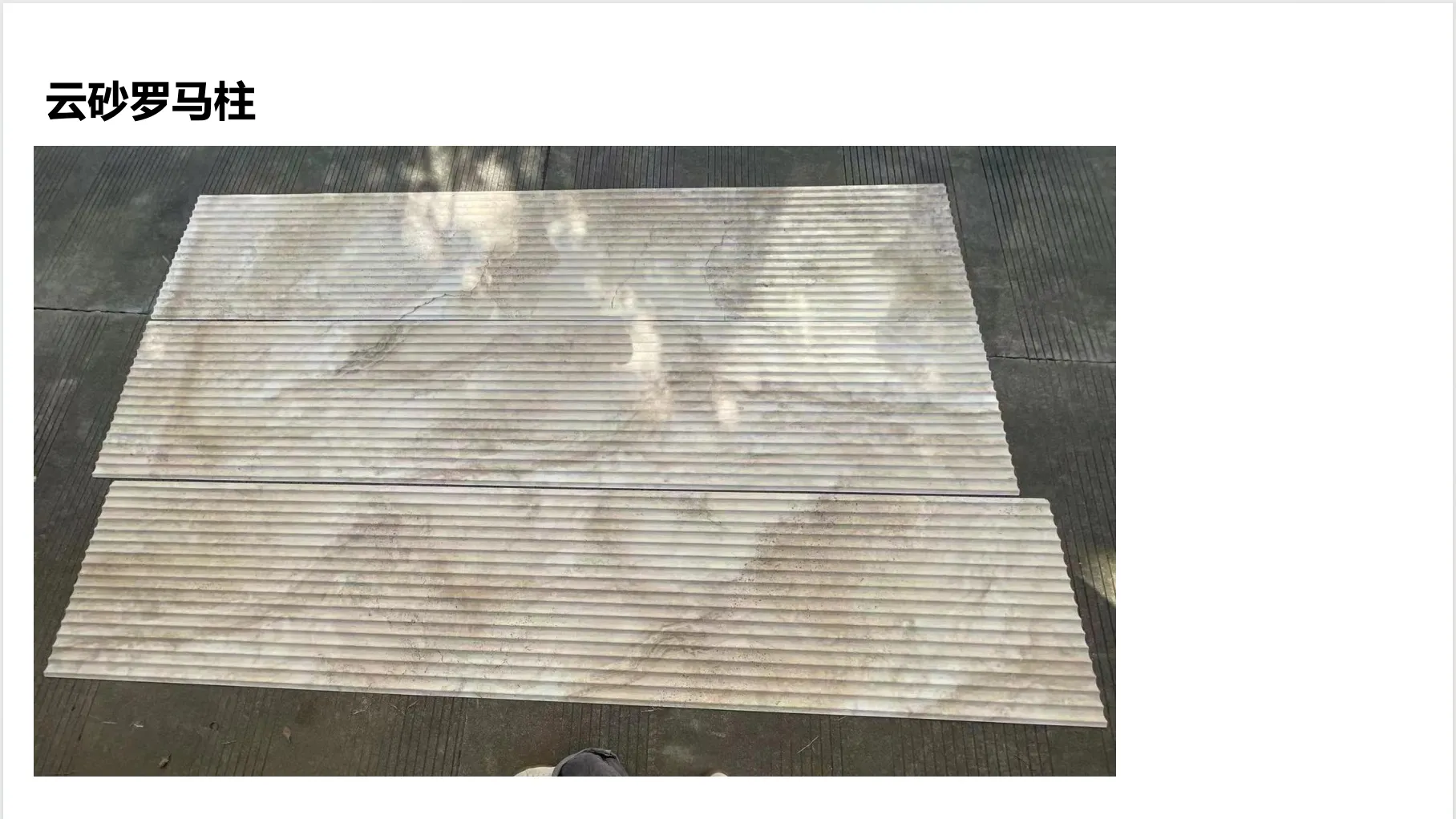
Consider the use of fluting, that classic vertical groove pattern from ancient Greece. Traditional flutes were deep and evenly spaced, carved by hand to catch the light. Modern designers have kept the fluting but played with scale: some pillars have ultra-narrow flutes, almost like pinstripes, while others have irregular, asymmetrical grooves that feel more organic. Pair that with a finish like lunar peak golden—a warm, metallic hue—and suddenly, a design element from 500 BCE feels right at home in a 2025 boutique hotel.
Texture is another bridge between old and new. Traditional marble pillars often aimed for smoothness, with polished surfaces that reflected light. Modern pillars, by contrast, embrace imperfection. A rough-hewn rammed earth board pillar (think sun-baked clay with visible layers) next to a sleek travertine (vintage black) pillar creates a dialogue: the earthiness of the past meeting the drama of the present. It's a sensory experience—run your hand from the rough rammed earth to the cool, smooth travertine, and you'll feel the evolution of design in your fingertips.
Even symbolism has shifted. Where traditional pillars said, "Look at our power," modern ones often say, "Look at our creativity." Take a pillar wrapped in woven (khaki) fabric—yes, fabric!—over a marble core. It's unexpected, softening the stone's hardness and adding a tactile, almost cozy element. Or a pillar made of stacked, irregular boulder slabs (vintage silver), each piece slightly different, like a modern cairn. These pillars don't demand reverence; they invite curiosity. They say, "We honor the past, but we're not stuck in it."
| Feature | Traditional Marble Pillars | Modern Marble Pillars |
|---|---|---|
| Material Focus | Pure marble or travertine, quarried and carved by hand. | Mixed materials: marble veneers, mcm flexible stone, fair-faced concrete, or foamed aluminium alloy. |
| Craftsmanship | Hand-carved, with visible tool marks and slight irregularities. | CNC-machined precision, 3D-printed details, and "vintage" treatments for aged texture. |
| Aesthetics | Symmetrical, with fluted columns and ornate capitals (Doric, Ionic, Corinthian). | Minimalist or eclectic: sleek lines, mixed textures (rough/smooth), and finishes like lunar peak silvery or travertine (vintage gold). |
| Functionality | Heavy, solid, and structural; designed to last centuries. | Lightweight, sustainable, and often modular; easier to install and repair. |
| Symbolism | Power, order, and legacy (e.g., temples, palaces). | Creativity, innovation, and connection (e.g., museums, tech offices, community spaces). |
At the end of the day, whether traditional or modern, marble pillars are time travelers. They carry the echoes of ancient stonemasons and the dreams of today's architects. They remind us that design isn't about replacing the old with the new—it's about conversation. A conversation between a Roman stonemason, chiseling a travertine block for the Colosseum, and a modern designer, 3D-printing a lunar peak golden pillar for a rooftop bar in Tokyo. A conversation between texture and technology, between weight and lightness, between "this is how we've always done it" and "what if we tried something new?"
So the next time you pass a marble pillar, take a second look. Is it smooth and fluted, whispering of ancient Greece? Or is it rough and silver-hued, shouting of today's creativity? Either way, it's not just holding up a roof. It's holding up a story—one that's still being written.
Recommend Products












