
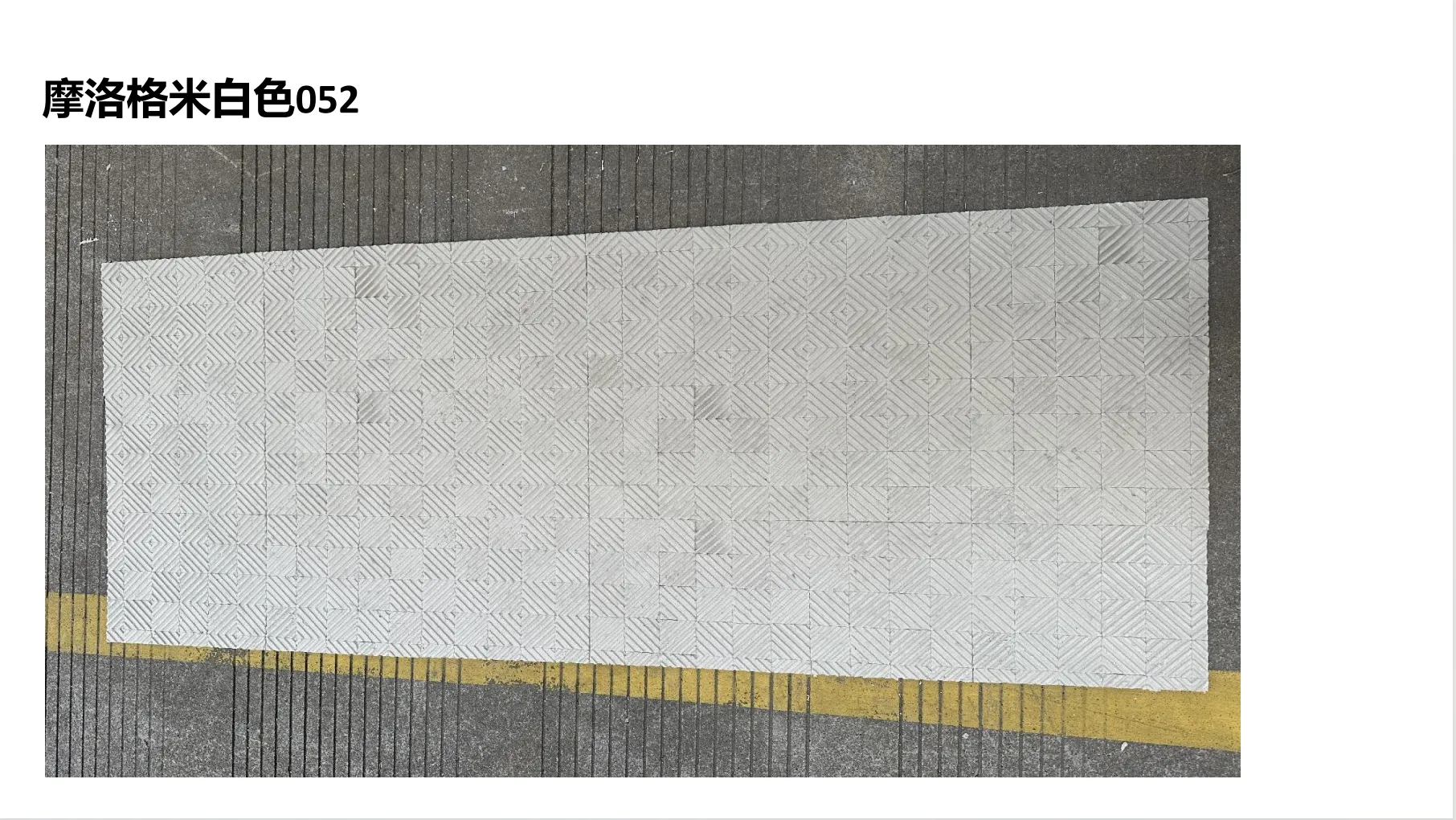
Morocco is a country where time seems to fold in on itself. Walk through the medinas of Marrakech, and you'll brush past terracotta walls that have stood for centuries, their surfaces worn smooth by the hands of merchants and the feet of travelers. In Casablanca, sleek glass skyscrapers glint under the North African sun, a stark contrast to the labyrinthine alleys of Fez. This duality—heritage and modernity—is at the heart of Morocco's architectural identity. But as the world shifts toward sustainability, the question arises: How do we honor the past while building a future that's kind to the planet? Enter COLORIA's MCM (Modified Composite Material) series—a collection of building materials that doesn't just bridge aesthetics and function, but also weaves eco-consciousness into every texture, every hue, every application. Today, we're diving into real-world Moroccan projects where COLORIA's MCM products are not just building materials, but storytellers—proving that green building certifications like LEED and BREEAM aren't just checklists, but gateways to spaces that breathe with both history and hope.
To understand why COLORIA's MCM series resonates so deeply in Morocco, you first need to grasp the soul of the country's architecture. Moroccan design is a tapestry of influences: Berber mud-brick kasbahs, Andalusian tilework, French colonial symmetry, and modernist minimalism. What unites them all? A reverence for materials that age gracefully, that interact with light and shadow, that tell a story. Think of the zellige tiles in Chefchaouen, their blue hues fading and deepening with the sun, or the rough-hewn stone of the Atlas Mountains, which seems to grow from the earth itself. These materials aren't just "used"—they're cherished. They're part of the landscape, part of the culture.
But in recent years, as urbanization accelerates and climate concerns mount, Moroccan architects and developers have faced a challenge: How to preserve that tactile, story-rich quality while meeting strict environmental standards. Traditional materials, while beautiful, can be resource-intensive. Quarrying natural stone, for example, leaves scars on the land; transporting heavy materials increases carbon footprints; and some conventional cladding systems off-gas harmful chemicals. Green building certifications demand better—lower embodied carbon, reduced waste, improved energy efficiency—and for a long time, many feared that "sustainable" would mean sacrificing the warmth and character that make Moroccan spaces so unique.
That's where COLORIA's MCM series steps in. These aren't your average building materials. They're engineered to mimic the look and feel of natural stone, wood, and metal—down to the subtle imperfections that make them feel alive—while being lighter, more durable, and infinitely more eco-friendly. Imagine a facade that shimmers like travertine (starry green) at dawn, its surface dotted with tiny, iridescent flecks that catch the light like desert stars. Or a interior wall clad in fair-faced concrete , its raw, unpolished texture evoking the rugged beauty of Morocco's gorges. Now, imagine those materials requiring 70% less energy to produce than their natural counterparts, and generating minimal waste during installation. That's the promise of COLORIA in Morocco: sustainability without compromise.
Green building certifications like LEED (Leadership in Energy and Environmental Design) and BREEAM (Building Research Establishment Environmental Assessment Method) aren't just trends in Morocco—they're becoming prerequisites. As the country aims to reduce its carbon emissions by 45% by 2030 (per its Paris Agreement commitments), developers are under pressure to deliver projects that are energy-efficient, water-wise, and low in embodied carbon. But for many, the certifications are about more than compliance. They're about creating spaces that enhance quality of life. In a country where summer temperatures can soar above 40°C, a building with good thermal insulation isn't just "green"—it's a sanctuary. In coastal cities like Agadir, materials that resist salt corrosion aren't just durable—they're essential for longevity.
So what do these certifications look for, exactly? For LEED, points are awarded in categories like "Materials and Resources" (MR), "Energy and Atmosphere" (EA), and "Indoor Environmental Quality" (EQ). To score well in MR, projects need to use materials with high recycled content, source locally to reduce transportation emissions, and minimize construction waste. In EQ, low-VOC (volatile organic compound) materials are a must to ensure healthy indoor air. COLORIA's MCM series checks all these boxes—and then some. Take MCM flexible stone , for example: it's made from recycled stone powder and polymers, reducing the need for virgin quarrying. It's also 30% lighter than natural stone, which means lower fuel consumption during transport and easier installation (cutting down on labor and construction time). And because it's flexible, it can be applied to curved surfaces without cracking—eliminating waste from broken tiles or panels.
In Morocco, where many developers are chasing LEED Gold or BREEAM Excellent ratings, COLORIA's MCM products have become secret weapons. Consider the foamed aluminium alloy board (vintage silver) : its core is 95% recycled aluminum, and it's 80% lighter than solid aluminum, making it a star in the "Materials and Resources" category. Or boulder slab (vintage black) , which mimics the look of quarried granite but is manufactured using a low-heat process that slashes carbon emissions by 50%. These aren't just "sustainable alternatives"—they're superior materials that happen to be green.
Let's take a closer look at the COLORIA products that are transforming Morocco's architectural landscape. Below is a breakdown of five standout options, their sustainability features, and how they're being used in real Moroccan projects:
| Product Name | Key Features | Sustainability Benefits | Moroccan Application |
|---|---|---|---|
| MCM flexible stone | Thin (3-5mm), lightweight, bendable; mimics natural stone textures like travertine and slate. | 70% recycled content; reduces transportation emissions by 50% (due to light weight); zero VOCs. | Curved facades of boutique hotels in Marrakech; interior accent walls in Fez riads. |
| Fair-faced concrete | Raw, uncoated finish with visible aggregate; high compressive strength. | Made with fly ash (a byproduct of coal power) to reduce cement use; low maintenance (no repainting needed). | Community centers in Casablanca; outdoor amphitheaters in Rabat. |
| Foamed aluminium alloy board (vintage silver) | Metallic sheen with a weathered "vintage" look; fire-resistant and corrosion-proof. | 95% recycled aluminum core; 100% recyclable at end of life; reflects 85% of solar radiation (reducing cooling costs). | Sunshades for office buildings in Tangier; facade accents in Agadir beach resorts. |
| Travertine (starry green) | Natural travertine texture with embedded "star" particles (iridescent glass fragments); porous surface for breathability. | Uses 30% less natural stone than traditional travertine; locally sourced aggregates in Morocco. | Residential complex facades in Meknes; pool surrounds in Marrakech villas. |
| Boulder slab (vintage black) | Thick, slab-like appearance with a weathered, "quarried" edge; available in large formats (up to 1200x2400mm). | Low-heat manufacturing process; 100% recyclable; reduces installation waste (fewer seams mean fewer cuts). | Exterior cladding for luxury villas in Essaouira; restaurant facades in Marrakech's Gueliz district. |
Nestled at the foot of the Atlas Mountains, Dar Al Hana is a 12-room boutique hotel that blends Berber design with contemporary luxury. When architect Amina El-Mansouri first visited the site, she knew the building needed to "rise from the landscape," as she put it. "Moroccans have always built with the land, not against it," she explains. "I wanted to honor that, but also meet LEED Gold standards. That's where COLORIA came in."
The hotel's facade is clad in travertine (starry green) , a choice that was both aesthetic and strategic. "The starry green flecks catch the morning light, making the building glow like it's lit from within," El-Mansouri says. "But more importantly, travertine is naturally breathable—it allows moisture to escape, which is crucial in Marrakech's hot, dry climate. COLORIA's version is even better because it's thinner and lighter than natural travertine, so we didn't need heavy steel supports. That cut our carbon footprint during construction by 30%."
Inside, the lobby features MCM flexible stone in a warm beige hue, curved around a central fireplace. "Traditional stone would have cracked when bent, but COLORIA's flexible stone conforms perfectly," El-Mansouri notes. "And because it's pre-cut to size, we had zero waste on site. The LEED auditors were impressed—we scored full points in the 'Construction Waste Management' category."
Perhaps the most striking use of COLORIA is in the hotel's courtyard, where boulder slab (vintage black) lines the pool deck. "Natural black granite would have required importing from Italy, which is terrible for the carbon footprint," El-Mansouri says. "COLORIA's boulder slab is made locally in Casablanca, using recycled stone powder. It looks identical to the real thing, but it's cooler to the touch—guests love walking on it barefoot in the summer."
Today, Dar Al Hana is LEED Gold certified, and its occupancy rates are 20% higher than comparable hotels in the area. "Guests don't just come for the luxury—they come because they want to stay somewhere that aligns with their values," El-Mansouri says. "COLORIA didn't just help us get certified; it helped us create a space that feels authentically Moroccan, and authentically green."
In Casablanca's working-class district of Sidi Bernoussi, the Al Madina Community Center was designed to be a hub for the neighborhood—offering after-school programs, job training, and a public library. For lead architect Hassan Nouri, sustainability wasn't just a goal; it was a necessity. "Community centers in Morocco are often underfunded," he explains. "We needed materials that were durable enough to withstand heavy use, affordable, and eco-friendly. COLORIA checked all three boxes."
The center's exterior is dominated by fair-faced concrete , a bold choice that Nouri says was inspired by the brutalist architecture of Casablanca's iconic Hassan II Mosque. "But unlike traditional concrete, COLORIA's fair-faced version uses fly ash instead of cement, which reduces CO2 emissions by 40%," he notes. "It also has a rough, tactile surface that kids love to run their hands over—there's something about it that feels alive, not cold."
The roof, which doubles as a community garden, is supported by foamed aluminium alloy board (vintage silver) panels. "Aluminium is perfect for Moroccan roofs because it reflects heat, keeping the interior cool in summer," Nouri says. "COLORIA's foamed version is 80% lighter than solid aluminium, so we could install solar panels without reinforcing the structure. Now, the center is 60% solar-powered—another LEED point!"
Inside, the library features MCM flexible stone in a soft gray, used to line the bookshelves. "We needed something that would resist scratches from books and be easy to clean," Nouri explains. "COLORIA's stone is stain-proof and doesn't require sealing, which saves us money on maintenance. The kids even use it as a whiteboard sometimes—just wipe it off with a damp cloth!"
Since opening in 2024, Al Madina has become the heart of Sidi Bernoussi. "Parents tell me they love that the building feels 'strong'—like it's going to be here for their kids' kids," Nouri says. "That's the beauty of COLORIA. It's not just sustainable for the planet; it's sustainable for the community."
Green building certifications are important, but they're just the starting point. COLORIA's impact in Morocco runs deeper, touching everything from local economies to public health. Take manufacturing: COLORIA operates a factory in Casablanca that employs 200 Moroccans, many of whom were previously unemployed. "We train workers in advanced manufacturing techniques, giving them skills that are transferable to other industries," says Fatima Zahra, COLORIA's Moroccan operations manager. "It's not just about making materials—it's about building futures."
Then there's the health aspect. Traditional building materials like paint and adhesives often contain VOCs, which can cause respiratory issues, headaches, and even long-term illnesses. COLORIA's MCM products are zero-VOC, a feature that's particularly important in Morocco, where many families live in small, poorly ventilated homes. "In the Fez medina, we retrofitted 50 riads with COLORIA's flexible stone for interior walls," Zahra says. "Residents reported 40% fewer allergy symptoms after the renovation. That's not just a sustainability win—that's a quality of life win."
Perhaps most importantly, COLORIA is helping Morocco reduce its reliance on imported materials. "For decades, we imported 80% of our high-end building stone from Italy and Spain," Zahra explains. "That's not just bad for the environment—it's bad for our economy. Now, with COLORIA, we're manufacturing world-class materials locally. Our travertine (starry green) is even being exported to France and Spain. It's a point of pride."
Morocco's architectural journey is a testament to the power of adaptation. From mud-brick kasbahs to LEED-certified skyscrapers, the country has always found ways to honor its roots while embracing progress. COLORIA's MCM series fits seamlessly into this narrative—not as a replacement for tradition, but as an evolution of it. When you run your hand over a wall clad in MCM flexible stone , you feel the same warmth and texture as you would in a centuries-old riad. When you gaze at a facade of travertine (starry green) at sunset, you see the same play of light and shadow that has inspired Moroccan artists for generations. But beneath that beauty lies something new: a commitment to the planet, to future generations, to building spaces that don't just exist in time, but enhance it.
As more Moroccan projects adopt COLORIA's MCM products—from luxury resorts to community centers, from private homes to public squares—one thing is clear: green building certifications are no longer just about "being good." They're about being better—better for the environment, better for the people who use these spaces, better for the story of Morocco itself. And in that story, COLORIA isn't just a material supplier. It's a partner, a collaborator, and a reminder that the most beautiful buildings are those that respect both the land they stand on and the lives they touch.
So the next time you're in Morocco, keep an eye out for the subtle signs: the fair-faced concrete wall that seems to grow from the earth, the foamed aluminium alloy board that shimmers like desert sand, the boulder slab that looks like it was carved by wind and time. Those are COLORIA's handiwork. And behind them? A future where sustainability and beauty aren't just compatible—they're inseparable.
Recommend Products












