
We've long admired stone for its strength and beauty. Marble floors in grand lobbies, granite countertops in kitchens, travertine facades that age like fine wine—these materials feel timeless. But "timeless" doesn't always mean "sustainable." The truth is, traditional building stones come with a hidden price tag: one written in carbon, water, and waste.
Take quarrying, for example. Extracting stone from the earth often involves heavy machinery guzzling diesel, blasting that scars landscapes, and tons of waste rock left behind—sometimes up to 30% of the quarried material is discarded as "scrap." Then there's transportation: raw stone is heavy, so shipping it across the globe pumps even more CO2 into the air. By the time a slab of traditional marble reaches a construction site, its carbon footprint can rival that of some plastics.
And it's not just stone. Concrete, the backbone of modern construction, is responsible for about 8% of global carbon emissions. Its production relies on cement, which requires burning limestone at high temperatures—releasing CO2 both from fuel and the stone itself. Even "natural" materials like hardwood can contribute to deforestation if not sourced responsibly.
So when we talk about "sustainable building," we're not just talking about solar panels or green roofs. We're talking about the very bones of our structures—the materials that make up 60-70% of a building's embodied carbon (the emissions from production, transport, and construction). That's where MS Travertino steps in.
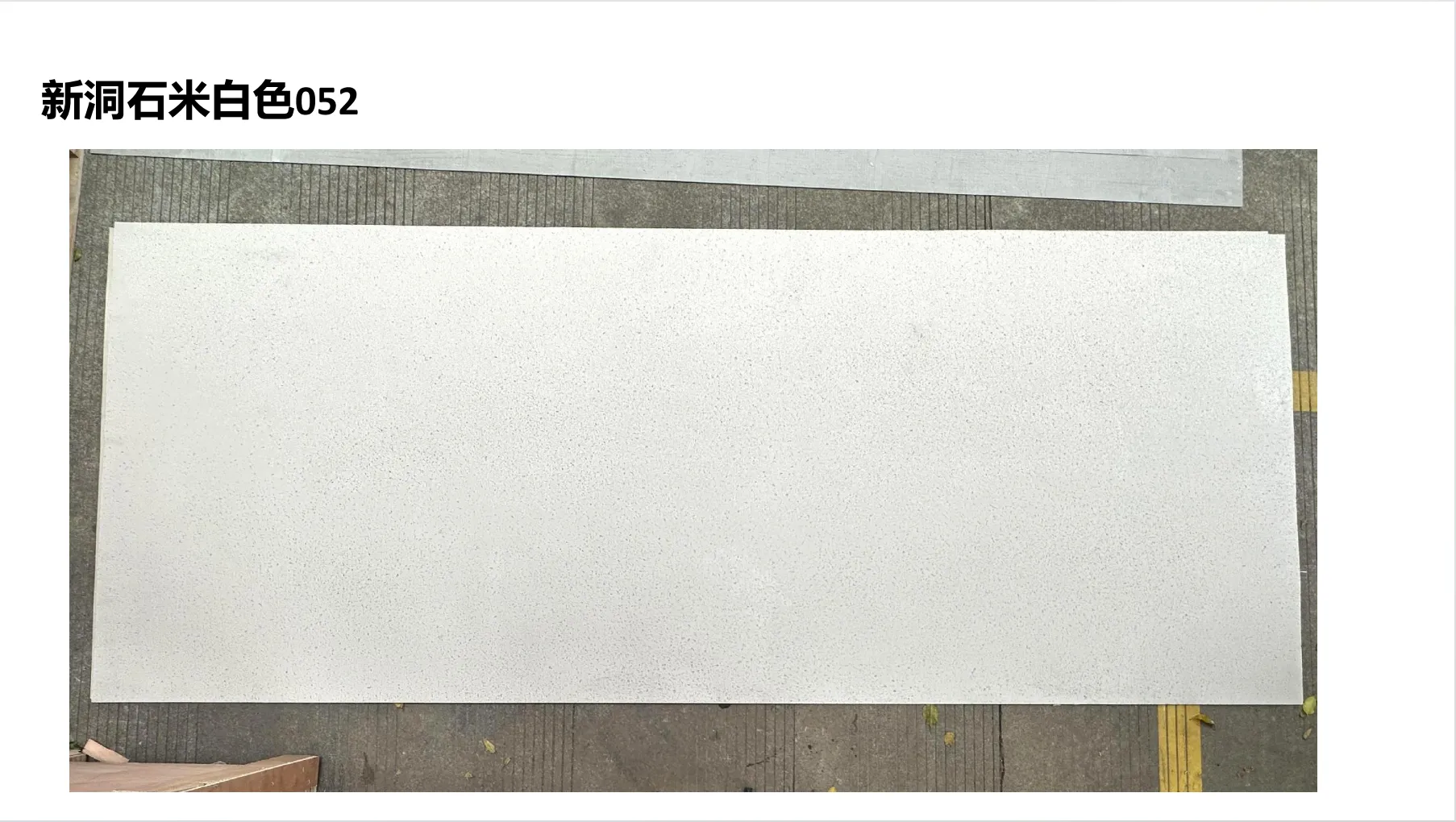
At first glance, MS Travertino looks like any other high-end travertine. Its surface is dotted with the characteristic pits and veins that give travertine its organic charm, and it comes in hues that range from soft beiges to dramatic travertine (starry green) —a deep, rich shade flecked with mineral deposits that glint like distant stars. But beneath that familiar beauty lies a process that's anything but traditional.
MS Travertino is part of the MCM (Modified Composite Material) family, a category of building materials designed to mimic the look and feel of natural stone while slashing its environmental impact. Here's how it works: instead of quarrying massive blocks of stone, MS Travertino starts with recycled stone dust and aggregates—leftovers from other quarry operations that would otherwise end up in landfills. These byproducts are mixed with a low-VOC (volatile organic compound) binder, pressed into thin, lightweight panels, and cured using energy-efficient processes that require a fraction of the heat of traditional stone manufacturing.
The result? A material that's 70% lighter than natural travertine, which means lower transportation emissions. It uses 85% less water in production than quarried stone, and since it's made from recycled materials, it reduces the need for new mining. Perhaps most importantly, its carbon footprint is up to 60% smaller than that of traditional travertine—a game-changer for architects and builders aiming for net-zero projects.
But don't let the "composite" label fool you. MS Travertino isn't some cheap imitation. It's durable enough to withstand harsh weather (think freezing temperatures, heavy rain, and UV rays), scratch-resistant, and easy to install. In fact, its lightweight nature makes it ideal for retrofitting older buildings, where structural weight is a concern. And because it's made in controlled factory conditions, each panel is consistent in color and texture—no more surprises when a shipment of natural stone arrives with unexpected variations.
To truly appreciate MS Travertino's low-carbon credentials, let's walk through its lifecycle—step by step, from "waste" to wall.
It starts at quarries across Europe and the Middle East, where natural stone is extracted for high-end projects. For every ton of natural travertine quarried, about 300kg ends up as dust, chips, or offcuts—too small or irregular for traditional use. Instead of dumping this waste, MS Travertino's suppliers collect it, sort it by color and mineral content, and ship it to manufacturing facilities in compact, dense bales (another win for transportation efficiency).
At the factory, the recycled stone aggregate is mixed with a water-based binder derived from plant starches—no toxic chemicals here. The mixture is poured into molds, which are then pressed under high pressure to remove air and ensure density. Unlike traditional stone curing, which often requires weeks of air-drying or high-temperature kilns, MS Travertino cures in low-energy ovens that use 75% less electricity than standard stone processing. Even the molds are reusable, cutting down on plastic waste.
Once cured, the panels are cut to size using precision saws that minimize dust (and the need for water-based dust suppression, which saves even more H2O). The finishing touches—like honing for a matte look or polishing for shine—are done with diamond-tipped tools that generate less waste than traditional grinding. Any scraps from cutting are recycled back into the production process, creating a closed-loop system.
Because MS Travertino panels are thin (just 6-8mm thick) and lightweight (around 8kg per square meter, compared to 25kg for natural travertine), a single truck can carry 3x more material than a load of natural stone. That means fewer trips, less fuel, and lower emissions. On site, installation is a breeze: the panels can be glued directly to walls or ceilings using eco-friendly adhesives, eliminating the need for heavy mortar. And since they're so light, installers can handle them without specialized equipment—reducing labor time and associated energy use.
By the time an MS Travertino panel is mounted on a wall, its total carbon footprint is roughly 2.3kg CO2e per square meter. Compare that to natural travertine, which averages 5.8kg CO2e per square meter, and it's clear: this isn't just a small improvement. It's a revolution.
MS Travertino is a star player in sustainable building, but it's rarely alone. The best green projects pair it with other low-carbon materials to create cohesive, eco-friendly spaces. Let's take a look at two standout options from the MCM lineup that complement MS Travertino perfectly.
For curved surfaces—think archways, rounded columns, or organic-shaped facades—rigid stone panels just won't cut it. That's where MCM flexible stone shines. Like MS Travertino, it's made from recycled stone aggregates and a flexible binder, but it's thin enough (just 3mm) to bend around curves with a radius as tight as 30cm. It comes in a range of finishes, from rough-hewn "rustic" to smooth "polished," and pairs beautifully with MS Travertino in both color and texture.
"We used MCM flexible stone to clad the curved lobby walls of a cultural center in Berlin," says Jan Richter, lead architect at Studio Erde. "We combined it with MS Travertino floors, and the effect is stunning—warm, flowing, and entirely low-carbon. Traditional curved stone would have required custom-cut blocks, generating tons of waste. Flexible stone? Zero waste, and half the installation time."
For projects that lean into modern, industrial design, foamed aluminium alloy board (vintage silver) is a match made in sustainable heaven. Aluminium is already one of the most recyclable materials on the planet (95% of the energy used to produce new aluminium is saved by recycling old aluminium), but foamed aluminium takes it a step further. The foaming process injects tiny air bubbles into the metal, reducing its weight by 60% while maintaining strength. The result is a lightweight, durable panel with a matte, weathered finish that adds depth to any space.
When paired with MS Travertino, the contrast is striking: the warm, organic texture of the stone balances the cool, sleek lines of the aluminium. It's a combination we've seen in everything from urban co-working spaces to coastal homes, where the aluminium's corrosion resistance and the stone's durability stand up to salt air.
Numbers tell a story, and when it comes to sustainability, the numbers on carbon footprints are impossible to ignore. Let's break down how MS Travertino stacks up against common building materials. All figures are based on cradle-to-gate data (from raw material extraction to factory gate) and measured in kg CO2e per square meter.
| Material | Carbon Footprint (kg CO2e/m²) | Water Usage (L/m²) | Durability (Expected Lifespan) | Recyclability |
|---|---|---|---|---|
| MS Travertino | 2.3 | 15 | 50+ years | 100% (recycled into new MCM panels) |
| Natural Travertine | 5.8 | 100 | 50+ years | Limited (crushed for aggregate only) |
| Standard Concrete | 8.1 | 200 | 30-40 years | Limited (recycled as fill material) |
| Granite | 7.2 | 120 | 60+ years | Limited (crushed for aggregate only) |
| Foamed Aluminium Alloy Board (Vintage Silver) | 3.1 | 5 | 60+ years | 100% (recycled into new aluminium products) |
The difference is clear: MS Travertino not only has a significantly lower carbon footprint than natural stone and concrete, but it also uses far less water and is fully recyclable at the end of its life. And when you factor in its lightweight design (which reduces transportation emissions) and ease of installation (which cuts down on on-site energy use), the gap grows even wider.
You've probably seen it before: stock photos of "sustainable" buildings that look more like computer renderings than real spaces—perfectly lit, zero flaws, and suspiciously lacking in the messy, beautiful details that make a place feel alive. That's why MS Travertino's focus on "real photos" is so refreshing. These aren't staged shots in a studio; they're images of actual projects, with natural light, visible seams, and the subtle variations that come with real-world installation.
Why does this matter? For one, it builds trust. Sustainable materials are often met with skepticism—"Is it really as durable as they say?" "Does it look cheap in person?" Real photos answer those questions. They show MS Travertino aging gracefully on a restaurant patio after two years of rain and sun. They capture the way travertine (starry green) shifts color depending on the time of day, from deep emerald in the morning to a softer sage at dusk. They prove that eco-friendly doesn't mean sacrificing beauty.
Real photos also inspire. When designers and homeowners see MS Travertino used in a cozy home office, a bustling café, or a community library, they start to imagine it in their own spaces. They see how it pairs with wood, glass, and metal, and they realize that sustainability isn't a niche choice—it's a design choice, one that can elevate any project.
"I used to avoid composite materials because the samples looked flat and fake," admits Carlos Mendez, an interior designer in Mexico City. "Then I saw real photos of MS Travertino in a friend's home. The texture was there, the depth was there—it looked like a million bucks. Now I specify it in almost every project. Clients love that they're doing good for the planet, and I love that I can deliver the aesthetic they want."
MS Travertino isn't just a product—it's a sign of where the industry is heading. As governments crack down on carbon emissions and consumers demand more sustainable options, building materials are being reimagined from the ground up. We're seeing innovations like carbon-capturing concrete, mycelium-based insulation, and even "living" bricks grown from bacteria. MS Travertino fits into this movement by proving that sustainability and luxury don't have to be opposites.
But the future won't be about one "perfect" material. It will be about systems: combining MS Travertino with MCM flexible stone for curved surfaces, foamed aluminium alloy board (vintage silver) for accents, and low-carbon insulation for energy efficiency. It will be about circularity, where materials are designed to be recycled or repurposed at the end of their life, creating a closed loop that minimizes waste.
Most importantly, it will be about choice. Every time we pick a material for a wall, a floor, or a facade, we're voting for the kind of planet we want to live on. MS Travertino gives us a vote that says: "I want beauty. I want durability. And I want to leave this Earth better than I found it."
Sustainable building isn't just about meeting regulations or checking a box on a green certification form. It's about creating spaces that nurture us—physically, emotionally, and spiritually—without harming the planet. MS Travertino does that. It's a material that feels good to touch, that tells a story of innovation and responsibility, and that will still be standing long after we're gone, a testament to the choices we made today.
So the next time you walk into a building, take a moment to look at the walls. What do they say about the people who built them? With MS Travertino, they say: "We cared." And in a world that needs more care, that's the most beautiful statement of all.
Recommend Products












