
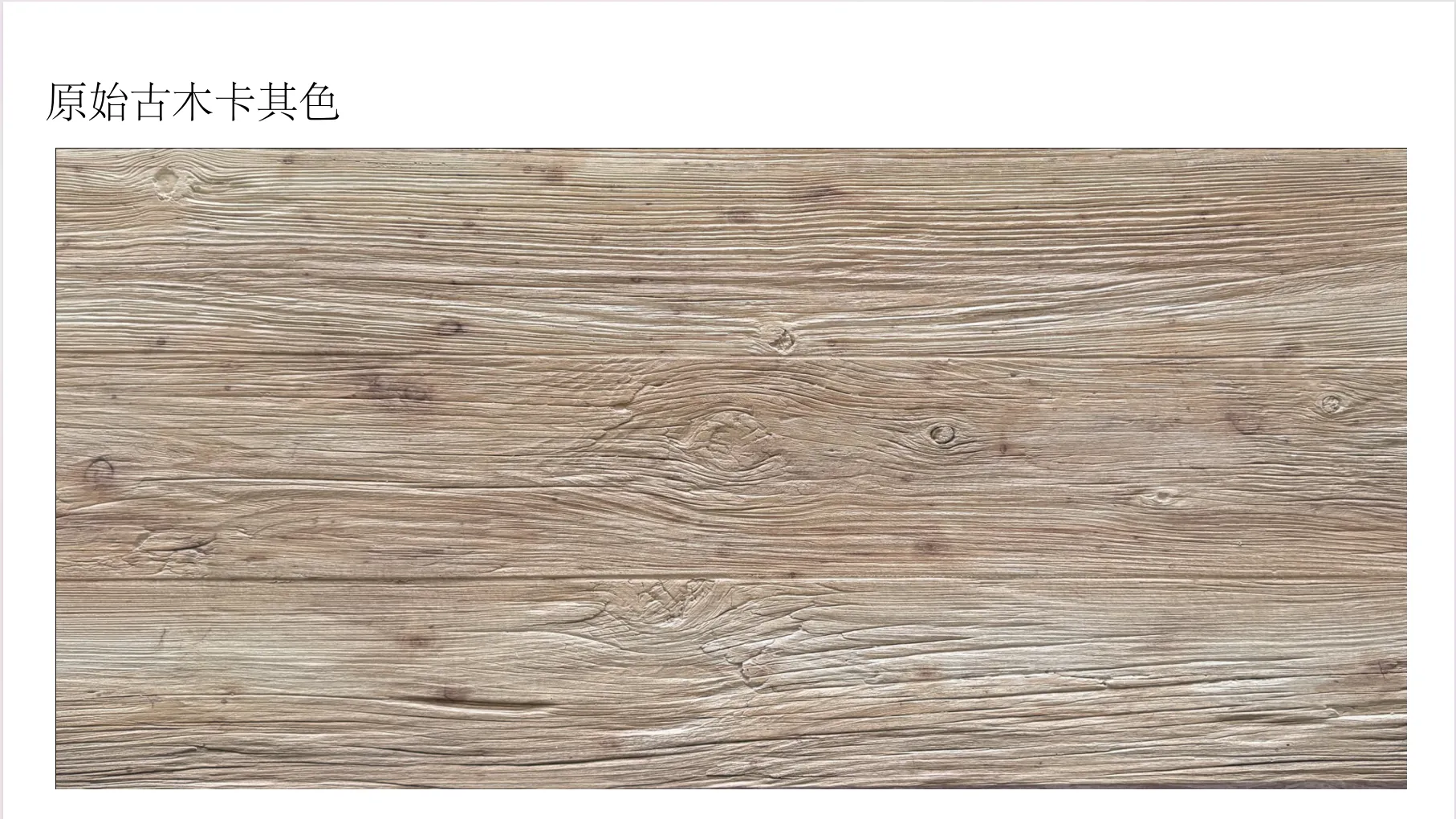
Imagine walking through a modern city square and being stopped in your tracks by a towering sculpture. At first glance, it looks like a masterpiece carved from ancient oak, its grains swirling like rivers frozen in time, its edges softened by decades of weathering. But as you step closer, your fingers brush against the surface—and you realize something extraordinary: this isn't wood at all. It's a 3D-printed creation, born from cutting-edge technology, yet steeped in the timeless artistry of woodworkers who lived centuries ago. This is the magic of MCM's 3D Printing Series, where the past and future of architectural sculpture collide in the most beautiful way.
For as long as humans have built, we've turned to wood as a medium of expression. There's something inherently human about it—the way it bends, the way it tells a story through every knot and burl, the way it connects us to the natural world. Ancient wood art, whether in the form of intricately carved temple beams in Japan or the weathered barn doors of rural Europe, isn't just about aesthetics; it's about memory. It's about capturing the essence of a culture, a moment, a craft that's passed down from hand to hand, generation to generation.
But here's the thing about traditional wood art: it's fragile. Wood warps, rots, burns. It can't withstand the harsh salts of coastal winds or the heavy rains of tropical climates. And for all its beauty, carving large-scale wood sculptures is a labor of love that takes months, even years—time that modern architecture, with its tight deadlines and ever-evolving designs, often can't afford. That's where MCM steps in. Their 3D Printing Series isn't just a tool; it's a bridge. A bridge between the artisans of old, who poured their souls into every chisel mark, and the architects of today, who dream in bold, impossible shapes.
Let's start with the heart of it all: ancient wood art. Think about the first time you ran your hand over a well-loved wooden table. Maybe it was your grandmother's kitchen table, scarred with years of homework scribbles and spilled milk, but still warm to the touch. That's the power of wood—it carries history in its fibers. Ancient woodworkers understood this. They didn't just carve wood; they collaborated with it. They let the grain guide their tools, turning flaws into features, and creating pieces that felt alive.
Take, for example, the wooden brackets in traditional Chinese architecture, known as "dougong." These interlocking structures, which support roofs without nails, are as much engineering marvels as they are works of art. Each piece is carved to fit perfectly with the next, a dance of precision and patience that's been refined over millennia. Or consider the "yosegi" marquetry of Japan, where tiny pieces of wood are assembled into intricate patterns that mimic landscapes, animals, or geometric designs—each grain direction chosen to catch the light just so. These aren't just decorations; they're stories told in wood.
But as beautiful as these traditions are, they have limits. Wood is organic, and organic materials decay. Many ancient wood sculptures have been lost to time, their details eroded by wind and rain, their stories faded. And even when preserved, they're often confined to museums, behind glass, where they can't interact with the world the way their creators intended. That's where the frustration sets in for modern architects: how do you honor that legacy while building for a world that demands durability, scalability, and innovation?
Enter MCM's 3D Printing Series. If ancient wood art is the soul of architectural sculpture, MCM's technology is the body that lets it walk, breathe, and thrive in the 21st century. This isn't your average 3D printing, the kind that spits out small plastic trinkets. We're talking about industrial-scale printers that can create panels, facades, even entire sculptures—all with the texture, depth, and warmth of hand-carved wood, but made from materials that can stand up to anything the elements throw at them.
What makes MCM's approach so special is that it doesn't replace traditional craftsmanship—it elevates it. Instead of starting with a block of wood, designers start with a digital scan of an ancient wood carving, or a hand-drawn sketch inspired by those traditions. Then, using MCM's proprietary software, they tweak, refine, and scale the design—adding curves that would be impossible to carve by hand, or integrating other materials that complement the wood-like texture. Finally, the 3D printer brings it to life, layer by layer, using a blend of polymers, fibers, and even natural materials that mimic the look and feel of wood.
I recently spoke with Maria, an architect in Barcelona who used MCM's 3D Printing Series for a community center project. "We wanted the facade to feel like it had been there for centuries, even though the building was brand new," she told me. "We drew inspiration from the old wooden barns in the Pyrenees—their weathered planks, the way the grain seems to flow like water. But we couldn't use real wood; the center is right by the coast, and the salt air would destroy it in years. MCM's 3D printed wood grain board was the answer. It looks so real, people still knock on it and ask if it's oak. But it's tough as nails. We tested it with salt spray, extreme heat, even freeze-thaw cycles—and it didn't budge."
Maria's story isn't unique. Architects and designers around the world are turning to MCM's 3D Printing Series to solve a common problem: how to create spaces that feel rooted in history without being trapped by it. Whether it's a hotel lobby that evokes a mountain lodge, a retail storefront that nods to old-world craftsmanship, or a public park sculpture that pays homage to local woodworking traditions, MCM's technology lets them do it all—faster, more affordably, and with materials that last.
Of course, none of this would work without the right materials. MCM's 3D Printing Series isn't just about the printer—it's about the palette of materials that bring these designs to life. Let's take a closer look at some of the stars of the show, and how they contribute to that perfect blend of ancient charm and modern durability.
| Material Name | Key Features | Applications | Aesthetic Vibe |
|---|---|---|---|
| Wood Grain Board | Mimics the look of real wood grain, with visible knots, swirls, and color variations. Made from a blend of recycled wood fibers and high-strength polymers for durability. | Facades, wall panels, furniture, decorative sculptures. | Warm, rustic, and familiar—like walking into a cabin in the woods, but with a modern twist. |
| Flexible Stone | Thin, lightweight, and bendable, yet strong enough to withstand impact. Can be printed in intricate shapes that mimic stone carvings. | Curved facades, ceiling panels, sculptural accents that need to conform to unique angles. | Earthy and grounded, with a texture that feels like hand-chiseled stone—perfect for adding depth to wood-inspired designs. |
| Travertine (Starry Blue) | A synthetic travertine with flecks of blue and silver that catch the light, mimicking the night sky. Porous texture adds visual interest. | Accent walls, outdoor sculptures, water features where light plays a key role. | Dreamy and otherworldly, pairing beautifully with wood grain to create contrast—think ancient forests under a starry sky. |
| MCM Big Slab Board Series | Large-format panels (up to 3m x 1.5m) that reduce seams and create a seamless look. Lightweight but rigid, ideal for large sculptures. | Facade cladding, statement walls, large-scale sculptures that need to make an impact. | Bold and dramatic, with the ability to showcase intricate wood patterns across expansive surfaces—like a mural painted in wood. |
Let's dive deeper into a few of these. Wood Grain Board is the backbone of many MCM 3D printed projects, and it's easy to see why. The level of detail is staggering—you can see the way the "grain" flows around a knot, the subtle variations in color that make real wood so unique. But unlike real wood, it's moisture-resistant, fire-retardant, and won't warp or split. I once ran my hand over a sample piece and had to double-check it wasn't real oak; the texture was that convincing—slightly rough to the touch, with just the right amount of give.
Then there's Flexible Stone, which is a game-changer for sculptural work. Traditional stone is heavy and brittle, making it hard to create curves or delicate details. Flexible Stone, though, is lightweight and bendable, which means architects can design sculptures that seem to defy gravity—think a wooden-inspired wave that curls over a plaza, or a series of interconnected panels that twist and turn like a ribbon. And because it's printed in layers, it can mimic the rough-hewn texture of stone carved with ancient tools, adding that "lived-in" feel to modern designs.
Travertine (Starry Blue) is where art meets science. Travertine itself is a classic building material, used in everything from the Colosseum to modern homes, but MCM's take adds a whimsical twist: tiny particles of reflective material that sparkle like stars when hit by light. Imagine a 3D printed sculpture that looks like a gnarled old tree during the day, its trunk rendered in Wood Grain Board, but at night, when the lights hit, the "leaves" (made of Starry Blue Travertine) twinkle like the night sky. It's that kind of magic that turns a building into an experience.
To really understand the impact of MCM's 3D Printing Series, let's walk through a real-world example. In 2024, the city of Portland, Oregon, commissioned a public sculpture for the downtown waterfront. The goal? To celebrate the region's logging history and the indigenous woodworking traditions that shaped the area. The challenge? To create something that would stand up to Oregon's rainy winters, salty river air, and heavy foot traffic—all while feeling warm and inviting, not cold and industrial.
The winning design, by local artist Elena Martinez, was called "Ancient Roots." It depicts a massive tree trunk, its roots spreading out like fingers into the ground, with carved faces and symbols hidden in the bark—nod to the stories and legends of the Chinook and Tillamook peoples who once lived along the river. But here's the catch: Elena didn't want to use real wood. "I wanted this sculpture to last for generations," she explained. "Real wood would rot within 20 years, and replacing it would be costly and heartbreaking. I needed something that could capture the soul of wood without its weaknesses."
Enter MCM's 3D Printing Series. Elena worked with MCM's design team to scan ancient wood carvings from local museums, including a 19th-century cedar totem pole and a hand-carved dugout canoe. Using that data, they created a digital model of the "Ancient Roots" sculpture, scaling it to 25 feet tall—taller than any real tree trunk they could have sourced. Then, they chose their materials: Wood Grain Board for the trunk and roots, to mimic the texture of old-growth cedar; Flexible Stone for the carved faces, to add depth and dimension; and Travertine (Starry Blue) for the "moss" that clings to the base, which sparkles when the morning sun hits the river.
The printing process took just six weeks—far less than the six months it would have taken to carve a similar sculpture from real wood. And when it was installed, the reaction was overwhelming. "Kids climb on the roots, people take photos with the faces, and everyone asks if it's real wood," Elena. "I even had an old logger come up to me and say, 'That's the spitting image of the cedar trees I used to cut in the '60s—only this one won't end up as toothpicks.' It was the best compliment I could have asked for."
But the real test came during Portland's rainy season. After three months of near-constant rain, the sculpture showed no signs of damage. No warping, no discoloration, no mold—just the same warm, weathered look it had on day one. "That's the beauty of MCM's materials," Elena said. "They don't just look like wood—they act like they've been through the elements, but they don't degrade. It's like having a piece of history that's built to last."
As impressive as "Ancient Roots" is, it's just the beginning. MCM's 3D Printing Series is evolving every year, with new materials, larger printers, and more advanced software that makes it easier than ever to merge ancient art with modern technology. So what does the future hold?
One trend that's already emerging is "biophilic design"—creating spaces that connect people with nature. MCM's Wood Grain Board and Flexible Stone are perfect for this, as they bring the look and feel of the outdoors inside, even in urban environments. Imagine an office building where the walls are printed to look like a forest, with dappled "light" (created with Starry Blue Travertine) filtering through the "trees." Or a hospital where the waiting room features 3D printed wood-inspired panels, proven to reduce stress and anxiety in patients. The possibilities are endless.
Another exciting development is the use of AI to help design these sculptures. MCM is experimenting with machine learning algorithms that can analyze thousands of ancient wood carvings, identify patterns, and generate new designs that honor those traditions while adding a modern twist. It's not about replacing human creativity—it's about giving designers a starting point, a wellspring of inspiration that draws from centuries of craftsmanship.
And let's not forget sustainability. MCM's materials are often made from recycled or eco-friendly ingredients, and 3D printing reduces waste by using only the material needed for the design. In a world where we're all trying to build more responsibly, this is a huge win. "We're not just preserving ancient art—we're preserving the planet," says Raj, MCM's sustainability director. "Every 3D printed sculpture made with our materials is a step away from deforestation and a step toward a circular economy."
At the end of the day, architecture is about more than just buildings. It's about creating spaces that make us feel something—connection, wonder, belonging. Ancient wood art does that by linking us to the past, to the hands that carved, sanded, and polished before us. MCM's 3D Printing Series does that by ensuring those connections don't fade with time.
Whether it's a small accent wall in a café or a towering sculpture in a city square, the work being done with MCM's technology is a testament to human ingenuity: honoring tradition without being bound by it, using innovation to keep history alive. It's about creating art that breathes, that evolves, that can be touched, loved, and passed down to future generations—not as a relic behind glass, but as a living, integral part of the world around us.
So the next time you walk past a building with a wooden-inspired facade, or a sculpture that looks like it was carved by ancient hands, take a closer look. It might just be MCM's 3D Printing Series at work—turning the past into something that's very much alive, right here, right now.
Recommend Products












