

Walk down any modern city street, and you'll notice a quiet revolution happening on building facades. Gone are the days when exterior walls were just functional barriers—today, they're canvases for architectural art, telling stories of creativity, culture, and innovation. At the heart of this revolution is COLORIA GROUP, a name that's become synonymous with pushing the boundaries of what's possible in building materials. Specializing in modified cementitious materials (MCM), they've taken the industry by storm with solutions that blend strength, sustainability, and stunning design. And among their most exciting offerings? The 3D Printed Bali Stone Wall Cladding—a game-changer that's making "impossible" designs a reality for architects and designers worldwide.
Let's start with the obvious: traditional stone cladding has its limits. Heavy, hard to customize, and often a nightmare to install on complex surfaces, it's long been a barrier for designers dreaming of bold, unconventional facades. Enter 3D printing technology. By combining this cutting-edge method with COLORIA's proprietary MCM, the game changes entirely. MCM, or modified cementitious material, is a lightweight, high-strength composite that's as durable as traditional stone but far more versatile. Think of it as stone with a superpower—flexible enough to bend, strong enough to withstand the elements, and eco-friendly enough to make sustainability advocates smile.
COLORIA's MCM 3D Printing Series takes this a step further. Instead of carving or cutting stone into shape, they print it layer by layer, allowing for intricate patterns, organic curves, and custom textures that would be nearly impossible with traditional methods. And when you pair that with the natural beauty of Bali Stone—a material inspired by the lush landscapes and coastal vibes of Bali—you get a cladding solution that's equal parts art and engineering.
Fun fact: Bali Stone, with its warm, earthy tones and subtle grain patterns, has long been a favorite for tropical and resort-style architecture. But with 3D printing, it's no longer limited to flat panels or simple shapes. Now, it can mimic everything from rolling ocean waves to the rough texture of volcanic rock—all while staying lightweight and easy to install.
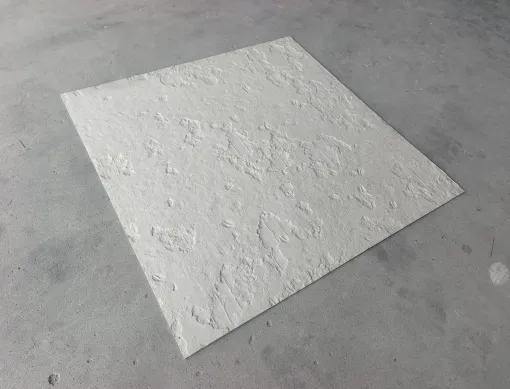
So, what exactly makes 3D Printed Bali Stone so special? Let's break it down. First, the aesthetics. Bali Stone naturally has a warm, inviting look—think soft beiges, warm grays, and hints of gold that evoke sandy beaches and sunlit cliffs. When printed in 3D, these tones and textures can be amplified or modified to fit any design vision. Want a facade that looks like it's been carved by wind and water over centuries? 3D printing can replicate those organic, weathered details with precision. Prefer something more modern, with sharp angles and geometric patterns? No problem—3D printing handles clean lines just as easily.
Take, for example, the Wave Panel design—a popular choice for coastal properties. With traditional stone, creating a wave-like curve would require expensive custom cutting and heavy installation. But with COLORIA's 3D Printed Bali Stone, those waves can be printed in one piece, lightweight enough to attach to most surfaces without extra structural support. The result? A facade that looks like it's frozen in motion, bringing the energy of the ocean right to the building's exterior.
Then there's customization. Architects and designers love to put their own stamp on a project, and with 3D printing, the sky's the limit. Whether it's a hotel wanting to incorporate local cultural motifs into its exterior or a residential building aiming for a one-of-a-kind look, COLORIA can print Bali Stone cladding in almost any shape, size, or pattern. And because MCM is a composite material, it's easy to tweak colors too—adding hints of starry green (like Travertine Starry Green) for a pop of color or deepening the tones for a more dramatic effect.
While 3D Printed Bali Stone is a showstopper, it's just one part of COLORIA's larger MCM family—and that's where the "limitless design possibilities" really shine. Let's talk about MCM Flexible Stone, for instance. Imagine you have a curved wall or a rounded archway that needs cladding. Traditional stone would crack or require complicated cutting, but Flexible Stone bends and conforms to the surface, like a high-tech stone blanket. It's perfect for interior accent walls or exterior features with non-flat surfaces, and it pairs beautifully with 3D Printed Bali Stone. Picture a building with a 3D-printed Bali Stone wave panel as the focal point, flanked by Flexible Stone in a complementary color—seamless, striking, and totally custom.
Then there's the MCM Big Slab Board Series. Sometimes, bigger is better—especially when you want a sleek, modern look with minimal seams. These large-format panels (think 1200x2400mm or even bigger) are ideal for commercial buildings, where a uniform, expansive facade makes a bold statement. And because they're made with MCM, they're still lightweight—no need for extra structural support, even on high-rise buildings. Pair a Big Slab Board base with 3D Printed Bali Stone accents, and you've got a facade that's both modern and inviting.
| Feature | Traditional Stone Cladding | 3D Printed Bali Stone (MCM) | MCM Flexible Stone |
|---|---|---|---|
| Weight | Heavy (often requires structural reinforcement) | Lightweight (up to 70% lighter than traditional stone) | Ultra-lightweight (can bend without breaking) |
| Customization | Limited to simple shapes; complex designs are costly | Unlimited—organic curves, geometric patterns, custom textures | Flexible for curved surfaces; limited to sheet-like forms |
| Installation | Time-consuming; requires skilled labor | Quick and easy; can be installed with basic tools | Simple peel-and-stick or mechanical fixing |
| Environmental Impact | High—quarrying and transportation emit CO2 | Low—recyclable materials, minimal waste in production | Low—same eco-friendly MCM base as 3D printed options |
| Design Flexibility | Basic flat panels or simple cuts | From wave-like curves to 3D mosaics and beyond | Ideal for rounded walls, columns, and non-flat surfaces |
Enough theory—let's talk real projects. Imagine a boutique hotel in Bali, where the owners wanted the exterior to blend in with the island's natural beauty while still standing out as a modern luxury destination. Using COLORIA's 3D Printed Bali Stone, the architects designed a facade that features undulating Wave Panels in soft beige Bali Stone, accented with pops of Travertine (Starry Green) to mimic the island's lush vegetation. The result? A building that looks like it's grown out of the landscape, not just plopped down on it.
Or consider a residential high-rise in a busy city, where the developer wanted to create a "vertical garden" effect without the maintenance of real plants. By using 3D Printed Bali Stone in varying shades of green and brown, printed to look like overlapping leaves and vines, the building's exterior becomes a living, breathing work of art—all without a single plant. The lightweight MCM panels also meant the building didn't need extra structural support, saving time and money during construction.
Even commercial spaces like restaurants and retail stores are getting in on the action. A trendy café in Tokyo, for example, used 3D Printed Bali Stone to create a feature wall that looks like a cascading waterfall, with each "droplet" printed in a slightly different shade of gray. The effect is stunning, drawing customers in and making the space feel unique and memorable. And because the panels are durable and easy to clean, they hold up to the daily wear and tear of a busy café.
In today's world, sustainability isn't just a buzzword—it's a necessity. And COLORIA gets that. All their MCM products, including the 3D Printed Bali Stone and Flexible Stone, are designed with the environment in mind. MCM is made from recycled materials where possible, and the production process generates minimal waste. Unlike traditional stone quarrying, which can ecosystems and contribute to deforestation, MCM production is low-impact and energy-efficient.
But it's not just about production. The lightweight nature of MCM also reduces transportation emissions—since the panels are lighter, fewer trucks are needed to ship them to job sites. And once installed, MCM cladding is long-lasting and low-maintenance, meaning less need for replacement over time. For architects and developers aiming for green building certifications like LEED or BREEAM, COLORIA's MCM products are a no-brainer.
What really sets COLORIA apart, though, is their commitment to being a one-stop solution provider. It's not just about selling materials—it's about partnering with designers from concept to completion. Need help refining a 3D printed design? Their team of engineers and designers can collaborate to turn your vision into a feasible, production-ready plan. Worried about installation? They offer technical support and training to ensure the panels go up smoothly. And with a global presence (including a strong footprint in Saudi Arabia and beyond), they can deliver products to projects worldwide, no matter how remote.
This holistic approach is a game-changer for busy architects and developers. Instead of coordinating with multiple suppliers for stone, installation, and customization, they can work with COLORIA from start to finish, streamlining the process and reducing headaches. It's why so many in the industry are turning to COLORIA for their most ambitious projects—they know they'll get not just materials, but a partner invested in their success.
At the end of the day, 3D Printed Bali Stone Wall Cladding isn't just a building material—it's a tool for creativity. It's about breaking free from the limits of traditional stone and letting design dreams take flight. Whether you're designing a tropical resort, a modern high-rise, or a cozy café, COLORIA's MCM 3D Printing Series, paired with Bali Stone, Flexible Stone, and Big Slab Boards, gives you the freedom to create something truly unique.
So, what will you build? With COLORIA's MCM solutions, the answer is simple: anything you can imagine. The future of building design is here, and it's lightweight, sustainable, and infinitely customizable. Welcome to the next chapter of architectural innovation—where stone meets 3D printing, and possibilities are limitless.
Recommend Products












