
Walk into any modern architectural marvel today, and you'll likely be struck by a quiet revolution unfolding in the materials that shape our spaces. It's not just about steel and glass anymore—today's designers are turning to materials that blend the warmth of tradition with the precision of cutting-edge technology. At the heart of this shift lies the MCM (Modified Composite Material) project board series, a collection that's redefining what's possible in construction and design. Among its standout stars? The 3D printed MCM marble pillars, a fusion of artistry and engineering that's turning heads in lobbies, hotels, and private residences alike. Let's dive into how these materials—from flexible stone to starry travertine—are transforming the way we build, and why they matter for anyone who cares about spaces that feel both timeless and alive.
MCM isn't just another building material—it's a philosophy. Born from the need to marry durability with design freedom, MCM materials like the 3D printing series and flexible stone have quickly become favorites among architects and interior designers. Unlike traditional stone or concrete, which can be heavy, brittle, or limited in shape, MCM products are engineered to be lightweight, resilient, and infinitely customizable. Think of it as the difference between a rigid canvas and a flexible one: suddenly, curves, intricate patterns, and bold textures that once felt impossible are now within reach.
Take the MCM flexible stone, for example. Picture a material that mimics the look and feel of natural stone—rough-hewn edges, subtle veining, the kind of texture that makes you want to reach out and touch it—but weighs a fraction of the real thing. It bends without breaking, adheres to curved surfaces effortlessly, and comes in shades that range from earthy beiges to the ethereal glow of travertine (starry green), a variant that shimmers with tiny flecks of color, like a night sky trapped in stone. This isn't just about aesthetics; it's about practicality. A 50-square-foot panel of MCM flexible stone might weigh 10 pounds, compared to 50 pounds for traditional stone, making installation faster, safer, and more cost-effective. For a boutique hotel in downtown Tokyo, that meant cladding an entire accent wall with starry green travertine in a fraction of the time it would take with natural stone—all while achieving a look that guests still mistake for the real deal.
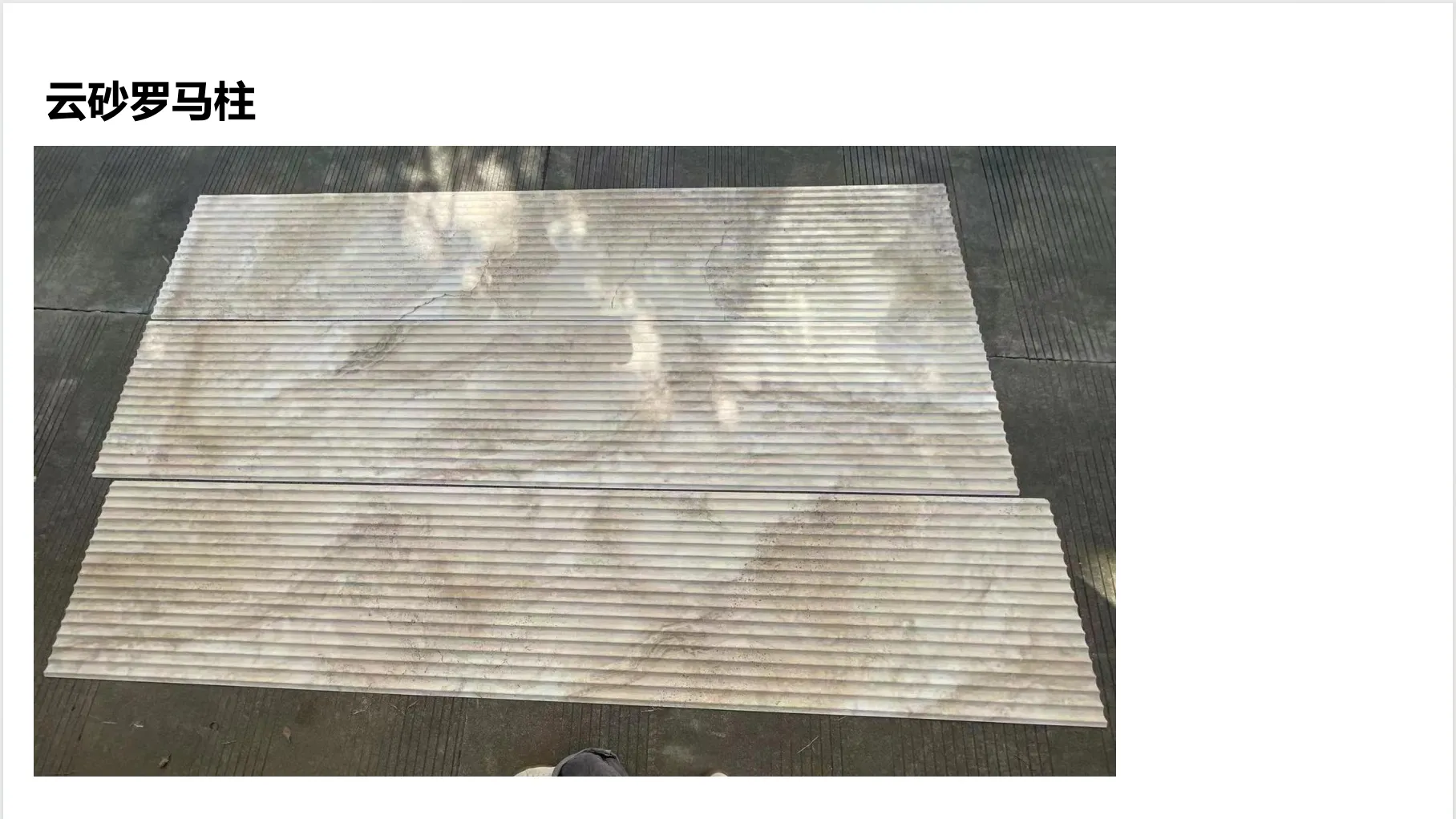
If MCM is the canvas, 3D printing is the brush that brings it to life. The MCM 3D printing series takes customization to a whole new level, allowing designers to create shapes and structures that were once the stuff of dreams. Nowhere is this more evident than in the 3D printed marble pillars—a product that has become a symbol of the series' potential. Traditional marble pillars are iconic, of course, but they're also heavy, expensive, and limited by the constraints of quarrying and carving. A single solid marble pillar might weigh over a ton, requiring cranes, reinforced foundations, and a team of stone masons to shape it. MCM 3D printed marble pillars, by contrast, are built layer by layer, using a composite that mimics the veining and density of marble but with the structural integrity to stand tall without the bulk.
I visited a residential project in Barcelona last year where the designer used these pillars to frame a grand staircase. Each pillar was printed with a spiral pattern that wrapped around its surface, a detail so precise it looked like it had been chiseled by hand over months. In reality, the entire set of four pillars was printed in a week, then finished with a sealant that gave them the soft, matte finish of aged marble. The homeowner, an artist herself, put it best: "They feel like they have a soul. Traditional marble can feel cold, but these? They have the warmth of something made with intention." That intention is key. 3D printing doesn't replace craftsmanship—it elevates it. Designers can tweak a pillar's pattern at the click of a button, experiment with textures, or even incorporate custom motifs (like family crests or local symbols) without adding weeks to the timeline.
But 3D printing in MCM isn't just for pillars. The technology extends to everything from wave panels that ripple like water frozen in time to semicircle boards that create dynamic, curved partitions in open-concept offices. One of my favorite applications? A restaurant in Lisbon that used 3D printed MCM thread panels to create a ceiling installation resembling a woven textile. The panels, printed in a soft beige hue, cast dappled shadows across the dining room at sunset, making every meal feel like a private dinner under a canopy of light. It's these small, sensory details that turn a space from functional to unforgettable—and MCM 3D printing makes them accessible to designers of all scales, not just those with unlimited budgets.
While the 3D printed marble pillars steal the spotlight, the MCM lineup is rich with other stars that deserve their moment. Take fair-faced concrete, a material that's been around for decades but has been reimagined through MCM's lens. Traditional fair-faced concrete can be unpredictable—blemishes, uneven coloring, and a tendency to crack if not poured perfectly. MCM fair-faced concrete, though, is consistent, smooth, and comes in shades from off-white to deep charcoal, with a finish that's both industrial and refined. It's the kind of material that works equally well in a minimalist living room (paired with warm wood tones) or a tech startup's headquarters (contrasted with foamed aluminium alloy boards in vintage silver, which add a sleek, metallic edge). For a co-working space in Berlin, combining fair-faced concrete walls with woven (khaki) panels created a vibe that felt both raw and cozy—like working in a converted warehouse that still remembers its roots.
Then there's the travertine family, a group of MCM materials that pays homage to one of nature's most beloved stones. Travertine (starry green) might be the showstopper, but variants like travertine (starry red) and travertine (starry blue) offer equally striking options. Imagine a retail store in Milan where the checkout counter is clad in starry red travertine, its surface dotted with crimson flecks that catch the light as customers approach. Or a home theater with starry blue travertine walls, turning movie nights into stargazing experiences. These aren't just "colors"—they're moods. Starry orange, for instance, evokes warmth and energy, making it perfect for a café's accent wall, while starry green feels calm and grounding, ideal for a yoga studio or bedroom retreat.
Curious how MCM stacks up against traditional materials? Let's break it down. Below is a comparison between traditional marble pillars and MCM 3D printed marble pillars, highlighting the key differences that make MCM a game-changer:
| Feature | Traditional Marble Pillars | MCM 3D Printed Marble Pillars |
|---|---|---|
| Weight | Heavy (often 500+ lbs per pillar) | Lightweight (50-80 lbs per pillar) |
| Installation Time | Days (requires cranes, specialized labor) | Hours (can be installed with basic tools) |
| Design Flexibility | Limited (shapes constrained by quarrying/carving) | Unlimited (custom patterns, curves, textures) |
| Durability | Prone to chipping, staining, and cracking | Resistant to moisture, impact, and UV damage |
| Cost | High (quarrying, transportation, labor) | Moderate (lower material and installation costs) |
The numbers speak for themselves, but the real magic is in the stories. A hotel in Bali recently replaced its aging traditional stone pillars with MCM 3D printed ones, not just to save on costs, but to create a lobby that felt more open and welcoming. The lighter pillars allowed for larger windows, flooding the space with natural light, while the customizable texture (they chose a subtle wood grain pattern) complemented the resort's tropical aesthetic. Guests now linger longer in the lobby, drawn to the pillars' unique look—and the hotel's occupancy rates have inched up as a result. It's a small example, but it underscores a bigger truth: when materials work with design, rather than against it, spaces become more than just buildings—they become experiences.
MCM materials aren't just for grand projects—they're for everyday spaces, too. Take fair-faced concrete, a staple in industrial design, but now accessible for home use. A young couple in Portland recently used MCM fair-faced concrete panels to clad their fireplace, pairing it with a bamboo mat board accent wall for a look that's modern yet cozy. "We wanted something that felt rugged but not cold," the homeowner told me. "The fair-faced concrete has this softness to it, like it's been weathered by time, even though it's brand new. And since it's lightweight, we didn't have to reinforce the wall—we installed it ourselves over a weekend."
For commercial spaces, the possibilities are even more expansive. The gobi panel, inspired by the textures of desert landscapes, has become a favorite for restaurant exteriors, adding warmth and texture to otherwise plain facades. A chain of coffee shops in Australia used gobi panels in earthy tones to create a "desert oasis" vibe, while a tech company in San Francisco opted for foamed aluminium alloy board (vintage gold) for its reception area, a material that gleams softly under LED lights and resists fingerprints—perfect for a space that sees hundreds of visitors daily. Even historical pathfinders stone, which mimics the weathered look of ancient cobblestones, has found new life in boutique hotels, where it's used to line walkways that feel like they've been there for centuries, even if the building is brand new.
At the end of the day, materials are about more than function—they're about feeling. A space clad in rough granite stone (medium grey) might feel imposing, while one with weaving (beige) panels feels soft and inviting. MCM materials excel at balancing these emotions, offering the best of both worlds: the authenticity of natural materials with the control of modern engineering. Take the lunar peak series, for example—silvery, golden, and black variants that evoke the rugged beauty of mountain tops. A ski lodge in Colorado used lunar peak silvery panels for its ceiling, creating the illusion of a starry, snow-capped sky indoors. Guests often remark that they feel "closer to nature" even when they're warm by the fire—a testament to how texture and color can shape our moods.
Or consider the epoch stone and century stone, two MCM variants designed to mimic the look of aged stone without the maintenance. A museum in Rome used century stone for its exhibit walls, pairing it with travertine (vintage gold) display pedestals. The result? A space that feels both ancient and contemporary, where artifacts from the Roman Empire sit alongside modern art, united by a material palette that bridges time. "It's about creating continuity," the museum's curator explained. "We didn't want the walls to compete with the art, but we also didn't want them to feel sterile. The century stone has this lived-in quality, like it's been holding stories for years. It makes the exhibits feel more alive."
As technology advances, so too will MCM materials. The 3D printing series is already evolving, with printers that can handle larger panels and more intricate designs, while new variants like the gradient color rammed earth board offer even more ways to play with color and texture. But what excites me most isn't the technology itself—it's the way these materials are putting design power back into the hands of creators. No longer limited by the constraints of traditional materials, architects and designers can now focus on what matters: creating spaces that inspire, comfort, and connect us. Whether it's a home with a 3D printed marble pillar in the entryway, a hotel with starry green travertine walls, or a community center clad in flexible stone that bends to hug the landscape, MCM is helping us build spaces that feel less like structures and more like extensions of ourselves.
So the next time you walk into a space that takes your breath away, take a closer look at the materials. Chances are, it's not just stone or concrete—it's MCM, working quietly in the background to turn good design into great experiences. And that, I think, is the real innovation: materials that don't just build spaces, but build moments.
Recommend Products












