
Walk into any space—whether it's a cozy café, a sleek office, or a historic home—and you'll notice something fundamental: the materials that shape it. For decades, builders and designers have leaned on tried-and-true options, while others have embraced cutting-edge innovations. Today, we're putting two heavyweights head-to-head: the time-honored sawing wood board and the revolutionary MCM 3D printing series . Both have their merits, but when it comes to efficiency—speed, sustainability, and design freedom—there's a clear conversation to be had. Let's dive in.
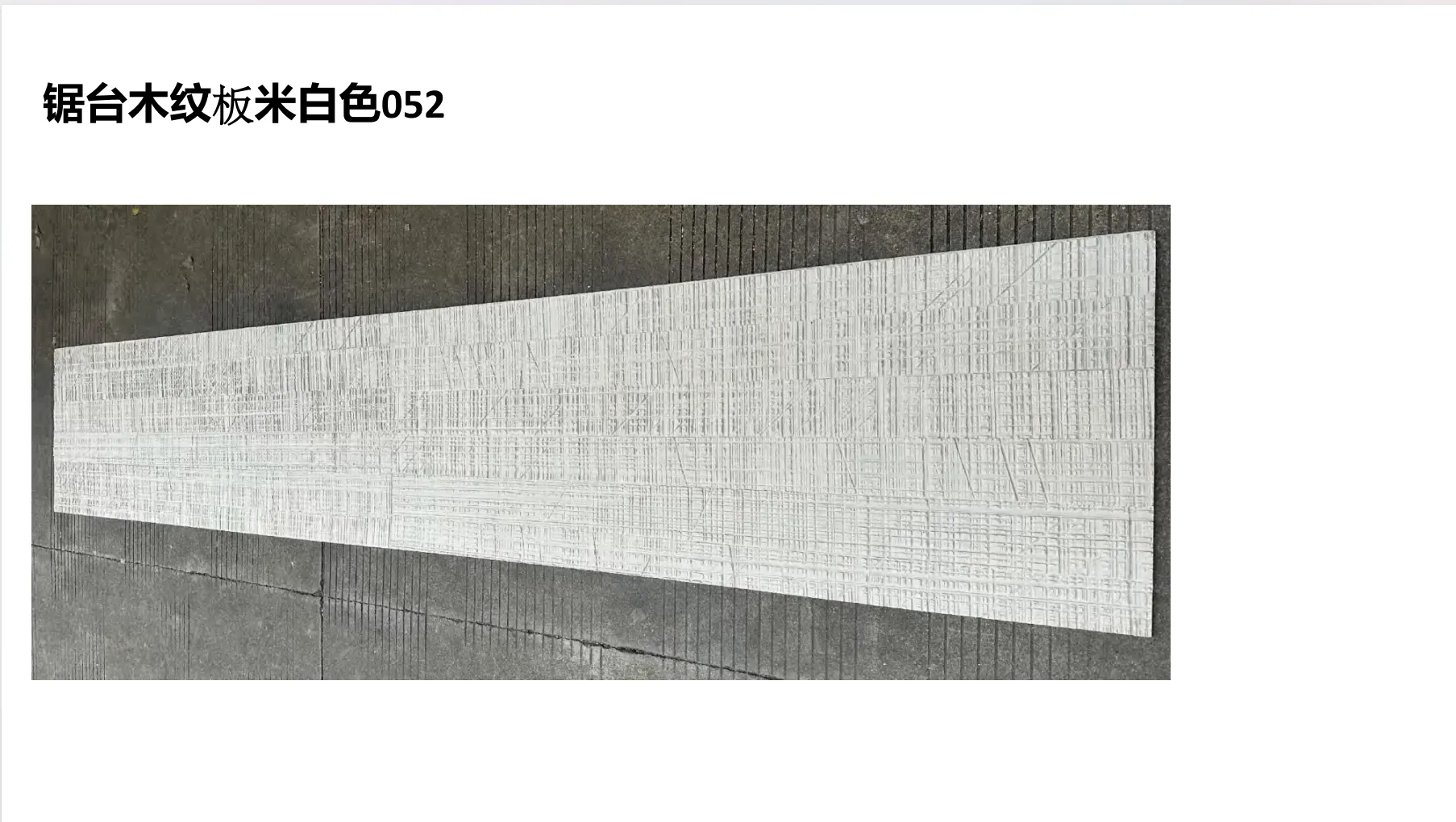
There's a reason sawing wood boards have been around for centuries. There's an undeniable warmth to wood—the way its grains twist and turn, the earthy scent, the feel of it under your fingertips. It's a material that tells a story, often sourced from slow-growing trees, milled by skilled hands, and shaped into everything from flooring to wall panels. But let's pull back the curtain on how it's made, and where efficiency might take a backseat.
First, the process. To create a single sawing wood board, you start with raw timber. Logs are transported to mills, where they're stripped of bark and cut into planks using large saws. But here's the first hurdle: not all wood is created equal. Knots, splits, or warping can render parts of a log unusable, leading to waste right from the start. Then comes drying—arguably the most time-consuming step. Freshly cut wood is "green," meaning it's full of moisture. If you skip drying, the board will shrink, crack, or warp once installed. So, mills use kilns or air-dry the wood for weeks, sometimes months, to bring moisture levels down to around 6-8%. For a small project, this wait might be manageable, but for large-scale builds? It can throw timelines off track.
Next, finishing. Even after drying, boards need sanding, staining, or sealing to protect against pests, moisture, and wear. Each step adds hours (or days) to production. And let's not forget design limitations. Wood is strong, but it's still a natural material. Curved shapes, intricate patterns, or oversized slabs? They're possible, but they require custom tools, more labor, and often more waste. For example, if you need a 10-foot-tall decorative panel with a wave pattern, a sawing wood board would likely involve gluing smaller pieces together, which weakens the structure and adds time.
Then there's sustainability. While wood is renewable, logging can contribute to deforestation if not managed responsibly. Old-growth forests, which yield the most stable wood, take decades to regrow. And even with responsible sourcing, the energy used in transportation, milling, and drying adds up. For builders aiming for eco-friendly credentials, these factors can't be ignored.
Now, let's shift to the new kid on the block: the MCM 3D printing series . MCM, or Modified Composite Material, is a game-changer. Think of it as a blend of natural minerals, polymers, and fibers—engineered to be lightweight, durable, and endlessly customizable. And when paired with 3D printing? It's like giving designers a magic wand. Here's why it's turning heads in the construction world.
First, how it works. MCM 3D printing uses computer-aided design (CAD) models to "print" materials layer by layer, much like a home 3D printer but on an industrial scale. The "ink" here is often a mix of flexible stone , resins, and recycled materials, which hardens quickly under UV light or heat. This process cuts out so many traditional steps: no logging, no drying, no gluing small pieces. You design it on a screen, hit print, and watch it take shape—sometimes in hours, not weeks.
Take the MCM big slab board series as an example. Traditional stone slabs (like marble or granite) are heavy, hard to transport, and limited by the size of the quarry block. But MCM 3D printing can produce big slabs—10 feet wide or more—with zero seams. Imagine a hotel lobby with a single, seamless wall panel in lunar peak silvery (a shimmering, moon-like finish)—no grout lines, no weak points, just a smooth, continuous surface. That's the power of 3D printing.
Design flexibility is another win. Want a wall that curves like a wave? Or a panel with intricate geometric patterns that would take a woodworker days to carve? MCM 3D printing handles it with ease. The software lets you tweak every detail—depth, texture, color—before printing, so there's no guesswork. And because it's additive (building up material instead of cutting it away), waste is minimal. Unlike sawing wood boards, where you might lose 20-30% of the log to sawdust or defects, 3D printing uses only what it needs, reducing material waste by up to 80% in some cases.
Sustainability also gets a boost. MCM often incorporates recycled materials like crushed stone or plastic, and 3D printing uses less energy than traditional manufacturing. Plus, since MCM is lightweight, transportation emissions drop too. A big slab board that would require a crane to move if it were stone? With MCM, two people can carry it. That's a game-changer for job sites with tight spaces or limited equipment.
To really see how these two stack up, let's compare them side by side. We'll look at production time, material use, design freedom, and more—because efficiency isn't just about speed; it's about making smart, sustainable choices.
| Category | Traditional Sawing Wood Board | MCM 3D Printing Series |
|---|---|---|
| Production Time | Weeks to months (drying alone takes 2-8 weeks; plus sawing, finishing) | Hours to days (design + printing + curing = 24-72 hours for most projects) |
| Material Waste | 20-30% (due to knots, warping, sawdust) | 5-10% (additive manufacturing uses only needed material) |
| Design Flexibility | Limited (curves, large slabs, or intricate patterns require extra labor/waste) | Unlimited (3D modeling allows custom shapes, textures, and sizes) |
| Environmental Impact | Medium-high (logging, kiln drying energy, transportation of heavy logs) | Low (recycled materials, lower energy use, lightweight for transport) |
| Installation Speed | Moderate (heavy boards may require multiple workers; pre-drilling for nails/screws) | Fast (lightweight panels can be installed with adhesives or simple fasteners; no pre-drilling) |
Does this mean sawing wood boards are obsolete? Not at all. There are projects where wood's warmth and tradition can't be replaced. Think a rustic cabin in the woods, a heritage restoration, or a boutique café aiming for that "handmade" feel. In these cases, the time and labor are part of the charm—customers or homeowners are paying for craftsmanship, not just a material.
But for modern builds, commercial spaces, or projects with tight deadlines, MCM 3D printing series shines. Imagine a tech startup needing a headquarters finished in 3 months, or a hotel chain rolling out a new design across 50 locations. MCM 3D printing ensures consistency, speed, and cost savings. Plus, with options like lunar peak silvery or flexible stone , you don't sacrifice aesthetics for efficiency. These materials can mimic wood, stone, or even metal—so you get the look you want without the hassle.
Take, for example, a recent project in downtown Chicago: a 12-story office building with a feature wall spanning the lobby. The design called for a 30-foot-tall panel with a gradient from lunar peak golden to lunar peak black , mimicking a sunset. Using traditional stone, this would have required 15+ slabs, custom cutting, and weeks of installation. With MCM 3D printing? The entire panel was printed in 3 sections over 3 days, installed in 8 hours, and cost 40% less than stone. The result? A showstopper wall that became the building's signature feature.
At the end of the day, both sawing wood boards and MCM 3D printing series have their place. Wood is a storyteller, a link to our past, and a material that feels alive. MCM 3D printing is the innovator, the problem-solver, and the key to building faster, smarter, and more sustainably. The "better" choice depends on what you value most: tradition or progress, craftsmanship or efficiency.
But here's the exciting part: they don't have to compete. Imagine a home where the floors are warm sawing wood boards, but the accent wall is a sleek MCM 3D printed panel in flexible stone —blending the best of both worlds. That's the future of building materials: using each tool for what it does best, and letting efficiency and heart coexist.
So, whether you're a builder, designer, or homeowner, the next time you choose materials, ask: What does this project need? And how can I honor both the past and the future? With MCM 3D printing series and sawing wood boards in your toolkit, the answer might just surprise you.
Recommend Products












