
Walk through any city, and you'll notice the silent storytellers all around—the buildings. From the weathered brick of a century-old townhouse to the sleek glass of a modern skyscraper, the materials we choose to build with don't just hold structures together; they shape the way we feel in a space. They're the difference between a room that feels cold and sterile and one that wraps around you like a well-loved blanket. Today, we're diving into a material revolution that's quietly redefining this narrative: 3D printed wood-cement boards, a star player in the MCM 3D Printing Series. It's a tale of merging the warmth of traditional wood with the precision of cutting-edge technology, and it all starts with a simple question: What if we could build with materials that honor the past while racing toward the future?
For decades, construction has relied on tried-and-true methods—mixing concrete in batches, cutting wood to size, assembling brick by brick. These methods built the world we live in, but they also came with trade-offs: waste, limited design flexibility, and a slow pace that struggled to keep up with the demand for innovative, sustainable spaces. Then 3D printing arrived, not as a replacement for tradition, but as a bridge. Suddenly, what was once impossible—curves that mimic natural landscapes, textures that feel handcrafted but are machine-perfect—became achievable. And in this wave of innovation, the MCM 3D Printing Series emerged, a collection of materials designed not just to be functional, but to connect with people.
At the heart of this series is a material that sounds almost contradictory at first: wood concrete. Imagine the grain of oak, the warmth of pine, intertwined with the durability of concrete. It's not just a composite; it's a conversation between two materials that have defined human shelter for millennia. But how do you print that? How do you capture the organic chaos of wood's texture in a layer-by-layer 3D printing process? That's where the prototyping journey began—and it was anything but straightforward.
The team behind the MCM 3D Printing Series didn't start with a finished product. They started with a vision: to create a board that felt like wood but could stand up to the elements like concrete, all while being printed in complex shapes that architects dream of. The early days were filled with late nights and failed experiments. "We'd print a sample, let it cure, and then run our hands over it—and it just felt… wrong," recalls Maria, a materials engineer on the project. "Concrete can feel cold, wood can feel too soft. We needed that sweet spot where it's sturdy but still invites touch."
The first challenge was the material mix. Traditional concrete is heavy, dense, and lacks the organic fibers that give wood its warmth. So they added recycled wood fibers—scraps from sustainable forestry operations—to the concrete matrix. But too many fibers, and the mix wouldn't flow through the 3D printer nozzle; too few, and the wood texture disappeared. "It was like baking a cake without a recipe," laughs Raj, the lead designer. "We'd adjust the ratio, print a small panel, and then test it for everything: flexural strength, water resistance, even how it felt when the sun hit it. One batch had too much pine fiber, and it smelled like a Christmas tree factory. Nice, but not exactly what we wanted for a hospital facade."
It wasn't until they looked to another star in the MCM lineup—the 3D Art Concrete Board—that things clicked. That board, known for its intricate, sculptural patterns, taught them how to manipulate the 3D printer's nozzle speed and layer height to create texture. "We realized we could vary the print density in different areas," Maria explains. "Denser layers for strength around the edges, lighter, airier layers in the center to mimic the porousness of wood. Suddenly, the samples started to feel alive. You could run your finger across them and feel the rise and fall of what looked like real wood grain, even though it was printed."
Another hurdle? Color. Concrete tends to default to gray, while wood spans a spectrum from pale birch to deep walnut. The team experimented with natural pigments—iron oxides for earthy reds, carbon for deep browns—mixing them into the concrete base before printing. The result? Boards that didn't just look like wood; they hued like it, too. A sample in "vintage oak" had warm amber undertones that shifted when viewed from different angles, just like real wood. "That was the 'aha!' moment," Raj says. "We took a photo of it next to a real wooden plank, and even our intern couldn't tell which was which. We knew we were onto something."
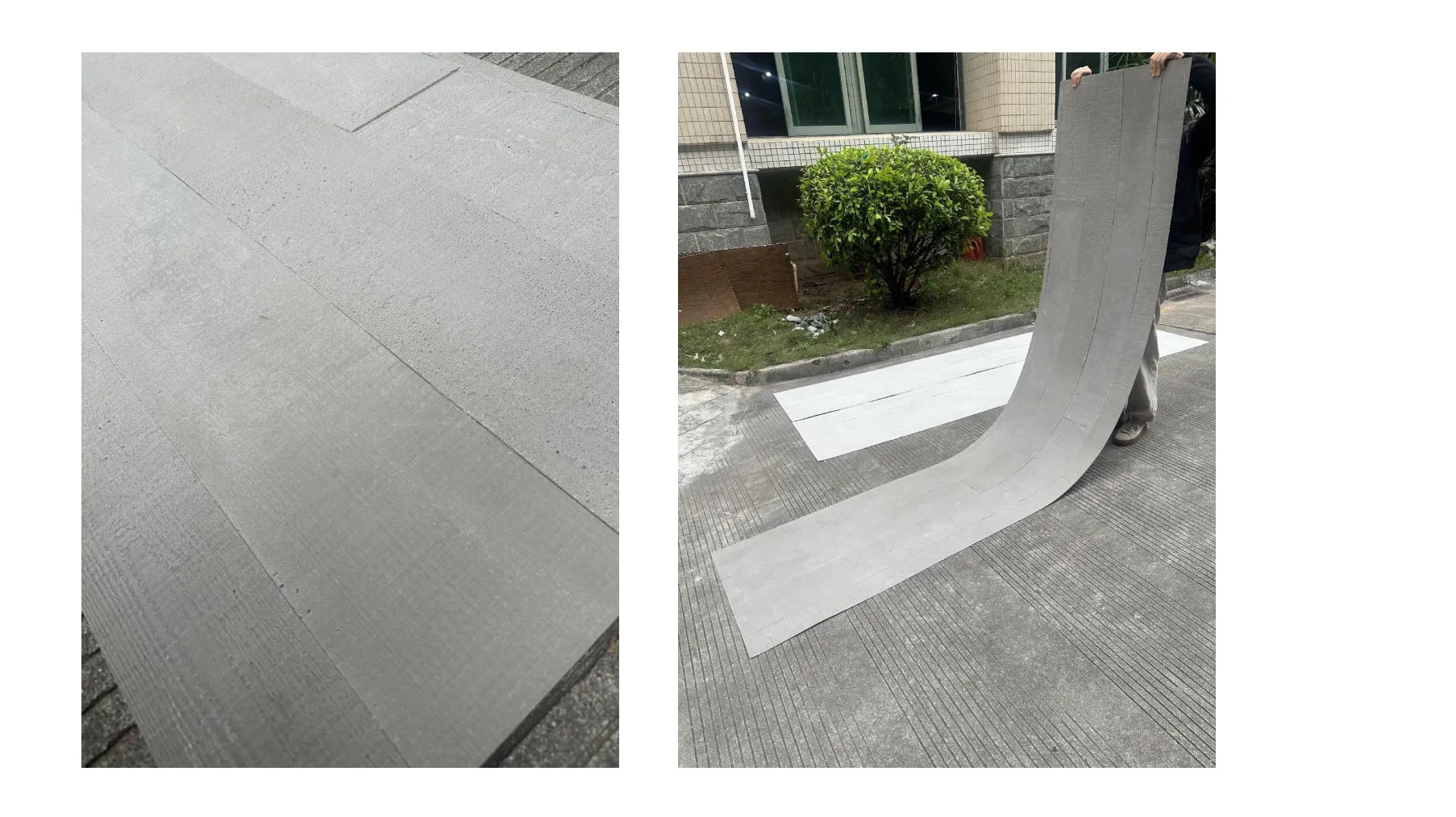
One of the most cherished items in the MCM lab is a photo album filled with prototype photos—what they call the "ugly duckling phase." There's the first failed print: a lumpy, gray slab with a few random wood fibers poking out, labeled "Frankenboard." Then there's a later version, smoother but with a harsh, artificial wood pattern, captioned "Looks like a computer-generated tree." Finally, there's the breakthrough prototype: a small panel, roughly 12x18 inches, with soft, swirling grain in warm chestnut tones. The note next to it reads: "87th try. Maria cried when she touched it." These wood concrete board real photos aren't just records—they're proof that innovation is as much about persistence as it is about talent.
Prototyping is one thing; scaling up is another. Printing a small panel in a lab is manageable, but printing a facade for a five-story office building? That requires precision, speed, and a material that can handle real-world conditions. The team's first full-scale test came in 2023, with a community center in Portland, Oregon. The architects wanted the building to blend into the surrounding forest, so they chose the MCM 3D printed wood concrete boards in "vintage pine"—a soft, golden hue with subtle grain patterns.
Installation day was equal parts excitement and nerves. The boards, each printed to custom sizes (thanks to 3D printing's design flexibility), arrived on-site stacked like giant puzzle pieces. "We'd printed them in sections, each with a unique texture that would flow into the next," says Carlos, the project manager. "When the first board was lifted into place, the sun hit it, and you could see the wood fibers catching the light. The construction crew stopped what they were doing—they just stared. One guy said, 'Is that… wood? On a concrete building?'"
The result? A facade that doesn't just reflect the forest; it feels like part of it. From the street, the building shimmers with warm, golden tones during the day, and at night, when the interior lights glow through the windows, the wood concrete boards cast soft, dappled shadows that mimic sunlight through tree leaves. "A kid walked by with his mom and said, 'It looks like the building is made of tree hugs,'" Carlos recalls. "That's the moment I knew we'd nailed it. It wasn't just a material anymore—it was a feeling."
If you flip through the MCM portfolio, you'll find a spread dedicated to this project. One photo shows a close-up of the facade: the 3D printed layers are visible as subtle horizontal lines, but between them, the wood fibers create a vertical grain that looks almost hand-carved. Sunlight angles across the surface, highlighting the contrast between light and dark fibers—like a slice of oak frozen in time. Another photo captures the building at dusk: the boards have shifted from golden to amber, blending with the setting sun, while the windows reflect the surrounding trees. It's not just a building; it's a dialogue between nature and technology. The caption reads: "Materials should tell a story. This one says, 'Welcome home.'"
Sure, the wood concrete boards look stunning—but they're more than just pretty faces. Let's break down why they're becoming a go-to for forward-thinking architects:
| Material | Production Method | Sustainability | Design Flexibility | Weight (per sq ft) | Installation Ease |
|---|---|---|---|---|---|
| Traditional Concrete Panels | Casted in molds, cut to size | High carbon footprint, limited recycling | Basic shapes only; custom molds expensive | 25 lbs | Heavy; requires cranes for large panels |
| Natural Wood Siding | Cut from logs, treated with chemicals | Sustainable if sourced responsibly, but prone to waste | Limited by wood grain and log size | 12 lbs | Easy, but requires regular maintenance |
| MCM 3D Printed Wood Concrete Board | 3D printed layer-by-layer with recycled wood fibers | 30% lower carbon footprint; recycled materials | Custom shapes, textures, and colors; no molds needed | 15 lbs | Lightweight; can be installed with standard tools |
The MCM 3D Printing Series isn't stopping with wood concrete boards. The team is already experimenting with new materials—like adding bamboo fibers for a more tropical vibe, or integrating recycled glass for a sparkling, starry effect (inspired by the travertine starry series, another fan favorite). "We're just scratching the surface," Raj says. "Imagine a hospital where the walls are printed with wood concrete boards, creating a calming, home-like environment. Or a school where the facade tells the story of the local ecosystem through 3D printed textures. Materials have the power to heal, to inspire, to connect—and 3D printing is how we unlock that."
And the wood concrete board real photos? They're more than marketing tools. They're proof that innovation doesn't have to be cold or clinical. They show buildings that feel human, materials that invite interaction, and a future where construction is as much about emotion as it is about engineering. "At the end of the day, we don't build with materials," Maria says. "We build with stories. And wood concrete boards? They're telling a story about where we've been—and where we're going."
The journey from prototyping to full-scale facades isn't just about technology. It's about remembering that buildings are for people. They're where we live, work, learn, and love. The MCM 3D printing series, with its wood concrete boards, gets that. It's not just about printing materials—it's about printing experiences . Experiences that make us pause, reach out, and think, "This feels like home."
So the next time you walk past a building with a facade that looks like it was woven from sunlight and tree branches, take a closer look. It might just be a 3D printed wood concrete board—proof that the future of construction isn't just about building up, but about building better .
Recommend Products












