
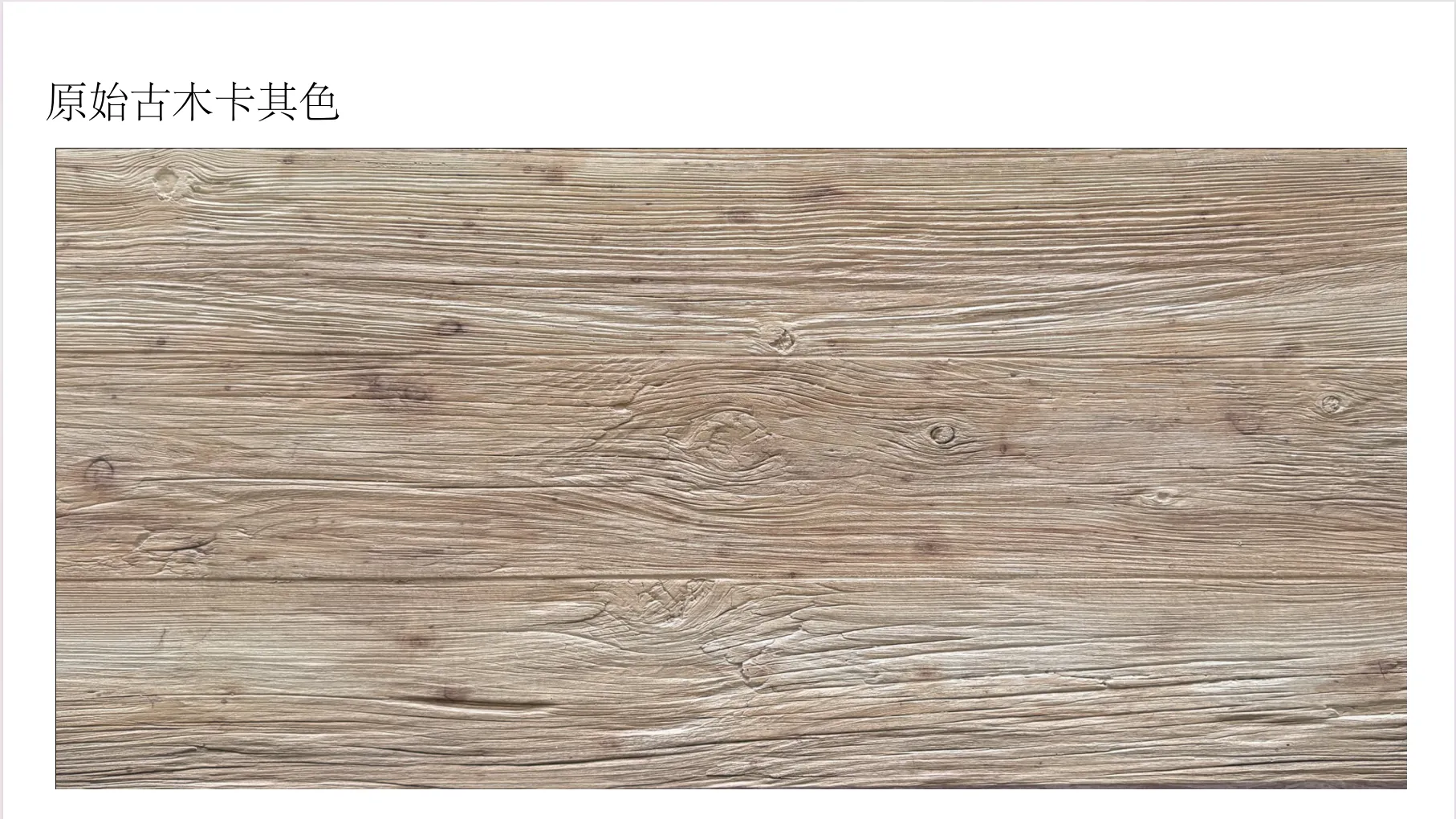
There's a quiet magic in ancient wood. It's not just a material—it's a storyteller. Run your fingers over a weathered beam, and you'll feel the years in its grooves: the storms it braved, the seasons it witnessed, the hands that once carved its edges. Architects and designers have long chased that magic, craving to bring the warmth and history of ancient wood into modern spaces. But here's the hard truth: ancient wood is finite. Old forests are protected, reclaimed timbers are rare, and even when you find a piece, it's fragile—too delicate for high-traffic areas, too precious to risk damage. That's where the intersection of tradition and technology begins to glow: enter COLORIA's mcm 3d printing series , a game-changer that lets us hold onto the soul of ancient wood while reimagining its future.
Let's start with the obvious: we love wood. Not just for its looks, but for what it represents. It's organic, grounding, a bridge between the natural world and the built environment. But ancient wood? That's a different beast. Think of the oak beams in a 17th-century cottage, the teak planks of a vintage ship, or the cedar panels of a historic temple. These pieces aren't just "wood"—they're artifacts. And as our cities grow, as we build more, the demand for that character only increases. The problem? There's simply not enough to go around. Worse, even when we do source reclaimed ancient wood, it often comes with compromises: cracks that weaken its structure, uneven surfaces that make installation a nightmare, or finishes that fade quickly under modern lighting.
That's where 3D printing steps in—not as a replacement for ancient wood, but as a preservationist. COLORIA didn't set out to "copy" wood; they set out to capture it. Using advanced 3D scanning technology, their team can take a single fragment of ancient wood—a weathered plank, a carved post, even a splinter—and digitize every nuance: the way the grain spirals around a knot, the depth of a 100-year-old scratch, the subtle color shifts from sun exposure. Then, with their mcm 3d printing series , they recreate that fragment at any scale, using modified composite material (MCM) that's stronger, lighter, and more sustainable than the real thing. It's not about faking history; it's about extending it.
Precision is where COLORIA's 3D printing truly shines. Let's walk through the process, because it's less "manufacturing" and more "archaeology meets art." First, a sample of ancient wood is selected. Maybe it's a piece from a deconstructed barn in Tuscany, or a teak beam from a colonial-era home in Southeast Asia. The team carefully scans it using high-resolution 3D scanners that capture details as small as 0.1mm—that's thinner than a human hair. Every bump, every groove, every imperfection is turned into a digital blueprint.
Next, the design team works their magic. Want to scale that 2-foot barn plank into a 10-foot wall panel? No problem. Need to adjust the color to match a modern color palette? Easy. The digital model is tweaked, refined, and tested—all without touching the original wood, preserving it for future generations. Then, into the 3D printer it goes, layer by layer, using MCM that's engineered to mimic wood's texture, weight, and even its "feel." The result? A panel that looks, feels, and even responds like ancient wood—without the fragility.
Take COLORIA's wood grain board , for example. One look at it, and you'd swear it was milled from a 200-year-old pine. The grain isn't just printed on top; it's embedded into the material, so when you run your hand over it, you feel the rise and fall of each line. It's the kind of detail that makes a space feel lived-in, not "designed." And because it's 3D printed, no two panels are exactly alike—just like real wood. That's the beauty of precision: it's not about perfection; it's about authenticity.
Meet the Stars of the Show: Ancient Wood, Reimagined
While the
mcm 3d printing series
is the backbone, COLORIA has crafted specific products that let designers lean into the ancient wood aesthetic. Here are two standouts:
Here's where things get exciting: with 3D printing, "custom" isn't a buzzword—it's the default. Let's say you're designing a boutique hotel, and you want the lobby walls to evoke the feel of a 1920s mountain lodge, but you need panels that are fire-resistant and lightweight. With traditional wood, you'd spend months hunting for reclaimed logs, then pay a fortune to have them milled (and cross your fingers they don't warp). With COLORIA's 3D printed MCM, you can scan a single lodge beam, adjust the color to warm up the space, scale it to 12-foot panels, and add a subtle texture that catches the light just right—all in weeks, not months.
Or maybe you're a homeowner with a passion for maritime history. You want your home office to feel like the captain's quarters of an old sailing ship, complete with the weathered teak walls. COLORIA can scan a fragment of a 18th-century ship's hull, replicate the salt-stained grain, and print panels that fit your exact room dimensions—no gaps, no uneven edges. And because MCM is mold-resistant, you won't have to worry about the humidity in your coastal home warping the wood (a very real problem with the real thing).
Even better, customization isn't just about size or shape. COLORIA's palette goes beyond "natural wood tones." Want your poly wood board in a soft sage green, to match your mid-century modern decor? Done. Crave a wood grain board with hints of gold, to add luxury to a restaurant bar? Consider it. The 3D printing process lets color pigments be integrated directly into the MCM, so the hue runs through the material—not just on top. That means no chipping, no fading, just rich, lasting color that evolves beautifully over time.
We can't talk about modern building materials without talking about sustainability—and here, COLORIA's 3D printed ancient wood shines. Traditional wood sourcing, even reclaimed, has a footprint: transportation emissions, energy for milling, and the risk of deforestation (even with "sustainable" labels). MCM, on the other hand, is a low-impact material. It's lightweight, so shipping uses less fuel. It's made with recycled polymers and natural minerals, reducing reliance on virgin resources. And because it's 3D printed, there's no waste—unlike traditional woodworking, where up to 30% of a log can end up as sawdust.
But the biggest win? By 3D printing ancient wood, we're protecting the real thing. Every panel of COLORIA's mcm 3d printing series is a vote to leave ancient forests standing, to preserve historic timbers instead of harvesting them, and to build in a way that honors the past without depleting it. It's design with a conscience—and that matters more than ever.
| Feature | Traditional Ancient Wood | COLORIA 3D Printed MCM Wood |
|---|---|---|
| Durability | Prone to cracks, warping, and rot; needs frequent sealing. | Water-resistant, fire-retardant, and scratch-proof; lasts 50+ years with minimal maintenance. |
| Customization | Limited by the size/shape of available wood; color adjustments require staining (which fades). | Unlimited size, shape, and color; textures and grains can be modified digitally. |
| Sustainability | Scarce; reclaimed options have high transportation/processing emissions. | Made with recycled materials; 3D printing reduces waste by 90% vs. traditional milling. |
| Installation | Heavy, requires specialized tools; uneven surfaces may need shimming. | Lightweight (50% lighter than wood); uniform panels for easy, fast installation. |
| Cost | High upfront cost for rare/reclaimed pieces; ongoing maintenance adds expense. | Lower upfront cost; minimal maintenance saves long-term. |
At the end of the day, what makes COLORIA's mcm 3d printing series special isn't just the technology—it's the heart behind it. This isn't about "fake" wood; it's about honoring wood. It's about letting us keep the stories, the texture, the warmth of ancient wood in a world that needs more connection to the past, not less. Whether you're an architect designing a hospital that needs calming, natural materials, a restaurant owner wanting to evoke a cozy, historic vibe, or a homeowner dreaming of a space that feels like it's been loved for generations, 3D printed MCM ancient wood lets you have it all: the soul of the old, the strength of the new.
And let's not forget the ancient wood itself—the real, irreplaceable pieces. By choosing 3D printed replicas, we're ensuring those artifacts stay where they belong: in museums, in protected historic sites, or in the hands of conservators, not on a construction site. We're not just building better spaces; we're preserving history.
As we look ahead, the line between "natural" and "technological" will only blur—and that's a good thing. COLORIA's mcm 3d printing series isn't just a product; it's a glimpse into a future where we don't have to choose between beauty and practicality, between tradition and progress. It's a future where every wall, every ceiling, every surface can tell a story—without costing the earth.
So the next time you walk into a space and feel that familiar warmth, that quiet sense of history, take a closer look. It might just be 3D printed. And that, in itself, is a new kind of magic: the magic of keeping the past alive, one precise, customizable panel at a time.
Recommend Products












