
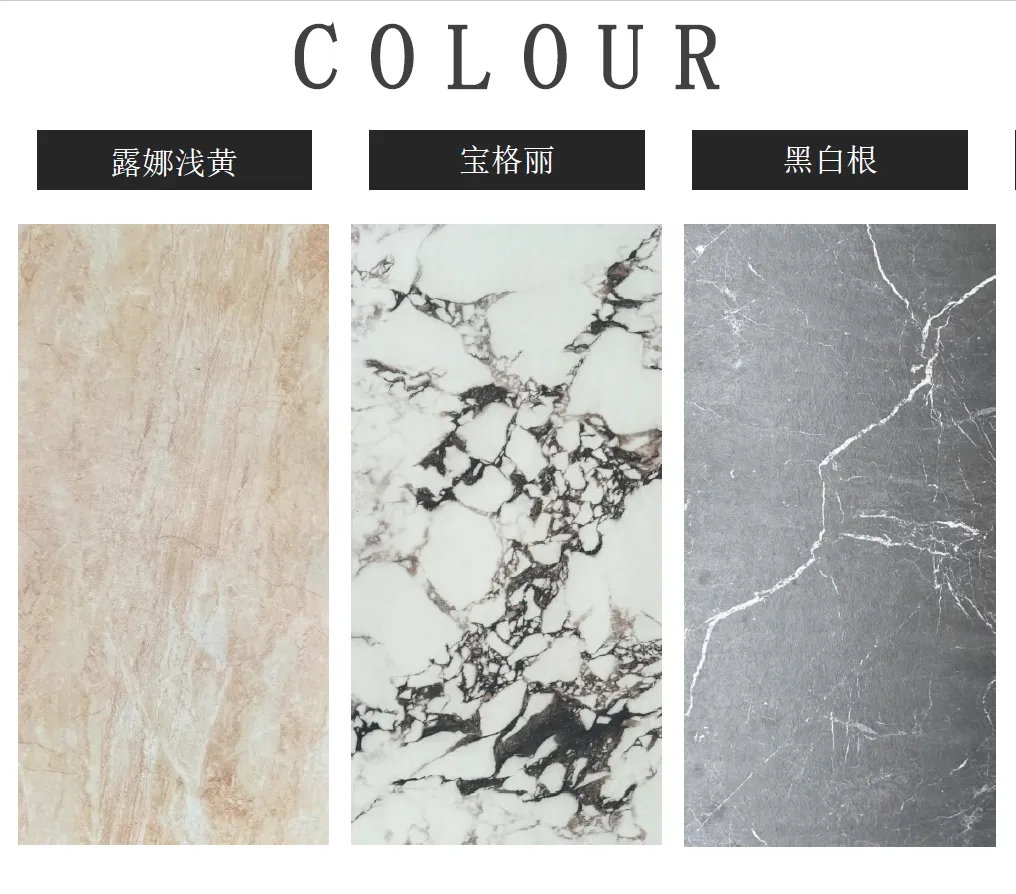
Walk into any well-designed space—a boutique hotel lobby, a modern office, or even a cozy home—and chances are, your eyes will linger on the walls, floors, or countertops. The materials that clothe these surfaces do more than just look good; they carry a silent footprint, one that stretches from quarries to factories, and from construction sites to landfills. In recent years, as sustainability moves from buzzword to business imperative, the choice between traditional materials like natural marble and innovative alternatives like MCM (Modified Composite Material) marble series has become about more than aesthetics. It's about the planet we're building for.
Natural marble has long been the gold standard of luxury. Its veined patterns, cool touch, and timeless elegance have adorned palaces, museums, and high-end homes for centuries. But behind that beauty lies a complex environmental story—one of resource-heavy extraction, energy-intensive processing, and significant waste. On the other side of the spectrum, MCM marble series emerges as a modern challenger, blending cutting-edge technology with eco-conscious design to replicate the look of natural stone while minimizing environmental harm. Let's dive into the details: how do these two materials stack up when it comes to our planet?
There's no denying natural marble's allure. Quarried from the earth in massive blocks, it's a product of millions of years of geological pressure—ancient oceans, mineral deposits, and time itself. But that "natural" label can be misleading when it comes to sustainability. Let's break down the journey from quarry to countertop, and the environmental toll at every step.
Marble quarrying is not a gentle process. To access the stone, companies clear vast areas of land, often in ecologically sensitive regions. Forests are cut down, habitats destroyed, and soil stripped away—leaving behind scars that can take decades, if not centuries, to heal. In places like Carrara, Italy (famous for its white marble), quarrying has been ongoing for over 2,000 years, and today, the landscape is pockmarked with massive pits, some over 100 meters deep. These quarries disrupt local water tables, too: pumping out groundwater to keep worksites dry can lower water levels for miles, affecting farms, villages, and wildlife.
Then there's the issue of waste. Only about 20-30% of a marble block is usable after extraction. The rest—called "overburden"—is discarded as rubble, often dumped into nearby valleys or rivers, clogging waterways and polluting soil. In some cases, chemical explosives are used to break up the stone, releasing dust and pollutants into the air, which can cause respiratory issues for nearby communities and acid rain when combined with moisture.
Once extracted, marble blocks are transported to factories to be cut into slabs, polished, and finished. This step is energy-intensive: cutting through a 10-ton block of marble requires diamond-tipped saws that run on electricity, often sourced from fossil fuels. Polishing, too, uses high-powered machinery and copious amounts of water to smooth the surface—up to 10,000 liters per slab, by some estimates. Much of this water is contaminated with stone dust and polishing chemicals, which, if not treated properly, can leach into rivers and groundwater, harming aquatic life and human health.
And the waste doesn't stop there. Cutting a slab to size for a specific project often results in offcuts—small pieces of marble that are too small to use for large surfaces. These offcuts are usually thrown away, adding to landfill waste. In fact, the Marble Institute of America estimates that up to 40% of processed marble ends up as waste before it even reaches a construction site.
Marble is heavy. A single slab can weigh over 500 pounds, and a truckload might carry just 10-15 slabs. Transporting these massive pieces from quarries (often in remote areas) to factories, then to distributors, and finally to construction sites requires fleets of large trucks, ships, and trains—all burning diesel or gasoline. The carbon emissions add up quickly: a slab traveling from Italy to the U.S., for example, can generate over 100kg of CO2 per ton, according to the International Council on Clean Transportation. For large projects, like a hotel lobby with 500 slabs, that's 50 tons of CO2 just from shipping.
Here's the irony: for all its strength, marble is surprisingly fragile. It's porous, meaning it stains easily (spill a glass of wine, and you'll know), and it scratches with everyday use. To keep it looking new, homeowners and businesses must seal it regularly with chemical treatments, which can leach into the environment over time. And when it does wear out or get damaged? Most marble ends up in landfills, where it doesn't biodegrade—it just sits, taking up space for centuries.
Enter MCM marble series—a category of building materials designed to mimic the look and feel of natural stone, but with a fraction of the environmental impact. MCM, or Modified Composite Material, is exactly what it sounds like: a blend of natural minerals (like stone dust or clay), recycled polymers, and other sustainable additives, pressed and cured into thin, lightweight panels. It's not "fake" marble; it's reimagined marble—one that prioritizes planet without sacrificing style.
At its core, MCM is about efficiency. Instead of mining massive blocks of stone, MCM manufacturers use recycled or waste materials from other industries. For example, stone dust from marble or granite processing (which would otherwise go to landfills) is mixed with recycled plastic polymers, fiberglass, or even agricultural waste (like rice husks) to create a durable, flexible material. The production process uses low heat and pressure, unlike the high-energy cutting and polishing of natural marble, and it requires minimal water—often 90% less than traditional stone processing.
The result? Thin, lightweight panels (usually 3-5mm thick) that look identical to natural marble, travertine, or granite. They're flexible enough to bend around curves, strong enough to withstand weather and wear, and—most importantly—far gentler on the planet.
MCM's sustainability story continues long after production. Let's compare its journey to natural marble:
MCM marble series isn't a one-size-fits-all solution—it's a family of products, each designed to replicate a specific natural stone or texture, from travertine to rammed earth to even foamed aluminum. Let's take a closer look at some standout options from the MCM lineup, and how they're pushing the boundaries of sustainable design.
If you've ever tried to wrap natural marble around a curved wall or column, you know it's nearly impossible without cutting it into tiny pieces (and creating a lot of waste). MCM flexible stone changes that. Thin, bendable, and versatile, it can conform to almost any shape—arches, columns, rounded edges—without breaking. Take travertine (starry green) , for example: MCM's version captures the stone's signature pitted surface and soft green hue, but in a panel that weighs just 4kg per square meter (compared to 20kg for natural travertine). That flexibility means fewer cuts, less waste, and a seamless, elegant finish—all while using 70% less raw material than traditional stone.
3D printing has revolutionized manufacturing, and MCM is no exception. The MCM 3D printing series uses advanced 3D printing technology to create intricate textures and patterns—think wave panels that mimic ocean swells, or star gravel with tiny, raised pebbles—with pinpoint accuracy. Unlike traditional stone carving, which chips away at a block (creating piles of waste), 3D printing adds material layer by layer, using only what's needed. The result? Zero waste during production, and designs that would be impossible to achieve with natural stone. For architects and designers, it's a dream: custom textures, minimal environmental impact, and the freedom to create without compromise.
For a more industrial, modern look, foamed aluminium alloy board (vintage silver) and its siblings (vintage gold, gold) are game-changers. Made from recycled aluminum (which requires 95% less energy to produce than new aluminum), these panels are lightweight, corrosion-resistant, and 100% recyclable at the end of their lifespan. They're perfect for exterior cladding—their durability means they stand up to rain, wind, and UV rays without fading—reducing the need for frequent replacements. And unlike natural metal panels, which are heavy and require energy-heavy mining, foamed aluminum MCM panels are a circular solution: made from waste, used for decades, then recycled again.
Rammed earth has been used in construction for centuries—think the Great Wall of China or traditional African mud-brick homes. It's a beautiful, natural material, but traditional rammed earth requires massive amounts of soil and labor, and it's heavy and prone to cracking. MCM's rammed earth board (matcha green) and variants (gradient, white, dark grey) capture that earthy, textured look using recycled soil, clay, and natural pigments—no massive excavation needed. Lightweight and stable, they're ideal for both interior walls and exterior facades, bringing warmth and history to a space without the environmental cost of traditional rammed earth.
Travertine is a classic—with its porous surface and warm tones, it's a staple in both modern and rustic design. But natural travertine quarrying is notoriously destructive, especially in regions like Turkey or Italy. MCM's travertine line, including travertine (starry green) , travertine (starry red) , and travertine (vintage silver) , replicates that look using recycled stone dust and pigments. The "starry" variants even mimic the stone's naturally occurring mineral deposits, creating a shimmering effect that looks just like the real thing. And because they're MCM, they're stain-resistant (no more panic over coffee spills!) and require zero sealing—saving both time and harsh chemicals.
Sustainability isn't just about what happens during production—it's about the entire lifecycle of a material. How long does it last? Can it be recycled? What happens when it's no longer needed? Let's compare natural marble and MCM on these critical end-of-life factors.
| Factor | Natural Marble | MCM Marble Series |
|---|---|---|
| Lifespan | 50-100 years (but prone to staining/scratches; often replaced sooner) | 30-50 years (resistant to stains, scratches, and weathering; low maintenance) |
| Recyclability | Limited—most ends up in landfills; can be crushed for aggregate, but energy-intensive | High—many MCM products are recyclable; can be ground down and reused in new panels |
| Maintenance | High—requires annual sealing with chemical treatments; sensitive to acids/stains | Low—no sealing needed; resistant to stains and scratches; easy to clean with water |
| Carbon Footprint (per m²) | ~50-80kg CO2 (extraction + processing + transportation) | ~10-15kg CO2 (production + transportation) |
While natural marble may have a longer theoretical lifespan, its practical longevity is often cut short by maintenance issues and damage. MCM, on the other hand, is built to last in real-world conditions—no fancy sealing, no fear of scratches, and a carbon footprint that's a fraction of the competition. And when it does reach the end of its life, many MCM products can be recycled into new panels, closing the loop on waste.
At the end of the day, the choice between natural marble and MCM marble series isn't just about aesthetics—it's about the kind of world we want to build. Natural marble is undeniably beautiful, but its beauty comes with a heavy price: destroyed ecosystems, high carbon emissions, and mountains of waste. MCM, by contrast, offers a new narrative—one where luxury and sustainability coexist, where the walls and floors of our spaces tell a story of innovation, not extraction.
From MCM flexible stone that bends to our design whims without bending the planet, to foamed aluminium alloy board that shines bright with recycled metal, to travertine (starry green) that captures the night sky without quarrying a single stone—MCM marble series proves that we don't have to sacrifice style for sustainability. It's a reminder that every material choice is a vote: for the environment, for future generations, and for a built world that's as kind to the planet as it is beautiful to inhabit.
So the next time you walk into a space and admire the walls, take a moment to wonder: what story do those materials tell? With MCM, it's a story we can all be proud of.
Recommend Products












