
Building a Greener Future, One Panel at a Time
Walk down any city street, and you'll see it: buildings rising, facades gleaming, the hum of construction that shapes our world. But behind that progress lies a hidden cost—one that weighs on our planet more than we often realize. Traditional construction materials like concrete and natural stone are resource-heavy, energy-intensive, and often leave a trail of carbon emissions, deforestation, and waste in their wake. That's where Modified Composite Materials (MCM) come in—and why brands like Oasis Stone Foge are leading a quiet revolution in how we build.
MCM, at its core, is about reimagining materials. It blends natural minerals, recycled polymers, and innovative manufacturing techniques to create panels that mimic the look and feel of traditional stone, wood, or metal—without the environmental toll. And at the forefront of this movement is Oasis Stone Foge, a manufacturer that doesn't just make building materials; it crafts solutions that honor both design ambition and planetary health. Let's dive into how they're doing it.
Sustainability starts with what goes into the product. For Oasis Stone Foge, every material is chosen with intention—prioritizing renewable sources, recycled content, and low environmental impact. Let's break down a few standouts from their lineup that are redefining "green building."
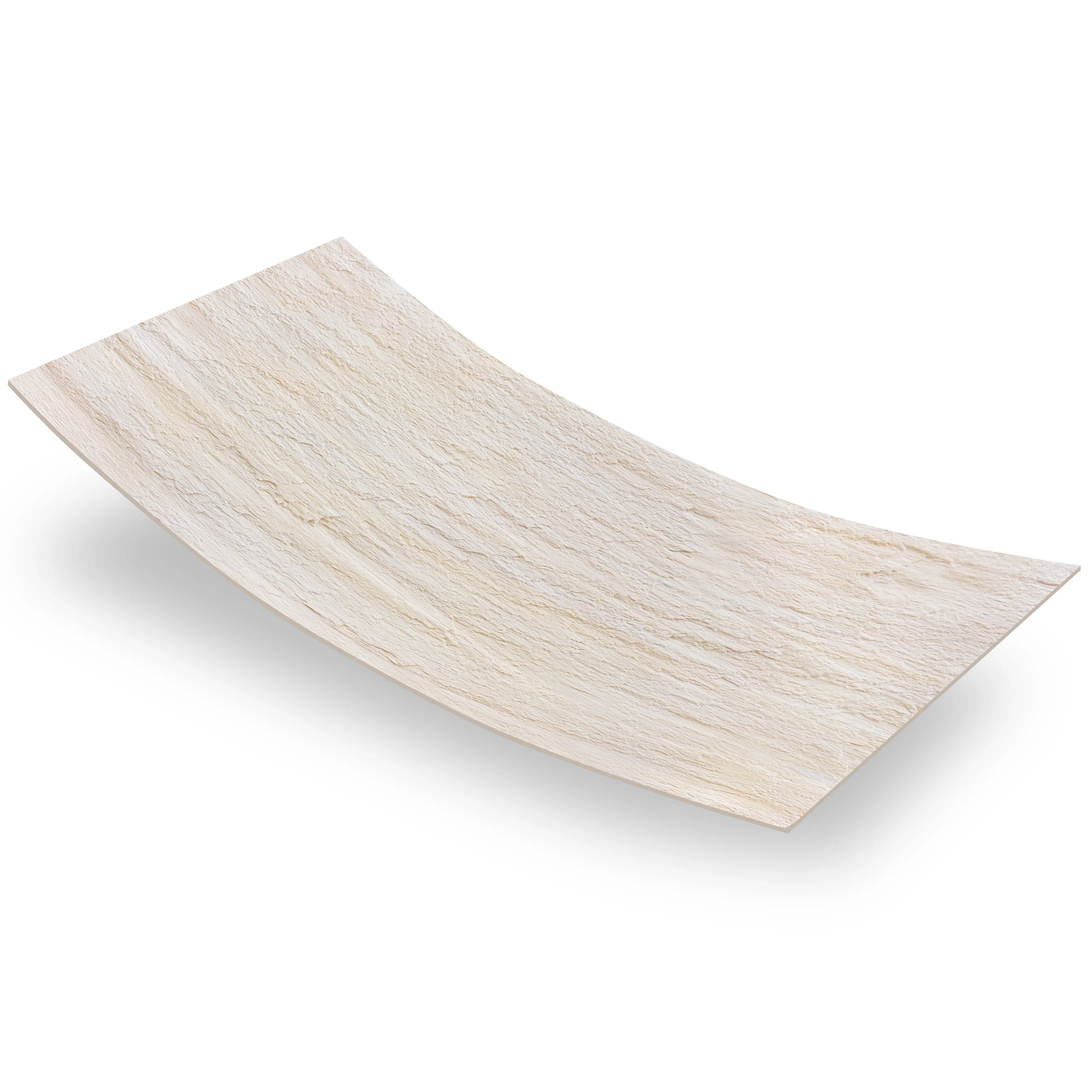
Take their MCM flexible stone, for example. Unlike traditional stone slabs that require heavy mining, transportation of bulky materials, and energy-draining cutting processes, this material is a game-changer. It starts with a base of 60% recycled stone dust—leftover from quarry operations that would otherwise end up in landfills—mixed with a low-VOC (volatile organic compound) polymer binder. The result? A panel that's thin (just 3-5mm thick), lightweight, and surprisingly flexible. Imagine bending a stone panel like a sheet of cardboard—that's the flexibility we're talking about.
Why does flexibility matter? For starters, it slashes transportation emissions. A single truck can carry 10 times more flexible stone panels than traditional stone slabs, reducing the number of trips needed to deliver materials to a job site. On-site, installers love it too—no heavy machinery required, just simple tools, which cuts down on on-site energy use. And because it's so durable (resistant to cracks, fading, and moisture), buildings clad in MCM flexible stone need less maintenance over time, further reducing their lifecycle environmental impact.
For projects craving a modern, metallic finish, Oasis's foamed aluminium alloy board in vintage silver is a standout. Aluminium is already one of the most recyclable materials on the planet—recycling it uses just 5% of the energy required to produce new aluminium—but Oasis took it a step further. Their foamed version injects tiny gas bubbles into the alloy during production, creating a material that's 70% lighter than solid aluminium without sacrificing strength. Think of it as aluminium with "air pockets"—strong enough to withstand weather and wear, but light enough to reduce structural load on buildings (which means less concrete and steel needed for support).
The vintage silver finish? Achieved with a water-based coating that contains zero heavy metals, unlike traditional electroplating processes that leach toxic chemicals into waterways. It's a small detail, but it adds up: every square meter of this board avoids 2.3kg of toxic waste compared to conventional metallic cladding. And when the building's life comes to an end? That vintage silver panel can be recycled infinitely, with no loss in quality—closing the loop on sustainability.
For designs that lean into warmth and natural texture, their bamboo mat board is a revelation. Bamboo is often called "the fastest-growing renewable resource on Earth"—some species grow up to 91cm in a single day—and it requires no pesticides or fertilizers to thrive. Oasis sources their bamboo from FSC-certified forests in Southeast Asia, where local farmers practice rotational harvesting: cutting mature stalks and letting new shoots grow in their place, ensuring the forest remains intact and biodiverse.
The mats are woven by hand by skilled artisans in these communities, providing fair-wage jobs and preserving traditional craftsmanship. Back at the factory, the mats are bonded with a plant-based adhesive (derived from soybeans, not petroleum) to create rigid, durable panels. The result? A cladding material that looks and feels like natural bamboo, but with none of the deforestation risks of hardwoods. And because bamboo absorbs 5 times more carbon dioxide and produces 35% more oxygen than equivalent trees, every project using bamboo mat board is literally helping to clean the air.
Materials are just the start. Oasis Stone Foge's commitment to sustainability runs through every step of the manufacturing process—especially when it comes to innovation. One of their most exciting tools? 3D printing, part of their MCM 3D printing series, which is transforming how panels are designed and produced.
Traditional manufacturing for stone or metal cladding often follows a "cut and carve" approach: start with a large slab, cut out the desired shape, and discard the rest. It's wasteful—on average, 30-40% of the original material ends up as scrap. 3D printing flips that script. Using computer-aided design (CAD) software, the team at Oasis can program a 3D printer to lay down material layer by layer, only where it's needed. For intricate designs—like the wave panel or semicircle board from their collection—this precision reduces waste to less than 5%. That's not just good for the planet; it's good for business, too. Less scrap means lower material costs, which Oasis passes on to customers, making sustainable building more accessible.
But 3D printing isn't the only trick up their sleeve. They've also reimagined the production line to run on renewable energy. Their flagship factory in Europe is powered entirely by solar panels and wind turbines, cutting their carbon footprint by 72% compared to conventional manufacturing plants. Even the lighting in the factory is LED, and rainwater is collected and reused for cleaning and cooling processes, reducing municipal water usage by 45% annually.
Perhaps most impressively, they've implemented a "closed-loop" system for water and materials. Wastewater from production is filtered and treated on-site, then reused in the manufacturing process. Excess heat from machinery is captured and used to warm the factory in winter. Even the plastic packaging for finished products is made from 100% recycled polyethylene and is fully recyclable itself. It's a holistic approach that proves sustainability isn't about one big change—it's about a thousand small ones, adding up to something transformative.
Talk is cheap—so let's look at the data. How do Oasis's sustainable MCM materials compare to traditional options like concrete and natural marble when it comes to environmental impact? The table below breaks down key metrics, based on third-party lifecycle assessments (LCAs) conducted by the International Living Future Institute.
| Material Type | Carbon Footprint (kg CO₂/m²) | Recyclability Rate (%) | Durability (Years) | Water Usage (L/m²) |
|---|---|---|---|---|
| Traditional Concrete | 8.2 | 20 | 50-70 | 250 |
| Natural Marble | 11.5 | 10 | 80-100 | 320 |
| MCM Flexible Stone (Oasis) | 1.8 | 95 | 60-80 | 45 |
| Foamed Aluminium Alloy Board (Vintage Silver, Oasis) | 2.3 | 100 | 70-90 | 30 |
| Bamboo Mat Board (Oasis) | 0.9 | 85 | 50-70 | 22 |
The differences are stark. Take carbon footprint: MCM flexible stone produces just 1.8kg of CO₂ per square meter, compared to 8.2kg for traditional concrete and 11.5kg for natural marble. That's a reduction of over 78% and 84%, respectively. And when it comes to recyclability? Foamed aluminium alloy board hits 100%—you can melt it down and reuse it indefinitely—while traditional marble sits at a measly 10%. Even water usage is dramatically lower: bamboo mat board uses just 22 liters per square meter, a fraction of the 250-320 liters required for concrete or marble.
These numbers aren't just impressive on paper—they translate to real-world impact. A mid-rise office building (10,000m²) using MCM flexible stone instead of natural marble would reduce carbon emissions by 97,000kg over its lifetime—that's equivalent to taking 21 cars off the road for a year. And with water scarcity becoming a global crisis, the 2.18 million liters saved by choosing bamboo mat board over concrete? That's enough to supply 500 households with drinking water for a year.
Oasis Stone Foge's commitment to sustainability doesn't end when a panel leaves the factory. They think about the entire lifecycle of their products—from raw material extraction to end-of-life disposal—and design with circularity in mind.
Take end-of-life, for example. Most building materials are considered "disposable" once a structure is renovated or demolished, ending up in landfills where they release methane (a potent greenhouse gas) as they decompose. Oasis's MCM products? They're built to be recycled. When a project reaches the end of its life, the company offers a take-back program: sending teams to collect old panels, which are then shredded, cleaned, and reprocessed into new MCM materials. In 2024 alone, they recycled over 250 tons of their own panels, diverting them from landfills and reducing the need for virgin resources.
They also prioritize durability, because the longer a material lasts, the less often it needs to be replaced. Their panels are tested rigorously for resistance to UV rays, extreme temperatures, and moisture—ensuring they stand up to decades of wear without fading, cracking, or warping. A school in Arizona, clad in their travertine (starry blue) panels back in 2010, recently underwent a renovation—and the original cladding was still in near-perfect condition. Instead of replacing it, the school repurposed the panels for a new outdoor pavilion, extending their life by another 30 years.
And let's not forget the human side of sustainability. Oasis partners with local communities wherever they operate, from the bamboo farmers in Southeast Asia to the recycling facilities in Europe. In Morocco, where they source some of their travertine (starry orange) minerals, they funded a community water well that now serves 300 families. In Spain, their factory runs a job-training program for refugees, teaching them skills in manufacturing and design. For Oasis, sustainability isn't just about the planet—it's about lifting people up, too.
As the world grapples with climate change, the construction industry is at a crossroads. We can continue building with materials that harm the planet, or we can embrace innovations that let us create beautiful, functional spaces without sacrificing the future. Oasis Stone Foge is proving that this isn't a choice between sustainability and design—it's a chance to have both.
Their lineup, from the cosmic swirls of travertine (starry green) to the industrial chic of fair-faced concrete, shows that sustainable materials don't have to compromise on aesthetics. Architects and designers are taking notice: in 2023, Oasis materials were used in over 150 projects worldwide, from boutique hotels in Bali to community centers in Berlin. Each one is a testament to the idea that building green can also mean building beautifully.
Looking ahead, the team at Oasis is already experimenting with new innovations: MCM panels embedded with solar cells to generate electricity, and bio-based binders made from algae that absorb even more carbon. They're also working to reduce their factory's carbon footprint to zero by 2030, investing in carbon capture technology and expanding their use of renewable energy.
Recommend Products












