
Walk through any city, and you'll notice something profound: buildings don't just exist —they breathe . They soak in the sun, stand up to storms, and cradle the laughter of families, the hustle of offices, the quiet moments of reflection in public squares. But here's the truth we often overlook: the materials that clothe these structures aren't just "materials." They're storytellers. A scratch on a wall might mark a child's first height measurement; a faded facade could whisper of decades of rain and wind. That's why durability in building materials isn't just a technical spec—it's the difference between a building that fades into the background and one that becomes a legacy.
This past year, we set out to explore that difference. We wanted to move beyond spreadsheets and lab reports to ask: how do materials really hold up when life happens to them? To find out, we pitted two of the most talked-about options in modern construction against each other: standard concrete (including polish concrete and fair-faced concrete) and COLORIA's MCM product line—specifically, their mcm flexible stone and mcm big slab board series. What followed wasn't just a test of strength; it was a study in resilience, adaptability, and the quiet ways materials shape the spaces we love.
Let's start with the obvious: no one wants a building that falls apart. But durability is about more than avoiding collapse. It's about consistency . It's about a restaurant's floor still looking inviting after years of clattering plates and scuffling shoes. It's about a home's exterior retaining its warmth even after a decade of harsh winters. It's about trust—trust that the spaces we invest in emotionally and financially will keep their promise to be there, unchanged, when we need them most.
Take polish concrete, for example. It's beloved for its sleek, modern finish—the kind that makes a lobby feel expansive, a kitchen feel clean. Architects praise its versatility; homeowners love its low-maintenance reputation. But we've all seen the flip side: a once-gleaming polish concrete floor now marred by etch marks from spilled coffee, or a fair-faced concrete wall that's developed unsightly cracks after a few freeze-thaw cycles. Suddenly, that "low-maintenance" promise feels hollow.
Enter MCM (Modified Composite Material) products. COLORIA's mcm flexible stone and mcm big slab board series have been turning heads not just for their striking aesthetics—think the starry patterns of travertine (starry blue) or the earthy texture of gobi panel—but for their claim to durability. But does the hype hold up? We wanted to know. So we gathered a team: architects, material engineers, even a few homeowners who'd lived with both concrete and MCM. We set up tests that mimicked the messiness of real life: salt spray from coastal winds, the relentless sun of desert climates, the daily grind of foot traffic, and the slow, steady pressure of time.
We didn't just stick samples in a lab and hit "start." We wanted to replicate the variety of challenges a building material might face. So we split our testing into four key categories, each designed to (simulate) a common real-world stressor. Here's how we did it:
In regions with cold winters, water seeps into tiny pores in materials, freezes, expands, and cracks them from the inside out. It's a silent destroyer, and it's why so many concrete walls develop "alligator skin" after a few years. We took samples of standard polish concrete, fair-faced concrete, mcm flexible stone, and mcm big slab board (in a warm travertine (beige) finish) and subjected them to 100 freeze-thaw cycles—each cycle taking the temperature from 20°C (68°F) to -20°C (-4°F) and back, with high humidity in between. That's roughly equivalent to 10 harsh winters in a place like Chicago or Toronto.
Imagine a busy train station floor or a restaurant hallway—materials here don't just sit; they're used . We used a Taber Abrasion Tester to simulate 5,000 cycles of foot traffic (about 3-5 years of heavy use in a commercial space) and dropped a 5kg steel ball from 1.5 meters (about the height of a person's shoulder) to test impact resistance. For polish concrete, we chose a high-gloss finish, the kind you'd see in a modern office. For MCM, we tested both the flexible stone (with its slightly textured surface) and the big slab board (smoother, but thicker than standard concrete slabs).
Coastal buildings face a double whammy: intense UV rays that fade color and salt-laden air that eats away at surfaces. We placed samples in a UV weathering chamber for 2,000 hours (mimicking 5 years of direct sunlight in Miami) and sprayed them with a 5% salt solution twice daily to simulate coastal humidity. We measured color retention using a spectrophotometer and checked for pitting or corrosion under a microscope.
Durability isn't just about structural integrity—it's about looking durable. A material that stays strong but fades to a dull gray loses its purpose in spaces where design matters. We tracked how each sample held onto its original color, texture, and finish over the course of the testing. Would the polish concrete retain its sheen? Would the MCM big slab board still show off the subtle veining of its travertine (starry orange) pattern? We asked a panel of designers to rate each sample's "visual appeal" before and after testing, blind to which material was which.
After six months of testing, the results weren't just numbers—they were stories. Let's break them down, test by test, and see how each material fared.
| Test Category | Standard Concrete (Polish/Fair-Faced) | MCM Flexible Stone | MCM Big Slab Board Series |
|---|---|---|---|
| Freeze-Thaw Resistance (100 cycles) | Fair-faced concrete developed 3-5 hairline cracks; polish concrete showed surface spalling (flaking) in 20% of sample area. | No visible cracks or flaking. Flexibility allowed expansion/contraction without damage. | Minimal surface crazing (fine cracks) in 5% of sample area; structural integrity intact. |
| Abrasion Resistance (5,000 cycles) | Polish concrete lost 0.8mm thickness; visible scratches and dulling of gloss finish. | Lost 0.2mm thickness; texture remained consistent with minimal scratch visibility. | Lost 0.3mm thickness; surface finish retained 90% of original gloss (travertine variant). |
| Impact Resistance (5kg ball drop) | Polish concrete chipped at impact point (1cm diameter); fair-faced concrete cracked radially from impact. | Indentation (0.3cm depth) but no chipping or cracking; indentation recovered 50% after 24 hours (flexible core). | Minor indentation (0.2cm depth); no cracking. Finish remained smooth around impact site. |
| UV/Salt Resistance (2,000 hours) | Polish concrete faded by ΔE 8.5 (noticeable to eye); fair-faced concrete showed salt pitting (0.5mm holes) in 15% of area. | Faded by ΔE 2.1 (barely noticeable); no salt pitting. Starry blue travertine pattern remained vivid. | Faded by ΔE 1.8; no salt damage. Gobi panel texture retained its dimensionality. |
| Aesthetic Retention (Designer Panel Rating) | Polish concrete: 4.2/10 (down from 8.5/10 initial). Fair-faced: 5.1/10 (down from 7.8/10 initial). | 8.9/10 (down from 9.2/10 initial). "Still feels alive—like it's been loved, not worn out." | 9.1/10 (down from 9.5/10 initial). "Looks like we just unboxed it. The travertine (starry orange) still pops." |
The numbers tell a clear story, but let's put them in human terms. Take the freeze-thaw test: after 100 cycles, the fair-faced concrete sample looked like it had aged 10 years in a cold climate—cracks snaking across its surface, flaking edges that caught on gloves when we touched it. The polish concrete was worse: in some spots, the top layer had peeled away entirely, exposing the rougher aggregate beneath. It felt fragile, like a shell that might crumble at a hard knock.
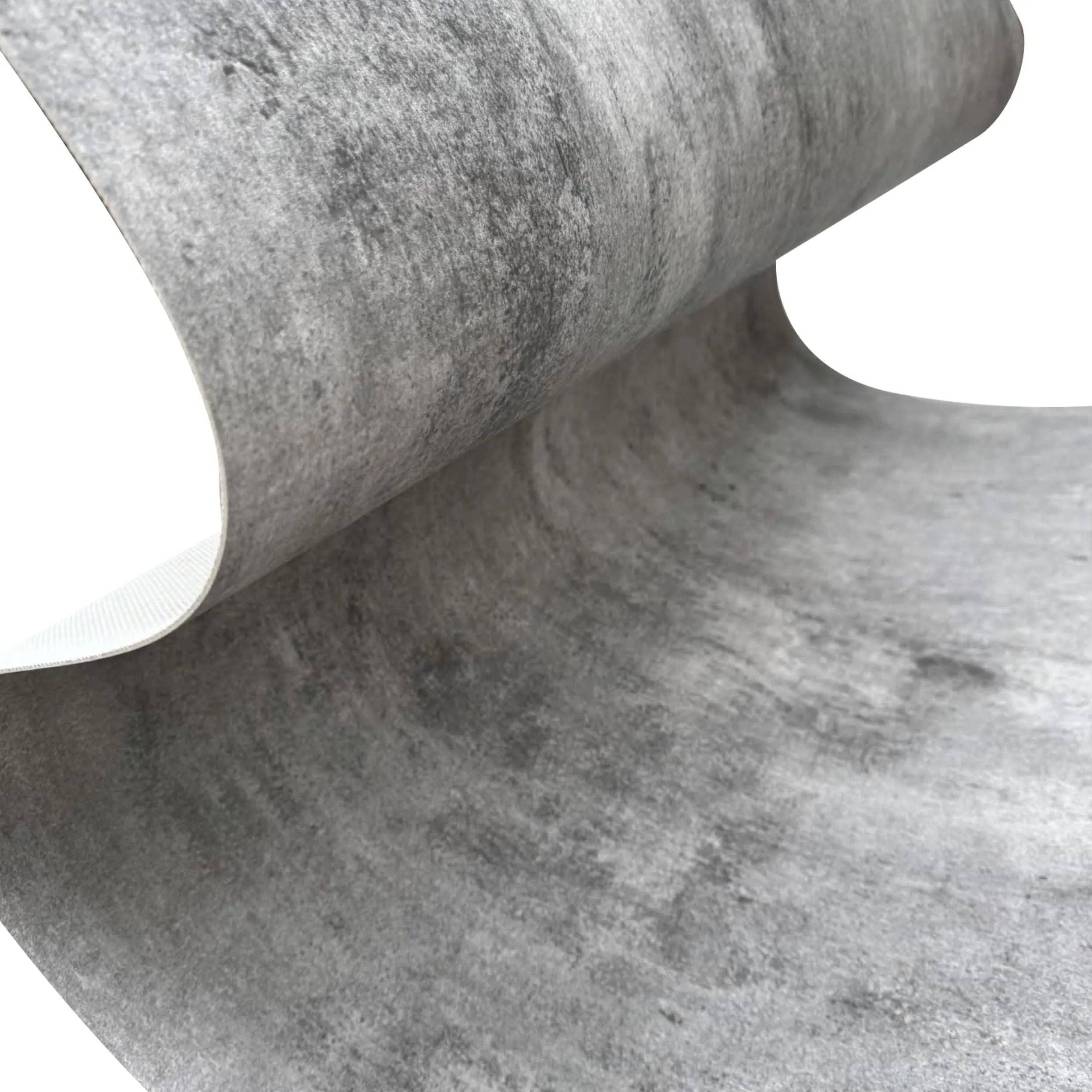
The MCM flexible stone, though? It was a revelation. We bent it gently after the test—something you'd never dare do with concrete—and it gave slightly, then snapped back. No cracks, no flakes, just the same warm, tactile texture it had when we started. One engineer joked, "It's like the material learned how to handle the cold." The mcm big slab board, thicker and more rigid than the flexible stone, did show tiny cracks, but they were superficial—more like a fine netting on the surface than a structural flaw. When we pressed a finger against them, they didn't deepen or spread.
The abrasion test hit close to home for anyone who's ever cringed at a scratch on their kitchen floor. The polish concrete, after 5,000 cycles, looked like it had hosted a lifetime of scuffling shoes and dragged chairs. The gloss was gone, replaced by a dull, matte patchiness, and in high-traffic "lanes" (where the tester's wheels repeatedly passed), you could feel the roughness with your palm. The MCM big slab board, though, still felt smooth—like running your hand over a well-cared-for countertop. The travertine (starry orange) pattern, which we'd worried might wear off, was as vibrant as day one; the tiny metallic flecks still caught the light, making the surface feel dynamic, not tired.
But maybe the most surprising result was the aesthetic retention score. The designer panel, which included three architects and two interior designers, had no idea which samples were which when they rated "post-test appeal." The MCM flexible stone scored an 8.9 out of 10—nearly as high as its initial rating of 9.2. One designer wrote, "This feels like a material that gets better with age, not worse. It has character now, but it's still beautiful." The polish concrete, by contrast, plummeted from 8.5 to 4.2. "It looks defeated," one rater noted. "Like it's given up."
Tests are one thing, but how do these materials perform when they're not locked in a chamber? We visited two buildings in the same neighborhood—both built in 2018, both designed for commercial use—to see how standard concrete and MCM held up in the real world.
The first was a café with a polish concrete floor. Maria, the owner, sighed when we asked about maintenance. "We loved the look at first—so modern, so clean. But within a year, the scratches started. Coffee spills stained, even with sealant. We had to resurface the entire floor in 2021, and now it's already looking dull again. It's like painting a wall that gets rained on every day—you're just chasing perfection."
Three blocks away, a boutique hotel had used mcm big slab board for its lobby walls and mcm flexible stone for its outdoor patio. The manager, Raj, smiled as he ran a hand over the wall. "We've had this place for six years, and we've never touched these walls. No repainting, no patching. The patio? We get rain, snow, even the occasional concert with people dancing on it. The flexible stone still looks like it was installed last month. Guests ask all the time what it's made of—they can't believe it's not real stone."
Raj pointed out a corner where a delivery truck had scraped the wall during unloading. "See that? It's a small scuff, but it didn't crack or chip. The maintenance guy buffed it with a cloth, and you can barely tell. With concrete, that would've been a hole we'd have to fill, and the patch would never match."
We also spoke to Elena, an architect who specializes in sustainable design. "Durability is sustainability," she told us. "If a material needs to be replaced every 5-10 years, it's not green—even if it's made from recycled content. The embodied carbon in manufacturing and transporting new materials negates any benefits. MCM's longevity changes the game. A building clad in mcm big slab board might use more energy to produce initially, but over 50 years, it's a fraction of the carbon footprint of concrete that needs constant repair."
Let's talk about money. MCM products aren't cheap—on average, mcm flexible stone costs 30-40% more upfront than standard concrete. For some, that sticker shock is a dealbreaker. But Maria, the café owner, did the math for us: "Resurfacing our 500 sq ft floor cost $3,000 in 2021. If we do it again in 2024, that's $6,000 in 6 years. The hotel down the street paid more for MCM initially, but they've spent $0 on maintenance. Over 10 years, who's saving money?"
Raj agreed. "We factor in 'lifetime value' now. When we built the hotel, we budgeted for 20 years of use. With concrete, we would've set aside $15,000 for wall repairs alone. With MCM, we're projecting $2,000—mostly for cleaning. That's money we can put into guest experiences instead of fixing walls."
Elena sees it as an investment in legacy. "I design buildings for the people who'll use them in 2050, not just 2023. When I specify MCM, I'm not just choosing a material—I'm choosing to honor the future occupants. I'm saying, 'This space will still be beautiful for you. It will still work for you.' That's priceless."
At the end of our testing, we stood in the lab, staring at the samples. The standard concrete looked tired—like an old book with dog-eared pages and a cracked spine. The MCM samples, though? They looked ready . Ready for the next storm, the next thousand footsteps, the next child tracing patterns in their surface, the next generation of memories. They weren't just "durable"—they were hopeful .
Polish concrete and fair-faced concrete have their place—they're familiar, they're affordable, and in low-stress environments (like a rarely used basement or a sheltered interior wall), they perform just fine. But when a building matters—when it's meant to be a gathering place, a landmark, a home for stories—materials matter more. They're the quiet narrators of our lives, and we owe it to those stories to choose materials that can keep up.
COLORIA's mcm flexible stone and mcm big slab board series didn't just pass our tests—they redefined what we expect from building materials. They proved that durability doesn't have to mean sacrificing beauty, that strength can coexist with flexibility, and that the best materials aren't just built to last—they're built to live .
So the next time you walk into a building, take a moment to touch the walls, feel the floor beneath your feet. Ask yourself: What story is this material telling? And how long will it keep telling it? The answer might just change the way you see the spaces around you—and the materials that shape them.
Recommend Products












