
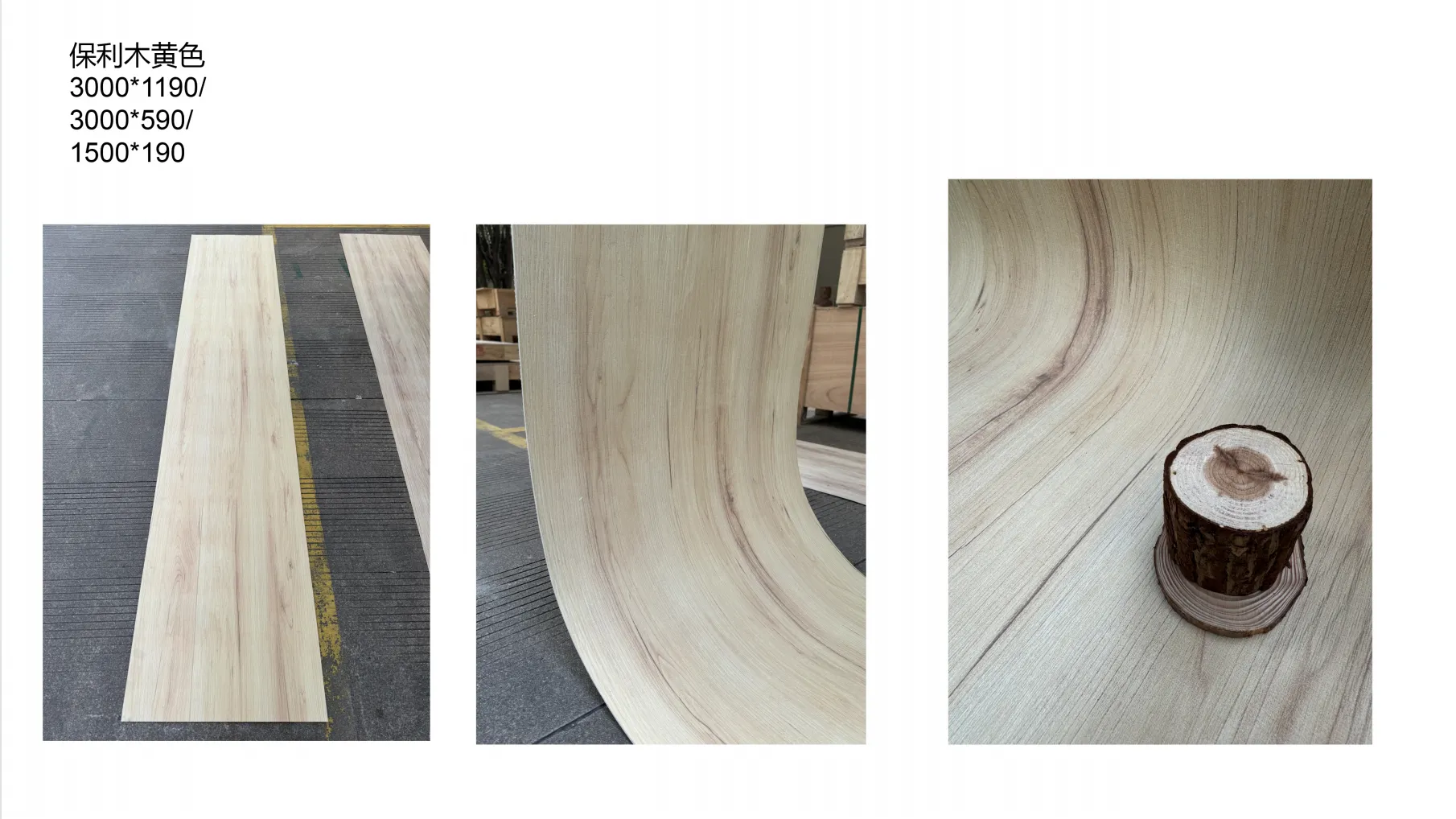
A closer look at how two innovative materials stand up to the demands of modern design
Let's start with a scenario we've all heard (or lived through): A beautiful new building facade, designed with sweeping curves and organic lines, starts to show cracks just a year after completion. The culprit? A material that looked stunning on paper but couldn't handle the subtle stresses of real-world installation—especially when it came to bending. In the world of architecture and construction, flexibility isn't just a nice-to-have; it's the difference between a design that lasts and one that becomes a costly repair project.
That's why today, we're diving deep into two materials that have been making waves in the industry: Poly Wood Board and MCM flexible stone (short for Modified Composite Material). Both have built reputations for blending durability with adaptability, but how do they truly perform when put to the test? We decided to find out with a series of bending tests—no fancy lab jargon, just raw, unfiltered results captured in real photos (and vivid descriptions for those who can't see them). Let's get into it.
Before we jump into the tests, let's talk about why bending matters. Think about the last time you walked through a modern art museum or a cutting-edge office building. Chances are, you noticed curves—soaring archways, undulating facades, walls that seem to flow like water. These designs aren't just for show; they're a response to a desire for spaces that feel human, not boxed in.
But here's the catch: Curved surfaces demand materials that can bend without breaking. A rigid stone or wood panel might snap under the pressure of being shaped into a gentle arc, leaving contractors with cracked pieces and frustrated clients. Bending tests reveal a material's "flexibility threshold"—how much force it can take before it fails, and how gracefully it bends along the way. It's not just about strength; it's about resilience. Can the material bend, absorb stress, and maybe even bounce back? That's the difference between a material that works on paper and one that works on the job site.
And let's not forget the practical stuff. Shipping, handling, installation—materials get jostled, dropped, and forced into tight spaces. A material that cracks when bent slightly during transport is a liability, plain and simple. So when we talk about bending tests, we're really talking about peace of mind.
Before we pit them against each other, let's get to know our two materials a little better. They might sound similar at first glance, but their stories, strengths, and personalities are surprisingly different.
Poly Wood Board has been turning heads in sustainable construction circles for years. Made from a blend of recycled wood fibers and high-density polyethylene (HDPE), it's designed to mimic the warmth and texture of real wood without the drawbacks—rotting, warping, or splintering. Think of it as wood's more resilient cousin, built to handle the elements while keeping a natural look.
Architects love it for interior accent walls, outdoor decking, and even furniture. It's lightweight, easy to cut, and marketed as "flexible enough for curved applications." But does that hold up when the pressure is on? That's what we came to find out.
Then there's MCM flexible stone —the new kid on the block that's quickly become a favorite for bold, eye-catching facades. Unlike traditional stone, which is heavy and rigid, MCM flexible stone is a thin, lightweight composite made by bonding natural stone particles (think marble, granite, or travertine) with a polymer backing. The result? A material that looks and feels like real stone but can bend like a sheet of plastic.
It's a game-changer for designers who want the luxury of stone without the structural limitations. Curved building exteriors, spiral staircases, even custom furniture—MCM flexible stone promises to make the impossible possible. But flexibility without strength is just a party trick. We needed to see if it could walk the walk.
To make this fair, we kept the test setup simple and consistent. Both materials were tested under identical conditions, with one goal: to see how they bend, when they break, and what they look like along the way. Here's how we did it:
We also tested both materials in two scenarios: static bending (slow, steady pressure) and dynamic bending (quick, sudden pressure)—to simulate both careful installation and accidental impacts during transport. Because let's be real: construction sites aren't always gentle.
Let's walk through the test as it happened. We started with Poly Wood Board, then moved to MCM flexible stone. Both were tested one after the other, with the same team and tools to eliminate variables. Here's how it went:
We placed the Poly Wood Board sample on the supports, centered it carefully, and started the press. At first, nothing seemed to happen—just the quiet creak of the wood frame. Then, at 50 pounds of force, we noticed a slight sag: about 0.5 inches at the center, with the panel curving gently downward.
At 100 pounds, the sag deepened to 1.5 inches. The surface of the Poly Wood Board started to show faint stress lines along the grain pattern (a visual detail we'd later confirm with the photos). Still, no cracks, no splinters—just a smooth bend. We kept going.
By 150 pounds, the panel had bent 25 degrees from horizontal, with a deflection of 2.75 inches. The stress lines were more pronounced now, but the board itself felt solid. Then, at 175 pounds, we heard a faint "pop." The center of the panel had developed a small crack along the wood grain, and the deflection jumped to 3.5 inches. We stopped the press—this was the failure point.
When we released the pressure, the Poly Wood Board didn't snap back completely. It retained a permanent 1-inch sag, with the crack still visible. The photos showed a clean, linear crack, no splintering—just a quiet surrender under the force.
Next up: MCM flexible stone. We swapped out the Poly Wood Board for the stone panel, centered it, and reset the press. From the start, this material felt different. At 50 pounds of force, it sagged 1 inch—already more than the Poly Wood Board at the same pressure. The surface, which had a matte, stone-like texture, started to stretch slightly, with the color darkening along the curve (a detail captured clearly in the photos).
At 100 pounds, the deflection hit 3 inches, and the bending angle was 35 degrees. Unlike the Poly Wood Board, there were no stress lines—just a smooth, continuous curve. The stone particles in the composite seemed to shift with the bend, giving the panel a "flowing" look rather than a rigid warp.
We kept pressing. At 200 pounds, the deflection was 4.5 inches, and the angle was 45 degrees. The panel looked like a shallow bowl, but still no cracks. The photos showed the edges lifting slightly off the supports, but the center held strong. We pushed to 250 pounds—double the force that cracked the Poly Wood Board—and the MCM flexible stone bent to 55 degrees, with a deflection of 5.25 inches. That's when we noticed something remarkable: the surface texture had changed. The stone particles had compressed along the curve, creating a subtle "ripple" effect, but there was no structural damage.
Finally, at 300 pounds, we hit the limit. The MCM flexible stone didn't crack—it delaminated . The polymer backing separated from the stone layer along one edge, causing the panel to fold rather than break. When we released the pressure, it (sprang back) to within 0.5 inches of its original shape, with the delamination as the only visible damage. The photos told the story: a clean separation, no shattered stone, just a material that knew when to give without giving up.
Numbers tell a clearer story than words alone. Here's how Poly Wood Board and MCM flexible stone stacked up in our bending tests:
| Metric | Poly Wood Board | MCM Flexible Stone |
|---|---|---|
| Failure Force | 175 lbs | 300 lbs |
| Maximum Bending Angle | 25° | 55° |
| Deflection at Failure | 3.5 inches | 5.25 inches |
| Failure Type | Cracking along grain | Delamination (backing separation) |
| Permanent Deformation | 1 inch sag | 0.5 inch sag |
| Visual Damage (Post-Test) | Linear crack, stress lines | Surface ripple, edge delamination |
Looking at the table, one thing is clear: MCM flexible stone outperformed Poly Wood Board in almost every flexibility metric. It bent further, handled more force, and showed less permanent damage. But does that mean Poly Wood Board is out of the running? Not necessarily—context matters.
Numbers on a page are one thing; real-world impact is another. Let's break down what these results mean for the people who actually use these materials—architects, contractors, and designers.
If you're designing a building with sweeping curves or undulating walls, MCM flexible stone is the clear winner. Its ability to bend 55 degrees without breaking opens up possibilities for shapes that would be impossible with rigid materials. Imagine a museum with a facade that mimics rolling hills—MCM flexible stone could make that vision a reality without compromising on the stone aesthetic.
Poly Wood Board, while flexible, tops out at 25 degrees. That's enough for gentle arcs (think a rounded bookshelf or a curved accent wall) but not for the bold, dramatic curves that define modern architecture. It's a solid choice for low-to-moderate flexibility needs, but it has limits.
Accidents happen. A ladder bumps a wall, a tool drops, a storm whips debris against the facade. In these cases, MCM flexible stone's ability to absorb sudden force (thanks to its polymer backing) is a huge advantage. It's less likely to crack or shatter, reducing repair costs and downtime.
Poly Wood Board, while durable, is still prone to cracking under sudden pressure. It's better suited for low-traffic areas where impacts are rare—think interior accent walls or furniture surfaces that don't see heavy use.
Poly Wood Board has a leg up here. Made from recycled materials, it's often more affordable than MCM flexible stone, which requires natural stone particles and specialized manufacturing. If your project is on a tight budget or prioritizes eco-friendliness over extreme flexibility, Poly Wood Board offers great value.
MCM flexible stone, while pricier, might save money in the long run by reducing installation time (it's lighter and easier to bend on-site) and minimizing waste (fewer broken panels mean fewer replacements).
After watching these two materials bend, flex, and ultimately reveal their limits, we came away with a simple conclusion: there's no "better" material—only the right material for the job.
Poly Wood Board is the reliable workhorse: eco-friendly, affordable, and flexible enough for most everyday applications. It's perfect for projects where gentle curves and natural wood aesthetics matter more than extreme bending capability. Think residential accent walls, outdoor decking, or furniture that needs to blend durability with warmth.
MCM flexible stone is the design revolutionary: bold, adaptable, and ready to push the boundaries of what's possible. It's the material for architects who dream in curves, contractors who need to install on tricky surfaces, and clients who refuse to choose between beauty and performance. From commercial facades to custom art installations, it's a material that doesn't just meet expectations—it redefines them.
At the end of the day, both Poly Wood Board and MCM flexible stone represent the future of construction materials: smart, sustainable, and designed with real-world challenges in mind. And isn't that what great design is all about? Solving problems while making the world a little more beautiful—one bend at a time.
We'll be sharing the full photo gallery of the bending tests on our website next week, so you can see the cracks, the curves, and the delamination for yourself. Because when it comes to materials that shape our spaces, transparency isn't just a buzzword—it's essential.
Recommend Products












