
Choosing the right building material can feel like solving a puzzle—one where aesthetics, durability, and versatility all need to fit together seamlessly. For designers, homeowners, and architects alike, the search often boils down to a single question: will this material work where I need it to? Today, we're putting two standout contenders under the microscope: Poly Wood Board and MCM Flexible Stone. More specifically, we're exploring their bending performance—the quiet superpower that turns rigid limitations into design possibilities. Let's dive in.
Before we get to the bending tests and real photos, let's make sure we're all on the same page about what these materials are.
Poly Wood Board is exactly what it sounds like—yet so much more. Imagine the natural grain, warmth, and texture of wood, but reimagined to stand up to the elements, resist warping, and yes, bend without breaking. Made from a blend of recycled wood fibers and high-density polymers, it's an eco-friendly alternative that doesn't skimp on character. Think of it as wood's practical cousin: still charming, but with a backbone of modern engineering. It's become a favorite for everything from outdoor decks with sweeping curves to indoor accent walls that crave a organic touch.
MCM Flexible Stone, part of the broader MCM (Modified Composite Material) family, is a game-changer for anyone who loves the look of natural stone but hates its rigidity. Crafted from crushed natural stone particles (think travertine, marble, or slate) bound together with a flexible polymer matrix, it's thin, lightweight, and surprisingly pliable. Unlike traditional stone slabs that crack under pressure, MCM Flexible Stone bends—making it perfect for curved surfaces, uneven walls, or designs that demand a little give. And yes, it's part of MCM's innovative 3D printing series , which means it can be shaped into intricate patterns without losing that all-important flexibility.
You might be wondering: Why focus so much on bending? Here's the thing: most buildings aren't made of straight lines. A curved staircase wall, a rounded fireplace surround, a wavy outdoor patio edge—these details turn a "nice" space into a memorable one. But rigid materials? They fight those curves. They crack, they chip, they force you to compromise. Bending performance isn't just about durability; it's about keeping your design vision intact.
To put this to the test, we compared Poly Wood Board and MCM Flexible Stone side by side, measuring how much each could flex before showing signs of stress. The results? Eye-opening. Let's break them down.
| Feature | Poly Wood Board | MCM Flexible Stone |
|---|---|---|
| Thickness | 8-12mm (standard) | 3-5mm (ultra-thin) |
| Minimum Bending Radius* | 50cm (gentle curves) | 15cm (tight, dramatic bends) |
| Material Composition | Wood fibers + high-density polymer | Natural stone particles + flexible polymer |
| Weight per sq.m | 12-15kg | 4-6kg |
| Performance Under Bending | Flexes smoothly; slight visible stress at 45° angles | Bends sharply without cracking; returns to shape post-flex |
*Minimum radius = smallest curve the material can form without damage
Numbers tell part of the story, but seeing tells the rest. That's where real photos come in. Let's walk through what these tests looked like in action.
They say a picture is worth a thousand words, and when it comes to bending performance, that couldn't be truer. We captured photos of both materials undergoing controlled bending tests, and the difference is striking.
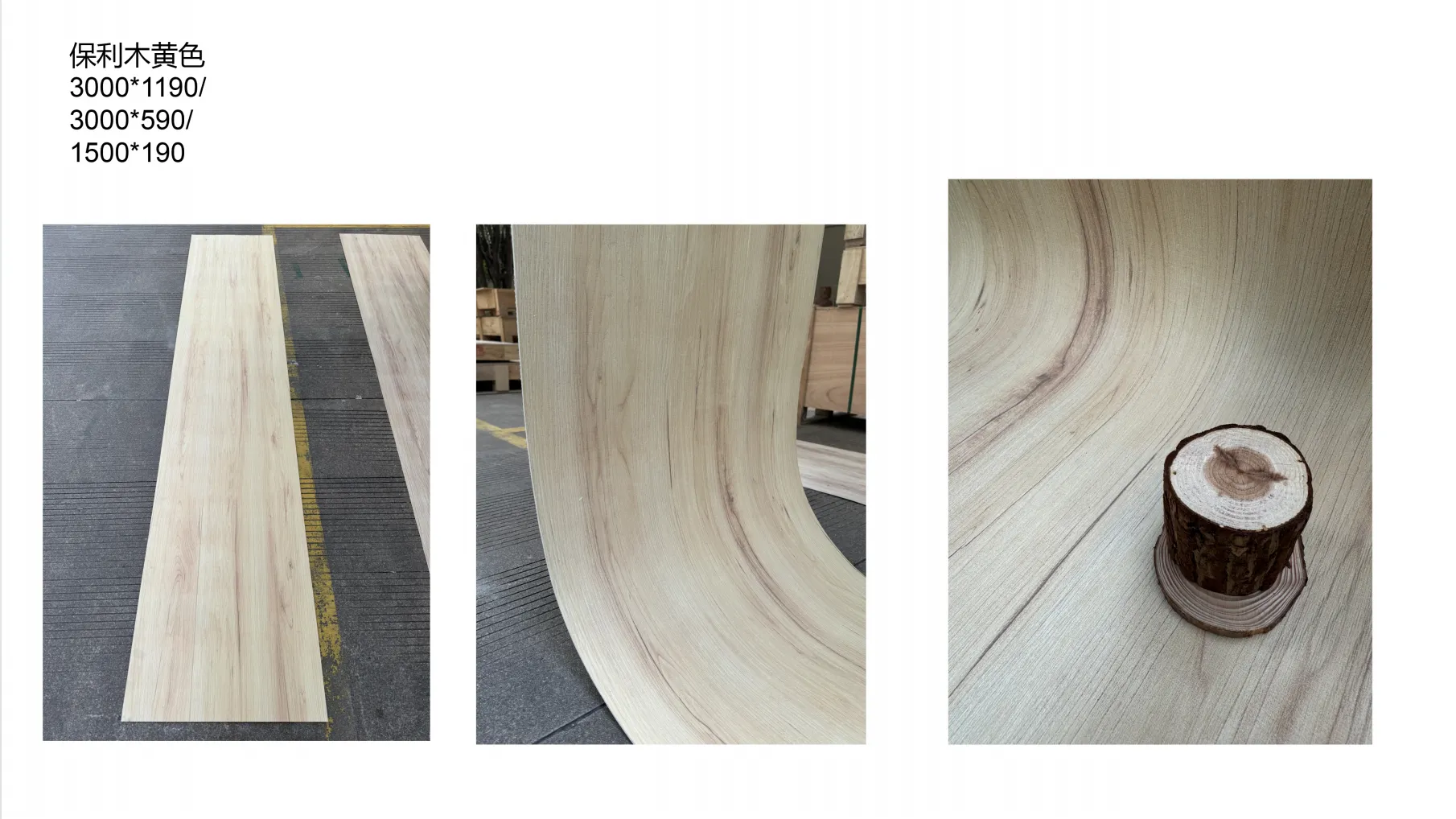
The first set of photos shows a 1m x 0.5m Poly Wood Board sample being bent over a cylindrical mold. At a radius of 50cm (about the curve of a large planter), the board bends smoothly. The wood grain—rich, warm, and realistic—stays intact, no splinters or splits in sight. Push it to a tighter radius, say 40cm, and you'll notice a slight "give" in the material, like a stiff but pliable ruler. It doesn't crack, but it's clear it has limits. One photo even captures the board being bent into a shallow U-shape around a mock fireplace corner; the edges lay flat, no gaps, no warping. For projects with gentle curves, this is more than enough.
MCM Flexible Stone, though, is in a league of its own. The photos here are almost hard to believe. One image shows a 2m x 1m panel of travertine-patterned MCM being rolled into a tube—yes, rolled—like a giant piece of paper. The surface, which mimics the pitted, earthy texture of natural travertine, doesn't chip or flake. Unroll it, and it lies flat again, as if nothing happened. Another photo zooms in on a corner bend: the stone is folded 90 degrees over a metal rod, and the only sign of stress is a faint crease that disappears when released. Even more impressive? A close-up of the material being bent repeatedly (over 50 times!) in the same spot; no cracks, no weakening, just consistent flexibility. It's like stone with a yoga practice.
What's the secret? That ultra-thin profile (3-5mm) and the flexible polymer binder. Traditional stone is heavy and brittle; MCM strips away the excess weight without losing strength. It's why it's become a go-to for flexible stone cladding panels on everything from retail storefronts to luxury hotels.
Lab tests are one thing, but how do these materials perform when the rubber hits the road (or the wall, or the deck)? Let's look at a few real-world examples.
Take the backyard deck of a family home in Portland, Oregon. The homeowner wanted a deck that wrapped around a curved pool edge, but traditional wood warps in the rain, and composite boards felt too rigid. Enter Poly Wood Board. The installer bent the boards to a 60cm radius, following the pool's curve perfectly. Two years later, the deck still looks new—no cracks, no splinters, and that warm wood tone hasn't faded. "It feels like real wood, but it bends like plastic," the homeowner laughed. "I never have to sand or stain it. Best decision we made."
Over in Chicago, a boutique café wanted an accent wall that curved behind the counter, mimicking the flow of a river. The designer initially considered marble, but the cost and weight were prohibitive. Then they discovered MCM Flexible Stone in a travertine (starry blue) finish. The installers cut the panels to size and bent them to a tight 20cm radius, creating a wave-like effect that customers can't stop (taking photos of). "It looks like we imported Italian stone and carved it on-site," the café owner said. "No one believes it's just 4mm thick. And when we had to adjust the curve mid-install? It bent again, no problem."
So, which one is right for you? It depends on your project's needs. If you love the look of wood, need moderate flexibility (gentle curves), and prioritize outdoor durability, Poly Wood Board is your match. It's warm, it's approachable, and it plays well with nature-inspired designs.
But if you crave the luxury of stone, need tight bends, or want to push the boundaries of what's possible (think 3D-printed patterns, cylindrical columns, or undulating feature walls), MCM Flexible Stone is the clear winner. Its ability to mimic natural materials while bending like a sheet of plastic is unmatched.
And remember: bending performance isn't the only factor. Poly Wood Board offers better impact resistance for high-traffic areas, while MCM Flexible Stone excels in lightweight cladding for tall buildings. The best part? Both materials are eco-friendly, with MCM even using recycled stone particles and Poly Wood Board incorporating sustainable wood fibers.
At the end of the day, building materials shouldn't limit your creativity—they should fuel it. Poly Wood Board and MCM Flexible Stone both do that, but in different ways. One brings the warmth of wood to gentle curves; the other turns stone into a flexible canvas for bold, dynamic designs. The real photos of their bending performance tell the story: these aren't just materials—they're tools for turning "what if" into "what is."
So, whether you're designing a cozy reading nook with a curved bookshelf or a statement wall that bends like a work of art, remember: flexibility matters. And with options like these, you'll never have to compromise again.
Recommend Products












