
Ensuring Excellence in Every Slab, Panel, and Surface
Walk into any modern architectural marvel, and you'll likely find it: the quiet grandeur of stone. Not just any stone, but materials like cloud stone, mcm flexible stone, and travertine (starry blue)—materials that don't just fill space, but tell stories. They clothe skyscrapers, warm up homes, and turn public plazas into works of art. But here's the thing: that beauty and durability don't happen by accident. Behind every slab of fair-faced concrete or sheet of foamed aluminium alloy board (vintage silver) lies a rigorous dance of quality control—a dance that ensures these materials don't just look good, but stand the test of time, weather, and wear.
In an industry where a single crack can compromise a building's integrity, or a color mismatch can derail a designer's vision, quality control isn't a luxury. It's the backbone of trust between manufacturers, architects, and the people who live and work in these spaces. And in a world where cloud stone and its counterparts are shipped across continents, global standards aren't just guidelines—they're the common language that keeps everyone on the same page. So let's pull back the curtain and explore what it really takes to meet those standards, and why they matter more than ever.
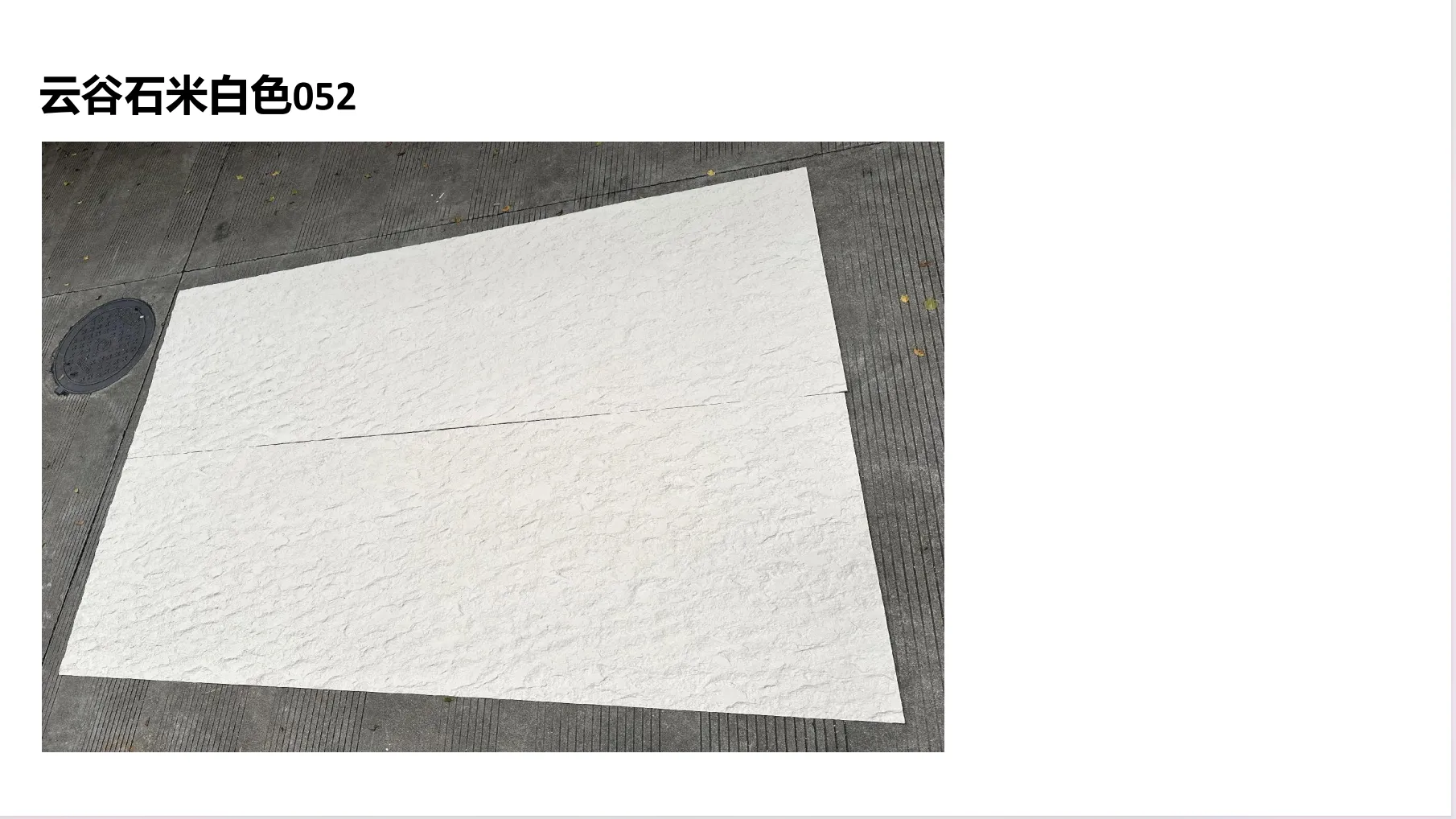
First, let's get clear on what we're talking about. "Cloud stone" isn't a single material—it's an umbrella term for a diverse family of natural and engineered stones, panels, and composites that have taken the construction world by storm. Think of it as nature and innovation shaking hands: there's the organic charm of travertine (starry blue), with its star-like speckles that evoke a night sky; the industrial chic of fair-faced concrete, which wears its raw, unpolished texture like a badge of honor; and the adaptability of mcm flexible stone, which bends and curves to fit even the most ambitious architectural designs. Add in options like foamed aluminium alloy board (vintage silver), with its metallic sheen and lightweight strength, and you've got a lineup that's as versatile as it is visually striking.
But what makes these materials "global"? It's simple: they're not bound by borders. A developer in Dubai might specify travertine (starry blue) for a hotel lobby, while an architect in Berlin could opt for mcm flexible stone for a museum facade. Meanwhile, a homebuilder in Tokyo might choose fair-faced concrete for a minimalist residence. This cross-continental demand means that quality can't be a local afterthought. A slab that works in the humid climate of Singapore needs to perform just as well in the freezing winters of Canada. That's where global quality standards step in—they're the rulebook that ensures consistency, no matter where the material is mined, manufactured, or installed.
Imagine trying to play a game without agreed-upon rules. Chaos, right? That's what the construction industry would look like without global quality standards. These standards are set by organizations like the International Organization for Standardization (ISO), ASTM International, and the European Committee for Standardization (CEN), and they cover everything from how a stone is quarried to how it's tested for strength. Let's break down the key pillars that these standards focus on:
Quality control isn't a one-and-done step—it's a journey that starts the moment a stone is extracted from the earth and ends long after it's installed. Let's walk through this process, step by step, to see where standards come into play:
1. Quarrying and Sourcing: It all begins with the raw material. Whether it's a block of travertine (starry blue) from a quarry in Italy or the minerals used to make mcm flexible stone in China, standards dictate how these resources are extracted. For example, ISO 14001 sets guidelines for environmental management during quarrying, ensuring that ecosystems are protected and waste is minimized.
2. Processing and Manufacturing: Once the raw material is sourced, it's time to shape it. For natural stones like travertine, this might involve cutting, polishing, or texturing. For engineered materials like fair-faced concrete, it's about mixing aggregates, cement, and additives to achieve the right strength and appearance. Here, standards like ASTM C170 (Standard Test Method for Compressive Strength of Hydraulic Cement Mortars) ensure that concrete mixes meet minimum strength requirements, while EN 12373-6 specifies how natural stone panels should be tested for flexural strength.
3. Testing, Testing, 1-2-3: This is where the rubber meets the road (or the stone meets the lab). Every batch undergoes a battery of tests to check for flaws. For example, water absorption testing ensures that travertine (starry blue) won't soak up moisture and crack in freezing temperatures. Abrasion resistance tests make sure that high-traffic areas using foamed aluminium alloy board (vintage silver) won't scratch or dull quickly. Even aesthetics are tested: colorimeter devices measure hue consistency across panels, so a wall clad in mcm flexible stone doesn't end up looking like a patchwork quilt.
4. Certification and Documentation: If a product passes all tests, it earns certifications that act as a seal of approval. LEED (Leadership in Energy and Environmental Design) certification, for instance, is highly sought after for sustainable projects, while CE marking indicates that a product meets European safety, health, and environmental requirements. These certifications aren't just pieces of paper—they're proof that the material has met global standards.
| Standard | Region | Key Focus Areas | Example Test for Travertine |
|---|---|---|---|
| ASTM C1527 | North America | Durability, slip resistance | Water absorption (max 3% for exterior use) |
| EN 12373 | Europe | Aesthetics, environmental impact | Color fastness to UV radiation (no fading after 1000 hours of testing) |
| GB/T 18601 | China | Mechanical strength, fire resistance | Compressive strength (min 25 MPa for interior wall panels) |
| AS 4455 | Australia | Weather resistance, sustainability | Freeze-thaw cycling (50 cycles without cracking) |
To see these standards in action, let's look at a hypothetical but realistic example: a global manufacturer based in Turkey that specializes in travertine (starry blue) and mcm flexible stone. Let's call them "Elysium Stone." Here's how they uphold global quality:
At the Quarry: Elysium sources travertine from ISO 14001-certified quarries in Denizli, Turkey, ensuring that extraction is done with minimal environmental impact. They also conduct regular soil and water testing to prevent contamination.
In the Factory: For their mcm flexible stone production, they use a proprietary mix of natural stone powder and polymer resins, tested to meet ASTM C170 for compressive strength and EN 13501 for fire resistance. Each batch of travertine (starry blue) is inspected under LED lighting to check for color consistency, with any slabs showing uneven speckling rejected.
In the Lab: Elysium has an in-house testing lab accredited by ILAC (International Laboratory Accreditation Cooperation). Samples of every product are tested for water absorption, flexural strength, and abrasion resistance. For example, their travertine (starry blue) undergoes 50 freeze-thaw cycles (per AS 4455) to ensure it can withstand cold climates, while their mcm flexible stone is bent to a 90-degree angle 100 times to test flexibility.
On the Ground: Even after shipping, Elysium provides on-site support. When a project in Canada ordered their travertine (starry blue) for a hotel lobby, their team traveled to inspect the installation, ensuring that the slabs were laid correctly and that the final result matched the approved samples.
The result? Elysium's products carry CE marking for Europe, ASTM certification for North America, and GB/T compliance for China—making them a go-to choice for global projects.
Of course, upholding global standards isn't always smooth sailing. One of the biggest challenges is variability in raw materials. Natural stones like travertine (starry blue) are products of nature, so no two slabs are identical. While standards allow for minor variations, striking the balance between "natural character" and "inconsistency" can be tricky. A client in Japan might expect near-perfect uniformity, while a client in Brazil might celebrate those unique imperfections as part of the stone's charm.
Another hurdle is cost. Meeting global standards often requires investing in better equipment, more rigorous testing, and higher-quality raw materials. For smaller manufacturers, this can be a barrier. However, the long-term payoff—customer trust, repeat business, and access to global markets—usually outweighs the upfront costs.
Then there's the issue of evolving standards. As sustainability becomes more critical, organizations like ISO are updating their guidelines to include stricter environmental criteria. Manufacturers must stay agile, investing in eco-friendly processes (like using recycled materials in mcm flexible stone) to keep up.
So, what's next for quality control in cloud stone production? The answer lies in technology and transparency. Here are a few trends to watch:
AI and Machine Learning: Imagine a camera that can scan a slab of travertine (starry blue) and instantly flag color inconsistencies or hairline cracks—before a human eye even spots them. AI-powered vision systems are making this a reality, reducing human error and speeding up inspections.
3D Scanning and Digital Twins: For complex projects, 3D scanning creates digital replicas of stone panels, allowing manufacturers and architects to test fit, durability, and aesthetics virtually before production. This not only reduces waste but also ensures that the final product matches the design exactly.
Blockchain for Traceability: Consumers and clients are increasingly demanding to know where their materials come from. Blockchain technology can track a stone's journey from quarry to installation, providing immutable records of testing, certifications, and sustainability practices. Want to know if your foamed aluminium alloy board (vintage silver) was sourced responsibly? Just scan the QR code.
Sustainability as a Core Standard: In the past, sustainability was a "nice-to-have." Now, it's a must. Standards like LEED and BREEAM are pushing manufacturers to reduce carbon footprints, use recycled materials, and design products that can be reused or recycled at the end of their life. Expect to see more "cradle-to-cradle" certifications in the coming years.
At the end of the day, quality control in cloud stone production is about more than meeting standards on paper. It's about building trust—trust between manufacturers and architects, between suppliers and clients, and between the people who create these materials and the people who live with them. When a homeowner touches a wall clad in mcm flexible stone, or a traveler walks across a lobby floor of travertine (starry blue), they're not just interacting with a material—they're experiencing the result of countless hours of testing, care, and commitment to excellence.
As the construction industry continues to go global, these standards will only grow in importance. They're the thread that weaves together diverse materials, cultures, and climates into a tapestry of quality. So the next time you admire a stunning stone facade or run your hand over a smooth concrete surface, take a moment to appreciate the unseen work—the quality control—that made it all possible.
Recommend Products












