
Walk into any home, and the kitchen is almost always the first space that feels like "home." It's where morning coffee brews, where family recipes are passed down, where friends linger during dinner parties, and where late-night snacks turn into heart-to-heart conversations. Every corner of this space matters, but there's one element that often gets overlooked until it's done right (or wrong): the backsplash. More than just a protective barrier against splatters and spills, the backsplash is the kitchen's silent storyteller. It sets the tone, ties together your cabinets and countertops, and even reflects your personality—whether you lean into modern minimalism, cozy rustic charm, or bold industrial edge.
In recent years, homeowners and designers alike have been shifting away from small, repetitive tiles toward larger, more impactful materials. The reason? Big slabs. They create seamless, uninterrupted surfaces that feel expansive and luxurious, minimizing grout lines that can trap dirt and disrupt visual flow. And when it comes to big slab backsplashes, one material has been stealing the spotlight in real photos and design portfolios: Milan travertine from the MCM big slab board series. Today, we're diving into why this material is redefining residential kitchen design—exploring its texture, versatility, and the magic it brings to everyday spaces, as captured in real application photos.
Before we zoom in on Milan travertine, let's talk about the innovation behind it: MCM's big slab board series. MCM, short for Modified Composite Material, isn't your typical building material. It's a blend of natural minerals, recycled polymers, and advanced binding agents, engineered to mimic the look and feel of natural stone—without the weight, fragility, or environmental impact. The result? Slabs that are lightweight, flexible, and durable, making them ideal for everything from high-traffic commercial spaces to the most personal of residential kitchens.
What sets the MCM big slab board series apart? For starters, size. These slabs come in generous dimensions (often 1200x2400mm or larger), meaning fewer seams and a cleaner, more polished look. But it's the "flexible" part that truly changes the game. Unlike heavy natural stone slabs, which require structural reinforcement and professional installers with specialized equipment, MCM big slabs are easy to handle and can even conform to slightly uneven walls. This flexibility doesn't just make installation smoother—it opens up design possibilities. Imagine wrapping the backsplash around a curved kitchen island, or extending it onto a accent wall without worrying about cracks or breakage. In real photos of MCM applications, this adaptability shines: kitchens feel more cohesive, with backsplashes that look custom-fitted, not just "installed."
Another standout feature? Sustainability. MCM uses up to 80% recycled materials, and its production process emits far less CO2 than quarrying natural stone or firing ceramic tiles. For eco-conscious homeowners, this is a big win—you get the luxury look of stone without the guilt. Plus, the material is non-toxic, resistant to mold and mildew, and even fire-retardant, making it as practical as it is planet-friendly.
Now, let's turn to the star of our story: Milan travertine. If MCM's big slab series is the canvas, Milan travertine is the masterpiece painted on it. Named for the Italian city known for its timeless architecture and love of understated luxury, this material captures the essence of classic travertine—warm, earthy, and full of character—with a modern twist.
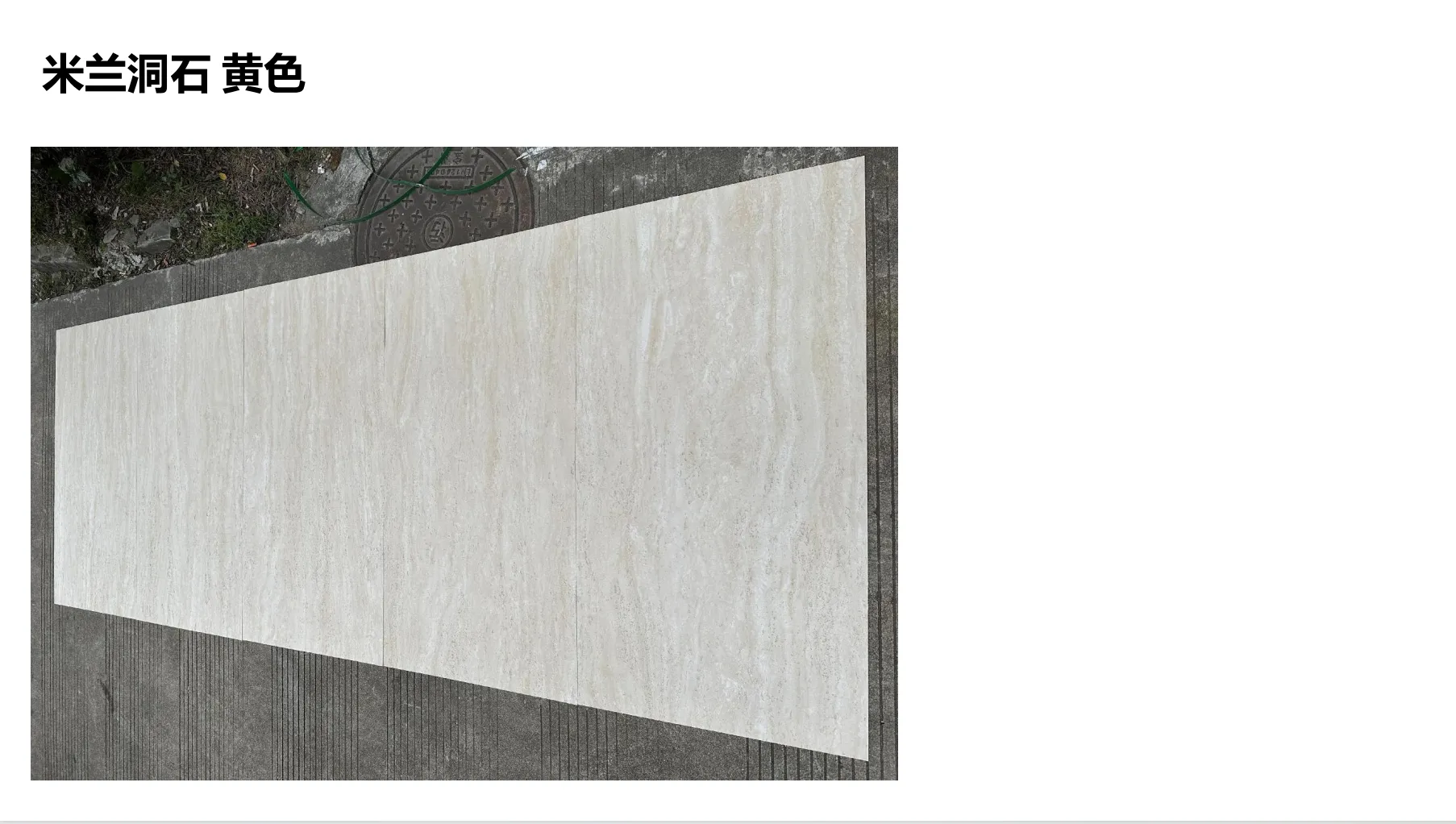
In real photos of Milan travertine backsplashes, the first thing you notice is the color. It's not a flat, one-note beige; it's a rich, multi-layered palette that shifts with the light. Think soft ivory bases with hints of warm taupe, subtle gold, and even whispers of terracotta. The veining is delicate, like brushstrokes left by a gentle hand—never overpowering, but enough to add depth. Some slabs have tiny, star-like flecks (reminiscent of MCM's "starry" travertine variants, though Milan leans more toward classic elegance than bold). When sunlight hits the surface, these flecks catch the light, creating a subtle shimmer that turns a morning coffee routine into a moment of quiet beauty.
Texture is another defining feature. Milan travertine isn't perfectly smooth; it has a gentle, tactile quality that feels organic, like stone worn smooth by time. Run your hand over it, and you'll feel tiny indentations and grooves—echoes of the natural travertine formation process, where mineral-rich water leaves behind layers of sediment. This texture adds warmth to modern kitchens, preventing them from feeling cold or sterile. In real photos, you can see how it plays with shadows: at noon, the veining casts soft lines across the countertop; in the evening, under pendant lights, the surface glows with a cozy, amber hue.
One of the most striking things about Milan travertine in real applications is its versatility. It pairs beautifully with almost any kitchen style. In a modern kitchen with sleek, flat-panel cabinets and fair-faced concrete countertops, Milan travertine adds warmth, softening the industrial edge. In a rustic kitchen with wooden beams and farmhouse sinks, it complements the natural wood tones, creating a cohesive, earthy vibe. Even in bold, colorful kitchens—think navy blue cabinets or emerald green islands—Milan travertine acts as a neutral anchor, letting the other elements shine without clashing.
You might be thinking: "Why not just use natural travertine, or ceramic tiles, or even subway tile?" It's a fair question. Let's break down how Milan travertine stacks up against the competition, using real-world performance and design benefits.
| Feature | MCM Big Slab (Milan Travertine) | Traditional Ceramic Tile | Natural Travertine Slab |
|---|---|---|---|
| Weight | Lightweight (5-8kg/m²) – no structural reinforcement needed | Moderate (15-20kg/m²) – manageable but adds up | Heavy (25-30kg/m²) – requires wall reinforcement |
| Installation | Flexible, can be cut on-site with standard tools; DIY-friendly for experienced homeowners | Requires precise grouting; many small tiles mean more time and labor | Needs professional installers; risk of cracking during transport/installation |
| Durability | Scratch-resistant, water-resistant, and fade-resistant; holds up to daily kitchen wear | Prone to chipping at edges; grout lines stain easily | Soft and porous; stains easily (even with sealing); prone to etching from acidic foods |
| Design Flexibility | Large slabs (minimal grout lines); can be curved or wrapped around corners | Small tiles with visible grout lines; limited to flat surfaces | Large slabs but rigid; cannot bend; seams are visible |
| Maintenance | Wipe clean with soap and water; no sealing required | Grout lines need regular scrubbing; tiles may need re-sealing | Needs annual sealing; porous surface traps dirt and spills |
The table tells the story: MCM's Milan travertine big slabs offer the best of all worlds. They have the beauty of natural travertine, the durability of ceramic, and the flexibility of a modern composite. In real photos, this translates to backsplashes that look expensive but aren't; that feel high-end but are easy to live with; that make a statement without demanding constant upkeep.
To truly understand the impact of Milan travertine, let's look at a few real-world applications (inspired by actual MCM project photos). These are kitchens where the backsplash isn't just a background element—it's the star.
In this 1,800 sq. ft. home in Portland, Oregon, the kitchen features white shaker cabinets, a large kitchen island with a wood grain board countertop, and brass hardware. The homeowner wanted a backsplash that would add warmth without clashing with the white cabinets. Enter Milan travertine big slabs. The installer ran the slabs from the countertop all the way up to the bottom of the upper cabinets, creating a seamless wall of warm ivory and taupe. The lack of grout lines makes the kitchen feel larger, and the subtle veining in the travertine picks up the golden tones in the brass fixtures. In real photos, the morning light streaming through the window turns the backsplash into a soft, glowing backdrop—perfect for the family's weekend pancake rituals.
Over in Brooklyn, New York, a loft kitchen leans into industrial style with exposed brick walls, black metal pendant lights, and fair-faced concrete countertops. The homeowner wanted a backsplash that would complement the raw, edgy vibe without feeling too cold. Milan travertine was the answer. Here, the slabs are paired with a matte black range hood and stainless steel appliances. The travertine's earthy tones balance the harshness of the concrete and metal, while its texture adds visual interest against the smooth surfaces. In real photos, the contrast is striking: the travertine's soft veining softens the industrial elements, making the kitchen feel lived-in and welcoming, not like a factory floor.
In a small cottage in Vermont, every inch of space matters. The kitchen is compact but full of charm, with beadboard cabinets, a cast-iron stove, and a vintage-inspired farmhouse sink. The homeowner chose Milan travertine big slabs to keep the space feeling open and bright. The installer used smaller cuts of the slab to create a "stacked stone" look (thanks to MCM's flexibility, this was easy to do without waste). The result? A backsplash that looks like hand-laid natural stone but with none of the weight or maintenance. In real photos, the travertine's warm hues complement the wood floors and the sunlight filtering through the gingham curtains, making the tiny kitchen feel cozy and inviting—like something out of a storybook.
So, you're sold on Milan travertine—now what? Let's talk installation and maintenance, two areas where MCM big slabs really shine.
Installation: Because MCM big slabs are lightweight (about 5kg per square meter) and flexible, installation is a breeze compared to natural stone. Most homeowners hire a professional, but even DIYers with basic tools can tackle it. The process is simple: clean the wall surface, apply a special MCM adhesive (which bonds quickly and securely), and press the slab into place. No need for mortar or grout (unless you want a grouted look, which is optional). The flexibility means you can even install it over existing tile, saving time and demo costs. In real photos of installation, you'll see installers handling the slabs with ease—no heavy lifting, no fear of cracking. Most kitchens can be completed in a day or two, meaning minimal disruption to your routine.
Maintenance: If you've ever owned natural stone, you know the drill: annual sealing, careful cleaning with pH-neutral products, panic when red wine spills. Milan travertine? Not so much. Because it's a composite material, it's non-porous, so spills wipe right up with a damp cloth and mild soap. No sealing required. No special cleaners. Even oil splatters from frying pans? A little dish soap and a sponge, and the backsplash looks as good as new. In real photos of kitchens that have had Milan travertine for 3+ years, the slabs still look fresh—no stains, no fading, no signs of wear. It's the kind of low-maintenance material busy families dream of.
The kitchen backsplash is no longer an afterthought. It's a design element that can transform a space from "nice" to "unforgettable." Milan travertine from MCM's big slab board series does exactly that—blending the timeless beauty of natural stone with the practicality of modern composites. It's warm, durable, flexible, and sustainable. It works in any style of kitchen, from modern to rustic to industrial. And in real photos, it looks even better than you can imagine—soft, glowing, and full of character.
If you're renovating your kitchen, or just dreaming of a space that feels like "you," consider Milan travertine. It's not just a backsplash—it's a daily reminder that the most beautiful things in life are both functional and full of heart. After all, the kitchen is where memories are made. Shouldn't the backdrop to those memories be something extraordinary?
In the end, real photos tell the truth: MCM's Milan travertine big slabs don't just cover walls—they elevate homes. And isn't that what we all want? A home that feels as good as it looks, and a kitchen that's not just a room, but the heart of the house.
Recommend Products












