
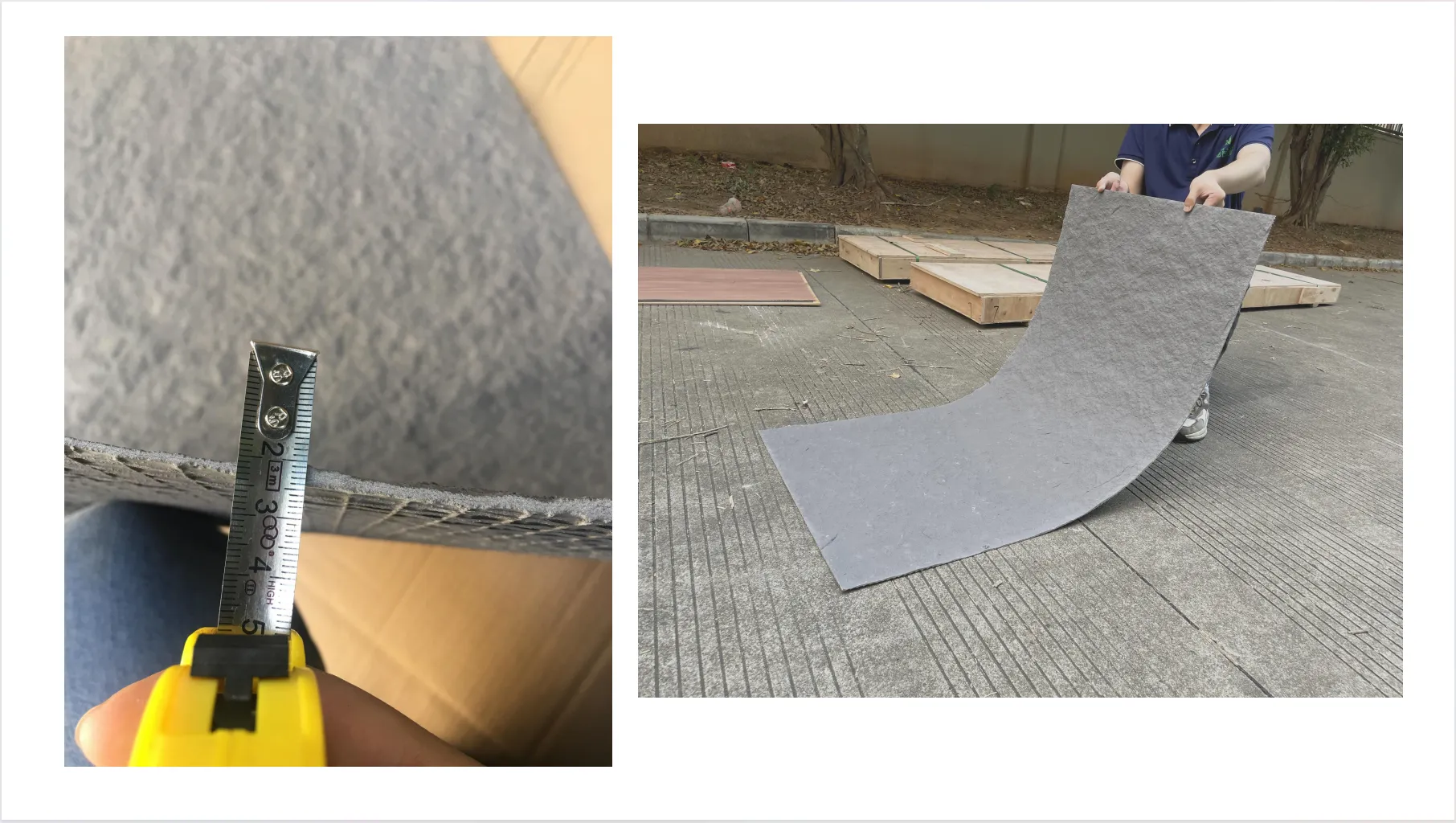
Walk down any city street, and you'll notice the stories buildings tell through their exteriors. Some shout with bold colors, others whisper with subtle textures, but few make a statement quite like rough granite. Its rugged, natural surface—pockmarked with history, as if chiseled by time itself—has long been a favorite for architects aiming to blend strength with beauty. But for years, there was a catch: granite, in its traditional slab form, is as rigid as it is stunning. Try to wrap it around a curved wall, a sweeping arch, or an organic, flowing facade, and you'd hit a wall (pun intended) of limitations. That is, until the rise of MCM flexible stone. Today, we're diving into the world of rough granite real pictures brought to life on curved exterior cladding—where tradition meets innovation, and rigid rocks learn to bend.
Let's start with the obvious: curves are hard. Not just for designers, who dream up sinuous, gravity-defying shapes, but for the materials that have to bring those dreams to life. Traditional rough granite slabs are heavy—we're talking hundreds of pounds per square meter—and unyielding. To install them on a flat wall? No problem. But ask them to follow the contour of a curved surface, and you're looking at a logistical nightmare. You'd either have to cut the slabs into tiny, awkward pieces (ruining the natural flow of the stone), or reinforce the structure to support the weight of custom-carved curved slabs (adding tens of thousands to the budget). For architects and builders, it often felt like choosing between design integrity and practicality. "We'd sketch these beautiful, organic facades," one architect friend told me recently, "and then the structural engineer would shake their head and say, 'Granite can't do that.' It was heartbreaking."
And then there were the real-world consequences. Buildings with curved exteriors often defaulted to smoother, less characterful materials—stucco, metal panels, or even painted concrete—sacrificing texture for flexibility. Rough granite, with all its raw appeal, was confined to boxy, angular designs. It was like having a masterpiece of a paintbrush but only being allowed to paint straight lines. But what if the brush could bend? What if the stone itself could adapt to the curve, not the other way around?
If traditional granite is a rigid old oak, MCM flexible stone is a willow—strong, but supple. MCM, or Modified Composite Material, isn't your average building material. It's a blend of natural stone aggregates (think crushed rough granite, mined from the same quarries that supply traditional slabs) and advanced polymers, engineered to be lightweight, durable, and yes—flexible. The result? A material that (retains) every bit of rough granite's tactile charm—the nooks, the crannies, the earthy color variations—but with the ability to wrap around curves like a second skin. Suddenly, that architect friend's sketches weren't just dreams anymore. They were blueprints.
But don't just take my word for it. Look at rough granite real pictures of MCM flexible panels, and you'll see the difference immediately. There's the texture: that same rugged, hand-hewn feel you'd expect from quarried granite, but without the weight. Run your hand over a sample, and you'll feel the granularity, the slight unevenness that makes natural stone so alive. Then, bend it. Gently, of course—but watch as the panel flexes, conforming to the curve of your arm. It's a little like magic, seeing something so clearly "stone" behave like a flexible sheet. That flexibility is game-changing for curved exterior cladding, where the goal is to make a building feel less like a stack of blocks and more like a living, breathing structure.
The MCM project board series is where this innovation really shines. Designed with large-scale architectural projects in mind, these boards are more than just materials—they're solutions. Think about a museum with a facade that sweeps upward in a gentle arc, meant to evoke the curve of a wave. Or a boutique hotel with a circular lobby, where the exterior walls wrap around the entrance like a hug. These aren't just aesthetic choices; they're statements about movement, flow, and harmony with the environment. And the MCM project board series, with its big slab capabilities and flexible core, makes them possible.
Take, for example, the MCM big slab board series. These panels come in sizes that minimize seams, ensuring that even curved surfaces look seamless. Imagine a 10-foot-tall curved wall clad in rough granite MCM panels—no visible breaks, just a continuous sweep of texture that draws the eye upward. Traditional granite slabs, by contrast, would require dozens of cuts and joints, disrupting the flow and making the curve look choppy. With MCM, the focus stays on the design, not the limitations of the material.
But what about durability? After all, exterior cladding has to stand up to rain, wind, UV rays, and the occasional hailstorm. MCM flexible rough granite isn't just pretty—it's tough. The polymer binding agents add resistance to cracking and chipping, while the natural stone aggregate ensures it can handle the elements. Unlike traditional granite, which can absorb water and stain over time, MCM panels are engineered to be low-maintenance, requiring little more than an occasional rinse to keep their rough texture looking fresh. For building owners, that means less time worrying about upkeep and more time enjoying the beauty of their curved facade.
Still on the fence? Let's break it down. Below is a comparison of traditional rough granite slabs and MCM flexible rough granite panels—two materials with the same soul, but very different personalities when it comes to curved exterior cladding.
| Feature | Traditional Rough Granite Slabs | MCM Flexible Rough Granite Panels |
|---|---|---|
| Weight | Heavy (80-100 lbs per sq ft) | Lightweight (5-8 lbs per sq ft) |
| Flexibility | Rigid; cannot bend without breaking | Flexible; can conform to curves with radii as tight as 6 inches |
| Installation | Requires heavy machinery and structural reinforcement | Can be installed with basic tools; no additional structural support needed |
| Seams | Many small slabs mean visible seams | Large panels minimize seams for a smoother look |
| Sustainability | High carbon footprint (quarrying, transportation, cutting waste) | Low carbon footprint (recycled polymers, minimal waste, lightweight transport) |
| Durability | Durable but prone to cracking from impact or thermal expansion | Impact-resistant; resists cracking from temperature changes |
The numbers speak for themselves. For architects and builders, the lightweight nature of MCM flexible stone alone is a win. Traditional granite slabs require cranes, scaffolding, and often reinforced steel frames to support their weight—a cost that adds up quickly, both in time and money. MCM panels, on the other hand, can be carried by two people, cut on-site with standard tools, and adhered directly to substrates like concrete, metal, or wood. That means faster installation, lower labor costs, and less stress on the building's structure. For a curved exterior, where every inch of the facade is a custom fit, this efficiency is a lifesaver.
Curved exterior cladding isn't just about solving a technical problem—it's about unlocking new design languages. When a building's facade can curve, it stops feeling like a static object and starts feeling dynamic. It invites the eye to move, to follow the flow of the walls, to imagine what's around the bend. And when that curved surface is clad in rough granite MCM panels, the effect is amplified. The texture of the stone adds depth, making the curve feel more organic, more rooted in nature.
Take, for example, a residential building with a curved entryway. Traditional materials might make that curve feel like an afterthought—a flat wall bent into shape. But with rough granite MCM panels, the curve becomes the star. The rough texture catches the light differently as the wall arcs, creating shadows that shift throughout the day. In the morning, the sun hits the convex side, highlighting the stone's pockmarks; in the afternoon, the concave side is bathed in softer light, making the texture feel warmer. It's a building that changes with the hours, telling a new story every time you look at it.
Or consider a cultural center with a facade inspired by natural landscapes—rolling hills, winding rivers, the curve of a canyon. With MCM flexible rough granite, that inspiration isn't just a concept; it's a reality. The panels can be shaped to mimic the undulations of the land, their rough surface echoing the texture of rock formations. It's architecture that doesn't just represent nature—it becomes part of it. And when you see rough granite real pictures of these projects, you don't just see a building. You see a conversation between human creativity and the natural world.
In the heart of a mid-sized city, the Riverfront Arts Center was designed to be a bridge between the urban landscape and the nearby river. The architect's vision? A facade that flowed like water—curving, undulating, and reflecting the movement of the current. Traditional materials couldn't handle the organic shape, but MCM flexible rough granite panels could.
The center's exterior features a series of sweeping curves, clad in rough granite MCM panels in a warm, earthy tone. From a distance, the building looks like a wave frozen in stone, its surface rippling with texture. Up close, the rough granite real pictures (and in person) reveal the details: tiny pits and grooves that catch the light, making the facade feel alive. Since opening, visitors often comment on how the building "feels like it belongs by the river"—a testament to how texture and form can work together to create emotional connections.
Installation was a breeze compared to traditional granite. The lightweight panels were carried up scaffolding by hand, cut to fit the curves on-site, and adhered to a simple metal frame. The result? A building that not only looks stunning but was built in half the time (and at a third of the structural cost) of a traditional granite-clad design. It's a perfect example of architectural big slab solutions in action—proving that sometimes, the biggest ideas come in flexible packages.
While curved exterior cladding is where MCM flexible rough granite really shines, its versatility doesn't stop there. These panels are equally at home on flat walls, where they add texture without the weight penalty. They work on interior surfaces too—think accent walls in lobbies, fireplaces that wrap around corners, or even ceiling treatments that bring the outdoors in. And because they're available in a range of colors and finishes (from classic gray to warm beige, with options like "lunar peak silvery" or "rustic red" for bold statements), they can adapt to any design style, from industrial modern to rustic charm.
One of the most exciting aspects is the ability to combine different MCM series. Pair rough granite panels with, say, foamed aluminium alloy boards for a mix of textures and metals, or with wood grain boards for a warm, organic feel. The MCM project board series is designed to play well with others, giving architects the freedom to mix and match materials without worrying about compatibility or installation headaches. It's like having a palette of natural materials that all speak the same language—flexibility.
In an era where "green building" is more than a buzzword—it's a responsibility—MCM flexible rough granite checks all the boxes. Traditional granite quarrying is resource-intensive, with heavy machinery, massive transportation costs, and significant waste (up to 30% of a block is lost during cutting). MCM panels, by contrast, use a blend of natural stone aggregates and recycled polymers, reducing the need for virgin materials. Their lightweight design also cuts down on transportation emissions—imagine shipping 100 sq ft of traditional granite versus 100 sq ft of MCM panels. The difference in fuel consumption is staggering.
But sustainability isn't just about materials; it's about longevity. MCM flexible rough granite is built to last. Resistant to water, UV rays, and temperature fluctuations, these panels won't fade, crack, or warp over time. That means less maintenance, fewer replacements, and less waste in the long run. And when a building does reach the end of its life, the panels can be recycled, closing the loop on the material's lifecycle. It's a sustainable choice that doesn't compromise on beauty or performance—proof that you can have your stone facade and save the planet too.
Let's talk about the nitty-gritty: installing MCM flexible rough granite panels. If you've ever watched traditional granite being installed, you know it's a slow, labor-intensive process. Cranes lift heavy slabs into place, workers carefully align them with precision tools, and structural engineers monitor every step to ensure the building can handle the weight. With MCM panels, the process is refreshingly simple.
First, the substrate is prepped—cleaned, smoothed, and primed to ensure good adhesion. Then, the panels are measured and cut to size. Thanks to their flexibility, cutting is easy with standard saws, and there's minimal waste. Next, a high-strength adhesive is applied to the back of each panel, and they're pressed into place. No heavy machinery, no complicated fasteners—just a few workers with basic tools and a keen eye for detail. For curved surfaces, the panels are gently bent to fit the radius of the wall, adhering smoothly as they conform to the shape. In most cases, a team can install 500+ sq ft of panels in a single day—compared to 50-100 sq ft with traditional granite. That speed doesn't just save time; it saves money, too, reducing labor costs and getting projects finished ahead of schedule.
At the end of the day, words can only do so much. To truly appreciate the beauty of MCM flexible rough granite, you need to see rough granite real pictures. Look for images of curved facades where the stone wraps around corners like a glove, their texture catching the light in different ways. Zoom in on the surface, and you'll see the individual grains, the tiny indentations, the natural variation that makes each panel unique. These aren't just "pictures of stone"—they're snapshots of possibility.
One of my favorite rough granite real pictures is from a residential project in a mountain town. The home's exterior features a curved entryway, clad in MCM flexible rough granite panels in a deep, charcoal gray. The curve is gentle, inviting, and the stone's rough texture contrasts beautifully with the smooth glass windows and warm wood accents. In the photo, the morning sun hits the panels, casting shadows that make the texture pop. It's not just a house—it's a home with personality, thanks in large part to the flexibility of the material. That's the power of MCM flexible stone: it doesn't just cover a building. It completes it.
As architects and designers continue to push the boundaries of what buildings can be—moving beyond boxes, embracing organic shapes, and prioritizing sustainability—materials like MCM flexible rough granite will only grow in importance. They're not just replacing traditional stone; they're redefining what stone can do. Curved exterior cladding, once a niche challenge, is becoming mainstream, and rough granite is at the forefront of that movement.
Imagine a skyline filled with buildings that bend and flow, their exteriors telling stories through texture and form. Imagine cultural centers that mimic natural landscapes, hotels that wrap guests in warmth, and homes that feel like they've been carved from the earth itself—all thanks to a material that learned to be both strong and supple. That future isn't far off. It's here, in the rough granite real pictures of today's most innovative projects, and in the hands of architects who refuse to let "can't" stand in the way of "can."
Rough granite has always been a symbol of strength—a material that stands the test of time. But strength, as it turns out, doesn't have to mean rigidity. With MCM flexible stone, rough granite has learned to dance—to bend, to flow, to adapt to the curves and contours of our most creative architectural visions. It's a reminder that innovation doesn't have to discard tradition; it can lift it up, giving old materials new life.
So the next time you see a building with a curved exterior, take a closer look. If it's clad in rough granite, chances are it's not traditional slabs holding it up. It's MCM flexible stone—lightweight, durable, and full of possibility. And if you're lucky enough to see rough granite real pictures of that building, pause for a moment. Let yourself appreciate the texture, the flow, the way the stone seems to move. Because in that moment, you're not just looking at a wall. You're looking at the future of architecture—where even the rocks can learn to bend.
Recommend Products












