
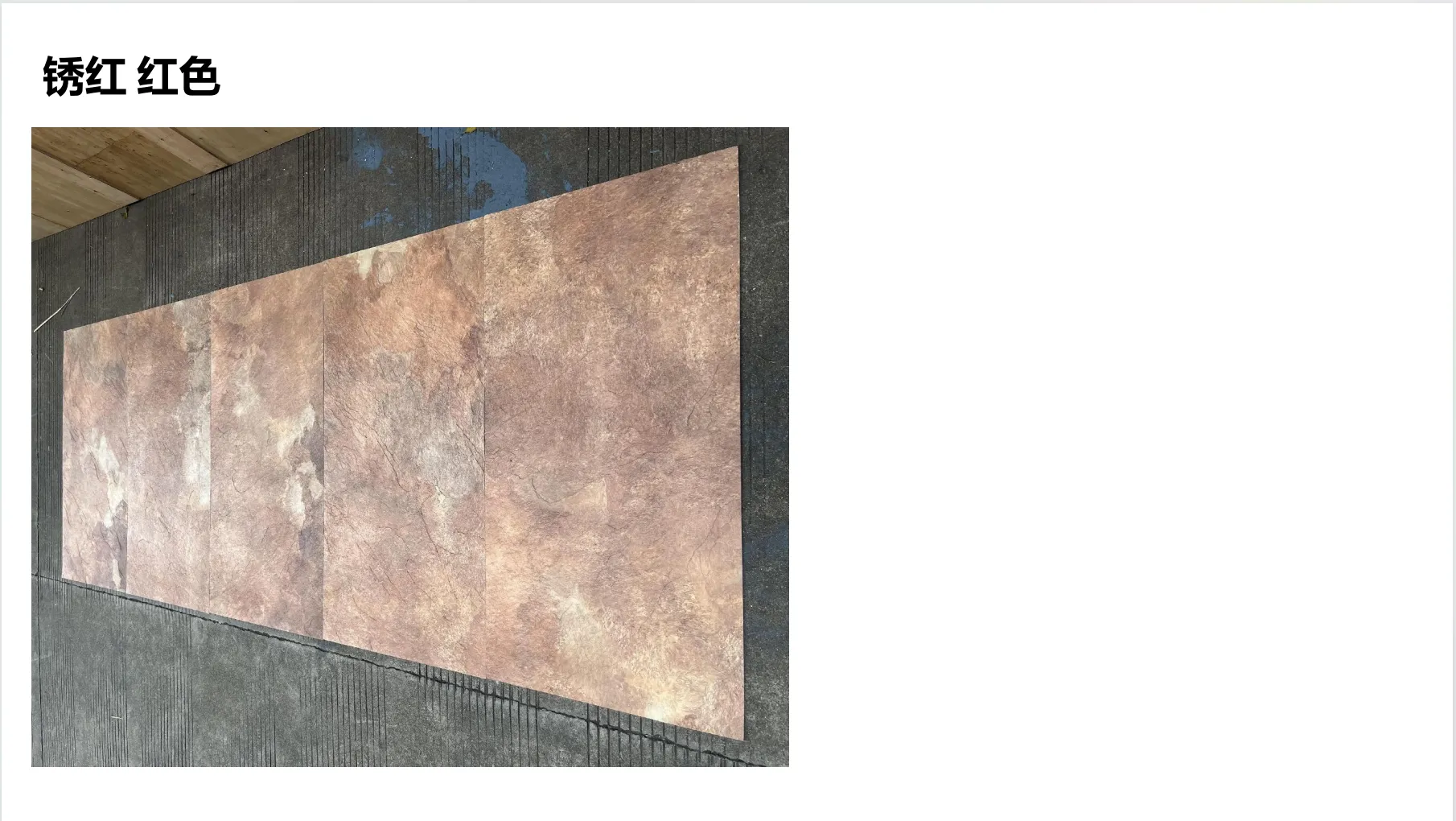
In the world of commercial architecture, few elements make a statement like a building's facade. It's the first impression, the silent storyteller, and the bridge between function and art. Yet for architects and designers, large-scale facades often mean balancing conflicting demands: durability against the elements, visual impact that stands the test of time, and installation practicality that keeps projects on schedule. Enter rusty red MCM big slab board —a material that doesn't just meet these demands, but redefines what's possible for commercial exteriors.
Imagine standing before a sprawling commercial complex—a shopping mall, a tech campus, or a corporate headquarters. Its facade stretches stories high, facing relentless sun, driving rain, and shifting temperatures. Traditional materials often falter here: natural stone is heavy and costly to install; metal panels can fade or corrode; even concrete, while durable, can feel cold and lifeless. Designers are left asking: Can a facade be both tough enough for the elements and rich enough to evoke emotion?
Rusty red MCM big slab board answers that question with a resounding yes. Part of the broader mcm big slab board series , it's engineered using modified composite material (MCM)—a blend of natural minerals and high-performance polymers that marries the best of stone, metal, and plastic. The result? A material that's lightweight yet incredibly strong, weather-resistant yet visually dynamic, and designed specifically for the grand scale of commercial architecture.
Why "Rusty Red"? This isn't just any red. It's a hue that feels lived-in, like metal that's gracefully aged over decades, but with the warmth of terracotta or the depth of a desert sunset. Subtle variations in texture—tiny flecks that catch the light, soft ridges that mimic natural weathering—give it a tactile quality that draws the eye, turning a flat facade into a canvas of light and shadow.
What makes rusty red MCM big slab board a game-changer for large facades? It starts with size. Traditional stone slabs max out at around 4x8 feet; MCM big slabs, however, can reach up to 10x5 feet or more. Fewer seams mean a cleaner, more cohesive look—critical for buildings where visual flow matters. But size alone isn't enough. MCM's secret lies in its composition:
To truly appreciate rusty red MCM big slab board, it helps to see how it compares to other popular facade materials. Let's put it head-to-head with two alternatives: fair-faced concrete (a staple for modern minimalism) and foamed aluminium alloy board (vintage gold) (a sleek, metallic option).
| Feature | Rusty Red MCM Big Slab | Fair-Faced Concrete | Foamed Aluminium Alloy (Vintage Gold) |
|---|---|---|---|
| Aesthetic Versatility | Warm, textured red with natural variation; mimics aged metal/stone hybrid | Uniform gray; industrial, minimalist look (limited color options) | Bright metallic gold; sleek but prone to showing fingerprints/scratches |
| Durability | Resists fading, cracking, and corrosion; 50+ year lifespan | Strong but prone to staining; may develop hairline cracks over time | Lightweight but scratches easily; can oxidize in humid climates |
| Installation Ease | Lightweight; can be cut on-site; quick to mount with mechanical fasteners | Heavy; requires formwork; longer curing time | Lightweight but requires precise handling to avoid dents |
| Sustainability | Recycled content; low-VOC; energy-efficient production | High embodied carbon; limited recyclability | Recyclable but energy-intensive to produce |
The verdict? While fair-faced concrete offers understated simplicity and foamed aluminium brings metallic flair, rusty red MCM big slab board delivers the best of both worlds: warmth and durability, flexibility and sustainability. It's not just a material—it's a design partner.
One of the joys of working with rusty red MCM big slab board is its ability to play well with others. For architects who want to add depth or contrast to a facade, pairing it with complementary materials can elevate the design. Here are a few standout combinations:
Take, for example, the recently completed Riverfront Plaza in Austin, Texas. A 12-story mixed-use building, its facade wraps around a corner lot, facing both a busy street and a scenic riverwalk. The architects chose rusty red MCM big slab board for the street-facing elevation, citing its ability to "command attention without overwhelming the historic neighborhood." The large slabs (8x4 feet each) created a seamless expanse of color that shifts with the sun—deep crimson at dawn, warm terracotta at noon, and coppery gold at sunset. Meanwhile, the river-facing side paired MCM with stream limestone (claybank) , blending the building into the natural landscape.
Another project, the TechHub Campus in Denver, used rusty red MCM to bridge the gap between industrial heritage and cutting-edge innovation. The building, housed in a repurposed factory, features original brick walls alongside new MCM panels. The rusty red hue echoes the factory's aged metal beams, while the MCM's modern engineering ensures the facade can withstand Colorado's harsh winters and intense summer sun.
At the end of the day, commercial facades are investments—both in a building's value and its brand identity. Rusty red MCM big slab board delivers returns on both fronts:
Rusty red MCM big slab board isn't just another building product. It's a solution for architects who refuse to compromise—who want facades that are as tough as they are beautiful, as practical as they are poetic. In a world of generic glass and steel, it stands out as a material with soul: one that tells a story of resilience, warmth, and timeless design.
For large-scale commercial projects, where first impressions last and durability is non-negotiable, rusty red MCM big slab board isn't just perfect—it's transformative. It turns facades into landmarks, and buildings into stories. And in the end, isn't that what great architecture is all about?
Recommend Products












