
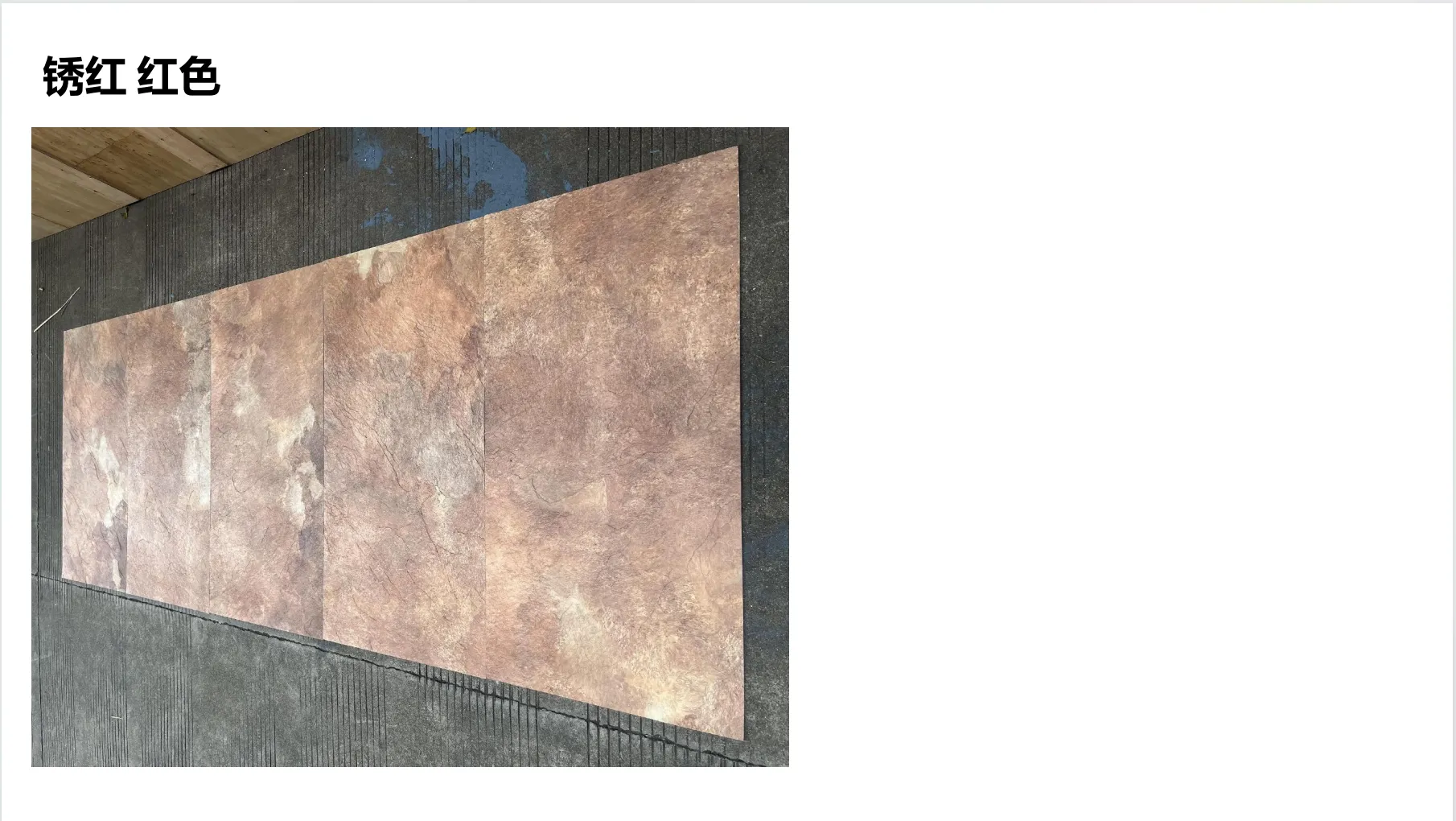
The art and science of keeping bold hues consistent—from blueprint to build
Picture this: You're standing at the base of a sprawling commercial complex, sunlight glinting off its facade. The design calls for a warm, earthy rusty red—one that evokes both strength and warmth, a color that ties the building to its industrial neighborhood while feeling modern and intentional. But as you scan the upper floors, your heart sinks: some panels lean orange, others veer toward brown, and a few even look washed-out, like a faded memory of the red you approved. For architects, contractors, and designers, this scenario isn't just frustrating—it's a threat to the project's integrity, budget, and client trust.
Rusty red isn't just a color; it's a statement. It's the hue of aged steel, the warmth of desert sunsets, and the character of weathered brick. But in large-scale projects—think shopping malls, corporate headquarters, or cultural centers—achieving consistent rusty red across thousands of square feet of cladding is notoriously tricky. Natural materials like stone or brick often come with inherent variations, and traditional synthetic panels can fade or shift under UV light. That's where MCM (Modified Composite Material) steps in, offering a lifeline for designers chasing that perfect, uniform rusty red. Let's dive into why this hue is so challenging, how MCM materials like flexible stone and rust board rise to the occasion, and the techniques that turn color chaos into cohesion.
Before we celebrate MCM's solutions, let's talk about the enemy: color variation . Rusty red is a complex shade, blending undertones of orange, brown, and even purple. Unlike neutral whites or grays—where minor shifts are harder to spot—rusty red demands precision. A 5% difference in pigment density can make one panel look "fiery" and the next "muddy," and when multiplied across a 10-story building, that inconsistency becomes a visual distraction.
Traditional materials amplify this problem. Natural travertine, for example, is beloved for its organic texture, but its porous surface absorbs minerals and light unevenly, leading to splotchy reds. Even concrete, a staple in modern construction, can vary batch to batch based on water content, curing time, and aggregate type. Add environmental factors—sunlight, humidity, pollution—and you've got a recipe for color chaos. One project manager I spoke with (let's call her Maya) recalled a hospital expansion where rusty red brick cladding arrived in three batches: "The first was perfect, the second was 20% lighter, and the third had this weird pinkish tint. We had to reorder 30% of the bricks, delaying the project by two months. The client was livid."
Then there's the issue of long-term durability . Rusty red, with its iron-rich pigments, is prone to fading when exposed to harsh weather. Traditional paint or coatings chip over time, leaving panels looking patchy. For buildings designed to stand for decades, this means ongoing maintenance costs—and a facade that never quite looks "finished."
Enter MCM: a category of engineered materials that combine the best of nature and technology. Products like MCM flexible stone , rust board , and travertine (starry red) are designed to mimic the look of natural materials—think the texture of weathered stone or the grain of aged wood—without the variability. Here's why they're game-changers for rusty red:
Take travertine (starry red) , a popular MCM variant that mimics the look of natural travertine but with added sparkle (tiny metallic flecks that catch light). Because it's engineered, the "starry" effect is evenly distributed, and the base red hue stays consistent panel to panel. One architect described it as "travertine's beauty, minus the stress of hunting for matching slabs."
Even with MCM's advantages, color matching isn't set-it-and-forget-it. It's a process that starts in the design phase and ends with on-site installation. Here's how professionals ensure their rusty red stays "on brand":
Digital renderings are great, but screens lie. Lighting, resolution, and device settings can warp colors. The best practice? Request physical MCM samples—at least 10x10cm—of products like rust board or travertine (starry red) . Test them in the project's actual environment: hold them up at different times of day (morning sun vs. golden hour), under artificial lighting, and even in rainy conditions. One designer I know keeps a "weathering box" where samples sit outside for 30 days to simulate aging—if the rusty red fades or shifts, it's back to the drawing board.
Gone are the days of "eyeballing" color. Modern manufacturers use spectrophotometers—devices that measure light wavelengths—to assign a numerical value to rusty red (think: L*a*b* color space, where L* is lightness, a* is red-green, and b* is yellow-blue). This "color fingerprint" ensures that every batch of MCM panels matches the approved sample within a tight tolerance (usually ΔE < 1, where ΔE is the difference between two colors; the human eye can barely detect ΔE < 2).
| Color Matching Method | How It Works | Pros | Cons | Best For |
|---|---|---|---|---|
| Visual Inspection | Human eye compares samples under standard lighting | Quick, low-cost | Prone to subjectivity; misses subtle shifts | Small projects with neutral colors |
| Spectrophotometry | Device measures light wavelengths for numerical color values | Objective, precise (ΔE < 1) | Requires specialized equipment | Large projects with bold hues (e.g., rusty red) |
| Digital Color Libraries | Cloud-based databases store color formulas for easy replication | Ensures consistency across batches/years | Relies on accurate initial formula input | Projects with future expansions (e.g., phase 2 buildings) |
| On-Site Weather Testing | Samples exposed to local climate for 3–6 months | Predicts long-term color stability | Time-consuming (delays production) | Projects in extreme climates (deserts, coastal areas) |
Even with spectrophotometry, MCM manufacturers test every production batch. A "master sample" (the approved rusty red) is kept on file, and each new batch is compared to it before shipping. If a batch is off by even ΔE = 1.5, it's rejected or reworked. One supplier I visited in Italy had a wall of "rejected" panels—each with a note: "Too orange," "Too dark," "Purple undertones." Their quality control manager joked, "We're more strict than a painter mixing custom lipstick."
Color matching doesn't end at the factory. Once panels arrive on-site, contractors should lay them out in a "mock facade" (a small section of the building) to check for any unexpected variations. Sunlight, shadows, and even the angle of installation can make panels look different than they did in the warehouse. For example, rust board with a matte finish might appear darker in direct sun and lighter in shade—so installers may need to adjust panel orientation to balance the look.
Let's ground this in reality with a case study: the Maplewood Arts Center , a 4-story cultural hub in Chicago with a facade designed to honor the city's industrial past. The architect, Lisa Wong, wanted a rusty red cladding that felt "lived-in but intentional"—a nod to the nearby old factories, but with a modern twist. Her initial plan? Natural red brick. But after visiting a supplier and seeing three "matching" brick pallets with different hues, she pivoted to MCM.
Lisa chose rust board (medium plaid) for its textured, woven-like surface and travertine (starry red) for accent panels. Here's how her team ensured uniformity:
Today, the Maplewood Arts Center's rusty red facade is the neighborhood's pride. "People stop to take photos," Lisa told me. "They comment on how 'warm' and 'unified' it looks. No one realizes it's not real brick—and that's the point. MCM gave us the aesthetic we wanted, minus the stress of chasing perfect color."
Ready to tackle your own rusty red project? Here's a checklist to keep color uniformity on track:
Rusty red isn't just a color—it's a story. It tells of resilience, warmth, and character. But to let that story shine in large projects, you need more than good design; you need materials that can keep up with your vision. MCM—with its controlled pigmentation, durability, and flexibility—turns the headache of color variation into a non-issue. From rust board to travertine (starry red) , these materials don't just match colors—they preserve the integrity of your design, project after project, year after year.
So the next time you stand before a rusty red facade that takes your breath away, remember: it's not magic. It's MCM, science, and a team that refused to settle for "close enough." And that's the kind of project that doesn't just get built—it gets remembered.
Recommend Products












