
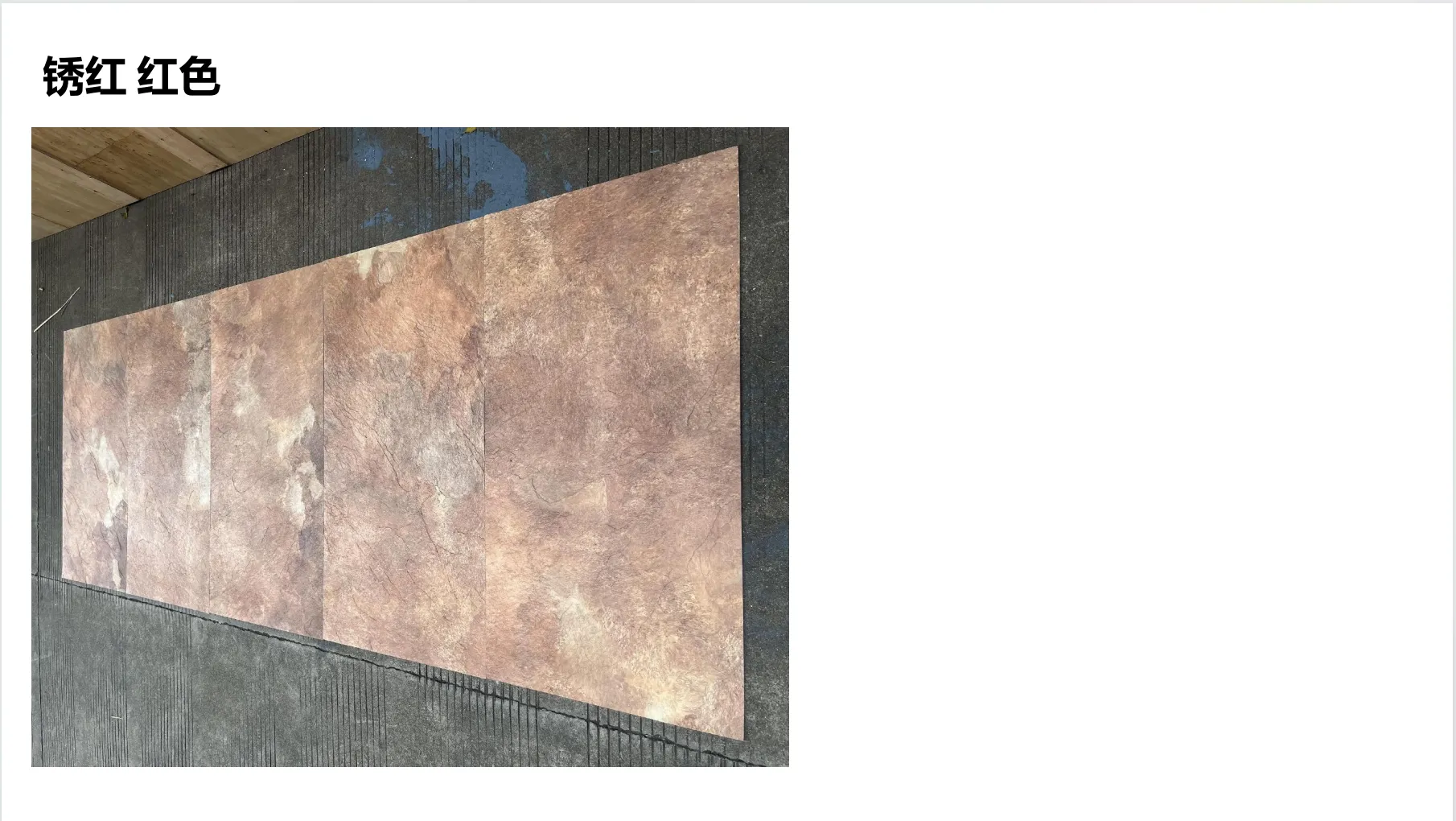
Before diving into color stability, let's get to know the star of the show: MCM, or Modified Composite Material. If you're not familiar, MCM is like the Swiss Army knife of building materials—lightweight, flexible, and surprisingly tough. Unlike traditional stone or brick, which can be heavy and brittle, MCM is crafted by blending natural minerals (think marble, granite, or limestone) with high-performance polymers. The result? A cladding material that's thin enough to bend without cracking, light enough to reduce structural load, and durable enough to handle the elements.
Within the MCM family, two standouts are the MCM flexible stone and MCM big slab board series . Flexible stone lives up to its name, conforming to curved surfaces or unique architectural details with ease—a godsend for designers working on non-linear projects. The big slab series, on the other hand, offers larger panels (often up to 1.2m x 2.4m), minimizing seams and creating a sleek, unified look for modern facades. And then there's Rusty Red—a color that doesn't just catch the eye; it holds onto it, even after years under the sun.
Rusty Red isn't just a pigment slapped onto a panel. It's a carefully engineered hue, inspired by the warm, weathered tones of ancient clay bricks or the rusted patina of industrial metal—colors that feel both timeless and alive. But unlike those traditional materials, which fade or corrode, Rusty Red MCM is built to last. So, what makes it different?
To understand why Rusty Red MCM stays vibrant, let's first talk about why most colors don't. Sunlight isn't just light—it's a cocktail of energy that wages war on pigments. UV radiation, in particular, breaks down the chemical bonds in colorants, causing them to lose their intensity. Heat exacerbates this process, speeding up molecular decay, while moisture (rain, humidity) can wash away surface treatments or seep into pores, further weakening color integrity. Even air pollutants, like smog or salt spray near coasts, can react with pigments, leading to discoloration or staining.
Traditional cladding materials often struggle here. Natural stone, for example, might have rich coloration, but its porous surface absorbs UV rays and moisture, leading to gradual fading. Painted metal panels rely on top coats that chip or wear thin, exposing the base material and turning once-bright reds into pale pinks. Even some composite claddings cut corners, using low-quality pigments or skipping UV inhibitors to save costs. The result? A building that looks dated within 5-10 years, requiring expensive repairs or replacement.
Rusty Red MCM takes a different approach. Instead of treating color as an afterthought, it's baked into the material's DNA. Let's break down how:
Most claddings use surface coatings or laminates to add color. While these might look good initially, they're the first to go when exposed to sunlight. Rusty Red MCM, however, integrates its colorants directly into the composite matrix during manufacturing. The natural mineral aggregates (like iron oxides, which give Rusty Red its depth) are mixed with polymers and binding agents before the panel is formed. This means the color runs through the entire thickness of the material, not just the top layer. Even if the surface is scratched or worn (which is rare, thanks to MCM's durability), the color underneath remains consistent.
MCM manufacturers don't just rely on tough pigments—they add UV stabilizers to the polymer blend. These compounds act like tiny bodyguards, absorbing or reflecting harmful UV rays before they can damage the colorants. Think of it as sunscreen for your building: invisible, but tirelessly working to prevent "sunburn" (i.e., fading). Testing shows that panels with these stabilizers retain up to 90% of their original color after 10,000 hours of accelerated UV exposure—equivalent to over a decade of real-world sunlight.
MCM's polymer base isn't just flexible—it's highly resistant to moisture, heat, and chemicals. Unlike porous stone or wood, it doesn't absorb water, so there's no swelling, warping, or mold growth to compromise color. Its low thermal expansion coefficient also means it doesn't crack or delaminate in extreme temperatures, keeping the color matrix intact. Even in coastal areas, where salt spray is a problem, Rusty Red MCM holds its own, thanks to corrosion-resistant additives that prevent discoloration from salt or humidity.
Talk is cheap—so MCM manufacturers put their money where their mouth is with rigorous testing. Let's take a look at some real-world data. In one industry standard test, Rusty Red MCM panels were exposed to QUV accelerated weathering, which simulates years of sunlight, rain, and condensation in just a few weeks. After 2,000 hours (about 7 years of outdoor exposure in most climates), the color difference (measured by Delta E, a unit of color change) was less than 3. For context, a Delta E of less than 1 is imperceptible to the human eye; under 3, the change is barely noticeable. By comparison, a standard painted metal panel might hit a Delta E of 8-10 in the same test—meaning a visible, significant fade.
Another test: freeze-thaw cycling. Panels are soaked in water, frozen to -20°C, then thawed, repeated 50 times. This mimics harsh winter conditions, where moisture freezes and expands, potentially cracking materials. Rusty Red MCM panels showed no signs of cracking, delamination, or color loss. Even the texture—subtle, like the grain of weathered stone—remained intact, proving that durability doesn't mean sacrificing aesthetics.
Color stability is a star feature, but Rusty Red MCM brings more to the table. Let's compare it to other common cladding materials to see how it stacks up:
| Feature | Rusty Red MCM Flexible Stone | Traditional Natural Stone (e.g., Red Sandstone) | Standard Painted Metal Panels |
|---|---|---|---|
| Color Retention (10-Year Estimate) | Delta E < 3 (negligible fade) | Delta E 8-12 (significant fade) | Delta E 10-15 (severe fade/chipping) |
| Weight (kg/m²) | 4-6 kg/m² (lightweight, easy installation) | 20-30 kg/m² (requires reinforced structure) | 8-12 kg/m² (moderate weight) |
| Flexibility (Resistance to Cracking) | Can bend up to 30mm radius without cracking | Brittle; prone to cracking under stress | Low flexibility; dents under impact |
| Maintenance Needs | Minimal (occasional rinse with water) | High (sealing every 2-3 years to prevent fading/staining) | Moderate (repainting every 5-7 years) |
| Sustainability | Recyclable, low embodied energy in production | High mining impact, heavy transportation footprint | Recyclable but energy-intensive to produce/recoat |
As the table shows, Rusty Red MCM isn't just about color—it's a holistic solution. Its lightweight nature reduces structural load, cutting construction costs. Flexibility allows it to adapt to curved walls or uneven surfaces, opening up design possibilities. And minimal maintenance means lower long-term expenses, making it a smart investment for both commercial and residential projects.
Rusty Red's blend of color stability, durability, and aesthetics makes it versatile. Here are a few spaces where it truly stands out:
First impressions matter for businesses. A Rusty Red MCM facade makes a bold statement, drawing customers in and maintaining that "new" look for years. Whether it's a boutique store, a restaurant, or a corporate office, the color adds warmth and personality without fading into the background.
Restoring or adding to historic structures often requires materials that match the original aesthetic while offering modern durability. Rusty Red MCM's weathered, earthy tone complements brick or stone heritage buildings, and its stability ensures it won't clash with aging originals over time.
Parks, plazas, and transit hubs face constant exposure to the elements. Rusty Red MCM cladding on pavilions, benches, or retaining walls adds visual interest without succumbing to sun, rain, or foot traffic.
Areas with intense sunlight (like deserts or tropical climates) or salt air (coastal cities) are tough on materials. Rusty Red MCM's UV resistance and corrosion protection make it a reliable choice here, outperforming traditional options that fade or corrode quickly.
In architecture, color isn't just about beauty; it's about identity. A building's hue can evoke emotion, reflect a brand, or honor a community's history. But that story fades if the color does. Rusty Red MCM doesn't just preserve color—it preserves that story, standing as a testament to thoughtful design and engineering.
Whether you're an architect designing the next landmark, a homeowner revamping your facade, or a developer aiming for longevity, the choice of cladding matters. Rusty Red MCM—with its MCM flexible stone core, big slab versatility, and unyielding color stability—proves that you don't have to choose between aesthetics and durability. It's a material that works as hard as the stories the buildings it adorns are meant to tell.
Recommend Products












