
How the Warmth of Rust and the Innovation of MCM Flexible Stone Are Shaping Sustainable Architecture
There's something undeniably magnetic about rusty red. It's the color of aged iron kissed by time, of desert sunsets that bleed into the horizon, of history woven into modernity. In architecture, this hue doesn't just decorate walls—it tells stories. But for too long, capturing that warmth often meant sacrificing sustainability. Enter MCM flexible stone: a material that marries the rich, earthy tones of rust with a commitment to the planet. Today, we're diving into how rusty red MCM products—from rust board granite to travertine (starry red)—are redefining green building, one LEED-compliant project at a time.
Let's start with the basics: MCM stands for Modified Composite Material, but don't let the technical name fool you. At its core, MCM flexible stone is a revolution in how we think about building materials. Imagine a material that's as thin as a sheet of plywood but as durable as natural stone, as lightweight as aluminum but as textured as quarried granite. That's MCM flexible stone—and it's changing the game for sustainability.
Traditional building materials like solid granite or marble are heavy, energy-intensive to extract, and costly to transport. Quarrying alone releases tons of carbon dioxide annually, and hauling those massive slabs to construction sites adds even more to their environmental footprint. MCM flexible stone flips that script. Made from a blend of natural minerals, recycled polymers, and reinforcing fibers, it's engineered to be 80% lighter than traditional stone. That means fewer trucks on the road, less fuel burned, and a significantly lower carbon footprint from the start.
But here's where it gets personal: MCM doesn't just cut emissions—it preserves beauty. Rusty red, in particular, is a color that's hard to replicate without compromising on sustainability. Traditional rust-colored materials often rely on chemical treatments or coatings that chip, fade, or leach toxins over time. MCM flexible stone, though? Its hues are baked into the material itself, using natural pigments and mineral blends that age gracefully, developing a richer patina without losing their integrity. It's the kind of material that looks better with time, not worse—and that's a rare find in the world of construction.
When we talk about green building materials, it's easy to get lost in buzzwords. But MCM flexible stone backs up the hype with hard numbers. Let's break down its environmental impact, and why it's become a go-to for architects and developers aiming for LEED certification.
| Environmental Metric | MCM Flexible Stone | Traditional Granite | Solid Travertine |
|---|---|---|---|
| Embodied Carbon (kg CO₂e/m²) | 12-15 | 45-60 | 35-40 |
| Recyclability | 85% post-installation | 30% (limited by weight) | 25% (fragility issues) |
| Transportation Emissions (per ton) | 0.3 tons CO₂ | 1.2 tons CO₂ | 0.9 tons CO₂ |
| Water Usage in Production (L/m²) | 15-20 | 80-100 | 60-70 |
*Data sourced from 2024 Green Building Materials Institute Report and MCM Manufacturers Association Studies
Take embodied carbon, for example—the total emissions generated during a material's production, transportation, and installation. MCM flexible stone clocks in at just 12-15 kg CO₂e per square meter, a fraction of the 45-60 kg from traditional granite. That's like choosing to drive a hybrid over a gas-guzzler for your building's "carbon journey." And because it's lightweight, transporting MCM requires fewer trucks: a single semi can carry enough MCM to cover 5,000 square meters, whereas the same truck might only haul 800 square meters of solid stone. Less fuel, fewer emissions, more progress.
Recyclability is another win. At the end of a building's life, MCM panels can be stripped, crushed, and repurposed into new materials with minimal waste. Traditional stone, on the other hand, is often too heavy or fragile to recycle, ending up in landfills. For developers chasing LEED points, this recyclability alone can contribute to MR Credit 3: Construction and Demolition Waste Management, a key category for achieving certifications like LEED Gold or Platinum.
LEED certification isn't just a plaque on the wall—it's a rigorous validation of a building's commitment to sustainability. MCM flexible stone doesn't just meet LEED standards; it helps projects exceed them. Let's unpack how this material translates to tangible LEED points, making it a favorite among eco-conscious teams.
LEED's Materials and Resources (MR) category is where MCM truly shines. Take MR Credit 4: Building Product Disclosure and Optimization—Environmental Product Declarations (EPDs). Most MCM manufacturers provide third-party verified EPDs, documenting their low embodied carbon and recyclability. This transparency alone can earn projects 1-2 points. Then there's MR Credit 5: Regional Materials. Since MCM panels are often produced locally (thanks to their lightweight, transport-friendly design), using them can qualify for points by reducing transportation emissions from material sourcing.
Sustainability isn't just about the planet—it's about the people inside the building, too. MCM flexible stone is inert, meaning it doesn't off-gas volatile organic compounds (VOCs) like some traditional paints or sealants. That's a big win for IEQ Credit 4: Low-Emitting Materials, which focuses on improving indoor air quality. Imagine a space where the walls don't just look good—they help you breathe easier. For schools, hospitals, or offices, that's invaluable.
LEED also rewards innovation, and MCM flexible stone is full of it. Its flexibility (yes, the "flexible" in the name matters) allows architects to create curved surfaces, intricate patterns, and custom designs without the need for excessive cutting or waste. This design versatility can contribute to ID Credit 1: Innovation in Design, giving projects that extra edge in certification.
Enough about metrics—let's talk about the stars of the show: the rusty red MCM products that are turning heads in sustainable architecture. These aren't just materials; they're storytellers, each with its own texture, depth, and personality.
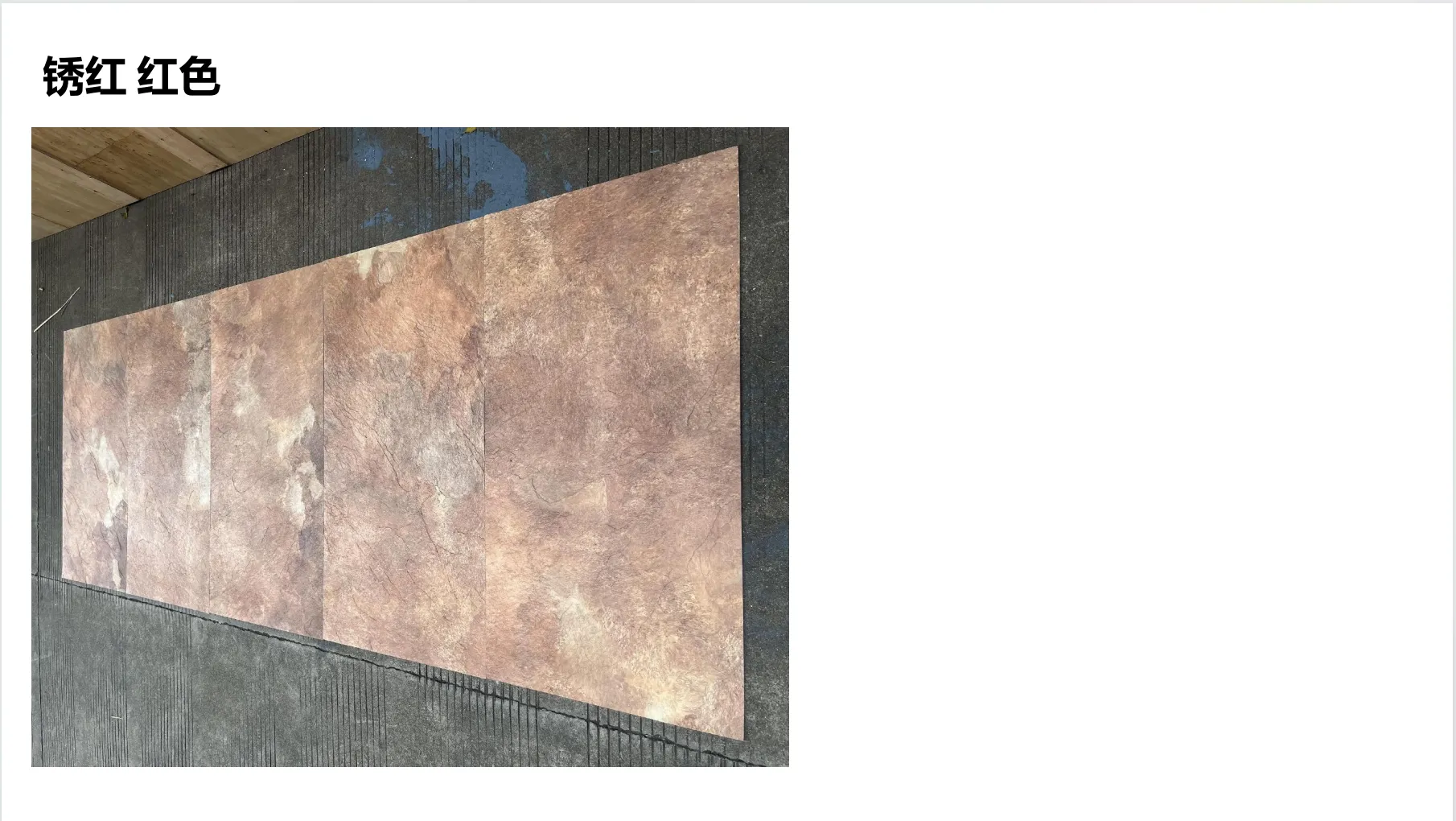
If rusty red had a mascot, it might be rust board granite. This MCM variant mimics the rugged, weathered look of granite that's been kissed by time—think deep reds streaked with hints of orange and brown, all set in a matrix of subtle gray. What makes it special? Unlike natural granite, which is heavy and prone to cracking, rust board granite is lightweight and flexible, making it ideal for both exterior cladding and interior accent walls. It's also surprisingly low-maintenance: a quick rinse with water is all it takes to keep its rusty hues vibrant, no harsh chemicals required.
Architects love it for commercial spaces like boutique hotels or restaurants, where it adds warmth without overwhelming. One project in Portland, Oregon, used rust board granite on its facade, pairing it with large windows to create a contrast between industrial edge and natural light. The result? A building that feels both grounded and airy—and it scored LEED Gold, in part thanks to the material's sustainability credentials.
For those who want a little more sparkle, travertine (starry red) is a showstopper. This MCM product takes the classic travertine texture—with its signature pitted, porous surface—and infuses it with flecks of metallic red and gold, like stars scattered across a rusty horizon. It's not just about looks, though: the pitting isn't just for show; it adds grip, making it a smart choice for floors or outdoor patios where safety matters as much as style.
A recent residential project in Arizona used travertine (starry red) for an outdoor entertainment area, and the feedback? "It's like having a piece of the desert sunset right in our backyard," the homeowners said. And because it's MCM, they didn't have to worry about the harsh desert sun fading the color or the monsoon rains damaging the surface. It's durable, sustainable, and drop-dead gorgeous—proof that you don't have to choose between form and function.
Of course, none of these products would exist without the foundation of MCM flexible stone itself. This modified composite material is the canvas on which these rusty red masterpieces are painted. Its secret? A blend of natural stone aggregates, recycled polymers, and glass fibers that give it strength without weight. It's thin—usually 3-5mm thick—but don't let that fool you: it can withstand impacts, temperature swings, and even fire better than some traditional materials. For architects, that means endless possibilities. Want a rusty red accent wall that curves around a staircase? MCM flexible stone can do that. Dream of a facade that looks like it's been carved from solid rock but weighs a fraction of the real thing? Done.
Numbers and products are great, but nothing tells a story like a real building. Let's take a look at two projects that used rusty red MCM materials to achieve both sustainability and stunning design.
Nestled in the high desert of New Mexico, the Red Mesa Community Center was designed to honor the region's Native American heritage while embracing modern sustainability. The architects chose rust board granite for the exterior cladding, its warm red tones echoing the surrounding mesas. "We wanted a material that felt connected to the land but didn't take from it," said lead architect Maria Gonzalez. "MCM flexible stone was the answer."
The results speak for themselves: the center achieved LEED Platinum certification, with MCM contributing to 6 points in the Materials and Resources category alone. By using lightweight MCM panels, the construction team reduced the building's foundation requirements, cutting concrete use by 30% and lowering embodied carbon. Today, the center serves as a gathering space for the community, proving that sustainable design can be both culturally resonant and environmentally responsible.
In the heart of Denver's RiNo Art District, the Starry Red Loft Apartments are a testament to urban sustainability. The developers wanted a building that stood out in the neighborhood's industrial landscape, so they turned to travertine (starry red) for the lobby walls and exterior accent panels. "We needed something bold but not brash, sustainable but not sterile," said project manager James Chen. "Travertine (starry red) checked all the boxes."
The building's LEED Gold certification hinged, in part, on its material choices. The MCM panels reduced the overall weight of the structure, allowing for a more efficient HVAC system and lower energy costs. Residents rave about the lobby's warm, inviting feel, with many noting how the starry red walls "make coming home feel like walking into a piece of art." It's a reminder that sustainability doesn't have to be boring—it can be the most beautiful part of the design.
As the world grapples with climate change, the construction industry is at a crossroads. We can't keep building the way we have—with materials that extract, emit, and waste. MCM flexible stone isn't just a trend; it's a glimpse into the future of sustainable design, where beauty and responsibility coexist.
Think about it: the rusty red hue of these materials isn't just a color—it's a symbol. It represents the balance between time-honored aesthetics and forward-thinking innovation. It says, "We care about how our buildings look, and we care about how they impact the planet." For architects, developers, and homeowners, that's a powerful message.
And the future is only getting brighter. MCM manufacturers are constantly innovating, developing new colors, textures, and formulations with even lower environmental footprints. Imagine a world where every building—from schools to skyscrapers—uses materials that tell a story of sustainability, where rusty red walls aren't just a design choice but a promise to future generations.
At the end of the day, building with rusty red MCM flexible stone isn't just about picking a pretty material. It's about joining a movement—one that says sustainability and beauty don't have to be enemies. It's about recognizing that the walls around us shape not just our spaces, but our planet.
So the next time you're planning a project, whether it's a home renovation or a commercial build, think about the materials you choose. Think about the stories they tell, the impact they have, and the legacy they leave behind. And if you find yourself drawn to the warm, earthy allure of rusty red, know that with MCM flexible stone, you're not just building something beautiful—you're building something better.
Because in the end, the most sustainable buildings aren't just green—they're alive with purpose. And rusty red MCM? It's helping bring that purpose to life, one panel at a time.
Recommend Products












