
How a single hue marries art, science, and resilience in modern architecture
Walk down any contemporary street, and you'll notice it: that warm, earthy red that catches the light like a sunset frozen in stone. Rusty Red MCM—short for Modified Composite Material—has become more than just a building material; it's a design statement. But what makes this color so captivating, and more importantly, how does it stand up to rain, sun, and time? Let's peel back the layers—literally and figuratively—to uncover the science behind Rusty Red MCM's enduring charm.
Before we dive into pigments and polymers, let's get clear on the star of the show. MCM, or Modified Composite Material, is a modern building material engineered to blend the best of nature and technology. Think of it as a high-performance hybrid: it starts with a base of mineral aggregates (like limestone or quartz) bound together by polymers, then reinforced with fibers for strength. The result? A lightweight, flexible panel that mimics the look of natural stone or metal but weighs up to 70% less than traditional materials.
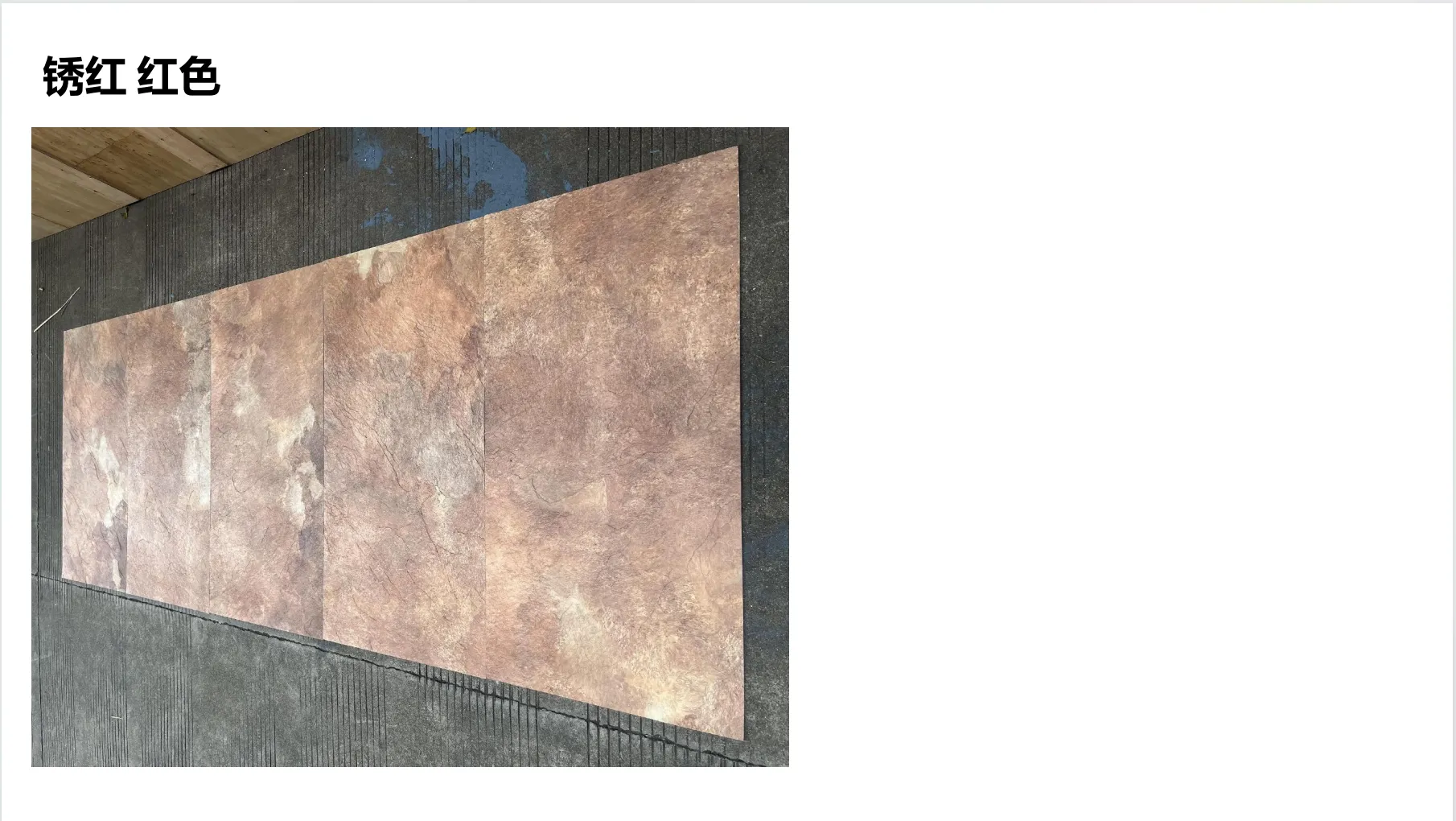
Rusty Red MCM isn't just a random shade in the MCM family—it's a standout in lines like the mcm project board series and mcm flexible stone , designed for facades, accent walls, and even furniture. Its color is intentional: a rich, terracotta-tinged red that evokes everything from industrial warehouses to sunbaked Mediterranean villages. But unlike a fresh coat of paint on concrete, this hue isn't here to fade.
Let's talk color psychology for a second. Red is bold—it signals warmth, energy, and character. But "rusty" red? That's where the magic happens. It softens the intensity, adding depth and a touch of nostalgia. It's the color of aged iron, of weathered barns, of stories. For architects and homeowners, it's a bridge between modern minimalism and rustic charm.
But aesthetics aside, the science of that specific red is fascinating. The pigment driving Rusty Red MCM is iron oxide—specifically, a form called hematite. You might know hematite from geology class: it's the mineral that gives rust its reddish-brown hue, and it's been used as a pigment for millennia (think prehistoric cave paintings). What makes MCM's version special is how it's processed.
Manufacturers grind hematite into ultra-fine particles (sometimes as small as 5 microns) and coat them with a protective silica layer. This coating does two things: it locks in the color, preventing the pigment from reacting with moisture or oxygen (which would dull the red over time), and it helps the pigment disperse evenly in the MCM's polymer matrix. The result? A consistent, vibrant red that doesn't streak or blotch—even across large panels.
Here's the truth: a beautiful color is useless if it fades after a single winter. That's why Rusty Red MCM's real genius lies in its weather-resistant armor. Let's break down the tech that keeps it looking fresh for decades.
Beneath that rusty red surface is a clear, ultra-thin topcoat—often a silicone-based or acrylic polymer—that acts like a force field. It's designed to repel water (so rain can't seep in and react with the pigment), block UV rays (the main culprit behind fading), and resist abrasion (from wind-blown sand or cleaning). Some manufacturers even add nanoscale particles to this topcoat, creating a "self-cleaning" effect: dirt slides off when it rains, reducing maintenance.
Before Rusty Red MCM hits the market, it endures months of torture testing. We're talking 1,000+ hours of UV exposure in a machine that mimics the sun's harshest rays, cyclic humidity tests (soaking the panels in water, then baking them dry), and freeze-thaw cycles (from -20°C to 60°C) to simulate extreme climates. The goal? To ensure color retention stays above 90% after 20 years of real-world use. For context, a standard exterior paint might start fading after 3–5 years.
MCM's core structure helps too. Unlike solid stone or metal, which can crack or warp with temperature changes, MCM's flexible matrix (thanks to those polymer binders) expands and contracts gently, preventing stress cracks that would let moisture in. And because the pigment is mixed *into* the material (not just painted on), there's no risk of chipping or peeling—even if the panel gets scratched.
To truly appreciate Rusty Red MCM, let's compare it to another popular finish: foamed aluminium alloy board (vintage gold) . Both are used for modern facades, but their performance differs in key ways. Check out the table below for a side-by-side look:
| Property | Rusty Red MCM | Foamed Aluminium Alloy Board (Vintage Gold) |
|---|---|---|
| Color Retention (20 years) | 90%+ (tested) | 75–80% (may develop patina) |
| UV Resistance | Excellent (silicone topcoat) | Good (anodized finish, but prone to fading in high UV) |
| Weight (per sq. meter) | 8–10 kg | 12–15 kg |
| Installation Cost | Moderate (lightweight = easier installation) | Higher (heavier, requires stronger support) |
| Sustainability | High (recyclable, low VOC) | Moderate (recyclable but energy-intensive to produce) |
The takeaway? Rusty Red MCM isn't just a pretty face. It's a workhorse, especially in climates with harsh sun or frequent rain. And while vintage gold aluminium has its own sleek appeal, Rusty Red MCM offers better long-term value for those prioritizing color longevity and ease of installation.
Let's ground this in real life. Take the Riverfront Arts District in Pittsburgh, where a 1920s warehouse was converted into loft apartments. The architects chose Rusty Red MCM for the exterior, pairing it with exposed brick and fair-faced concrete . Five years later, the red still pops against the gray skyline, even after harsh winters and humid summers. "We wanted something that felt industrial but warm," says lead architect Maria Gonzalez. "Rusty Red MCM checked both boxes—and it hasn't needed a single touch-up."
Or consider a boutique hotel in Arizona, where the desert sun beats down 300+ days a year. The owners opted for Rusty Red MCM on the poolside cabanas, replacing the original wood panels that warped and faded within two seasons. Now, guests rave about the "cozy, southwestern vibe," and the maintenance team reports zero issues with color loss or water damage.
In an era of green building, Rusty Red MCM has another trick up its sleeve: it's surprisingly eco-friendly. Many manufacturers use recycled stone and polymer waste in the composite mix, cutting down on raw material extraction. The pigments are non-toxic (no heavy metals here), and the production process emits less CO2 than firing ceramic tiles or mining natural stone.
Plus, its lightweight nature reduces transportation emissions (trucks can carry more panels per trip), and its longevity means fewer replacements over a building's lifetime. For LEED-certified projects, that's a win-win: beauty, durability, and a smaller carbon footprint.
At the end of the day, Rusty Red MCM is a storyteller. It's the color that turns a plain wall into a conversation piece, that makes a commercial building feel like a home, that bridges the gap between past and present. And the fact that it does all this while standing up to the elements? That's the science part—turning "what if" into "what will last."
So the next time you pass a building with that warm, rusty glow, take a closer look. Behind that color is a blend of geology, chemistry, and human ingenuity—proof that when we design with both heart and science, the results can be truly timeless.
Recommend Products












