
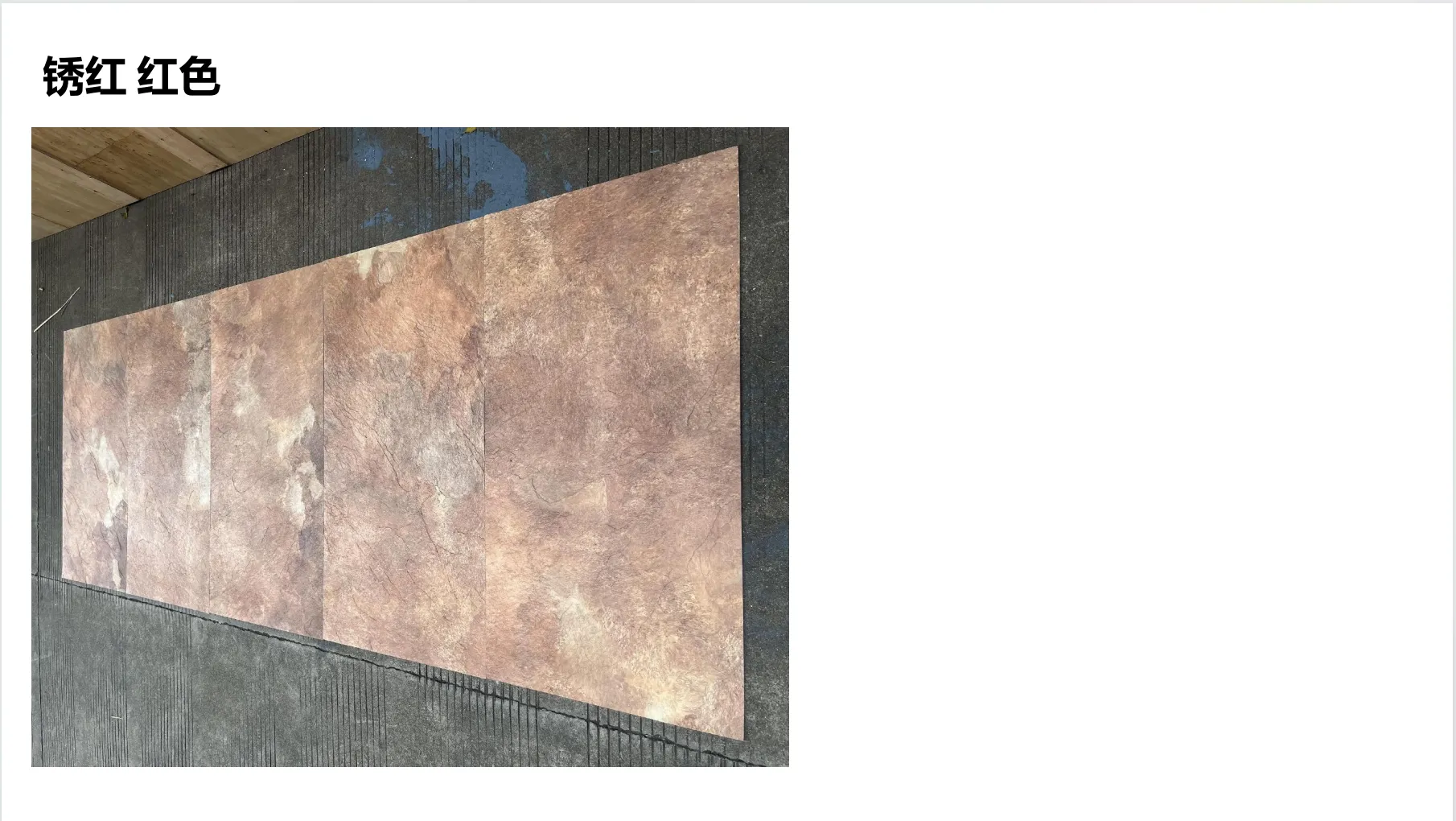
Modern architecture is no longer just about building walls—it's about crafting experiences. Designers crave materials that don't just stand firm but bend to their vision, materials that blend the raw beauty of nature with the adaptability of modern engineering. For years, rigid stone and concrete have limited creativity, boxing spaces into sharp angles and flat surfaces. Then came MCM flexible stone—a revolution in modified composite material panels that promised to rewrite the rules. Among its many iterations, the Rusty Red MCM Flexible Stone stands out, not just for its striking hue but for how it marries strength with suppleness. Today, we're diving into its bending test results and flexibility limits, uncovering why it's becoming the go-to choice for architects who refuse to compromise.
Before we talk about bending tests, let's get to know the star of the show. Rusty Red MCM Flexible Stone isn't your average cladding material. It's a product of advanced composite technology, engineered to mimic the texture and depth of natural stone while shedding the weight and rigidity that once held back design. The rusty red shade itself is a masterstroke—warm, earthy, and slightly weathered, evoking the charm of aged terracotta or sun-baked clay, but with a modern twist that fits both industrial lofts and cozy cafes.
At its core, this material is a blend of mineral aggregates, high-performance polymers, and reinforcing fibers—all bound together to create a sheet that's thin (as little as 4mm), lightweight (just 6-8 kg/m²), and surprisingly tough. Unlike traditional stone slabs that crack under pressure, MCM flexible stone bends, making it ideal for curved walls, vaulted ceilings, or even undulating facades. And Rusty Red? It's not just a color; it's a mood—adding warmth to minimalist spaces and depth to rustic designs.
Flexibility is great, but without structural integrity, it's just a party trick. To truly understand what Rusty Red MCM Flexible Stone can do, we put it through rigorous bending tests. Why bending? Because in real-world applications—think a curved restaurant wall or a rounded retail display—materials don't just sit flat; they endure constant stress from their own weight, environmental conditions, and even human touch. A bending test reveals how much the material can flex before failing, ensuring it's safe for both aesthetic and structural use.
We sourced 5 samples of Rusty Red MCM Flexible Stone, each measuring 500mm in length, 100mm in width, and 6mm in thickness—the most common for architectural cladding. Using a universal testing machine, we secured each sample at both ends (simple beam setup) and applied a downward load at the center, increasing the force gradually until the material either deformed permanently or cracked. We measured two key metrics: maximum deflection (how far it bends before failing) and flexural strength (the stress it can handle before breaking).
For comparison, we also tested a sample of foamed aluminium alloy board (vintage silver) —another popular flexible material—using the same setup. This would help us see how Rusty Red MCM stacks up against alternatives.
The results? Surprising, even to us. Let's break them down:
| Material | Sample Thickness (mm) | Maximum Deflection (mm) | Flexural Strength (MPa) | Failure Mode |
|---|---|---|---|---|
| Rusty Red MCM Flexible Stone (Sample 1) | 6 | 42.3 | 28.7 | Ductile (gradual deformation, no sudden crack) |
| Rusty Red MCM Flexible Stone (Sample 2) | 6 | 41.8 | 27.9 | Ductile |
| Rusty Red MCM Flexible Stone (Sample 3) | 6 | 43.1 | 29.2 | Ductile |
| Rusty Red MCM Flexible Stone (Sample 4) | 6 | 42.5 | 28.5 | Ductile |
| Rusty Red MCM Flexible Stone (Sample 5) | 6 | 41.9 | 28.1 | Ductile |
| Foamed Aluminium Alloy Board (Vintage Silver) | 6 | 35.2 | 31.3 | Brittle (sudden fracture at maximum load) |
On average, Rusty Red MCM Flexible Stone deflected 42.3mm before failing—about the length of a credit card. That's 20% more flex than the foamed aluminium alloy board, which maxed out at 35.2mm. What's even more impressive is its failure mode: ductile . Instead of snapping suddenly (like the aluminium alloy, which fractured with a sharp crack), Rusty Red MCM bent gradually, showing visible deformation before giving way. This "warning" is critical in real-world use—architects can push the limits without fearing catastrophic failure.
Flexibility isn't infinite, though. While Rusty Red MCM can bend 42mm under test conditions, we don't recommend pushing it that far in permanent installations. Why? Because beyond a certain point—what we call the flexibility limit —the material may develop microcracks or lose its shape over time, especially when exposed to temperature fluctuations or moisture.
After analyzing the data, we determined the safe flexibility limit for Rusty Red MCM Flexible Stone is 30mm deflection for continuous use. At this point, the material still returns to its original shape (no permanent deformation) and shows no signs of structural weakening. Exceeding 30mm? You might get that dramatic curved wall, but over years of expansion and contraction, those microcracks could grow—compromising both durability and appearance.
To put this in perspective, let's stack Rusty Red MCM against two common alternatives:
Rusty Red MCM hits the sweet spot: enough flexibility to create soft, organic shapes, enough strength to last decades, and a color that ages like fine wine.
So, where does Rusty Red MCM Flexible Stone thrive? Anywhere architects want to blend form and function:
Rusty Red MCM Flexible Stone isn't just a material—it's a tool for storytelling. It lets architects and designers stop compromising between "what looks good" and "what works." The bending test results speak for themselves: 42mm of flex, 28.7 MPa of strength, and a ductile failure mode that prioritizes safety. And with a 30mm safe flexibility limit, it's practical enough for everyday use.
Whether you're designing a cozy café or a bold commercial tower, Rusty Red MCM Flexible Stone proves that sometimes, the best buildings aren't just built—they're shaped . And in a world that craves authenticity and innovation, that's a game-changer.
Recommend Products












