
Where Innovation Meets Artistry—How MCM Materials Are Redefining What's Possible in Public Spaces
Picture this: You're standing in a sunlit plaza, and before you rises an installation that seems to defy gravity—a sweeping curve of warm, earthy red that wraps around a steel frame like a ribbon of aged terracotta. As you step closer, your hand brushes the surface; it's surprisingly light, with a texture that feels both organic and intentional, like the bark of an ancient tree or the patina of a well-loved metal sculpture. This isn't just art—it's a conversation between the artist's vision and the material itself. And that material? Rusty Red MCM, part of a revolutionary lineup that's turning the world of art installations on its head.
For decades, artists have grappled with the limitations of traditional materials. Stone is heavy and unforgiving, metal is rigid, and wood warps with time. But in recent years, a new player has emerged: MCM, or Modified Composite Material. And among its many iterations—from the sleek lines of the MCM 3D Printing Series to the versatility of MCM Flexible Stone—one variant has captured the imagination of artists worldwide: Rusty Red MCM. It's not just a material; it's a storyteller, blending the warmth of aged iron with the flexibility of modern engineering to create installations that feel both timeless and cutting-edge.
Art installations are more than just objects—they're experiences. They shape how we interact with space, evoke emotions, and even challenge our perceptions. But for an installation to truly resonate, the material behind it must be more than a passive canvas; it must be an active collaborator. That's where MCM shines. Unlike traditional stone or metal, MCM is engineered to balance form, function, and feeling—and nowhere is this more evident than in the Rusty Red variant.
Let's start with the basics: MCM is a composite material made from natural minerals, recycled polymers, and reinforcing fibers. This unique blend gives it a rare set of properties: it's lightweight (up to 70% lighter than natural stone), flexible (able to bend without cracking), and highly customizable (in color, texture, and shape). For artists, these traits are game-changers. Imagine trying to hang a 20-foot curved sculpture made of marble—it would require cranes, structural reinforcements, and a small fortune. With MCM Flexible Stone, that same sculpture could be installed by a small team, weigh a fraction of the marble version, and still retain the tactile depth of natural stone.
| Material | Flexibility | Weight (per sq.m) | Customization | Sustainability |
|---|---|---|---|---|
| Traditional Stone | Low (brittle, prone to cracking) | 20-30 kg | Limited (shape/color fixed by quarry) | High carbon footprint (mining/transport) |
| MCM Flexible Stone | High (bends up to 30° without damage) | 5-8 kg | Unlimited (colors, textures, curves) | Recycled materials, low emissions |
| 3D Printed MCM (3D Printing Series) | Variable (depends on design; lattice structures = ultra-light) | 3-6 kg | Intricate geometries (no molds needed) | Minimal waste (additive manufacturing) |
The table above tells a clear story: MCM isn't just better than traditional materials—it's different . It's a material designed for the artist who refuses to compromise between vision and feasibility. And when you add Rusty Red into the mix, that difference becomes even more profound.
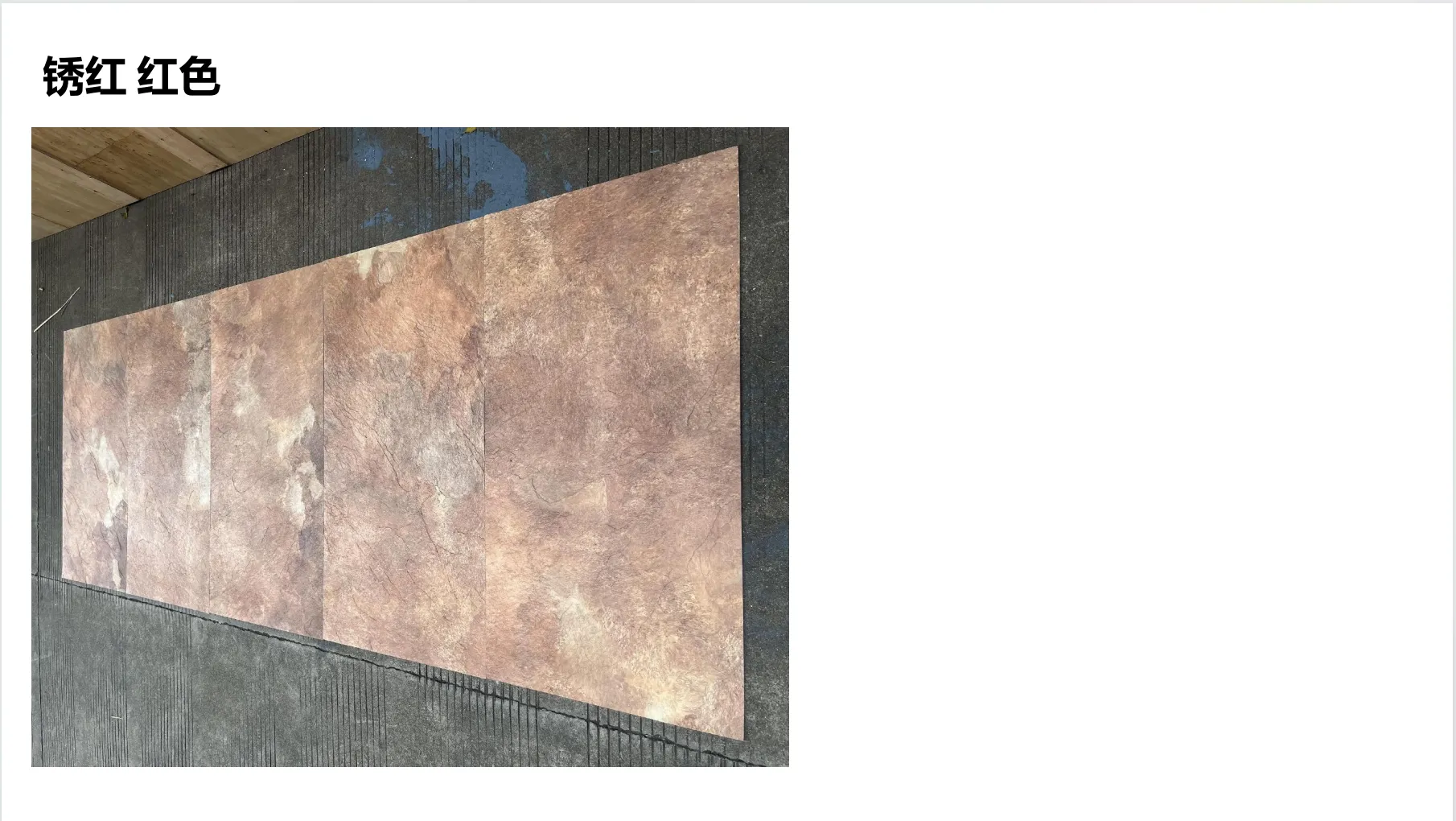
Color is emotion. A vibrant blue might evoke calm; a bold yellow, energy. But Rusty Red? It's a color with depth—a hue that feels lived-in, like it holds memories. Imagine walking through a gallery and encountering a wall of Rusty Red MCM: its surface isn't flat or uniform. Instead, it has the subtle variations of weathered iron, with streaks of amber and hints of brown that catch the light. It's not just red; it's a narrative of time, of oxidation, of nature's quiet transformation of metal into art.
Artists are drawn to this complexity. Take, for example, a recent installation in a public park titled Echoes of Industry . The artist used Rusty Red MCM panels, cut into the shape of factory gears, to create a 10-foot-tall sculpture. From a distance, it looks like a relic of the industrial age, but up close, the material's flexibility becomes apparent: the gears "float" on curved supports, gently swaying in the breeze. Traditional metal gears would have been too heavy to suspend; painted wood would have lacked the texture of aged metal. Rusty Red MCM, however, delivered both—the aesthetic of history and the physics of possibility.
But Rusty Red isn't just for industrial themes. Its earthy warmth also pairs beautifully with natural landscapes. A coastal installation in California, Tides and Time , used Rusty Red MCM slabs to mimic the color of the cliffs at sunset. The material's resistance to saltwater and UV rays ensures the installation will retain its vibrancy for decades—a durability that traditional painted wood or even natural sandstone can't match.
If Rusty Red MCM is the color of storytelling, the MCM 3D Printing Series is the pen that writes new chapters. 3D printing has revolutionized manufacturing, but when paired with MCM, it becomes a tool for artistic liberation. Unlike traditional 3D printing materials (like plastic or resin), MCM 3D Printing Series filaments combine the strength of composite materials with the precision of additive manufacturing—meaning artists can create structures that were once impossible.
Consider the challenge of creating a large-scale installation with intricate latticework—say, a ceiling piece that looks like a web of red threads suspended overhead. With traditional methods, this would require welding metal rods (heavy, time-consuming) or casting resin (fragile, toxic). With 3D printed MCM, the artist can design the lattice in CAD software, hit "print," and watch as layers of Rusty Red MCM are deposited to form a structure that's both lightweight (thanks to hollow internal channels) and surprisingly strong. The result? A 15-foot-wide installation that weighs less than 50 kg and can be installed with a simple pulley system.
Another advantage of 3D printing MCM is customization. Artists aren't limited by molds or standard sizes. Want a sculpture with 100 unique, interlocking pieces? 3D printing can produce each one individually. Need a panel with a texture that mimics the veins of a leaf? The printer can replicate that texture down to the millimeter. This level of detail is why the MCM 3D Printing Series is becoming a favorite for interactive installations—like one in a children's museum where kids can touch a wall of 3D-printed Rusty Red MCM "bubbles," each with a different tactile pattern (smooth, ridged, pitted) that responds to light.
For artists working on a grand scale—think murals, facade installations, or immersive environments—the MCM Big Slab Board Series is a game-changer. These slabs, which can be as large as 1.2m x 3.6m, offer seamless surfaces that traditional stone simply can't match. Imagine covering an entire gallery wall with a single piece of Rusty Red MCM, free of grout lines or seams. The effect is breathtaking—a continuous canvas that draws the eye across the entire space, unbroken by joints.
But size isn't the only benefit. The Big Slab Board Series is also engineered for easy installation. Unlike natural stone slabs, which require heavy machinery to lift, MCM big slabs can be carried by two people and mounted using a simple adhesive system. This not only saves time and labor costs but also opens up possibilities for temporary installations—like a pop-up exhibit in a historic building where drilling into walls is prohibited. The slabs can be attached to lightweight frames, displayed for the duration of the exhibit, then removed without damaging the structure.
One memorable use of the Big Slab Board Series was in a retrospective of a renowned painter known for his large-scale abstract works. The curator wanted to bring the artist's canvases to life by turning them into 3D walls. Using Rusty Red MCM big slabs, they printed the artist's brushstrokes directly onto the material's surface, creating a tactile version of his paintings that visitors could walk around and even touch. The slabs' flexibility allowed for subtle curves in the walls, mimicking the movement of the artist's hand—a detail that would have been impossible with rigid stone or wood.
As artists continue to push boundaries, materials like Rusty Red MCM, the 3D Printing Series, and Big Slab Boards are becoming essential tools in their toolkit. They're not just materials—they're enablers, turning "what if" into "what is." Whether it's a small gallery piece or a city-wide public art project, MCM offers something traditional materials can't: the freedom to dream without limits.
So the next time you encounter an art installation that makes you pause, that feels both familiar and revolutionary, take a closer look. Chances are, you're not just looking at art—you're looking at the future of material innovation. And if it's wrapped in the warm, earthy tones of Rusty Red? You're looking at MCM, turning spaces into stories, one panel at a time.
Recommend Products












