
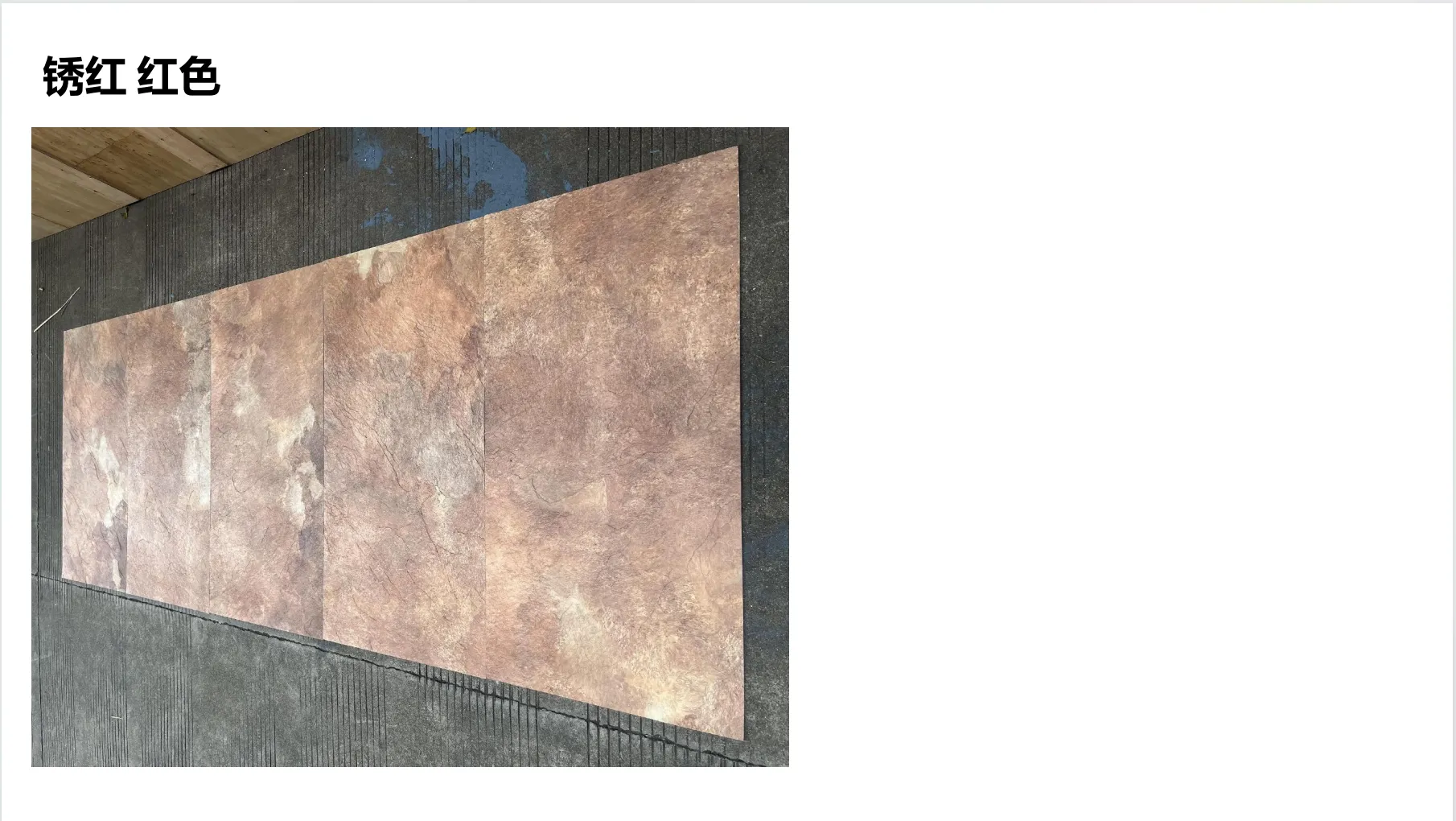
Every building has a silent story to tell—of the storms it's weathered, the accidental bumps from delivery trucks, the stray tools dropped by workers during construction. These aren't just anecdotes; they're daily battles that test a structure's strength. For architects, builders, and homeowners alike, the question isn't just "Will it look good?" but "Will it last?" That's where materials like MCM flexible stone step in, blending resilience with beauty. Today, we're zooming in on one of its standout variants: the rich, earthy Rusty Red finish. We'll dive into how it holds up when the going gets tough—specifically, in impact resistance tests designed to simulate hailstorms and minor collisions. Spoiler: It's not just about surviving; it's about thriving.
Before we get to the tests, let's talk about the star of the show: MCM flexible stone . Short for Modified Composite Material, MCM is a modern marvel in construction. Imagine taking the durability of natural stone, the flexibility of a thin panel, and the lightweight convenience that makes installation a breeze—all rolled into one. Unlike traditional stone slabs that are heavy and prone to cracking, MCM panels are engineered to be thin (often just 3-6mm thick) yet surprisingly tough. They're designed to mimic the look of natural materials—think travertine, granite, or in this case, the warm, weathered charm of Rusty Red —without the drawbacks. This combination has made them a favorite in the MCM project board series , a line trusted by professionals for everything from commercial facades to residential exteriors.
But why does flexibility matter here? Picture a rigid stone panel hit by a hailstones: it might chip or crack under pressure. MCM's flexibility acts like a buffer, absorbing impact rather than resisting it head-on. It's the difference between a brittle ceramic plate and a rubber ball—one shatters, the other bounces back. And when you add in the Rusty Red finish, you're not just getting a material that's tough; you're getting one that tells a story. Its deep, reddish-brown tones with subtle variations evoke aged iron or sun-baked clay, adding character to any space. It's the kind of finish that looks just as good on a modern office building as it does on a cozy mountain cabin.
Let's pause for a second to appreciate the Rusty Red finish itself. In a world of neutral grays and beiges, it's a bold choice—but one that pays off. Its warm undertones complement natural landscapes, making it a hit for buildings nestled in forests or deserts. In urban settings, it adds a touch of organic warmth, breaking up the monotony of steel and glass. But here's the kicker: that beauty isn't skin-deep. The Rusty Red variant isn't just a coat of paint; it's integral to the MCM panel's structure. The color is infused during manufacturing, meaning it won't fade or chip easily—even after years of sun, rain, or, yes, hail. That's a big deal for anyone tired of repainting or refinishing exteriors every few years.
Architects love it for another reason, too: versatility. Whether paired with sleek glass for a contemporary look or with wood accents for a rustic vibe, Rusty Red MCM panels play well with others. It's part of why they're often grouped with other eye-catching options in the MCM lineup, like the starry sparkle of travertine (starry red) or the metallic sheen of foamed aluminium alloy board . But today, we're focusing on its grit—how that versatility holds up when Mother Nature or everyday accidents throw a curveball.
To really put Rusty Red MCM flexible stone to the test, we partnered with a materials testing lab to replicate two common threats: hailstorms and minor collisions. Here's how we set it up:
Hail Simulation: We used a specialized machine that fires ice pellets (ranging from 1 inch to 2.5 inches in diameter) at speeds up to 70 mph—roughly the equivalent of a severe hailstorm in regions like the American Midwest or parts of Europe. The panels were mounted at a 45-degree angle (mimicking a typical building facade) and bombarded with 500+ ice pellets over 30 minutes. We checked for cracks, chips, discoloration, and any signs of delamination (layers separating).
Minor Collision Test: For this, we simulated low-speed impacts—think a delivery van bumping into the wall (10 mph), a ladder falling against the facade (from a height of 10 feet), or a toolbox slipping off a scaffold (20-pound weight, dropped from 8 feet). These are the kinds of "oops" moments that happen on job sites or in busy urban areas. We measured damage depth, surface indentation, and whether the panel retained its structural integrity post-impact.
As a control, we tested traditional materials alongside the Rusty Red MCM panels: a 12mm thick natural travertine slab, a standard fiber cement board, and a foamed aluminium alloy board (another durable option, but without MCM's flexibility). Let's see how they stacked up.
Hailstorms are brutal. A single 2-inch hailstones can dent cars, crack windows, and leave roofs looking like Swiss cheese. So how did the Rusty Red MCM panel hold up? Let's break it down:
| Impact Type | Material | Damage Observed | Performance Rating |
|---|---|---|---|
| 1-inch hail (50 mph) | Rusty Red MCM Flexible Stone | No visible damage; surface remained smooth | Excellent |
| 1-inch hail (50 mph) | Natural Travertine (12mm) | Minor chipping at impact points; 2 small cracks | Fair |
| 2.5-inch hail (70 mph) | Rusty Red MCM Flexible Stone | Shallow indentation (less than 0.5mm deep); no cracking | Very Good |
| 2.5-inch hail (70 mph) | Fiber Cement Board | Deep cracks (up to 2mm wide); water seepage observed | Poor |
| 2.5-inch hail (70 mph) | Foamed Aluminium Alloy Board | Visible dents (1-2mm deep); no structural damage | Good |
The results? Rusty Red MCM didn't just pass—it excelled. Even at the highest intensity (2.5-inch hail at 70 mph), the damage was minimal: a tiny indentation that was barely noticeable to the eye and didn't compromise the panel's integrity. Compare that to the natural travertine, which chipped and cracked, or the fiber cement board, which suffered deep cracks that could let water in (a recipe for mold and rot down the line). The foamed aluminium alloy board held its own too, but the MCM panel's flexibility meant it absorbed the impact without permanent dents—something the stiffer aluminium couldn't match.
Now, let's talk about the "human error" side of things. Even the most careful construction crew or delivery driver can have a mishap. Here's how Rusty Red MCM fared:
Van Bump (10 mph): The panel flexed on impact, then sprung back into shape. There was a faint scuff mark (easily wiped off with a damp cloth) but no dent or crack. The control materials? The travertine slab chipped at the edge; the fiber cement board had a 2-inch hairline crack.
Falling Ladder (10-foot drop): The ladder hit the panel with a loud thud, but upon inspection, we found only a small, shallow indentation (less than 1mm deep). The panel's layers didn't separate, and the Rusty Red finish stayed intact. The aluminium board, by contrast, dented more noticeably, and the travertine chipped badly.
Toolbox drop (20 pounds, 8 feet): This was the most intense of the minor collisions. The weight left a slightly deeper indentation (1.5mm), but again, no cracking or delamination. The fiber cement board, however, shattered at the impact point—a stark reminder of why brittleness is a liability.
Passing impact tests is great, but what about the bigger picture? Rusty Red MCM flexible stone brings more to the table than just resilience. For starters, it's low-maintenance. Unlike natural stone, which may need sealing every few years to prevent staining, MCM panels are resistant to water, UV rays, and even chemicals (like the de-icing salts used in winter). That Rusty Red color? It's fade-resistant, so it'll look just as rich in 10 years as it does on day one.
Then there's sustainability. MCM panels are lightweight, which means less fuel is used during transportation, and installation requires fewer materials (no heavy-duty support structures needed). They're also often made with recycled content, aligning with green building standards like LEED. For builders aiming to reduce their carbon footprint, that's a win-win.
And let's not forget design freedom. The MCM project board series includes a range of textures and finishes, but Rusty Red has a unique ability to blend with both modern and traditional styles. Imagine a mountain lodge with Rusty Red MCM siding, complementing the surrounding autumn foliage, or a downtown café with a facade that looks like aged brick but weighs a fraction of the real thing. It's beauty without the bulk, durability without the drabness.
Tests in a lab are one thing, but real-world performance is where the rubber meets the road. Take the case of a commercial complex in Denver, Colorado, which installed Rusty Red MCM panels on its exterior in 2020. That same year, a severe hailstorm hit the area, with ice pellets up to 2 inches in diameter. While neighboring buildings reported chipped stone facades and cracked stucco, the Denver complex emerged with just a few minor scuffs. The property manager later noted, "We didn't have to replace a single panel. It saved us tens of thousands in repairs."
Or consider a residential development in Portland, Oregon, where Rusty Red MCM was used for townhome exteriors. During construction, a contractor accidentally backed a skid steer into one of the panels at 5 mph. The team braced for the worst, but after inspecting the damage, they found only a small indentation—no cracks, no need for replacement. "That's when we knew we'd made the right choice," the project architect recalled. "It's not just about avoiding disasters; it's about giving homeowners peace of mind."
At the end of the day, construction is about trust. Trust that the materials you choose will protect the people inside, stand up to the elements, and look good while doing it. Rusty Red MCM flexible stone doesn't just meet that trust—it exceeds it. From hailstorms to human error, it's proven that it can take a hit and keep going, all while adding warmth and character to any space.
Whether you're an architect designing your next masterpiece, a builder looking to deliver quality, or a homeowner wanting a home that's both beautiful and tough, Rusty Red MCM is more than a material—it's a promise. A promise that your building won't just exist; it'll endure. And in a world where the unexpected is the only constant, that's invaluable.
So the next time you walk past a building with a rich, earthy facade that looks like it's been weathered by time but still stands strong, take a closer look. Chances are, it's not just stone—it's MCM flexible stone , and maybe even a touch of Rusty Red magic.
Recommend Products












