
Blending resilience, warmth, and desert-inspired beauty in every panel
Imagine standing on a rooftop in Jeddah at dusk, watching the sun dip below the horizon, painting the sky in hues of amber and terracotta. This is the color of Saudi Arabia—warm, bold, and deeply rooted in the land. Today, architects and designers across the Kingdom are on a mission to capture that essence in buildings that don't just exist in the desert, but belong to it. They need materials that can withstand the unforgiving aridity: scorching sun, sandstorms that carve through stone, and temperatures that test the limits of durability. Yet, they refuse to sacrifice beauty for resilience. Enter Rusty Red MCM —a material that doesn't just endure the desert; it celebrates it.
In a region where traditional mud-brick structures have stood for centuries, modern architecture demands a new language—one that honors heritage while embracing innovation. MCM (Modified Composite Material) has emerged as that bridge, and its Rusty Red variant? It's the perfect dialect for Saudi Arabia's landscape. Let's dive into why this material is becoming the go-to choice for projects that aim to be both timeless and tough.
To understand why Rusty Red MCM shines, we first need to understand the challenge. Saudi Arabia's climate is not just hot—it's extreme . Summer temperatures regularly climb above 45°C (113°F), with UV radiation so intense it can fade paint in months and crack natural stone over time. Sandstorms, driven by dry winds, hurl abrasive particles that erode surfaces like sandpaper. Even humidity, though low, can fluctuate drastically, causing materials to expand and contract, leading to cracks and weakening.
Traditional building materials often struggle here. Natural granite, while durable, is heavy and prone to heat absorption, turning facades into radiators. Concrete, though common, can develop hairline cracks under thermal stress, letting in moisture (when rare rains come) and accelerating decay. Wood? It warps and fades within years, requiring constant maintenance. What's needed is a material that's lightweight (to reduce structural strain), UV-resistant (to keep color vibrant), and flexible (to withstand thermal movement). That's where MCM steps in—and Rusty Red is leading the charge.
MCM, or Modified Composite Material, is a revolutionary cladding solution made by bonding natural mineral aggregates with high-performance polymers. The result? A panel that's 70% lighter than natural stone, yet twice as strong. Its secret lies in the composition: the mineral core provides the texture and depth of natural materials, while the polymer matrix acts as a shield against the elements. For arid climates like Saudi Arabia's, this means:
But MCM isn't just about function—it's about expression . With a range of textures and colors, it allows designers to mimic everything from ancient travertine to modern metal. And Rusty Red? It's the color that speaks directly to Saudi Arabia's soul.
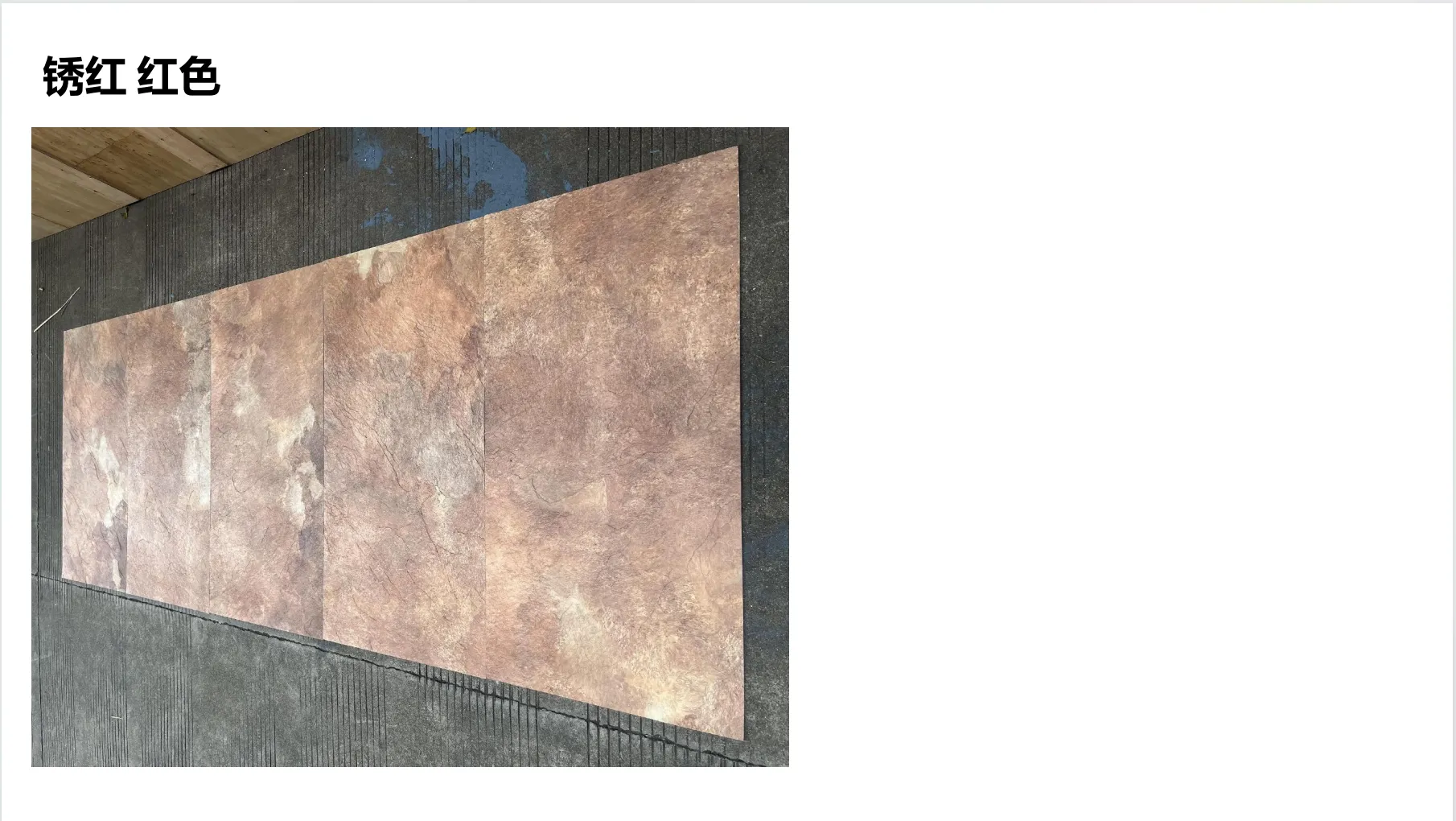
Close your eyes and picture the Saudi desert at sunrise. The sand shifts from deep burgundy to warm terracotta, mirroring the sky as it blazes to life. That's the inspiration behind Rusty Red MCM. It's not a flat, artificial red, but a nuanced hue with depth—subtle variations in tone that mimic the natural patina of desert rocks weathered by time. This isn't just aesthetics; it's intentional. The color's earthy undertones blend seamlessly with the landscape, making buildings feel grounded, not imposed.
But what truly sets Rusty Red MCM apart is how it performs in the field. Let's take a real-world example: the Al-Madinah Cultural Center, a new community hub in the heart of the city. Its facade, clad in Rusty Red MCM panels, has now withstood three Saudi summers. Walk up to it today, and you'll notice something remarkable: the color is as rich as the day it was installed. No fading, no blotching—just that same warm, desert-inspired red. The secret? MCM's color is inherent . Unlike painted surfaces, which sit on top, Rusty Red's pigment is mixed into the composite matrix, so even if the surface is scratched (a common issue in sandstorms), the color remains consistent.
Texture matters too. Rusty Red MCM isn't smooth or glossy; it has a subtle, tactile finish that mimics the rough-hewn beauty of traditional desert stone. Run your hand over it, and you'll feel the faint grooves and ridges—details that catch the light at different times of day, transforming the facade from muted to radiant as the sun moves. In Riyadh, where the light is harsh and direct, this texture softens the building's appearance, making it inviting rather than stark.
While Rusty Red is a star player, it rarely performs alone. MCM's versatility lies in its ability to mix and match series, creating layered, dynamic facades that tell a story. For Saudi projects, these complementary series pair beautifully with Rusty Red:
Lunar Peak Series: Available in silvery, golden, and black, these panels add a touch of modern elegance. Imagine a Rusty Red facade with Lunar Peak Silvery accents—like desert sand at dusk, where the red earth meets the cool glow of the moon. Perfect for commercial buildings aiming for a blend of tradition and contemporary flair.
Foamed Aluminium Alloy Board (Vintage Gold/Silver): Lightweight and metallic, these panels bring a sleek, industrial edge. A Rusty Red base with Vintage Gold accents evokes the warmth of desert sunsets with a hint of luxury—ideal for boutique hotels or high-end residential complexes.
Travertine (Starry Blue/Orange): For projects that want to nod to Saudi's coastal areas (like Jeddah or Dammam), Travertine's starry patterns in blue or orange add a playful contrast to Rusty Red. Imagine a beachfront villa with Rusty Red walls and Starry Blue Travertine accents—like the desert meeting the sea.
Rammed Earth Board (Gradient): MCM's Rammed Earth series, with its soft, earthy gradients, complements Rusty Red's boldness. A gradient from Rusty Red to Beige Rammed Earth mimics the natural transition from desert dunes to rocky outcrops, creating a facade that feels like a slice of the landscape.
| Feature | Rusty Red MCM | Natural Granite | Concrete | Traditional Clay Brick |
|---|---|---|---|---|
| Weight (per sq.m) | 8-12 kg | 50-60 kg | 20-25 kg | 15-20 kg |
| UV Resistance | Excellent (no fading for 15+ years) | Good (may fade slightly over time) | Poor (prone to discoloration) | Fair (fades and weathers) |
| Sandstorm Resistance | High (non-porous, scratch-resistant surface) | Medium (abrasion can dull finish) | Low (surface erodes, develops cracks) | Medium (brittle, prone to chipping) |
| Installation Ease | High (lightweight, modular panels) | Low (heavy, requires specialized labor) | Medium (site-mixed, time-consuming) | Medium (labor-intensive, mortar required) |
| Aesthetic Versatility | High (custom colors, textures, and finishes) | Medium (limited natural variations) | Low (basic, uniform appearance) | Medium (traditional look, limited modern adaptability) |
Talk is cheap—let's look at the proof. In Jeddah's Al Hamra District, a new residential complex called "Desert Bloom" has become a local landmark, thanks in no small part to its Rusty Red MCM facade. Designed by Saudi architect Lina Al-Mansoori, the project aimed to create "homes that feel like they've grown from the desert." The Rusty Red panels, paired with Lunar Peak Golden accents, wrap the buildings in a warm embrace. Residents report that the apartments stay cooler in summer than neighboring concrete buildings, and the facade has retained its color despite two harsh sandstorm seasons.
In Riyadh, the "Heritage Mall" uses Rusty Red MCM alongside Foamed Aluminium Alloy Board (Vintage Silver) to bridge old and new. The mall's exterior features large Rusty Red panels that mimic the texture of ancient Nabataean stone, while silver accents add a modern twist. Shoppers often comment on how the building "feels familiar, like something from our history, but fresh." For the developers, the choice was clear: "We needed a material that could handle Riyadh's heat but also make people feel connected to the land. Rusty Red MCM did both."
Even in smaller projects—like the boutique "Oasis Café" in Al Khobar—Rusty Red MCM shines. The café's outdoor patio is clad in the material, which withstands the coastal humidity and salt air. Owner Amjad Al-Zahrani notes, "We wanted the patio to feel like an extension of the desert, even here by the sea. The Rusty Red panels don't just look great; they've held up to rain, wind, and sun without a single repair. Best decision we made."
For architects like Riyadh-based Sami Haddad, the appeal is personal. "I grew up in a mud-brick house in the Najd region," he says. "The color of that brick—warm, earthy, full of life—stuck with me. When I discovered Rusty Red MCM, it was like finding that color again, but better. It has the soul of traditional materials with the performance of the future."
Sustainability is another draw. MCM is eco-friendly, using recycled materials in its composition and requiring less energy to produce than natural stone. In a country increasingly focused on green building (Saudi Vision 2030 emphasizes sustainable development), Rusty Red MCM aligns with both environmental and aesthetic goals. "Clients ask for 'desert-appropriate' design now," says Haddad. "That means materials that don't harm the planet and look like they belong here. Rusty Red MCM checks both boxes."
Saudi Arabia's built environment is at a crossroads. It's evolving from utilitarian structures to spaces that celebrate identity, resilience, and beauty. In this journey, materials matter—and Rusty Red MCM is more than a material. It's a symbol of how modern innovation can honor tradition, how durability can coexist with warmth, and how a single color can capture the spirit of a nation.
As the sun sets over Riyadh, casting its golden light on a skyline dotted with Rusty Red facades, one thing is clear: this material isn't just building structures. It's building a legacy—one that says, "We are of the desert, and we will thrive in it." For architects, designers, and dreamers across Saudi Arabia, Rusty Red MCM is more than a choice. It's a promise—to the land, to the people, and to the future.
Recommend Products












