
Choosing building materials is like picking a lifelong companion for your home or project—you want something that won't fade, crack, or lose its charm after a few years. For decades, traditional options like natural stone, concrete, and wood have been the go-to, but they often come with a hidden cost: shorter lifespans, high maintenance, or heavy weights that strain structures. Enter Rusty Red MCM (Modified Composite Material), a modern solution that's turning heads in architecture and design. But how does its longevity really stack up against the classics? Let's dive in, explore the science behind durability, and see why more builders and homeowners are making the switch.
Walk through any historic neighborhood, and you'll spot the timeless appeal of natural stone—think travertine (starry red) facades or boulder slab pathways that tell stories of decades past. But beauty often comes with a price. Natural stone, while stunning, is porous. Over time, rainwater seeps in, freezes in winter, and expands, causing cracks. UV rays fade its color, and heavy foot traffic wears down its surface. A typical natural travertine wall might look perfect for 10–15 years, but by year 20, you're looking at patching, resealing, or even replacing sections.
Then there's concrete—sturdy, affordable, and everywhere. But traditional concrete isn't invincible. It's prone to spalling (flaking) when exposed to salt or harsh weather, and its monolithic nature means a single crack can spread quickly. Even fair-faced concrete , celebrated for its raw, industrial look, often needs repairs within 15–20 years if not meticulously maintained. And let's not forget weight: a 200 sq. ft. natural stone wall can weigh over 2,000 lbs, requiring reinforced structures and driving up construction costs.
Wood, another classic, brings warmth but battles rot, pests, and warping. Even treated lumber might last 20–30 years outdoors, but without annual staining or sealing, that number drops to half. For commercial projects or high-traffic areas, traditional materials often mean constant upkeep—a drain on time and money that many can't afford long-term.
"We installed natural rust board siding on our cottage 12 years ago. It looked amazing at first—rich, earthy tones that complemented the forest around us. But after five winters, the edges started to chip. By year eight, we noticed water stains inside, and a contractor told us the stone had absorbed moisture and started to deteriorate from the inside out. Replacing it cost almost as much as the original installation. I wish we'd known then what we know now about MCM." — Sarah, homeowner in Vermont
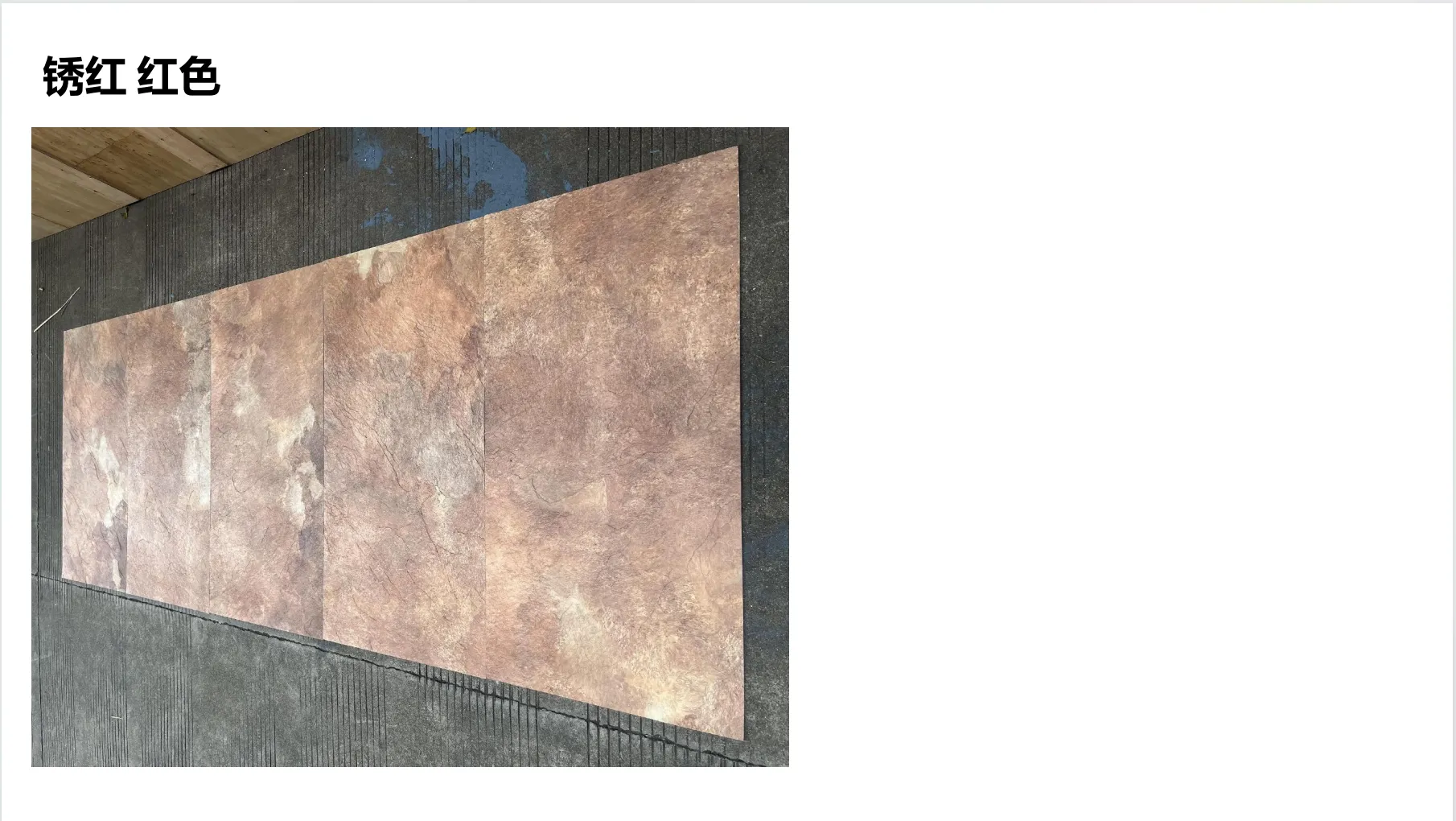
MCM, or Modified Composite Material, is a game-changer in the building world. It's a blend of natural minerals, recycled polymers, and fiberglass, engineered to mimic the look of traditional materials but with supercharged durability. Rusty Red MCM specifically replicates the warm, weathered charm of rusted metal or aged stone—think the patina of an old barn roof or the earthy hues of a desert canyon—without the actual rust or decay.
Unlike natural stone or solid metal, MCM is lightweight (typically 3–5 lbs per sq. ft., compared to 20–30 lbs for natural stone) and flexible. Its secret? A layered structure: a strong yet bendable core sandwiched between a protective outer layer that resists UV rays, moisture, and impact. This design isn't just about looks—it's about longevity. Manufacturers test MCM rigorously, exposing it to extreme temperatures (-40°F to 180°F), salt spray, and heavy rainfall to ensure it holds up. The result? A material built to last, not just for years, but for generations.
Numbers tell the story best. Let's compare Rusty Red MCM to three common traditional materials: natural travertine (starry red) , traditional concrete, and boulder slab (a dense natural stone). We'll look at lifespan, maintenance, weight, and more to see how they stack up.
| Material | Average Lifespan (Years) | Annual Maintenance | Weight (lbs/sq. ft.) | Installation Complexity | Sustainability |
|---|---|---|---|---|---|
| Rusty Red MCM | 40–50+ | Minimal: Occasional washing with mild soap | 3–5 | Easy: Lightweight, can be cut with standard tools | High: Made with recycled materials; low carbon footprint |
| Natural travertine (starry red) | 15–25 | High: Annual sealing, periodic patching of cracks | 20–25 | Complex: Requires heavy equipment and reinforced framing | Low: Quarrying depletes natural resources; high transportation emissions |
| Traditional Concrete | 15–20 | Moderate: Sealing every 2–3 years; crack repairs | 15–20 | Moderate: Needs formwork and curing time | Moderate: High cement production emissions; limited recyclability |
| Boulder Slab (Natural Stone) | 20–30 | High: Resealing yearly; prone to staining | 25–30 | Very Complex: Requires structural engineering approval | Low: Non-renewable; high waste during quarrying |
The table speaks volumes: Rusty Red MCM doubles (or even triples) the lifespan of many traditional materials while slashing maintenance needs. Its lightweight nature is a game-changer for both new builds and renovations—no need for extra structural support, which saves time and money during construction. And sustainability? MCM's use of recycled polymers and minerals reduces reliance on quarrying, making it a greener choice for eco-conscious projects.
It's all in the engineering. Let's break down the science:
Flexibility = No Cracks: Traditional materials like concrete and natural stone are rigid. When a building shifts (and all buildings do, slightly, with temperature changes or ground movement), rigid materials crack. MCM's composite core bends slightly, absorbing stress without breaking. It's like the difference between a glass plate and a rubber mat—drop both, and the rubber wins.
Protective Outer Layer: MCM's top layer is treated with UV inhibitors and moisture-resistant coatings. Think of it as a built-in sunscreen and raincoat for your material. Natural stone has no such protection, so its color fades and pores absorb water. With MCM, even after 40 years in the sun and rain, that rusty red hue stays vibrant.
Resistance to the Elements: MCM laughs off extreme weather. Freeze-thaw cycles? No problem—its low water absorption rate (less than 1%) prevents ice from expanding inside. Salt from coastal areas or de-icing chemicals? MCM doesn't corrode or pit like metal or natural stone. It's why coastal homes and snowy regions are quick to adopt MCM.
Don't just take our word for it—look at the projects that have stood the test of time. In 2005, a commercial complex in Phoenix, Arizona, installed Rusty Red MCM panels on its exterior. Phoenix is brutal for building materials: 110°F summers, monsoon rains, and intense UV rays. Today, 18 years later, those panels still look new. No fading, no cracks, no need for major repairs. The maintenance crew? They hose them down twice a year. Compare that to the neighboring building, which used natural boulder slab and has replaced 30% of its stone panels due to weathering.
Residential projects tell a similar story. A housing development in Colorado used Rusty Red MCM for siding on 50 homes in 2010. Ten years later, a survey found 98% of homeowners reported "no visible signs of wear" and "zero maintenance costs beyond washing." One homeowner noted, "I have a friend with a natural stone house built the same year. He's repainted his trim three times and replaced his stone steps once. I've done nothing but enjoy my siding."
If you value longevity, low maintenance, and sustainability, MCM is a no-brainer. It's ideal for:
The only catch? MCM can have a higher upfront cost than basic concrete or low-grade natural stone. But when you factor in 40+ years of no maintenance and no replacement, it's a fraction of the long-term cost of traditional materials. It's an investment that pays off—literally—over time.
Building materials shouldn't be a temporary fix—they should be a legacy. Traditional options like natural stone and concrete have their place, but their limited lifespans and high maintenance make them a risky bet for the future. Rusty Red MCM changes the narrative, offering the beauty of traditional materials with the durability of modern engineering. It's not just about lasting longer; it's about living better—with less stress, lower costs, and a home or project that looks as good in 40 years as it did on day one.
So, the next time you're choosing materials, ask yourself: Do I want something that fades, cracks, and costs more over time? Or do I want Rusty Red MCM —a partner that's in it for the long haul? The answer, we think, is clear.
Recommend Products












