
Let's start with a scenario we've all heard (or lived through): a construction project where the deadline looms like a storm cloud, and every day feels like a race against the clock. Maybe it's a retail space that needs to open before the holiday rush, a corporate office renovation timed to coincide with a company's big product launch, or a public facility with a strict completion date tied to community events. In these moments, contractors and project managers aren't just building—they're fighting for every minute. And more often than not, the materials they choose can make or break that fight.
That's where the Rusty Red MCM Project Board Series comes in. Part of the broader MCM project board series, this line of flexible stone cladding panels isn't just another building material. It's a solution crafted with one goal in mind: to turn tight deadlines from a source of stress into an achievable target. In a world where "fast-track construction" has gone from a buzzword to a necessity, this series is quickly becoming the go-to for teams who refuse to choose between speed, quality, and aesthetics.
Let's be honest: construction schedules have never been tighter. Urban spaces are denser, clients are more demanding, and the cost of delays—whether in labor, permits, or lost revenue—can be astronomical. A 2023 survey by the Construction Industry Institute found that 68% of projects finish behind schedule, with material-related issues (think slow installation, heavy lifting requirements, or on-site customization delays) ranking among the top culprits. For contractors, this isn't just about meeting a date on a calendar; it's about protecting their reputation, keeping clients happy, and staying profitable in a competitive market.
Take, for example, a mid-sized restaurant renovation in a busy downtown area. The client wants to reopen in time for summer, when foot traffic peaks. The contractor has 10 weeks to strip the old interior, install new electrical and plumbing, and finish the exterior cladding. Traditional stone panels would require weeks of on-site cutting, sealing, and fitting—not to mention the heavy equipment needed to move them. By the time they're done, summer might be half over, and the client's revenue projections would take a hit. But with a prefabricated MCM panel system like the Rusty Red series? That timeline could shrink by 30% or more. Suddenly, "impossible" becomes "we've got this."
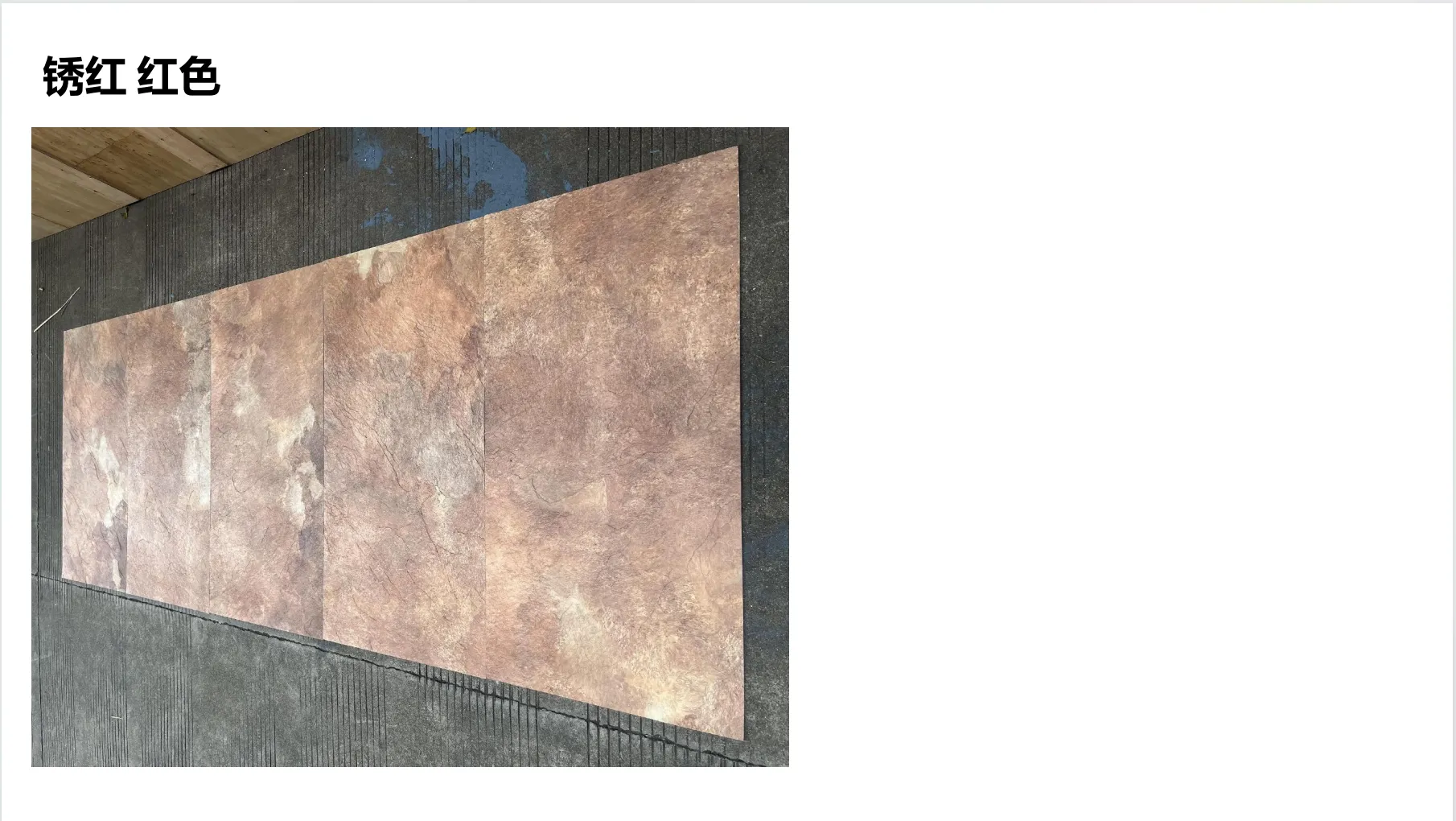
At first glance, you might think, "It's just a cladding panel—what's the big deal?" But dive deeper, and you'll see why this series is turning heads. Let's start with the star of the show: that rich, earthy rusty red hue. It's not just a color; it's a statement. Warm, bold, and versatile, it adds instant character to everything from modern storefronts to industrial-chic offices. But aesthetics are just the start. What really sets it apart is how it's engineered to work with your team, not against them.
Unlike traditional stone or concrete panels, which often require on-site cutting, grinding, and sealing, these panels arrive prefabricated and ready to install. That means no more dust clouds from cutting tools, no more wasted material from botched measurements, and no more waiting for custom pieces to be shipped. It's like ordering a pre-assembled bookshelf instead of a flat-pack—you're not just saving time; you're eliminating the risk of human error in the process.
Let's break down the features that make the Rusty Red MCM Project Board Series a fast-track champion. These aren't just specs on a datasheet—they're real-world solutions to the problems crews face every day.
Traditional natural stone panels can weigh upwards of 50 kg per square meter. That's not just heavy to transport; it's slow to install. Crews need cranes or forklifts to move even a few panels, and each placement requires careful coordination to avoid damage. The Rusty Red MCM panels, by contrast, weigh in at just 8–12 kg per square meter. That's a 70–80% reduction in weight. What does that mean for your team? It means two workers can carry a stack of panels up a ladder or onto a scaffolding without breaking a sweat. It means fewer trips back and forth from the truck. It means no more waiting for the crane operator to become available. In short, it turns a two-person, hour-long task into a 15-minute job.
And don't let the light weight fool you—these panels are tough. Made from a composite of natural stone aggregates and high-strength modified polymers, they're resistant to scratches, impacts, and weathering. We're talking about a material that can stand up to rain, snow, UV rays, and even the occasional rogue shopping cart in a retail parking lot. For contractors, that's peace of mind: speed doesn't mean sacrificing durability.
One of the biggest time drains in cladding installation is on-site customization. Traditional panels often arrive with rough edges, requiring on-site cutting to fit around windows, corners, or unique architectural features. This not only adds hours (or days) to the timeline but also creates waste—scraps of stone that end up in landfills. The Rusty Red MCM series solves this with prefabricated MCM panel systems. Each panel is cut, shaped, and finished in a controlled factory environment, using computer-aided design to ensure exact measurements. Need a panel with a notch for a window frame? It arrives ready to slide into place. Working with a curved wall? The factory can pre-bend panels to your exact radius. This level of precision eliminates 90% of on-site cutting, turning what used to be a "measure twice, cut once" headache into a "unpack and install" breeze.
In today's construction landscape, "fast" can't come at the expense of "green." Clients, regulators, and even consumers are demanding materials that reduce environmental impact. The Rusty Red MCM Project Board Series checks that box, too. As part of the MCM project board series, it's classified as a green building material, with several eco-friendly credentials: it uses recycled stone aggregates (up to 40% in some panels), requires minimal water and energy during production compared to traditional stone quarrying, and is 100% recyclable at the end of its life. For projects chasing LEED certification or aiming to market themselves as sustainable, this is a huge win. And here's the bonus: sustainable materials often qualify for tax incentives or rebates, which can offset project costs. So, you're not just building faster—you're building smarter, too.
Installation systems matter. Even lightweight, pre-cut panels can slow down a project if the mounting process is complicated. The Rusty Red series uses a simple, interlocking "click-and-go" system that requires no special tools—just basic hand tools and a level. The panels attach to a lightweight aluminum subframe, which is first secured to the wall. Each panel then locks into place with a tongue-and-groove design, ensuring a tight, seamless fit. No messy adhesives that require curing time. No drilling hundreds of holes. A crew of two can easily install 100+ square meters in a single day. Compare that to traditional stone, which might take the same crew 2–3 days to install the same area, and the time savings start to add up fast.
Sometimes, seeing is believing. Let's put the Rusty Red MCM Project Board Series head-to-head with two common alternatives: traditional natural stone cladding and standard fiber cement panels. The difference in speed and efficiency is clear.
| Feature | Traditional Natural Stone | Standard Fiber Cement Panels | Rusty Red MCM Project Board Series |
|---|---|---|---|
| Weight (kg/m²) | 40–60 | 18–25 | 8–12 |
| Installation Rate (m²/day per crew of 2) | 30–40 | 60–70 | 100–120 |
| On-Site Cutting Required? | Yes (60–80% of panels) | Yes (30–40% of panels) | No (prefabricated to specs) |
| Special Equipment Needed | Crane/forklift, wet saw | Scaffolding, circular saw | Basic hand tools, ladder |
| Sustainability | High embodied carbon (quarrying, transport) | Moderate (some recycled content) | High (recycled aggregates, low energy production) |
The numbers speak for themselves. With the Rusty Red series, a crew can triple the installation speed of traditional stone and nearly double that of fiber cement. For a 500 m² cladding project, that's the difference between finishing in 12 days (natural stone) and 4 days (Rusty Red). That's a full week saved—time that can be redirected to other tasks, or better yet, give your team a buffer if unexpected issues pop up (and let's face it, they always do).
Enough talk—let's look at how this series is performing in the field. These aren't hypothetical scenarios; they're stories from contractors who've swapped stress for success.
A regional retail chain in the Midwest needed to renovate 10 store exteriors in time for the back-to-school shopping season—a deadline just 8 weeks away. Each store required approximately 300 m² of cladding, and the client wanted a bold, eye-catching look to attract customers. The contractor initially considered traditional brick, but quick calculations showed that with bricklaying speeds (about 20 m²/day per crew), each store would take 15 days—meaning the entire project would take 150 days, well past the deadline.
Enter the Rusty Red MCM Project Board Series. The contractor opted for the prefabricated panels, and here's what happened: Each store's cladding was installed by a 3-person crew in just 3 days. That's 30 days total for all 10 stores—leaving 26 days to spare for final touches and inspections. The client was thrilled; the stores opened on time, and the rusty red color became a signature part of their brand refresh. The contractor? They've since used the series on three more projects.
A 1920s-era office building in downtown Boston needed a facade update to meet modern energy codes, but with a catch: the city's historic preservation board required the new cladding to match the building's original "rustic red sandstone" aesthetic. Traditional sandstone was heavy, expensive, and would have required months of installation, disrupting tenants. The Rusty Red MCM panels offered a solution: the color matched the historic stone perfectly, and the lightweight design meant installation could be done without reinforcing the building's structure. A crew of four installed 800 m² of panels in just 12 days, with minimal disruption to the offices below. The result? A building that looks timeless, meets modern standards, and stayed on budget.
Yes, speed is the headline, but contractors aren't just choosing the Rusty Red MCM Project Board Series because it's fast. They're choosing it because it makes their jobs easier, their clients happier, and their businesses more profitable. Let's break down the "hidden wins" that keep teams coming back.
Clients remember when you deliver on time—and they especially remember when you deliver early. Finishing a project ahead of schedule doesn't just earn you a "thank you"; it earns you trust. And in construction, trust translates to repeat business and referrals. One contractor in Texas put it this way: "We used the Rusty Red series on a hotel renovation, and the client was so impressed they hired us for their next two projects. They said, 'If you can finish that fast without cutting corners, we want you on every job.'"
Time is money, and labor is one of the biggest costs on any job. Installing traditional stone might require a crew of 6 for a week; with Rusty Red MCM, that same job can be done by 3 people in 2 days. That's a 75% reduction in labor hours. For a project with $50/hour labor rates, that's tens of thousands of dollars saved—money that can be passed on to the client (making your bid more competitive) or kept as profit.
On-site cutting and customization generate a lot of waste—scraps of stone, dust, and debris that need to be hauled away. That's not just bad for the environment; it's bad for your budget. Dumpster rentals, disposal fees, and cleanup time add up. The prefabricated Rusty Red panels generate almost no on-site waste, which means lower disposal costs and a cleaner, safer worksite. One crew foreman noted: "We used to spend an hour every day just cleaning up stone dust. With these panels, we sweep once at the end of the day and call it good."
As green building materials become more than a trend—they're a requirement in many cities—having a sustainable option in your toolkit is a must. The Rusty Red series' recycled content, low embodied carbon, and recyclability help projects qualify for LEED, BREEAM, or other green certifications. For clients who want to market their buildings as eco-friendly (and attract tenants who care about that), this is a huge selling point. It's not just about doing the right thing for the planet; it's about staying competitive in a market that values sustainability.
At the end of the day, the Rusty Red MCM Project Board Series is more than a building material. It's a partner for teams that refuse to let deadlines dictate their success. It's for the contractor who wants to finish early, the project manager who wants to avoid overtime, and the client who wants a space that looks great and stands the test of time.
In a world where "good enough" is no longer enough, this series proves that you can have it all: speed without sacrificing quality, aesthetics without the hassle, and sustainability without the premium price tag. So the next time you're staring down a tight deadline, remember: the right materials don't just build structures—they build confidence. And with the Rusty Red MCM Project Board Series, confidence is just a panel away.
Recommend Products












